Research
Demonstrating Arena 5.0: A Photorealistic ROS2 Simulation Framework for Developing and Benchmarking Social Navigation
Overview Research area: Robotics — social navigation, simulation frameworks, benchmarking, and sim-to-real transfer, built on ROS2. Technical level: Intermediate. The paper assumes familiarity with RO
- arXiv
- 2610.11220
- Published
- 2026-10-08
- Authors
- Volodymyr Shcherbyna, Linh Kästner, Duc Anh Do, Hoang Tung, Huu Giang Nguyen, Maximilian Ho-Kyoung Schreff, Tim Seeger, Eva Wiese, Ahmed Martban, Huajian Zeng, An Tran, Nguyen Quoc Hung, Jonas Kreutz, Vu Thanh Lam, Ton Manh Kien, Harold Soh
AI summary
Overview
- Research area: Robotics — social navigation, simulation frameworks, benchmarking, and sim-to-real transfer, built on ROS2.
- Technical level: Intermediate. The paper assumes familiarity with ROS2, navigation stacks, simulators, and benchmarking metrics, but its contributions are presented at a framework level rather than as deep algorithmic derivations.
- Scope: The paper introduces Arena 5.0, an open-source ROS2 framework that adds photorealistic NVIDIA Isaac Gym/Isaac Sim simulation, a state-of-the-art social navigation benchmark, and generative-AI world and scenario generation on top of the authors' earlier Arena releases.
What This Paper Is About
Research in social navigation — robots moving safely around people — suffers from a gap between simulation and real deployment. Existing benchmarks tend to be 2D, static, limited in scenario or robot variety, or reliant on legacy software such as ROS1, which makes results hard to reproduce or transfer to industry-grade systems. Arena 5.0's goal is to close that gap by combining photorealistic simulation, a broad planner/robot/sensor suite, and automated generation of diverse human-centric worlds and scenarios inside one ROS2-based platform.
Key Contributions
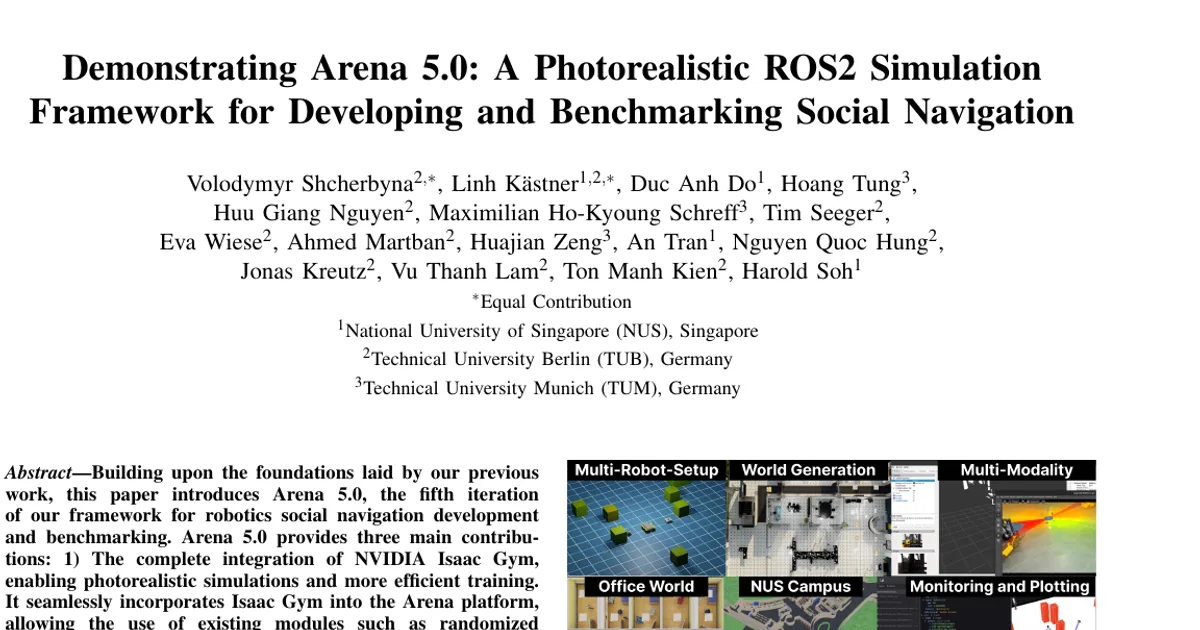
- Full integration of Isaac Gym into Arena. This includes a ROS integration of Isaac Gym so it interoperates with ROS-based systems, exposing existing Arena modules (randomized environment generation, evaluation tools, ROS2 support, planners, robot models, and APIs) inside Isaac Gym. The authors describe it as a wrapper that lowers Isaac Gym's documentation and setup barriers.
- A comprehensive benchmark of state-of-the-art social navigation strategies. Planners are evaluated across generated and customized worlds and scenarios of varying difficulty, using a wide range of social navigation metrics covering performance, naturalness, and social behavior. In the demonstration, hospital, office, and warehouse worlds are each generated at 4 difficulty levels, and every planner in the paper's planner table is run for 15 runs per world with the average metric value recorded.
- Automated and customizable scenario generation and task planning. New world/cenario generation modules use generative AI and LLMs (the Arena-Gen module, extended with a refined scene-graph LLM, a new diffusion model for population, and complete integration into the Isaac Gym pipeline), supporting settings such as emergency and rescue situations, and supporting customization for specific research needs.
- Validation through a user study. The platform's performance and usability were assessed through a user study with 20 participants, with the authors reporting significant improvements in usability and efficiency compared to previous versions.
Main Findings
- Isaac Gym is now usable through Arena wrappers: Participants in the user study praised the integration and simplified wrappers, noting they had previously avoided Isaac Sim due to limited documentation and complex setup, and that with Arena's wrappers many were able to quickly generate scenarios and benchmark approaches in Isaac Sim.
- The web interface is preferred over the old workflow: Users described the web-based interface as more intuitive and appealing than the previous JSON-based configuration workflow.
- Arena-Gen generates varied environments: Participants confirmed the Arena-Gen modules effectively generate a variety of environments, though some suggested expanding the pipeline beyond the three indoor environments to settings such as warehouses.
- Stability and cost concerns remain: Two participants reported occasional stability concerns, particularly longer wait times for world generation prompts, and only a few instances produced incorrect floorplans leading to unrealistic 3D worlds. Several users cited increased computational demand from Isaac Sim integration and questioned whether earlier simulators would remain supported; the authors state that Arena's modular, simulator-agnostic architecture ensures continued compatibility.
- The benchmark produces plotting-ready results: The benchmark results are illustrated in Figure 10, where each planner's metric is displayed in various plotting styles, with data preprocessing methods provided via a customizable iPython notebook. Specific numeric benchmark outcomes are not reported in the paper text.
- The platform is selected for competition use: Arena 5.0 has been selected as the official hosting platform for competitions, including the forthcoming SocialNav2025 workshop.
- Pedestrian simulation is configurable: The platform uses HuNavSim and fine-tuned social force models compatible with Gazebo v2 and Isaac Sim, includes human-to-human interactions among pedestrians, interpolates animations smoothly, and switches animations on the fly based on behavior state through an abstract EntityManager interface.
- Simulation scales favorably with complexity: The authors observe that performance scales more favorably with environment complexity and agent count than lighter-weight simulators, and that certain sensors are less computationally intensive to simulate than in Gazebo or Unity.
Methodology in Plain English
The authors build on their own prior releases — Arena 3 added world generation and social interaction modules, and Arena 4.0 migrated the platform to ROS2 with extended world generation — and add a photorealistic simulator, a benchmark, and generative world creation.
For simulation, they wrap Isaac Gym/Isaac Sim so that Arena's existing ROS2-facing modules (world loading, semantics, scenario and benchmark configuration, robot and non-robot entity management, parameter server, navigation stack interfacing, and pedestrian simulation) work inside it. Pedestrian behavior is handled by an abstract EntityManager interface that can accommodate different pedestrian simulators such as HuNavSim and social force models such as LightSFM, with Arena forwarding parameters and interpreting behavior trees.
For world generation, a user supplies natural language text or a 2D floorplan. Text is converted into a 3D Scene Graph using a fine-tuned Google T5-Small model split into two sub-models: one generates the room and doorway lists, and the second infers objects for those rooms using the prompt plus semantic reasoning. The authors trained these on their own machine-generated dataset of roughly 60,000 entries mapping (prompt, available rooms, available objects) to ((rooms, doorways), room-to-object mappings), with training settings of batch size 16, 10 epochs, AdamW optimizer, learning rate 3⋅10⁻⁵, 500 warmup steps, weight decay 0.01, dropout rate 0.1, and gradient accumulation 4. Floorplans are then generated with HouseDiffusion and post-processed, objects are placed per room with the mixed diffusion model MiDiffusion, and a scenario is generated and edited by the user before export to the simulation setup module. A web application with a stateless HTTP backend, including a central /pipeline endpoint that takes a text prompt and runs all subsequent steps automatically, exposes this workflow.
For evaluation, they implemented wrapper classes for 2D lidar, 3D lidar, RGB, RGBD camera, IMU, sonar sensor, and foot contact sensor, and extended their metrics suite with additional social metrics across performance, naturalness, and social categories. They then generated hospital, office, and warehouse worlds at 4 difficulty levels each and ran all listed planners for 15 runs per world, averaging each metric. Finally, they ran a user study with 20 participants from universities in Germany, the US, Singapore, Japan, and Korea, spanning prior Arena users, social navigation researchers without Arena experience, and computer science or engineering students, who installed the platform, ran task modes, training runs, and planners on multiple robots, then completed a questionnaire.
Why This Matters
Impact on research: The paper argues that the absence of a unified benchmark is a main bottleneck in social navigation robotics research, citing studies by Francis et al. and Singamaneni et al. By combining a unified benchmark, a large planner and robot suite, richer sensor modalities (including rgbd, sonar, and imu sensors that many benchmarks lack), and ROS2-native tooling, Arena 5.0 aims to make results more reproducible, comparable, and transferable — and it gives the community a shared competition platform.
Real-world applications:
- Healthcare: social navigation is cited as increasingly important in healthcare, and the paper generates hospital worlds and an example benchmark for a care robot (cob4) in a hospital environment.
- Logistics: logistics is listed among the sectors where social navigation matters; warehouse environments are among the generated world types, including scenarios such as children in a warehouse.
- Assistive robotics: listed as a third sector where social navigation is gaining importance, with humans interacting unexpectedly with robots (running towards, playing with, or obstructing them).
- Emergency and rescue situations: the scenario generation and task planning modules explicitly support emergency and rescue situations, alongside normal operating hours and unexpected events.
Industry relevance: The paper frames sim-to-real transfer as a major concern and notes that many platforms rely on legacy software such as ROS1, complicating the transition to industry-grade systems. Arena 5.0 targets ROS2, incorporates the Navigation2 (Nav2) stack with several state-of-the-art planners and commonly used robotic platforms, and integrates photorealistic simulators and diverse sensors that the authors argue are increasingly required by industry as computational power grows.
Future Directions
- Expand world generation coverage: World generation is currently limited to three environment types, and the authors state that expanding this coverage via globally sourced datasets is a priority.
- Improve human motion visualization: Human motion visualization depends on pre-existing animation assets, and new animations require specialized 3D modeling expertise; the authors plan to integrate motion-capture transfer methods into the Arena ecosystem.
- Add advanced planning and learning approaches: Future work aims to integrate more advanced planning approaches and multi-agent reinforcement learning methods.
- Extend environments and delivery: The authors plan to add outdoor worlds and weather conditions, and to release Arena-Web, which will replicate most platform features in a web-based application for broader accessibility.
- Open question raised by users: Whether earlier simulators will remain supported given the increased computational demand of Isaac Sim — the authors respond that the simulator-agnostic architecture ensures continued compatibility.
Target Audience
Social navigation researchers and robotics engineers who need reproducible benchmarking and photorealistic human-centric simulation; developers working with ROS2 and Nav2 who want to integrate planners, robot models, or new sensors into a modular stack; teams preparing for competitions such as the SocialNav2025 workshop; researchers in human-robot interaction and sim-to-real transfer; and students or practitioners who previously found Isaac Gym/Isaac Sim difficult to adopt and want a documented, open-source wrapper around it.
Authors’ abstract
Building upon the foundations laid by our previous work, this paper introduces Arena 5.0, the fifth iteration of our framework for robotics social navigation development and benchmarking. Arena 5.0 provides three main contributions: 1) The complete integration of NVIDIA Isaac Gym, enabling photorealistic simulations and more efficient training. It seamlessly incorporates Isaac Gym into the Arena platform, allowing the use of existing modules such as randomized environment generation, evaluation tools, ROS2 support, and the integration of planners, robot models, and APIs within Isaac Gym. 2) A comprehensive benchmark of state-of-the-art social navigation strategies, evaluated on a diverse set of generated and customized worlds and scenarios of varying difficulty levels. These benchmarks provide a detailed assessment of navigation planners using a wide range of social navigation metrics. 3) Extensive scenario generation and task planning modules for improved and customizable generation of social navigation scenarios, such as emergency and rescue situations. The platform's performance was evaluated by generating the aforementioned benchmark and through a comprehensive user study, demonstrating significant improvements in usability and efficiency compared to previous versions. Arena 5.0 is open source and available at https://github.com/Arena-Rosnav.