Research
Deep Persona: A Psychologically Grounded Architecture and Evaluation Framework for Role-Playing Agents and Simulations
Deep Persona: A Psychologically Grounded Architecture and Evaluation Framework for Role-Playing Agents and Simulations Overview Research area: Natural Language Processing (LLM-based role-play agents,
- arXiv
- 2609.22255
- Published
- 2026-09-06
- Authors
- Rotem Dror, Zohar Elyoseph, Yuval Haber, Elad Refoua, Oshrat Ayalon, Adir Solomon
AI summary
Deep Persona: A Psychologically Grounded Architecture and Evaluation Framework for Role-Playing Agents and SimulationsOverview
Research area: Natural Language Processing (LLM-based role-play agents, persona simulation, and dialogue evaluation, with ties to clinical training and mental health simulation).
Technical level: Intermediate. The paper combines a prompt-engineering architecture with statistical evaluation machinery (distributional distance testing), so it helps to be comfortable with LLM prompting, basic dialogue metrics, and multivariate statistics.
Scope in one sentence: The paper proposes a three-layered psychological architecture for constructing LLM personas and a reference-free evaluation framework, inspired by the Autism Diagnostic Observation Schedule (ADOS), that scores how human-like persona dialogue is against empirical human dialogue distributions.
Publication details: arXiv:2609.22255v1 [cs.CL], dated 06 Sep 2026, licensed CC BY 4.0. Authors are affiliated with the University of Haifa (Faculty of Computer and Information Science; School of Therapy, Counseling and Human Development) and Bar-Ilan University (PhD Program of Hermeneutics and Culture, Interdisciplinary Studies Unit; Department of Psychology).
What This Paper Is About
Most LLM persona systems rely on short, flat character descriptions, such as a personality trait or an assigned role. These shallow prompts can guide individual responses but tend to drift, hallucinate, or break character across extended interactions. The paper introduces a structured alternative that encodes a character's observable behavior, latent beliefs, and hidden motivational drives as separate layers, and pairs it with an evaluation framework that measures whether the resulting dialogue is statistically distinguishable from real human dialogue.
Key Contributions
-
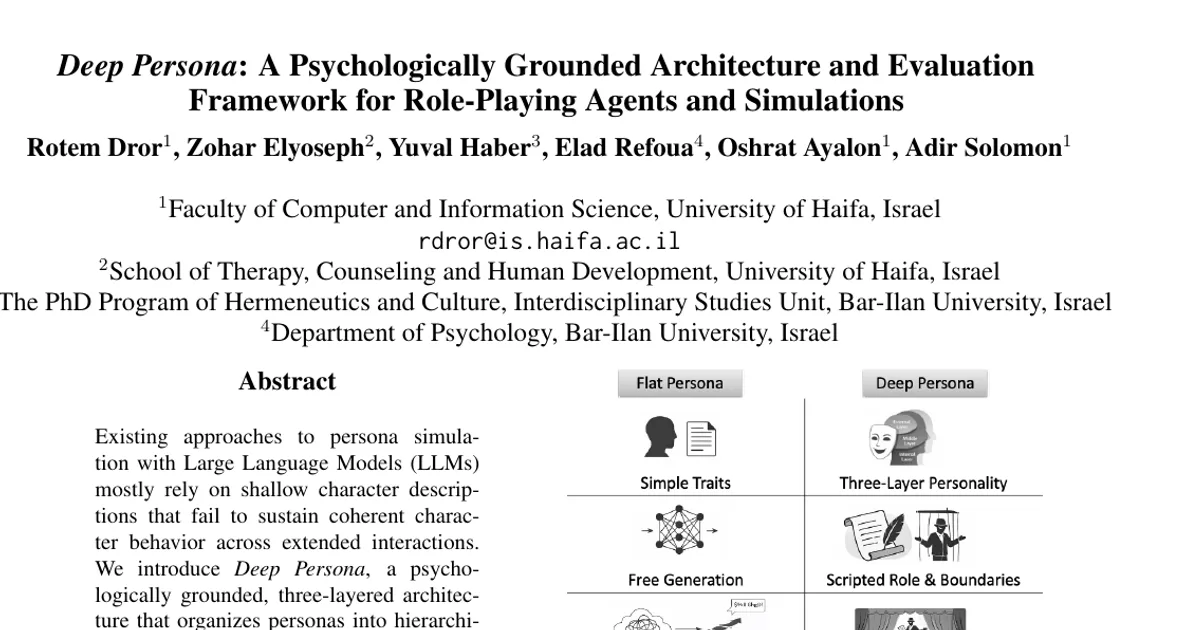
A three-layered persona architecture (Deep Persona). Personas are organized into an External Layer (conscious, publicly expressed identity, communication style, emotional tone), a Middle Layer (pre-conscious beliefs, attitudes, and contextual information revealed only under specific triggers), and an Internal Layer (unconscious core motivations, hidden constraints, and drives that are never verbalized). The architecture is governed by two stated principles: scripted determinism (the LLM is treated as a stochastic engine executing a rigidly specified script rather than an autonomous agent) and bounded agency (the persona is restricted to reactive roles within a predefined scenario).
-
An expert-elicitation process and modular prompt architecture. A structured interview with a domain expert captures narrative background, initial context, emotional tone, communication patterns, conscious goals, semi-conscious material, unconscious drives, psychological needs, resistance patterns, evolution, triggers for change, and ethical/behavioral boundaries. This specification is then compiled into functional prompt modules: a Short Introduction, Interaction Structure, Narrative Background and Motivations, a Three-Layer Personality Module, a Control and Logic Module, and an optional Embodied Expression Module for nonverbal cues in square brackets.
-
A reference-free, ADOS-inspired evaluation framework. Four automated metrics are proposed: Pragmatic Fluidity & Echolalia (user–agent lexical overlap via ROUGE-L or Jaccard, self-repetition over a sliding window, and an echolalia event rate), Joint Attention Capability (whether new entities or topics introduced by the user are referenced in the next agent turn), Affective Congruence (cosine similarity between emotion probability vectors of verbal content and bracketed nonverbal actions), and Emotional Expression Diversity & Intensity (lexical diversity of emotion terms and intensity modifiers). The paper also describes an alternative Judge Agent implementation of these metrics.
-
The Dialogue Naturalness Score (DNS). A composite score comparing an agent's scoring profile against the multivariate human distribution using the Mahalanobis distance, with the squared distance following a chi-squared distribution (n = 4) to test whether the agent is statistically indistinguishable from human behavior (a non-significant result, p > 0.05). DNS is defined as exp(−λ · d_M(S_A)²). The paper also presents a case study of two Deep Personas evaluated with this framework.
Main Findings
-
High pragmatic fluency but weak deeper conversational dimensions. Across human–LLM datasets, pragmatic fluency (S_pragmatics) is high, in the range 0.88–0.97, indicating fluent, non-repetitive responses. Joint attention varies substantially: Role-Play settings score 0.78–0.84, ABC-Eval scores 0.46, and CounselChat (human–LLM) scores 0.93.
-
Emotional expression is where the largest gaps appear. Open-domain human–LLM datasets show low emotional diversity and intensity, while CounselChat (human–LLM) shows an elevated S_emotion of 2.2054, which the authors describe as possible over-amplification of affect in therapeutic settings. Human baselines on the same metric are 0.1152 for DailyDialog and 1.4264 for CounselChat (human–human).
-
Human baselines differ by dataset character. DailyDialog has a low S_joint-attention of 0.3521 and S_emotion of 0.1152, reflecting short everyday exchanges, whereas CounselChat (human–human) has S_joint-attention 0.8854 and S_emotion 1.4264, consistent with its therapeutic context.
-
DNS results are highly baseline-dependent. Under the DailyDialog baseline, Role-Play and ABC-Eval reach moderate-to-high DNS with many statistically indistinguishable dialogues (for example, ABC-Eval 0.8181 with 505/528 dialogues, Role-Play Vanilla 0.6705 with 28/29). Under the CounselChat (human–human) baseline, most datasets fail sharply (for example, Role-Play Boss 0.0600 with 0/28, ABC-Eval 0.0633 with 0/528). CounselChat (human–LLM) is the mirror image: 0.7940 with 3118/3507 under the CounselChat (human–human) baseline but only 0.0479 with 124/3507 under the DailyDialog baseline.
-
The two Deep Personas exceeded the evaluated human–LLM datasets under the combined baseline. Sarah (0.9177, 1/1 dialogue indistinguishable) and Evelyn (0.8503, 16/16) both reached high DNS and were statistically indistinguishable from human interaction at p > 0.05 against the combined human baseline, which pooled DailyDialog and CounselChat (human–human). Under the DailyDialog baseline they scored 0.5586 and 0.8583; under the more demanding CounselChat (human–human) baseline they scored 0.3283 and 0.2549.
-
Embodied expression was measured only for the Deep Personas. Because the examined datasets lack nonverbal cues, Affective Congruence is not reported for them. Sarah's Embodied Expression Module produced nonverbal cues in 84% of turns (41/49) with S_congruence = 0.52; Evelyn's produced cues in 100% of turns with S_congruence = 0.35.
-
Adversarial stress tests are described but not fully reported. The protocol comprises a Hallucination Trap, an Out-of-Role Request, and Ethical Stressors. The paper text provided states that "The Sarah simulation contained two str" before truncation, so full stress-test outcomes are not reported in the available content.
-
Not reported: the paper content does not report affective congruence values for human datasets, and the truncated text does not include the complete stress-test results or any code/model release details.
Methodology in Plain English
The authors first assume that anything not written into the system prompt will degrade over long conversations, so they treat the LLM as an actor following a detailed script rather than as an autonomous agent. They restrict personas to reactive roles, because proactive roles such as therapist or scientist require handling unbounded inputs while holding a long-term strategy.
Construction starts with a structured expert interview, implemented by an AI agent within the Cesura.ai platform, that draws out the character's history, opening situation, emotional tone, speech patterns, conscious goals, information that only surfaces after trust is established, unconscious drives, psychological needs, resistance patterns, and hard ethical boundaries. That material is compiled into a modular prompt: an introduction, an interaction structure with initialization, main phase, termination conditions and turn counts, a narrative background that starts in medias res, a three-layer personality section where the external layer is written as enforceable rules, the middle layer as conditional triggers, and the internal layer as persistent motivational constraints that must never be verbalized, plus a control and logic module that tracks turns and stage transitions, and an optional embodied expression module that emits bracketed gestures and facial expressions.
For evaluation, the authors adapt communicative dimensions from the ADOS protocol, explicitly stating they are not modeling clinical populations or claiming equivalence between LLM behavior and conditions such as autism. They compute four scores per dialogue and compare an agent's four-dimensional profile against the mean vector and covariance matrix estimated from human dialogue. The squared Mahalanobis distance is tested against a chi-squared distribution with four degrees of freedom, and a DNS is derived with a scaling parameter λ. They set λ = 0.089 by mapping the 95th percentile of the chi-squared distribution for three degrees of freedom to a threshold Naturalness Score of 0.5, and they use S_pragmatics weights α = β = γ = 0.33, an echolalia threshold τ_echo = 0.65, and α = 0.7 for S_emotion. They then run this pipeline on two human–human datasets and three human–LLM datasets, and finally on two Deep Persona simulations built with Gemini 2.5 Pro.
Why This Matters
Persona simulation is moving from entertainment into training environments where realism and stability carry real consequences, including clinical skill development. The paper's diagnosis is that flat prompts produce surface fluency without emotional depth, and the evaluation literature has largely measured stylistic consistency or text-origin detection rather than the psychological coherence of an agent operating inside a simulation. By pairing an architecture with an instrument adapted from clinical practice, the work offers a way to test whether a simulated patient or interlocutor behaves like a person rather than merely sounding like one.
Real-world applications:
- Mental health and clinical training. The case study environments are a suicide risk assessment session with Sarah, a 17-year-old at risk of suicide, and a parental mentalization training scenario with Evelyn, a teenager facing peer pressure and risky vaping behavior. The authors note global professional shortages as motivation for reproducible simulated patient practice.
- Soft-skills training across organizations and institutions, which is the stated use case of the Cesura.ai platform used for persona construction.
- Educational tools and conversational assistants that need to sustain a specific identity and interaction boundaries across many turns.
- Entertainment platforms and role-playing agents where character break and role drift directly degrade user experience.
Industry relevance: The two concrete levers for practitioners are prompt architecture (closed-world specification, bounded agency, staged evolution, non-disclosure rules) and a scoring instrument that can be run during development or after deployment. The framework is reference-free, meaning it does not require hand-labeled ground truth for each new persona, which makes it practical as a regression test against human baselines.
Future Directions
- Complete and report the adversarial stress-test results. The Hallucination Trap, Out-of-Role Request, and Ethical Stressors are defined, and the available text breaks off mid-sentence while describing Sarah's stress tests, leaving the pass/fail outcomes across personas and datasets unreported.
- Validate the Judge Agent. The paper notes that the main limitation of an LLM-as-a-judge implementation is inherited bias from the underlying foundation model, including over-rewarding verbosity or penalizing unconventional but coherent expression, and points to established methodologies for assessing judge reliability and validity.
- Separate intentional from unintentional affective incongruence. The paper explicitly flags as a limitation that the Affective Congruence measure does not distinguish between the two.
- Extend embodied expression to more datasets and personas. Affective congruence was only computable for the two Deep Personas because the examined human–LLM and human–human datasets contain no nonverbal cues, which limits cross-comparison.
- Test whether the architecture generalizes beyond the two case-study personas. The case studies involve only two personas, both implemented with Gemini 2.5 Pro, and both conversations were conducted with the character's own developer pretending to be the intended user rather than with independent users.
Target Audience
Researchers and practitioners working on LLM role-play, persona modeling, and dialogue evaluation will find the metric definitions and the DNS procedure most directly usable. Clinical simulation designers and mental health training developers, including teams building simulated patients for therapist education, are a second core audience given the case studies and the ADOS-inspired instrument. Prompt engineers and product teams building character-based agents will benefit from the modular prompt architecture. Finally, researchers in human–AI interaction and psychometrics may be interested in the adaptation of a clinical instrument into automated dialogue metrics and its statistical framing.
Authors’ abstract
Existing approaches to persona simulation with Large Language Models (LLMs) mostly rely on shallow character descriptions that fail to sustain coherent character behavior across extended interactions. We introduce Deep Persona, a psychologically grounded, three-layered architecture that organizes personas into hierarchical levels of observable expression, latent beliefs, and core motivational drives, for constructing highly convincing role-playing agents. Governed by the principles of scripted determinism and bounded agency, the architecture restricts the model to a reactive engine guided by a structured internal script. We further propose a reference-free evaluation framework that benchmarks dialogue naturalness against empirical human distributions using established psychological clinical instruments and adversarial stress-tests. Empirical evaluation reveals that while LLMs achieve high pragmatic fluency, they exhibit systematic limitations in emotional expression and joint attention. In addition, we present a case study of two Deep Personas and evaluate them using the proposed framework, demonstrating that structured personas can produce interactions that more closely align with human conversational behavior.