Research
Decoupling Scene Perception and Ego Status: A Multi-Context Fusion Approach for Enhanced Generalization in End-to-End Autonomous Driving
Overview Research area: End-to-end autonomous driving, specifically planning-oriented architectures in computer vision and robotics. Technical level: Advanced. The paper assumes familiarity with bird'
- arXiv
- 2511.13079
- Published
- 2025-11-17
- Authors
- Jiacheng Tang, Mingyue Feng, Jiachao Liu, Yaonong Wang, Jian Pu
AI summary
Overview
- Research area: End-to-end autonomous driving, specifically planning-oriented architectures in computer vision and robotics.
- Technical level: Advanced. The paper assumes familiarity with bird's-eye-view (BEV) encoders, query-based transformer decoders, deformable attention, knowledge distillation, and open-loop planning metrics.
- Scope: One sentence: The paper diagnoses the over-reliance on vehicle ego status in end-to-end driving models as an architectural flaw and proposes AdaptiveAD, a dual-branch framework that separates scene-driven from ego-driven reasoning and fuses them adaptively.
What This Paper Is About
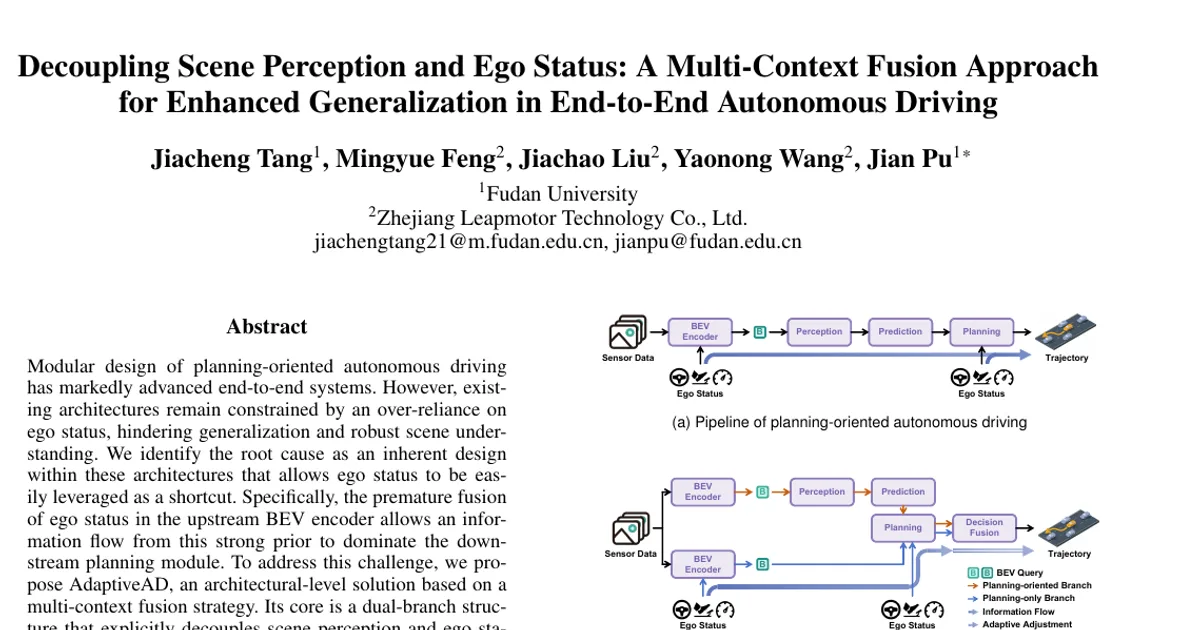
End-to-end driving models tend to "drive by inertia" rather than "drive by sight" because their planning modules can lean on the vehicle's own kinematic state (ego status) as a shortcut instead of actually understanding the scene. The authors trace this to a specific architectural choice: ego status is fused into the BEV encoder early in the pipeline, letting a strong prior flow straight into planning. The goal is to restructure the information flow so the model must ground its decisions in perception, while still keeping planning dynamically feasible.
Key Contributions
- Diagnosis and architectural remedy for the ego-status shortcut. The authors identify the premature fusion of ego status inside the BEV encoder as the root cause of causal confusion, and propose a multi-context fusion strategy that explicitly decouples scene-driven reasoning from ego-driven reasoning.
- A dual-branch framework with adaptive fusion. One branch encodes a BEV feature without ego-status enhancement and reasons over agent queries, map queries, and BEV features; the other branch retains ego-motion compensation and interacts its ego query directly with the motion-compensated BEV. A scene-aware fusion module initialized from the scene-driven BEV map arbitrates between the two decision contexts.
- Three supporting innovations. A path attention mechanism that samples BEV features along a hypothesized future trajectory, BEV unidirectional distillation that transfers motion-compensated features from the ego-driven "teacher" to the scene-driven "student," and an autoregressive online mapping task that creates a feedback loop from planning to mapping.
- State-of-the-art open-loop planning on nuScenes plus generalization evidence. Reported gains include a 22 percent reduction in average L2 error and a 57 percent reduction in collision rate versus the VAD baseline, along with substantially smaller degradation under perturbed ego velocity and on NAVSIM and Bench2Drive.
Main Findings
- nuScenes open-loop planning: AdaptiveAD reports average L2 of 0.47 m (0.23 at 1s, 0.43 at 2s, 0.74 at 3s) and average collision rate of 0.12 percent (0.05, 0.12, 0.18), at 3.0 FPS. For comparison, the table lists UniAD at 0.73 m / 0.61 percent / 1.8 FPS, VAD at 0.61 m / 0.28 percent / 3.4 FPS, PPAD at 0.58 m / 0.19 percent / 2.6 FPS, SparseDrive at 0.61 m / 0.10 percent / 5.2 FPS, and BridgeAD at 0.58 m / 0.08 percent / 3.1 FPS.
- Scene generalization: nuScenes is described as roughly 75 percent straight-driving scenarios. Under left/right turn navigation commands, VAD degrades from an average L2 of 0.62 m and collision rate of 0.33 under straight driving to 0.91 m and 0.18, while AdaptiveAD moves from 0.47 m and 0.11 to 0.63 m and 0.16. Under the Turning-nuScenes protocol, VAD reports 0.92 m / 0.38 against AdaptiveAD's 0.63 m / 0.28.
- Ego-status reliance: Injecting noise into ego velocity at inference causes VAD's average L2 to rise from 0.61 m to 5.54 m when velocity is zeroed out — an increase the paper describes as over 800 percent. AdaptiveAD rises from 0.47 m to 4.08 m. At a 100 m/s perturbation, VAD reaches 14.93 m average L2 and 6.26 percent average collision rate versus 5.06 m and 4.86 percent for AdaptiveAD.
- Cross-benchmark robustness: On NAVSIM and Bench2Drive, AdaptiveAD reports a PDMS of 86.4, DS of 49.47, and SR of 19.23, versus 81.2, 44.35, and 16.91 for VAD. Under zeroed velocity, VAD falls to PDMS 51.5 while AdaptiveAD holds 61.4.
- Ablation: Starting from a baseline that keeps ego-status enhancement (average L2 0.57 m, collision 0.22 percent, 3.4 FPS), adding the dual-branch structure without regularizers (ID-2) worsens L2 to 0.62 m. Adding BEV unidirectional distillation (ID-3) recovers L2 to 0.58 m while cutting the collision rate by over 60 percent to 0.08 percent. Scene-aware initialization (ID-4) improves trajectory accuracy by roughly 10 percent to 0.52 m. The full model (ID-5) reaches 0.47 m and 0.12 percent at 3.0 FPS.
- Path attention beats deformable attention: With identical computational overhead, path attention yields 0.47 m average L2 and 0.12 percent average collision against 0.48 m and 0.15 percent for standard deformable attention.
- Plug-in generalizability: Adding path attention to UniAD improves average L2 from 0.73 m to 0.68 m and average collision from 0.61 percent to 0.55 percent. Adding autoregressive online mapping to SparseDrive improves average L2 from 0.58 m to 0.53 m.
- Qualitative behavior: In an obstacle-avoidance scenario, the baseline model fails to perceive a stopped vehicle and plans a collision course, while AdaptiveAD identifies the obstacle and produces an avoidance maneuver. The authors also report that autoregressive online mapping accelerates convergence by mitigating optimization conflict between mapping and planning heads.
- Not reported in the provided content: Training cost in GPU hours, inference latency in milliseconds, and per-horizon numbers for FusionAD (listed as dashes in the table).
Methodology in Plain English
The researchers keep the VAD architecture as a foundation but split the model into two parallel paths. The first path, called the scene-driven branch, deliberately removes the step where ego status is injected into the BEV queries, so everything downstream — agent queries, map queries, and the planning decision — is produced from perception alone. The second path, the planning-only branch, keeps the conventional ego-status enhancement and produces a trajectory driven mainly by the vehicle's kinematic state.
Because removing ego status can leave the scene-driven BEV features blurred for moving objects, the authors add a distillation task in which the motion-compensated BEV from the ego-driven branch acts as a teacher for the scene-driven student, with gradients stopped on the teacher. They also replace standard deformable attention in the ego-BEV interaction with path attention: for each planning mode, a preliminary trajectory is decoded, reference points are sampled uniformly in time along it, and each reference point gets its own attention head that samples local features nearby. This restricts evidence gathering to the corridor of the hypothesized future path.
The two branches' decisions are then merged. A fusion query is initialized using a global average pooling of the scene-driven BEV map plus learnable modality embeddings, and a stack of six fusion layers first aligns the two decision contexts with multi-head self-attention and then synthesizes the final trajectory through cross-attention. A second auxiliary task, autoregressive online mapping, requires the perceived map to be consistent whether the ego follows the predicted or the ground-truth trajectory, applying a masked L1 loss over the region where the two perception footprints overlap plus a Gaussian Wasserstein distance loss to keep gradients stable. The model is trained in PyTorch with MMDetection3D, predicting a 3-second trajectory from 2 seconds of history over a 60 m x 30 m range, with 6 ego-BEV interaction layers and 6 fusion layers, for 60 epochs on 32 NVIDIA A100 GPUs using AdamW, a batch size of 2 per GPU, and auxiliary loss weights of (0.01, 0.1, 0.01, 0.01, 0.01). The shared backbone is a ResNet-50 with FPN pretrained on nuImages, images are resized to 256 x 704, BEV resolution is 0.15 m, and query counts are 300 agent, 100 map, and 3 planning modes with a feature dimension of 256.
Why This Matters
- Impact on research: The paper reframes ego-status over-reliance from a data-bias problem to an architectural one, arguing that data-level and regularization-level fixes address symptoms rather than the internal information flow. It supplies a structural alternative and a perturbation-based evaluation protocol (noise injected into ego velocity) that other groups can reuse.
- Real-world application — emergency maneuvers: A high-speed vehicle facing a sudden obstacle is exactly the scenario where inertia-based planning fails; scene-driven evidence is the safety-critical ingredient.
- Real-world application — long-tail and unfamiliar roads: Consistent performance on left/right turns, where ego status is least predictive, matters for roads and intersections absent from training benchmarks.
- Real-world application — degraded state estimation: Noisy or unavailable odometry from GNSS/IMU is common; the paper shows resilience when ego velocity is corrupted or zeroed.
- Real-world application — production ADAS stacks: A 3.0 FPS inference rate with the same backbone and overhead as the baseline suggests the decoupling adds little cost, and the plug-in results show path attention and autoregressive mapping transfer to other models.
- Industry relevance: The work is a collaboration between Fudan University and Zhejiang Leapmotor Technology, an automaker, and its conclusions are corroborated on both an open-loop benchmark (NAVSIM) and a closed-loop CARLA-based simulator (Bench2Drive).
Future Directions
- Information leakage through distillation: The supplementary material acknowledges that ego-status cues could pass from the teacher BEV to the student BEV, and argues the risk is small because the loss is spatially confined and any residual cues travel a long, lossy path — this remains an open verification question.
- Combining architectural decoupling with ego-status learning: The authors state that learning ego status as an auxiliary task (as in SparseDrive and BridgeAD) and architectural decoupling are not mutually exclusive, leaving hybrid designs unexplored.
- Integration with generative world models: The conclusion proposes that the modular decoupled design is a natural fit for combining with world models to strengthen causal reasoning and scene understanding.
- Training efficiency and multimodal planning: The paper names extending the framework to handle multimodal planning and improving training efficiency as structured next steps, without reporting experiments on either.
Target Audience
Autonomous driving and robotics researchers working on end-to-end or planning-oriented architectures; computer vision graduate students interested in causal confusion, shortcut learning, and BEV representation design; and industry engineers building production or prototype driving stacks who need planning that stays robust when ego state estimates are unreliable.
Authors’ abstract
Modular design of planning-oriented autonomous driving has markedly advanced end-to-end systems. However, existing architectures remain constrained by an over-reliance on ego status, hindering generalization and robust scene understanding. We identify the root cause as an inherent design within these architectures that allows ego status to be easily leveraged as a shortcut. Specifically, the premature fusion of ego status in the upstream BEV encoder allows an information flow from this strong prior to dominate the downstream planning module. To address this challenge, we propose AdaptiveAD, an architectural-level solution based on a multi-context fusion strategy. Its core is a dual-branch structure that explicitly decouples scene perception and ego status. One branch performs scene-driven reasoning based on multi-task learning, but with ego status deliberately omitted from the BEV encoder, while the other conducts ego-driven reasoning based solely on the planning task. A scene-aware fusion module then adaptively integrates the complementary decisions from the two branches to form the final planning trajectory. To ensure this decoupling does not compromise multi-task learning, we introduce a path attention mechanism for ego-BEV interaction and add two targeted auxiliary tasks: BEV unidirectional distillation and autoregressive online mapping. Extensive evaluations on the nuScenes dataset demonstrate that AdaptiveAD achieves state-of-the-art open-loop planning performance. Crucially, it significantly mitigates the over-reliance on ego status and exhibits impressive generalization capabilities across diverse scenarios.