Research
Decoupling Action from Egocentric Observation for World Simulation
Overview Research area: Computer vision and generative video, specifically egocentric (first-person) action transfer and neural video world simulation. Technical level: Advanced. The method operates d
- arXiv
- 2610.27946
- Published
- 2026-10-20
- Authors
- Yue Ma, Pengjie Song, Xinyu Wang, Yi He, Zeqian Long, Fangneng Zhan, Kaichen Zhou, Hongyu Liu, Hongfa Wang, Peihao Li, Haoyang Huang, Nan Duan, Qifeng Chen
AI summary
Overview
Research area: Computer vision and generative video, specifically egocentric (first-person) action transfer and neural video world simulation.
Technical level: Advanced. The method operates directly on the denoising trajectory and internal attention features of a pretrained video diffusion transformer, so familiarity with diffusion sampling, velocity prediction, and DiT attention is assumed.
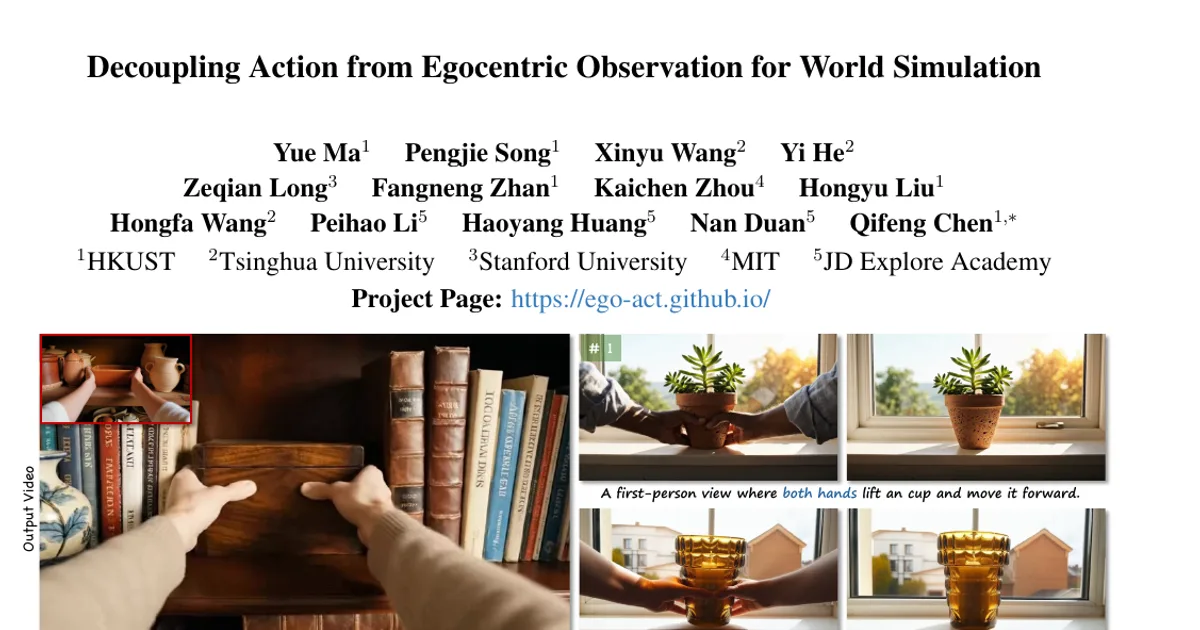
Scope: The paper proposes EgoACT, a training-free, test-time framework that re-creates a demonstrated first-person manipulation action in a new visual scene while preserving hand-object structure and contact physics, along with a new 350-video benchmark called EgoActionBench.
What This Paper Is About
Given a first-person video of someone performing a manipulation task (grasping, pouring, opening, handover), the goal is to separate what the action is from how the scene happens to look, then generate a new video in which the same action unfolds in a different scene with different objects and appearance. The hard part is that existing approaches either force the generation to follow explicit geometric controls (hand poses, meshes, keypoints) that carry estimator errors, or replay raw motion patterns that cannot encode contact dynamics, producing broken hands and physically implausible contact. EgoACT instead intervenes inside the video diffusion model's denoising process at inference time, using no extra geometric estimators and no additional training.
Key Contributions
-
A test-time formulation of egocentric action transfer. EgoACT decouples transferable action semantics from observation appearance by optimizing the generation latent during inference, with all model parameters frozen and no external geometric estimators required.
-
Velocity-guided Structure Anchoring (VSA). A soft-masked, velocity-level regression applied during early denoising that anchors the generated trajectory to a reference-consistent latent flow, preventing hand-object structural collapse before the interaction layout forms.
-
Sparse Correspondence Calibration (SCC). A confidence-weighted cross-entropy objective over sparse, locally searched cross-frame correspondences, applied in mid-to-late denoising to correct contact jitter and delayed object response while a stay regularizer keeps the latent near its original sampling path.
-
EgoActionBench. A benchmark of 350 egocentric manipulation videos and 1,400 evaluation prompts, spanning 287 indoor and 63 outdoor scenes, with 164 single-hand and 186 two-hand interaction cases, annotated for scene type, hand type, action category, and object category, and covering grasping, opening, pouring, placing, tool use, and handover.
Main Findings
-
Leading results on EgoActionBench task metrics. EgoACT reports Text Similarity 0.2746, Motion Fidelity 0.2750, Temporal Consistency 0.9866, and Appearance Consistency 0.9617, compared with the strongest baseline on each metric (VACE at 0.2624 Text Similarity, InterDyn at 0.2434 Motion Fidelity and 0.9673 Temporal Consistency, VACE at 0.9149 Appearance Consistency).
-
Best scores across all four reported VBench metrics. Subject Consistency 0.9732, Background Consistency 0.9719, Aesthetic Quality 0.5633, and Motion Smoothness 0.9898, exceeding VACE (0.9439, 0.9507, 0.4647, 0.9881), DiTFlow (0.5065 Aesthetic Quality, 0.9868 Motion Smoothness), and DiTFlow's 0.9750 Temporal Consistency from the first metric block.
-
Human evaluation agrees with the automatic metrics. In a user study with 20 volunteers over 50 randomly selected test cases, EgoACT was consistently preferred and achieved the highest excellent/good ratio across all evaluated aspects.
-
VSA is the component responsible for hand structure. Removing VSA drops Motion Fidelity to 0.2442 and Appearance Consistency to 0.9312 (versus 0.2750 and 0.9617 with both modules), and visually produces frequent hand distortion, broken fingers, and implausible contact geometry.
-
SCC is the component responsible for interaction realism. Removing SCC yields 0.2398 Motion Fidelity and 0.9487 Appearance Consistency, with contact jitter and delayed object response, while preserving coarse hand motion.
-
Placement in the denoising schedule matters. SCC applied too early over-constrains the latent and disrupts action-appearance decoupling; applied too late it has limited effect because fine details have already solidified. The reported operating window is steps 35 to 45 within a 50-step sampler.
-
Baseline failure modes are distinct. Mask2IV and CosHand preserve hand shape better but generate implausible object responses (objects staying static despite clear grasping motion); InterDyn and DiTFlow show structural artifacts, floating contacts, and broken spatial relations when hands and objects are tightly coupled.
-
Inference cost is modest relative to the base model. On an NVIDIA A100, an 81-frame 832×480 video takes approximately 413 seconds total, of which VSA adds around 23 seconds and SCC around 72 seconds.
Methodology in Plain English
EgoACT runs two copies of the same frozen video diffusion model side by side. The reference branch is fed a noised version of the observation video at exactly the same noise level as the current generation step, and is evaluated with a null-text prompt purely to extract guidance targets. The generation branch is fed the latent being generated with the target text prompt, and only this latent is updated.
In the early steps, VSA asks a simple question: at this noise level, in which direction does the reference video's latent want to move? That "velocity" is treated as a tangent direction on the video manifold that implicitly encodes how hands, objects, and their spatial relations should evolve. The generation latent is nudged (through 10 AdamW steps per guided outer step) to match that direction, weighted by a soft mask derived from Attention Motion Flow — internal attention-based motion cues read out of the model itself — so that moving hands and manipulated objects get strong anchoring while static background gets only a weak constraint. This is applied over the first 20% of the outer denoising process.
In the mid-to-late steps, SCC looks at local cross-frame matches. For each token in one frame it searches a small displacement window in the next frame, keeps the top-k displacements according to the reference branch's scores, and turns both branches' scores into probability distributions over that same sparse support. A confidence weight based on the entropy of the reference distribution suppresses ambiguous tokens, and a cross-entropy loss pushes the generated branch toward the reference branch's preferred local displacements. A stay regularizer limits how far the latent drifts from its original sampling path.
No part of the base model is trained. The base generator is WAN-2.1, and the guidance weights are 15.0 for VSA, 1.0 for the SCC correspondence term, and 0.05 for the stay regularizer.
Why This Matters
Impact on research. The paper reframes egocentric action transfer from "estimate geometry, then condition on it" to "steer the denoising process itself," which sidesteps a whole class of estimator-induced errors and removes the need for hand-pose or mesh annotation pipelines. It also argues that motion-level features alone are insufficient for manipulation, since they do not carry contact timing or object response — a distinction that separates this work from general video motion transfer.
Real-world applications:
- Robot learning data generation: producing large volumes of varied manipulation demonstrations from a small number of human first-person recordings, without teleoperating hardware for every scene variation.
- Embodied policy learning and evaluation: supplying controllable, action-consistent videos as training or test environments for manipulation policies.
- Content and simulation authoring: restaging a captured real-world interaction in a new environment, object set, or visual style for film, AR/VR, or synthetic dataset creation.
- Scalable world simulation: serving as a component in interactive world models where the underlying interaction logic must stay physical while the appearance is free to change.
Industry relevance. The method is training-free and plugs into an existing pretrained video diffusion transformer, which lowers the barrier to adoption for teams already running such a model; the reported overhead of roughly 23 seconds for VSA and 72 seconds for SCC on top of a 413-second base generation is a comparatively small price for improved interaction plausibility. The benchmark also gives teams a shared, action-centric evaluation target rather than relying on generic video-quality metrics.
Future Directions
-
Beyond the fixed guidance window. The reported schedule (VSA in the first 20% of steps, SCC between steps 35 and 45 of 50) is hand-set; an open question is whether the timing and weighting can be made adaptive per video or per action category.
-
Extending past a single base model and modality. The method is demonstrated on WAN-2.1 with RGB egocentric input only; whether the velocity-anchoring and sparse-correspondence ideas transfer to other diffusion transformer backbones, or to depth/pose-conditioned inputs, is untested here.
-
Richer interaction physics. Structural collapse and local correspondence drift are addressed, but the paper does not evaluate force, deformable objects, or multi-object stacked manipulation, which are common in real egocentric footage.
-
Benchmark growth and metric validity. EgoActionBench contains 350 reference videos and 1,400 prompts, expanded from real recordings, public manipulation datasets, and generated videos; scaling coverage and validating whether the automatic metrics (Text Similarity, Motion Fidelity, Temporal Consistency, Appearance Consistency) correlate with human judgment at finer granularity remain open.
Target Audience
Researchers and engineers working on video diffusion models, video motion transfer, egocentric vision, and embodied AI or world models. It is most useful to readers who already understand diffusion sampling and transformer attention and want a concrete, training-free technique for controlling interaction structure during generation, as well as to those who need a benchmark for evaluating action preservation and hand-object plausibility rather than generic video quality. Readers new to diffusion models will find the high-level problem framing accessible but the methodology sections demanding.
Authors’ abstract
Egocentric action transfer aims to decouple the semantic action from egocentric observations and reproduce them in new visual contexts, enabling scalable world simulation, embodied policy learning, and robotic data generation. Existing approaches to transferring actions rely on condition-guided video generation, which converts the observation video into explicit geometric controls (e.g., hand poses or meshes) to drive synthesis. However, these methods introduce geometric estimation errors, making it difficult to preserve physically plausible interactions when transferred to new scenes. Alternatively, motion transfer methods directly extract motion patterns from the observation video, yet motion-level features alone cannot encode rich contact dynamics, frequently leading to severe hand structural collapse and implausible contact layout. To address both limitations, we present EgoACT, a test-time framework for egocentric action transfer that operates directly on the denoising process of video diffusion models without requiring additional geometric estimators. EgoACT uses Velocity-guided Structure Anchoring to stabilize reference-consistent hand-object structure in the early denoising stage, and Sparse Correspondence Calibration to refine reliable local correspondences in the mid-to-late denoising stages. Together, these two components preserve transferable action semantics while improving temporal coherence and interaction realism. We further establish EgoActionBench, a benchmark for evaluating action preservation, visual quality, and hand-object plausibility across diverse egocentric manipulation scenarios. Experiments show that EgoACT generates more coherent and physically plausible interaction videos than strong baselines.