Research
Decentralized Master-Mind: Joint Action Refinement through Iterative Intent Denoising in Multi-Agent Pathfinding
Overview Research area: Multi-agent path finding (MAPF), decentralized multi-agent reinforcement learning, learned communication, and iterative refinement inspired by diffusion models. Technical level
- arXiv
- 2609.32019
- Published
- 2026-09-25
- Authors
- Valeriy Vyaltsev, Anton Andreychuk, Taisia Zlotnikova, Konstantin Yakovlev, Aleksandr Panov, Alexey Skrynnik
AI summary
Overview
Research area: Multi-agent path finding (MAPF), decentralized multi-agent reinforcement learning, learned communication, and iterative refinement inspired by diffusion models.
Technical level: Advanced. The paper uses Dec-POMDP formalism, information-theoretic bounds (conditional total correlation, KL divergence), and a critic-free group-relative policy-optimization method, though the central idea can be stated simply.
Scope: The paper proposes DMM (Decentralized Master-Mind), a decentralized MAPF policy that replaces one-shot independent action sampling with iterative, communication-coupled refinement of per-agent "action intents," trained by imitation learning followed by a critic-free RL method called MICPO.
What This Paper Is About
Decentralized MAPF policies let each agent act from partial observations, but they almost always sample their final action independently from their own predicted distribution. When several coordinated joint actions are valid in the same situation, independent sampling can recombine individually sensible choices into joint actions that stall or collide — a failure that can occur even when each agent's action distribution is learned correctly. The paper's goal is a decentralized mechanism that lets agents coordinate their stochastic choices before committing, and a training method that optimizes the resulting multi-round refinement against full-trajectory outcomes.
Key Contributions
-
Diagnosis of the factorization gap. The paper identifies a structural limitation of learnable decentralized MAPF policies: independently sampling each agent's final action yields a product distribution that cannot represent residual dependence between agents' choices, even with communication. This is formalized as a lower bound showing the best product executor incurs an irreducible error of at least the conditional total correlation TC(A | X), plus a term for action-relevant information missing from each agent's local context.
-
DMM (Decentralized Master-Mind). A method that reframes joint action selection as iterative refinement of discrete action intents across K communication rounds. Each agent initializes a random intent, broadcasts it alongside a learned message feature, samples a discrete vote, and updates the intent with a step size δ ∈ (0,1) before committing via argmax on the final intent.
-
MICPO (Multi-agent Iterative Commitment Policy Optimization). A critic-free, group-relative RL method that fine-tunes DMM's multi-round refinement on trajectory-level outcomes. It builds matched groups of trajectories that share the same sampled initial intent at each step, normalizes two trajectory-level reward components separately (as in GDPO), and computes importance ratios per agent and per refinement round.
-
Demonstrated scale and coverage. DMM is evaluated as a standalone policy on POGEMA and as the policy inside a MAPF solver with post-sampling action processing on 1,600 MovingAI tasks, and is shown to scale to over one million simultaneously acting agents in obstacle-rich environments.
Main Findings
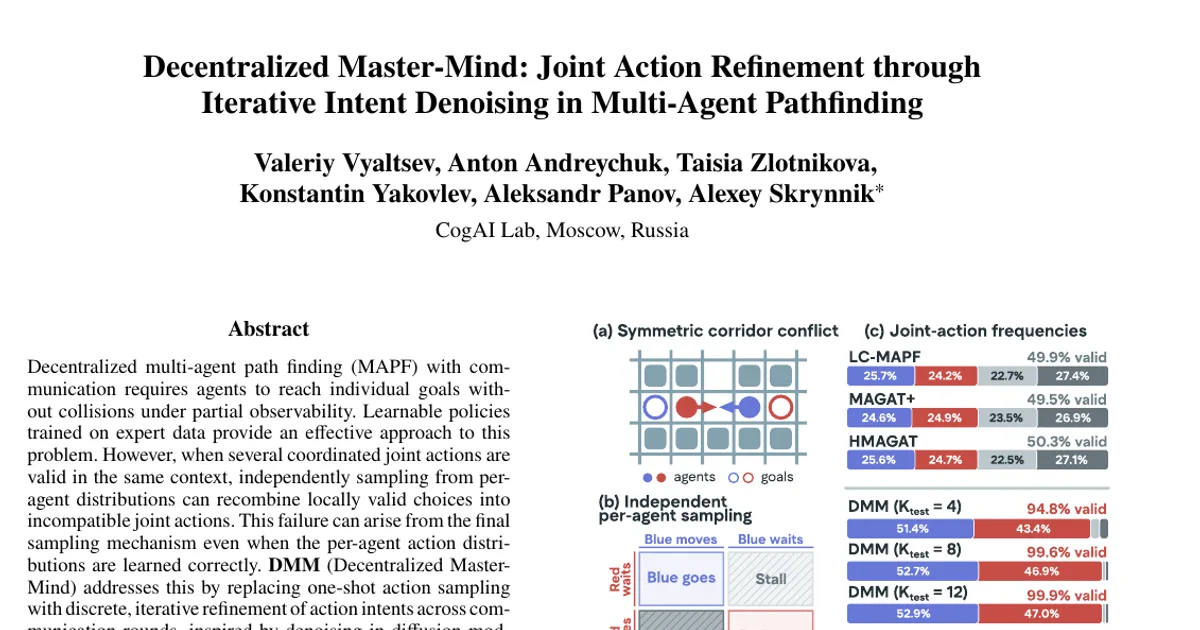
- Independent sampling fails on multimodal joint actions. In a symmetric corridor where two agents must swap positions, independent sampling from per-agent distributions permits four joint outcomes: blue goes, red goes, mutual waiting (stall), and simultaneous movement (collision). Only two are valid coordinated resolutions.
- Even exact local marginals are not enough. Where the expert assigns P*((g,w) | x) = P*((w,g) | x) = 1/2, each exact local marginal is uniform over {g, w}, so independent sampling assigns probability 1/4 to every pair, including the collision (g,g) and the stall (w,w). At this context, TC(A | X = x) = log 2 > 0.
- Measured baselines spread probability across all four outcomes. Joint-action frequencies from 1,000 samples per independently trained checkpoint, averaged across five checkpoints, show that LC-MAPF, MAGAT+, and HMAGAT distribute probability nearly uniformly over the four corridor outcomes, yielding about 50% valid joint actions. DMM instead concentrates probability on the two valid outcomes.
- More refinement rounds improve valid joint-action frequency. With checkpoints trained at K_train = 4, increasing test-time refinement depth from K_test = 4 to 8 and 12 raises the displayed valid joint-action frequency from 94.8% to 99.6% and 99.9%, respectively.
- Highest coverage on MovingAI. On 1,600 MovingAI tasks, DMM fine-tuned with MICPO solves 1,598 — the highest coverage among the evaluated methods — while achieving solution costs close to the strongest baselines.
- Competitive as a standalone decentralized policy. On POGEMA, DMM is compared against other decentralized approaches using only their learned policies, without downstream action correction; DMM generally maintains higher success rates as team size grows and achieves lower solution costs across the evaluated domains.
- Large-scale decentralized execution. DMM scales to over one million simultaneously acting agents in obstacle-rich environments, which the authors describe as the first learning-based MAPF policy to fully solve instances at that scale.
- Critic-free training is motivated by MAPF structure. A centralized critic must generalize over a combinatorially large joint state, while a decentralized critic has only partial information about the global outcome; MICPO removes the value function and instead compares rollouts under matched conditions.
Methodology in Plain English
The approach starts from an observation about how decentralized policies finish their decisions. Communication lets agents gather richer context from neighbors, but at the end each agent independently draws its own action. When the correct team behavior involves several equally valid coordinated options, those separate draws can mix options that don't belong together.
DMM changes the ending. Instead of drawing an action once, each agent keeps an "intent" — a score for each of the five actions (wait, up, down, left, right) — held in mean-centered log-space. This intent starts from an uninformative random Dirichlet sample and is refined over K synchronous communication rounds. In each round an agent broadcasts both its current intent (projected into message space) and a learned message feature. It receives messages from its k nearest neighbors within observation range (an egocentric (2ρ+1) × (2ρ+1) patch), decodes them together with its fixed latent observation encoding, produces action logits, samples a discrete vote from the resulting softmax, and blends that vote into its intent. After K rounds it commits to the action with the highest intent value. The distinctive part is that the thing being refined is itself the thing being communicated, so agents see each other's intents while they are still forming.
Training happens in two stages. First, imitation learning supervises the votes at every refinement round against expert MAPF actions. Because early noisy votes would send uninformative intents to neighbors, the authors use two forms of teacher forcing: with probability β₀ the initial intent is biased toward the expert action, and with probability β_r the sampled vote at a round is replaced by the expert action. Both probabilities are annealed toward a retained nonzero floor.
Second, MICPO fine-tunes the same refinement process on complete rollouts. It removes the critic and instead builds matched groups of trajectories that share the same sampled initial intent at each environment step, while later votes are sampled independently. Each rollout gets a team return combining a "cost" component (average log of 1 + per-agent off-goal duration) and a "blocked action" component (average number of blocked non-wait actions), each normalized within its matched group with a numerical-stability threshold. The resulting group-relative advantage is shared across all agents and rounds. To control cost, the method ranks trajectories within each group by team return and replays only the κ highest and κ lowest, sampling S environment timesteps from them, and computes importance ratios per agent and per refinement round rather than one episode-level ratio.
Why This Matters
Impact on research. The paper gives a formal account of why independently sampled per-agent actions can fail even when learning is correct — connecting decentralized MAPF to the "multimodality problem" of non-autoregressive sequence models and to the information loss formalized by Huang et al. as conditional total correlation. It also shows that the fix is not necessarily more communication or more capacity, but a change in when stochastic choices are coupled. The DMM/MICPO combination adds a critic-free RL recipe suited to multi-agent, multi-round refinement, a regime where both centralized and decentralized critics are poorly matched.
Real-world applications:
- Warehouse fleets, where many robots must move through shared aisles and intersections without deadlocking.
- Autonomous transportation and city-scale mobility, where vehicles must coordinate local maneuvers under partial observability.
- Logistics and automated sorting facilities, where throughput depends on avoiding mutual stalls at chokepoints.
- Large-scale simulation and stress testing of multi-robot deployments, where the ability to run over a million simultaneous agents on GPU matters for validation.
Industry relevance. Decentralization is the property that lets per-agent computation stay independent of team size, which is exactly what makes deployment economically viable as fleets grow. The paper reports both high task coverage on a standard benchmark (1,598 of 1,600 MovingAI tasks) and execution at over one million agents, addressing the two practical questions industry cares about: solution quality and scalability. Code is released at https://github.com/CognitiveAISystems/DMM.
Future Directions
- Understanding the refinement-depth trade-off. Valid joint-action frequency improves when test-time depth exceeds training depth (94.8% at K_test = 4 to 99.6% at 8 and 99.9% at 12, with K_train = 4), but the paper does not report the cost or latency implications of deeper test-time refinement at scale.
- Comparison against concurrent centralized refinement. DiffLNS is described as a concurrent approach that centrally refines the joint action tensor of all agents and passes results to LNS2 for repair; a direct, matched comparison with DMM's decentralized per-timestep refinement is a natural open question.
- Broadening the architecture study. The experiments instantiate DMM with two architectures, DMM-3M and DMM-0.8M (described in Appendix B); how the intent-refinement mechanism behaves with other backbones or richer communication graphs remains open.
- Transferring the factorization analysis. The paper argues the decentralization gap mirrors a general product-distribution limitation; extending this analysis to value decomposition and other decentralized decision frameworks could clarify when refinement is necessary rather than merely helpful.
Target Audience
Researchers and practitioners in multi-agent reinforcement learning, multi-robot coordination, and MAPF who are already comfortable with Dec-POMDPs and policy-gradient methods. It is most valuable to readers interested in why decentralized policies fail at coordination rather than only in benchmark numbers, and to engineers building large-scale multi-robot or fleet systems who need decentralized execution that does not degrade as team size grows. Readers looking for beginner-level introductions to MAPF should start elsewhere, though the corridor example and the intuitive framing of independent sampling are accessible on their own.
Authors’ abstract
Decentralized multi-agent path finding (MAPF) with communication requires agents to reach individual goals without collisions under partial observability. Learnable policies trained on expert data provide an effective approach to this problem. However, when several coordinated joint actions are valid in the same context, independently sampling from per-agent distributions can recombine locally valid choices into incompatible joint actions. This failure can arise from the final sampling mechanism even when the per-agent action distributions are learned correctly. DMM (Decentralized Master-Mind) addresses this by replacing one-shot action sampling with discrete, iterative refinement of action intents across communication rounds, inspired by denoising in diffusion models. Agents initialize random action intents and refine them through local communication, coupling their choices before commitment. DMM is pretrained with imitation learning on expert MAPF solutions and further optimized with MICPO, a critic-free group-relative reinforcement-learning method designed for multi-agent, multi-round action refinement. DMM generally achieves higher success rates and lower solution costs than the evaluated learnable baselines. On 1,600 MovingAI tasks, DMM fine-tuned with MICPO solves 1,598, the highest coverage among the evaluated methods, while achieving solution costs close to those of the strongest baselines. DMM also scales to over one million simultaneously acting agents in obstacle-rich environments. These results show that round-level intent refinement can improve joint-action coordination while preserving decentralized execution.