Research
Data Whitening Improves Sparse Autoencoder Learning
Overview Research area: Mechanistic interpretability of neural networks, specifically sparse autoencoder (SAE) training as a method for extracting human-interpretable features from language model acti
- arXiv
- 2511.13981
- Published
- 2025-11-17
- Authors
- Ashwin Saraswatula, David Klindt
AI summary
Overview
Research area: Mechanistic interpretability of neural networks, specifically sparse autoencoder (SAE) training as a method for extracting human-interpretable features from language model activations.
Technical level: Intermediate. The paper assumes familiarity with sparse coding, SAEs (ReLU and Top-K variants), and interpretability evaluation, but the core idea — preprocessing inputs with PCA whitening — is conceptually simple.
Scope: The paper argues theoretically, through 2D simulations, and empirically on SAEBench that applying PCA whitening to input activations before SAE training consistently improves interpretability metrics at a small cost to reconstruction fidelity.
What This Paper Is About
Sparse autoencoders are trained on neural network activations that are correlated and have uneven variance across directions, which makes their optimization landscape awkward and can leave the learned features misaligned with genuinely meaningful concepts. The authors propose a fix borrowed from classical sparse coding and neuroscience: whiten the activations with PCA (decorrelate them and equalize variance) before training, which reshapes the optimization landscape so that pursuing sparsity also yields interpretable features. The goal is to show that this one preprocessing step improves interpretability without changing SAE architecture or loss design.
Key Contributions
- A theoretical analysis showing that whitening reshapes the SAE optimization landscape, making it more convex-like and isotropic.
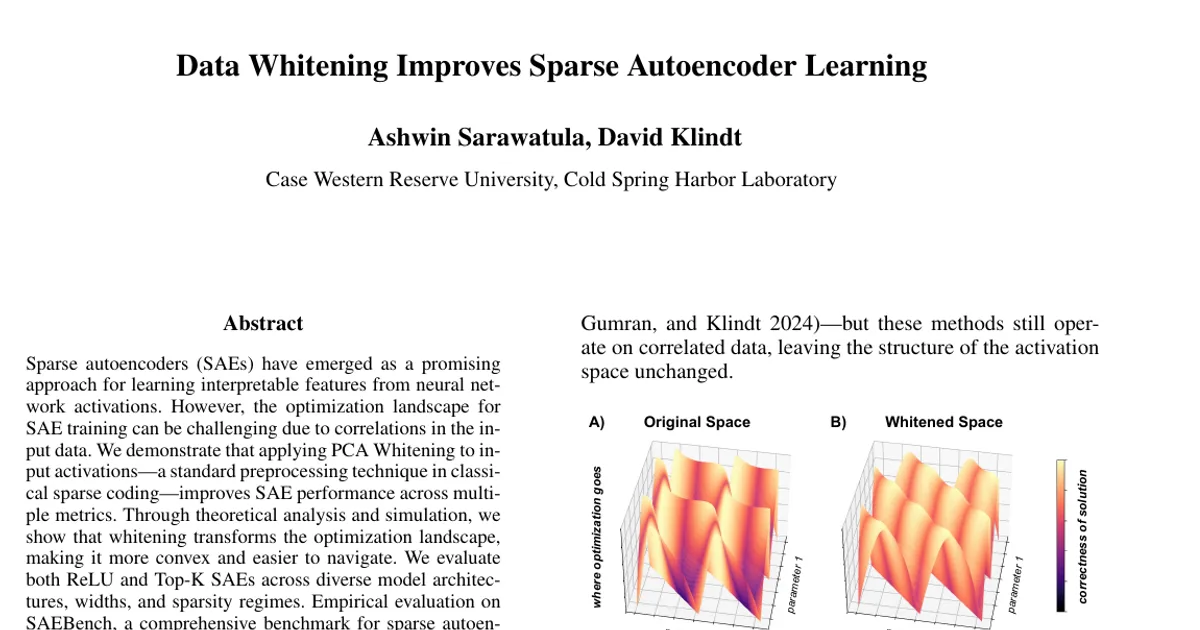
- A simulation study on synthetic 2D data that visualizes the complete optimization landscape before and after whitening, demonstrating that sparsity and feature recovery become aligned after whitening.
- A systematic empirical evaluation on SAEBench using Pythia-160M (layer 8, d=768) and Gemma-2-2B (layer 12, d=2304), across both ReLU and Top-K architectures and dictionary widths of 2^14 and 2^16.
- Reported interpretability gains of +7.3% sparse probing accuracy, +54.03% spurious correlation removal, and +372% targeted probe perturbation after whitening.
Main Findings
-
ReLU SAEs gain strongly on interpretability: Whitening improved sparse probing (Top 1) from 0.757 ± 0.008 to 0.812 ± 0.008 (+7.15%, p=1.05·10⁻⁵), SCR (Top 20) from 0.176 ± 0.015 to 0.271 ± 0.019 (+54.03%, p=3.25·10⁻⁶), and TPP (Top 20) from 0.021 ± 0.004 to 0.098 ± 0.010 (+372.00%, p=5.66·10⁻⁶).
-
Top-K SAEs gain mainly on sparse probing: Sparse probing improved from 0.754 ± 0.005 to 0.809 ± 0.008 (+7.30%, p=2.62·10⁻⁵). SCR moved from 0.311 ± 0.008 to 0.304 ± 0.010 (−2.41%, p=0.23) and TPP from 0.141 ± 0.037 to 0.152 ± 0.031 (+7.96%, p=0.24) — neither change statistically significant.
-
Reconstruction quality drops slightly but significantly: For ReLU SAEs, CE Loss Score fell from 0.980 ± 0.005 to 0.954 ± 0.006 (−2.64%, p=2.86·10⁻⁵) and explained variance from 0.813 ± 0.028 to 0.772 ± 0.027 (−5.02%, p=2.84·10⁻⁶). For Top-K SAEs, CE Loss fell from 0.990 ± 0.002 to 0.968 ± 0.004 (−2.27%, p=4.68·10⁻⁴) and explained variance from 0.837 ± 0.025 to 0.794 ± 0.025 (−5.22%, p=1.12·10⁻⁴).
-
Interpretability does not track the sparsity–fidelity frontier: The authors report that the best interpretability comes at a mild cost to reconstruction, challenging the assumption that an optimal sparsity–fidelity trade-off is where interpretability peaks. They connect this to prior SAEBench findings that Matryoshka SAEs score best on several interpretability metrics while performing worse on the sparsity–fidelity frontier.
-
Landscape simulation: Without whitening, the sparsest regions of the 2D landscape are misaligned with accurate feature recovery, and the basin is narrow and elongated with steep gradients; after whitening, the landscape becomes approximately rotationally symmetric with a smooth, bowl-like basin, and high-sparsity regions overlap with accurate feature recovery. The authors also report better Hessian conditioning at the optimum after whitening.
-
Whitening favors soft sparsity: Benefits were more pronounced for ReLU SAEs across all metrics. The authors attribute this to ReLU's soft sparsity allowing distributed representations of varying feature strength, whereas Top-K's hard fixed-k sparsity discards weaker but informative activations.
Methodology in Plain English
The authors take raw activations from a target layer of a language model and fit a PCA whitener before SAE training begins. They mean-center the activation matrix, compute its covariance, eigendecompose it, and build a whitening matrix from the inverse square root of the eigenvalues times the transpose of the eigenvectors (with a small constant added for numerical stability). A matching dewhitening matrix restores the original scale. The encoder then learns sparse features in this decorrelated space, the sparsity penalty is computed there, and the decoder's output is dewhitened before the reconstruction loss is computed — so reconstruction is still judged against the model's original activation distribution. The whitening parameters are computed once and frozen for both training and evaluation.
To build intuition, they also run a controlled 2D simulation: 10,000 synthetic points are generated by mixing sparse, heavy-tailed sources through a random 2×2 dictionary. They then exhaustively sweep 1,024 angles for each of two dictionary vectors (1,048,576 grid points), computing a sparsity metric (inverse mean L1 norm of reconstructed sources) and a feature-recovery metric (cosine similarity to the true dictionary, invariant to permutation and sign flips) at every point, and visualize the results as 3D surfaces.
For the main experiments, they train on 500M tokens from The Pile with batch size 2,048 and context length 1,024, using a learning rate of 5×10⁻⁵ with 1,000 warmup steps, 5,000 steps of sparsity penalty warmup, and learning rate decay to zero over the last 20% of training. They evaluate on five SAEBench metrics: CE Loss Score, Explained Variance, Sparse Probing (Top 1) across 35 binary diagnostic tasks, SCR (Top 20), and TPP (Top 20).
Why This Matters
Impact on research. The paper suggests that a standard preprocessing step from classical sparse coding — long used in the Olshausen and Field tradition and in ICA, and thought to occur in the retina — has been overlooked in modern SAE training. It implies that architecture changes and sparsity-penalty tuning are not the only levers for interpretability, and that activation geometry itself shapes what features get learned. It also provides counterevidence to the assumption that interpretability and reconstruction fidelity are aligned.
Real-world applications.
- Auditing and debiasing language models by removing spurious correlations (SCR is explicitly framed around confounding variables such as gender and profession).
- Causal analysis of model internals through targeted probe perturbation, which tests whether ablating a latent linked to a target class selectively harms that class.
- Producing cleaner feature dictionaries for safety and red-teaming work that depends on locating specific concepts inside a model.
- Improving the reliability of interpretability tooling used to explain or debug deployed systems.
Industry relevance. The method requires no architecture change and no loss change — only a one-time preprocessing fit — which makes it cheap to adopt in existing SAE training pipelines built on the open-source dictionary_learning framework. The trade-off it introduces (small reconstruction loss for large interpretability gains) is a policy decision for teams whose downstream use prioritizes interpretability over exact reconstruction.
Future Directions
- Extending evaluation beyond the middle layers studied here (layer 8 for Pythia-160M, layer 12 for Gemma-2-2B) and beyond the sub-2B parameter scale, since the authors explicitly note both limitations.
- Combining whitening with denoising, on the theory that whitening gives equal weight to noisy directions and thus may allocate compression budget to noise.
- Replacing the reconstruction term in the objective with the final cross-entropy loss after reconstruction, unwhitening, and the rest of the model forward pass, to mitigate the CE drop.
- Testing interactions with other SAE innovations (gated SAEs, transcoders, Matryoshka SAEs) and with other modalities such as vision and audio, and quantifying the conditioning measures and gradient dynamics claimed by the theory on high-dimensional real activations.
Target Audience
Researchers and engineers working on mechanistic interpretability, sparse coding, and dictionary learning — particularly those training SAEs on language model activations using SAEBench or the dictionary_learning framework. It is also relevant to practitioners who need debiasing or causal-ablating tools built on sparse features, and to readers interested in the connection between classical efficient-coding theory and modern deep learning interpretability.
Authors’ abstract
Sparse autoencoders (SAEs) have emerged as a promising approach for learning interpretable features from neural network activations. However, the optimization landscape for SAE training can be challenging due to correlations in the input data. We demonstrate that applying PCA Whitening to input activations -- a standard preprocessing technique in classical sparse coding -- improves SAE performance across multiple metrics. Through theoretical analysis and simulation, we show that whitening transforms the optimization landscape, making it more convex and easier to navigate. We evaluate both ReLU and Top-K SAEs across diverse model architectures, widths, and sparsity regimes. Empirical evaluation on SAEBench, a comprehensive benchmark for sparse autoencoders, reveals that whitening consistently improves interpretability metrics, including sparse probing accuracy and feature disentanglement, despite minor drops in reconstruction quality. Our results challenge the assumption that interpretability aligns with an optimal sparsity--fidelity trade-off and suggest that whitening should be considered as a default preprocessing step for SAE training, particularly when interpretability is prioritized over perfect reconstruction.