Research
DANCE: Density-agnostic and Class-aware Network for Point Cloud Completion
Overview Research area: 3D computer vision, specifically learning-based point cloud completion (reconstructing the missing parts of incomplete 3D scans). Technical level: Advanced. The method combines
- arXiv
- 2511.07978
- Published
- 2025-11-11
- Authors
- Da-Yeong Kim, Yeong-Jun Cho
AI summary
Overview
Research area: 3D computer vision, specifically learning-based point cloud completion (reconstructing the missing parts of incomplete 3D scans).
Technical level: Advanced. The method combines a NeRF-style ray-sampling scheme with a transformer decoder, an opacity filter, and a classification-guided fusion network, and evaluates against a large field of recent baselines.
Scope: The paper proposes DANCE, a single framework for point cloud completion that can accept inputs of varying density, produce outputs of flexible density, and use category information learned directly from 3D geometry rather than from images.
What This Paper Is About
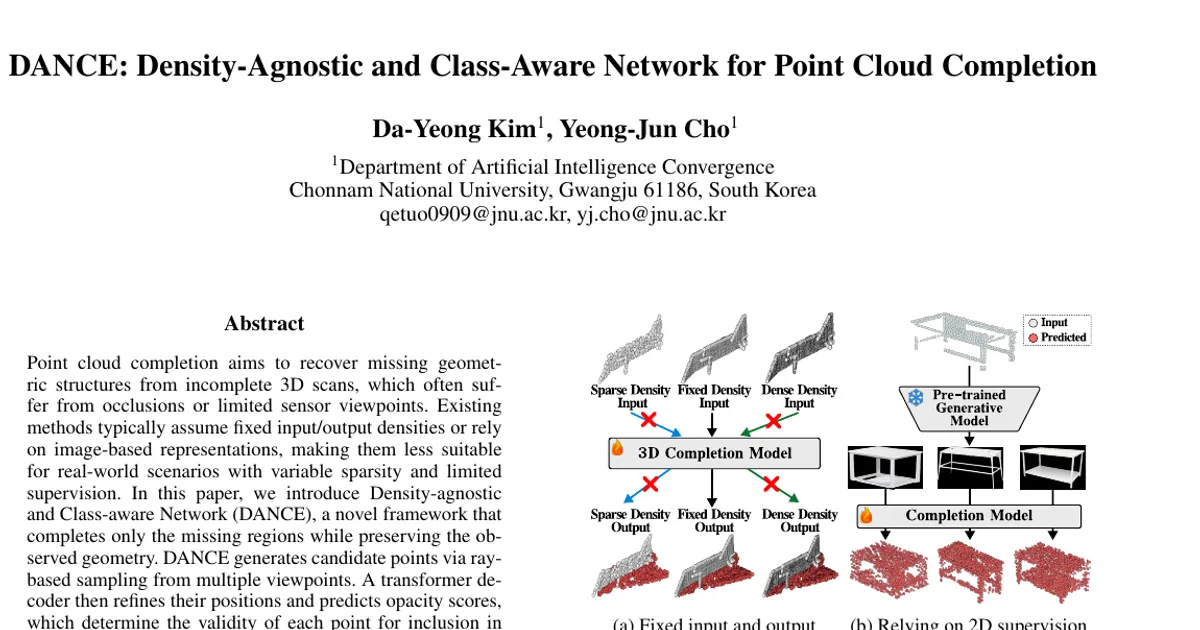
Incomplete 3D point clouds arise constantly in practice because of occlusions, limited sensor coverage, and constrained viewpoints, and completion methods try to fill in the missing structures. Most existing methods either assume a fixed input and output density (generating a fixed number of points no matter how much is missing) or turn the partial point cloud into 2D images and lean on image-based generative priors, which can distort the geometry that was actually observed. DANCE addresses both problems by completing only the missing regions, generating candidate points with ray-based sampling, and filtering them by a predicted opacity score, while a classification head supplies semantic guidance learned purely from the 3D input.
Key Contributions
-
The DANCE framework itself: a point cloud completion network that is density-agnostic (handles varying input sparsity and needs no fixed output size) and class-aware (uses category information as a prior for reconstruction).
-
A ray-based candidate point generation scheme: inspired by NeRF-style sampling, DANCE defines
Vviewpoints whose faces surround the object, casts rays through anR x Rgrid on each face, and samples one 3D point per ray, producingM = V·R²candidate points. -
A decoder that refines only the missing regions: a face transformer with cross-attention against a global feature and self-attention within each viewpoint group, followed by a classification head and a fusion network that predicts a per-point 3D offset and an opacity value; points with opacity ≥ 0.5 are kept, and the result is unioned with the original input.
-
State-of-the-art results and robustness claims: reported best overall performance on the PCN and MVP benchmarks, plus robustness to varying input density and to Gaussian noise, with no image supervision required. The paper states this is the first attempt at density-agnostic 3D point cloud completion.
Main Findings
-
PCN benchmark (Tab. 2): DANCE reports an overall CD-Avg of 6.46, DCD-Avg of 0.528, and F1 of 0.859, compared with PCDreamer (2025) at 6.52 CD-Avg / 0.531 DCD-Avg / 0.856 F1, CRA-PCN (2024) at 6.56 / 0.537 / 0.846, and SVDFormer (2023) at 6.61 / 0.534 / 0.848. Per-category CD-Avg for DANCE is Plane 3.53, Cabinet 8.6, Car 6.88, Chair 6.89, Lamp 5.44, Couch 8.28, Table 6.24, Boat 5.82.
-
Ablation on the classification head (Tab. 1): removing classification degrades results to 6.46 CD-Avg, 0.528 DCD-Avg, 0.856 F1, compared with 6.42, 0.524, and 0.859 for the full model. The text describes this as a CD-Avg reduction from 6.46 to 6.42; the paper's Tab. 2 reports 6.46 as the overall PCN CD-Avg for the full model.
-
Ablation on the face transformer (Tab. 1): removing the face attention design gives 6.52 CD-Avg, 0.534 DCD-Avg, 0.849 F1, which the authors say consistently degrades performance across all metrics, supporting the value of self-attention within viewpoint-specific groups.
-
MVP benchmark (Tab. 3): at 4,096 points DANCE reports 4.19 CD-Avg and 0.662 F1, versus DualGenerator at 4.29 and 0.643; at 8,192 points DANCE reports 3.37 CD-Avg and 0.754 F1, versus DualGenerator at 3.38 and 0.747.
-
Density flexibility: DANCE is trained with R = 21, but the output density can be changed at inference time by using values such as R = 17 or R = 29 without retraining. For the MVP experiments, R = 21 was used for the 4,096-point output and R = 33 for the 8,192-point output.
-
Noise robustness: when Gaussian noise is added to the PCN dataset at varying levels, DANCE reports smaller performance degradation than SVDFormer and SeedFormer across all noise levels tested. The specific noise magnitudes are not reported in the provided text.
-
Qualitative behavior: the paper reports that DANCE recovers thin and symmetric parts (for example on lamps and chairs) that prior methods miss, and that a direct qualitative comparison with PoinTr, which also completes only missing regions, favors DANCE in fine-grained structure recovery.
Methodology in Plain English
Step 1: place virtual cameras. The method imagines V viewpoints arranged around the partial object, each with a flat face pointed at it. With V = 6, these faces form a hexahedral box around the object. Each face carries an R x R grid of positions.
Step 2: shoot rays and drop candidate points. From each viewpoint, a ray is cast through every grid cell. One 3D point is sampled along each ray, drawn from a Gaussian distribution centered between the face and the object surface. Because object points live on the surface, one point per ray is enough. This yields M = V·R² candidate points, i.e., a rough initial guess at the missing geometry.
Step 3: encode. Both the candidate points and the original incomplete point cloud pass through the same 3D encoder (PointNet-style or DGCNN backbones are both possible). The candidates produce per-point features; the incomplete cloud is max-pooled into a single global feature that summarizes the visible shape.
Step 4: refine with attention. A transformer decoder processes the candidate features viewpoint by viewpoint. Each group cross-attends to the global feature (so candidates absorb context from the observed shape), then self-attends within its own group (so neighboring candidates stay locally consistent), with positional embeddings for both viewpoint and point.
Step 5: classify. A small MLP plus softmax reads the global feature and predicts the object's class distribution, providing a category-specific prior with no image data involved.
Step 6: predict offsets and opacity. Each candidate defines a local coordinate frame, with the sampling ray as the z-axis and the two face axes as x and y. A compression-expansion MLP with a 4-dimensional bottleneck (matching the four predicted numbers) refines the features, the class probabilities are concatenated, and a prediction head outputs a 3D offset and an opacity value per candidate. Candidates with opacity ≥ 0.5 are shifted by their offset and kept; the rest are discarded.
Step 7: assemble and train. The surviving predicted points are unioned with the original input, so observed geometry is preserved. Training minimizes a weighted sum of Chamfer Distance between prediction and ground truth and a cross-entropy classification loss, balanced by a hyperparameter λ.
Why This Matters
Impact on research. The paper reframes point cloud completion as a density-free problem rather than a fixed-size regression problem, and it demonstrates that useful semantic priors can be extracted from incomplete 3D geometry alone, without paired image data or 2D generative models. It also imports a NeRF-style opacity-gating idea into 3D completion, giving a simple mechanism for deciding how many points the output should contain.
Real-world applications (as motivated by the paper and its stated domain):
- Autonomous driving, where sensor coverage and object distance produce wildly varying point densities.
- Robotics, where a robot needs a complete 3D model of an object before grasping or navigating.
- 3D reconstruction pipelines that must merge partial scans taken from different viewpoints.
- Any deployment using 3D sensors whose resolution or object distance changes between captures, since the same trained model can serve different density settings by adjusting
R.
Industry relevance. The method requires no image–point cloud pairs, which the paper argues is impractical to collect at scale, and it avoids retraining when the desired output resolution changes. That combination lowers data-collection cost and makes a single deployed model usable across sensors with different characteristics.
Future Directions
- Adaptive view sampling: replacing the fixed viewpoint positions and constant number of views with a scheme that adapts to the input's geometric patterns, which the authors propose for objects with highly complex or asymmetric structures.
- Testing on real sensor data: the robustness study uses Gaussian noise added to PCN and reports no training or inference cost figures, so deployment cost on real scans remains open.
- Extending density-agnostic behavior to other tasks: the framework's candidate-point-plus-opacity design is described as the first attempt at density-agnostic completion, raising the question of whether the same idea transfers to related 3D generation or reconstruction problems.
- Filling in unreported details: the paper does not report parameter counts, runtime, or the specific noise levels used in the robustness experiment in the provided content, leaving room for follow-up measurement and reproducibility work.
Target Audience
Researchers and graduate students working on 3D vision, point cloud processing, and shape completion; engineers building perception or reconstruction systems for autonomous driving, robotics, or 3D scanning who need models that tolerate variable sensor density; and readers interested in transferring implicit-representation ideas such as ray sampling and opacity gating from neural rendering into geometric reconstruction. Familiarity with transformers, Chamfer Distance, and point cloud benchmarks like PCN and MVP will make the paper much easier to follow.
Authors’ abstract
Point cloud completion aims to recover missing geometric structures from incomplete 3D scans, which often suffer from occlusions or limited sensor viewpoints. Existing methods typically assume fixed input/output densities or rely on image-based representations, making them less suitable for real-world scenarios with variable sparsity and limited supervision. In this paper, we introduce Density-agnostic and Class-aware Network (DANCE), a novel framework that completes only the missing regions while preserving the observed geometry. DANCE generates candidate points via ray-based sampling from multiple viewpoints. A transformer decoder then refines their positions and predicts opacity scores, which determine the validity of each point for inclusion in the final surface. To incorporate semantic guidance, a lightweight classification head is trained directly on geometric features, enabling category-consistent completion without external image supervision. Extensive experiments on the PCN and MVP benchmarks show that DANCE outperforms state-of-the-art methods in accuracy and structural consistency, while remaining robust to varying input densities and noise levels.