Research
D-COT: Disciplined Chain-of-Thought Learning for Efficient Reasoning in Small Language Models
Overview Research area: Natural Language Processing, specifically reasoning in Small Language Models (SLMs) via Chain-of-Thought (CoT) distillation and preference optimization. Technical level: Interm
- arXiv
- 2602.21786
- Published
- 2026-02-25
- Authors
- Shunsuke Ubukata
AI summary
Overview
- Research area: Natural Language Processing, specifically reasoning in Small Language Models (SLMs) via Chain-of-Thought (CoT) distillation and preference optimization.
- Technical level: Intermediate. It assumes familiarity with CoT reasoning, knowledge distillation, LoRA fine-tuning, and preference optimization (ORPO/DPO), but the core idea is explained through concrete examples.
- Scope: The paper proposes D-CoT (Disciplined Chain-of-Thought), a training framework that uses control tags as scaffolding to restructure—rather than merely truncate—the reasoning traces distilled into an SLM, evaluated on Qwen3-8B against MMLU-Pro and GPQA-diamond.
What This Paper Is About
When frontier LLMs' long, elaborate reasoning traces are distilled into smaller models, the smaller models often cannot manage the complex context: they "overthink," drift into unnecessary loops and recalculation, and end up both slower (more tokens) and less accurate. This paper's goal is not to delete parts of the reasoning trace after the fact, but to teach the small model a disciplined structure for how it thinks, using explicit "control tags" during training that signal when to fact-check, compute, or explore alternatives. The result claimed is that Qwen3-8B simultaneously becomes more accurate and much more token-efficient, and that it retains the learned structure even when the tags are not used at inference.
Key Contributions
- The D-CoT framework. A method to mitigate overthinking in SLMs by structuring the reasoning process with control tags (
<TEMP_LOW>,<TEMP_MID>,<TEMP_HIGH>) that act as scaffolding during training, rather than passively removing CoT segments. - Substantial benchmark gains with little data. Using roughly 5,000 training samples, the paper reports a 9.9% improvement on GPQA-diamond and a 9.1% improvement on MMLU-Pro (0-shot). (Section 5.1 states the MMLU-Pro gain in table terms as 9.07 points.)
- Token-efficiency improvement. A significant reduction in average output tokens is reported, verifying that D-CoT optimizes inference efficiency as well as accuracy.
- Evidence of internalization. The model is shown to internalize the disciplined thought structure, achieving its best results even when control tags are not explicitly invoked during inference.
Main Findings
- MMLU-Pro accuracy: The Base model achieved 55.66% accuracy with 1,742 average tokens; D-CoT (LoRA) with the Base prompt achieved 64.73% with 1,496 tokens—described as an improvement of 9.07 points.
- Highest accuracy came without forced prompts: The best MMLU-Pro score (64.73%) was recorded without explicitly forcing the Custom prompt, which the author interprets as confirmation that the reasoning process was internalized.
- MMLU-Pro token reduction: D-CoT with the Custom prompt used 1,199 average tokens, described as a 31.2% reduction compared to the baseline.
- GPQA-diamond accuracy: D-CoT (Dynamic/Custom) achieved 52.93%, versus the Base model's 43.03%—an improvement of 9.9 points.
- GPQA-diamond token reduction: Average tokens fell from 5,875 (Base) to 2,073 (D-CoT), a 64.7% reduction; the Dynamic/Custom configuration reported 2,153 tokens.
- Null-rate collapse: The proportion of GPQA responses from which no valid answer could be extracted via regex dropped from 30.91% (Base) to under 5% (D-CoT); the specific figures reported are 3.54% for Dynamic/Custom and 1.82% for Locked/Custom.
- Gains are not a null-rate artifact: After null-corrected scoring (null responses given random-chance credit of 25%, matching GPQA's 4-choice format), D-CoT (54.47%) still surpassed the corrected Base score (50.76%).
- Pareto improvement: The accuracy–token plots show D-CoT conditions clustered in the high-accuracy, low-token quadrant, forming a Pareto frontier. The separation between Base and D-CoT clusters is described as substantially larger than the variation caused by temperature or prompt settings.
- Behavioral shift from overthinking to directed self-correction: The Base model exhibited "probabilistic oscillation" ("Wait, but..." loops consuming hundreds of tokens), while the D-CoT model performed a single focused verification and resolved it. The Base model also wasted tokens simulating longhand arithmetic, a behavior D-CoT skipped without having been explicitly trained to avoid it.
- Teaching structure, not domain knowledge: Training domains had near-zero semantic overlap with GPQA (peak similarity approximately 0.15) and low overlap with MMLU-Pro (peak similarity approximately 0.35, with 102 borderline samples removed). The paper argues the control tags encode domain-independent cognitive operations, and that overthinking is itself a domain-independent pathology.
- Dynamic temperature gave only marginal gains: Improvements from dynamic temperature control were 0.51–1.52 points, leading the author to conclude the control tags' primary value is in organizing the training signal rather than controlling sampling at inference.
- Deliberate domain separation: Seven training domains unrelated to the benchmarks were chosen specifically to isolate the effect of structured reasoning from domain-knowledge transfer and to enable decontamination verification.
Methodology in Plain English
The core idea. Instead of copying a large model's long reasoning trace verbatim into a small model, the researchers attach small "mode" labels to segments of the trace. The tags are named after temperature because they signal a cognitive style: <TEMP_LOW> for fact-checking, listing prerequisites, and constraints; <TEMP_MID> for normal responses, algorithmic processing, and calculation; <TEMP_HIGH> for creative solutions and multi-perspective viewpoints. The order of tags is deliberately not fixed—the sequence is determined by the nature of the task.
Building the data. A teacher model (Qwen3-235B-Instruct, A22B, via the OpenRouter API) generated training samples using few-shot system prompts with three fully worked examples. Each sample has six fields: user_prompt, thought_chosen (a meta-reasoning plan explicitly deciding where and why to use each tag, including a token plan), chosen_response (the ideal response with tags prefixing each segment), thought_rejected, rejected_response, and reasoning (a one-sentence summary of the flaw, used only for quality assurance, not for training).
Deliberate domain mismatch. Training scenarios came from seven domains rarely represented in academic benchmarks: Legacy IT Operations, Corporate Politics, DIY Engineering, Supply Chain Logistics, Regulatory Compliance, Cybersecurity Incident Response, and Event Crisis Management. From these, 119 scenario topics were defined across 5 instruction templates (emergency response, procedure drafting, crisis management, risk analysis, and constraint optimization).
Flawed responses as negatives. 31 rejection categories were defined across three axes: tag usage failures (complete token absence, token omission, premature creativity), content quality failures (architectural naivety, latency blindness, compliance hallucination), and safety/judgment failures (safety violation, dangerous minimization). The rejected responses were designed to be "competent but misguided"—coherent and well-written but with a specific fatal flaw—forcing the model to learn the alignment between tag usage and content quality.
Data scale and cleaning. 5,181 samples were produced via random sampling from 18,445 possible combinations of scenarios, templates, and rejection categories. Dual-criterion filtering removed samples with cosine similarity above 0.55 (using all-mpnet-base-v2 embeddings) or with 13-gram overlap against the GPQA and MMLU-Pro test sets: 102 samples were removed against MMLU-Pro, zero against GPQA-diamond. The final clean dataset contained 5,079 samples.
Training. ORPO (Odds Ratio Preference Optimization) was chosen over standard SFT or DPO because preliminary experiments indicated SFT alone incurred an "alignment tax" that degraded generalization, and because ORPO needs no reference model. LoRA training ran on an RTX 5090 using the Unsloth library, with the Lion (8-bit) optimizer, learning rate 4e-6, β_ORPO = 0.1, batch size 1 (gradient accumulation 8), warmup ratio 0.1, cosine learning rate scheduler, bfloat16 precision, and 2 epochs. Thought fields were placed inside <think> blocks following Qwen3's native thinking format, so the model learns to plan which tags to use and why.
Evaluation. MMLU-Pro was evaluated 0-shot on all 12k questions (10 choices); GPQA-diamond (198 questions) was evaluated 0-shot as a 5-seed average. Six conditions were compared, combining model (Base vs. D-CoT), temperature (Locked vs. Dynamic), and prompt (Base vs. Custom). Dynamic settings switched sampling temperature based on the generated tag: 0.3 for <TEMP_LOW>, 0.6 for <TEMP_MID>, 0.8 for <TEMP_HIGH>; Locked used a fixed 0.6. Following Qwen3's official recommendations, Top-P was 0.95 and Top-K was 20, with greedy decoding (temperature = 0) avoided because it induces infinite loops in Qwen3. Maximum output length was 2,048 tokens for MMLU-Pro and 8,196 for GPQA-diamond.
Why This Matters
The paper challenges a common assumption in the distillation literature: that the way to fix an SLM's overthinking is to cut its reasoning down. D-CoT argues and provides evidence that restructuring the reasoning—teaching the model when to check facts, compute, and explore—improves both accuracy and efficiency at once, rather than trading one for the other. By training on domains deliberately unrelated to the benchmarks, the study also offers a cleaner experimental design: any gains can be attributed to reasoning structure rather than knowledge leakage. This matters because it suggests that reasoning ability can be transferred as a cognitive pattern independent of subject matter, which is a much more general and reusable finding than task-specific fine-tuning.
- Enterprise incident response: The training domains (cybersecurity incident response, supply chain logistics, regulatory compliance) mirror real operational decision-making where a model must gather constraints before acting and avoid dangerous shortcuts.
- Cost-sensitive deployment of small models: A 64.7% reduction in average output tokens on GPQA-diamond directly translates to lower inference cost and latency for teams running SLMs at scale.
- On-premise or edge reasoning: Small models that reason in fewer tokens are better suited to environments without large GPU budgets or with tight latency requirements.
- Structured decision-support tools: The control-tag scheme (fact-check, compute, explore) is a legible interface for building systems where users need to see the mode of reasoning being applied.
Industry relevance: The method uses LoRA, a single RTX 5090, and roughly 5,000 samples, which puts disciplined reasoning training within reach of small teams rather than only well-resourced labs. The release of training code, benchmark results, and the full 5,181 Chosen/Rejected-pair dataset supports practical reproduction.
Future Directions
- Testing on other model families and scales. The conclusion explicitly states that future work will verify the method's effectiveness on other model families and at other scales, since all reported results are on Qwen3-8B.
- Analyzing attention maps to explain internalization. The paper calls for mechanistic analysis of why the model retains disciplined reasoning when control tags are absent at inference.
- Resolving when dynamic temperature is worth it. Dynamic temperature yielded only 0.51–1.52 points of improvement against notable implementation complexity, leaving open whether tag-aware sampling is worthwhile in any setting.
- Extending beyond GPQA and MMLU-Pro. The paper notes that DLCoT's effectiveness was unverified outside mathematical tasks and that DLCoT lost accuracy on AIME2024 (53.3% to 40.0%); D-CoT is evaluated only on two benchmarks here, and its behavior on math-heavy or other high-difficulty task types is not reported.
Target Audience
Researchers and practitioners working on reasoning in small language models, efficient inference, and CoT distillation will benefit most. It is also relevant to engineers applying LoRA-based preference optimization (ORPO) to domain-specific assistants, and to readers interested in whether reasoning structure—as opposed to reasoning content—can transfer between domains. A background in fine-tuning and preference optimization helps, but the central idea is explained with a worked example that makes it accessible to intermediate readers.
Authors’ abstract
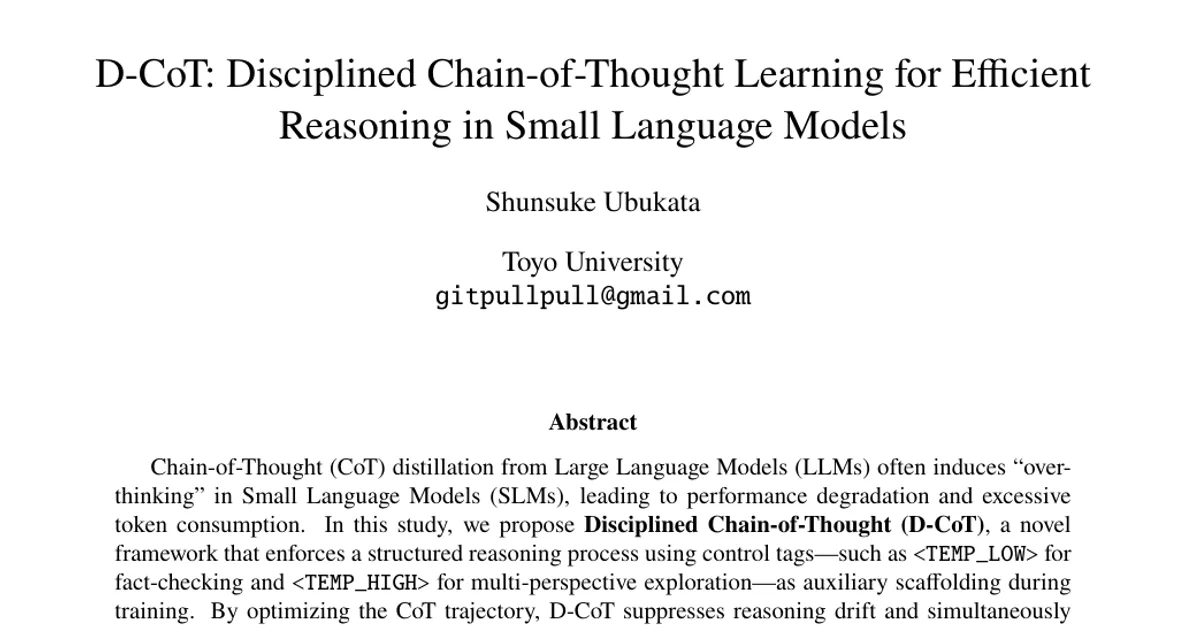
Chain-of-Thought (CoT) distillation from Large Language Models (LLMs) often induces "overthinking" in Small Language Models (SLMs), leading to performance degradation and excessive token consumption. In this study, we propose Disciplined Chain-of-Thought (D-CoT), a novel framework that enforces a structured reasoning process using control tags -- such as <TEMP_LOW> for fact-checking and <TEMP_HIGH> for multi-perspective exploration -- as auxiliary scaffolding during training. By optimizing the CoT trajectory, D-CoT suppresses reasoning drift and simultaneously achieves token reduction and performance improvement. We demonstrate the efficacy of our approach on Qwen3-8B: with only 5,000 training samples, D-CoT significantly boosts accuracy on GPQA-diamond by 9.9% and MMLU-Pro (0-shot) by 9.1%, while drastically reducing computational costs. Furthermore, we confirm that the model internalizes this disciplined thought structure, maintaining high performance even without explicit control tags during inference.