Research
Cross-Centaur: Modeling Individual Decision-Making Across Psychological Tasks with Language Models
Overview Research area: Computational cognitive science and natural language processing — using fine-tuned large language models (LLMs) as models of individual human decision-making across multiple ps
- arXiv
- 2610.23157
- Published
- 2026-10-16
- Authors
- Hikaru Asano, Hidezo Suganuma, Ryutaro Mori, Yukino Baba
AI summary
Overview
Research area: Computational cognitive science and natural language processing — using fine-tuned large language models (LLMs) as models of individual human decision-making across multiple psychological tasks.
Technical level: Intermediate. Readers will benefit from familiarity with supervised fine-tuning of LLMs, negative log likelihood as an evaluation metric, and standard paradigms in behavioral economics and cognitive psychology (bandit tasks, risky choice, social preferences).
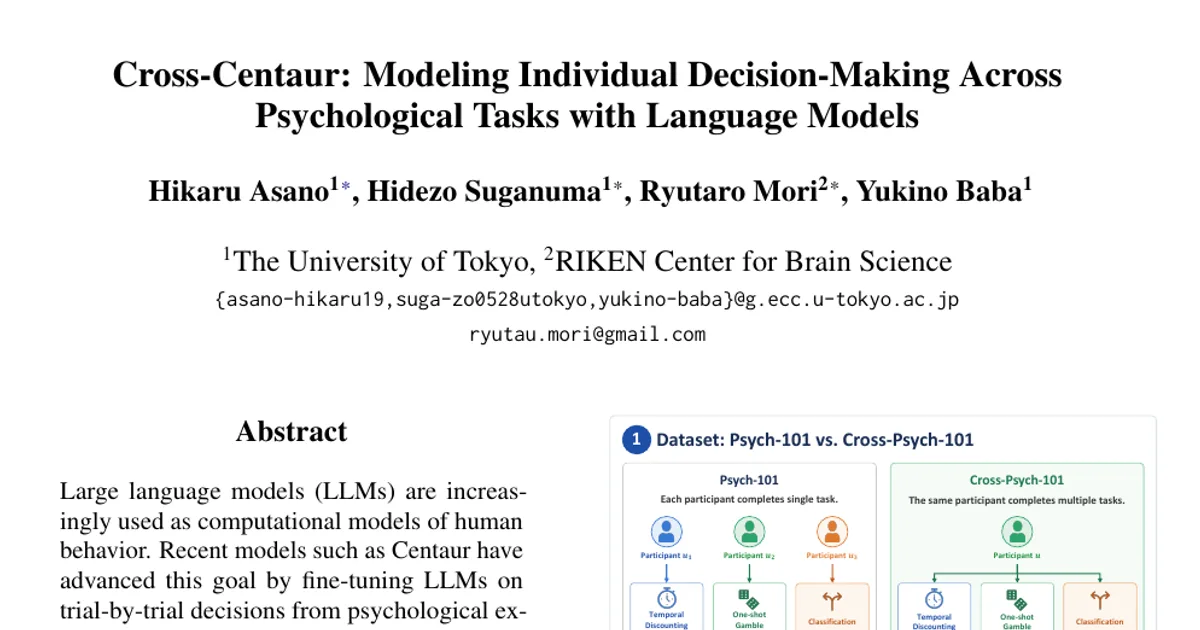
Scope: The paper introduces Cross-Psych-101, a dataset linking the same participants across 12 decision-making tasks, and Cross-Centaur, a Qwen3-8B model fine-tuned to predict a participant's target-task actions from their behavior in a different source task.
What This Paper Is About
Prior work fine-tuned LLMs on Psych-101, a large collection of trial-by-trial human decisions, producing a model called Centaur that predicts behavior within a task. But Psych-101 does not connect the same people across different tasks, so such models learn population-level regularities rather than stable individual signatures. This paper asks whether a person's behavior in one psychological task can be used to predict that same person's behavior in a different task, and builds both a dataset and a model to test it.
Key Contributions
-
A new task formulation. The authors define cross-task prediction of individual behavior as a supervised language-modeling problem: given a source task description, the same participant's source-task transcript, and a target task description, generate that participant's target-task transcript (which reduces to same-task prediction when source and target coincide).
-
Cross-Psych-101, a cross-linked behavioral dataset. 591 participants and 261,551 valid decisions across 12 tasks spanning four categories (Bandit, Tradeoff, Structure, Social), collected so that each participant completes tasks from two categories — enabling both within-category and across-category transfer tests.
-
Cross-Centaur, a fine-tuned model. Starting from Qwen3-8B, the authors first fine-tune on Psych-101 to obtain Centaur, then adapt to Cross-Psych-101, training loss only on action tokens delimited by
<<...>>so the model learns decisions rather than feedback text. -
Empirical and representational evidence. Held-out-participant and held-out-task evaluations, prompt ablations (original / shuffled-source / target-only), and linear-probe plus visualization analyses showing that hidden states encode participant-level tendencies that transfer across tasks.
Main Findings
-
Cross-Centaur gives the best overall action prediction. In the main table of negative log likelihood (lower is better), Cross-Centaur reaches 0.646 overall, compared with Centaur at 0.652, Qwen3-8B Base at 0.680, and Qwen3-14B Base at 0.672 — and it achieves the best score in nearly all columns.
-
Inference-time prompting does not substitute for fine-tuning. Qwen3-8B with explicit reasoning scores 1.009 overall, with behavioral hints 0.680; Qwen3-14B with reasoning scores 0.953 and with hints 0.672. Neither reasoning prompts nor quantitative summaries of prior tendencies improved the off-the-shelf models.
-
Transfer works within and across psychological categories. Cross-Centaur improves over baselines both when the source task is from the same category as the target ("Same cat.") and when it is from a different category ("Other cat."), across all four families.
-
Task-level comparisons mostly favor Cross-Centaur, with exceptions. On the task-level table it is best or near-best on most of the 12 tasks (e.g., 2-Armed Bandit 0.294 / 0.313 participant-held-out / task-held-out, versus Centaur 0.300 / 0.315; Correlated Bandit 1.462 / 1.780 versus 1.493 / 1.819). It is slightly worse in a few cells, such as Social Value (1.629 / 1.649 versus Centaur 1.613 / 1.618) and the task-held-out One-Shot Gamble (0.520 versus 0.505).
-
Gains shrink when the target paradigm is unseen. Cross-Centaur still beats Centaur and Qwen3-8B in the task-held-out setting, indicating generalization to unseen target paradigms, but the improvements are smaller than when the target family appeared during fine-tuning.
-
The ablation shows the gain depends on correctly matched source behavior. For Cross-Centaur, the original prompt is strongest across task families (e.g., Bandit 0.774, Tradeoff 0.790, Structure 0.780, Social 1.065). Shuffling the source transcript to a different participant degrades performance (0.798, 0.858, 0.786, 1.119), and removing the source observation entirely also degrades it (0.810, 0.889, 0.804, 1.125).
-
Hidden states encode transferable participant tendencies. Probe accuracy (higher is better) is often comparable across models for same-task inputs, but Cross-Centaur is stronger in cross-task settings — for example 0.749 versus Centaur's 0.542 for Bandit with a same-category source, and 0.567 versus 0.533 for Structure with an other-category source. Visualization with the shuffled-card risk-preference score shows participant representations increasingly organized by that tendency once the target-task description is appended, even when no shuffled-card behavior was shown.
-
The dataset reproduces canonical behavioral patterns. In the Two-Armed Bandit task, mean regret fell from M = 1.31 at trial 0 to M = 0.90 at trial 9; in the Estimation task, mean absolute error was 15.3 in the Additive condition versus 19.5 in the Non-additive condition; Social Value Orientation scores clustered into prosocial and individualistic regions as previously reported.
-
The predicted distribution is narrower than the human one. The authors report in the appendix (referenced in Limitations) that Cross-Centaur captures the overall participant-level tendency in Two-armed bandit regret, but its predicted regret distribution is narrower than the human distribution.
Methodology in Plain English
Data collection. Participants were recruited on Prolific, restricted to US residents who self-reported English fluency and had a prior approval rate of at least 90%. Each participant was randomly assigned two of the four task categories and completed three tasks per category, with quotas keeping the six category-pair combinations roughly balanced; category order was randomized while task order within a category was fixed. Compensation was a £5.00 base plus a performance-based bonus; median completion time was 36 minutes and mean effective hourly wage approximately £8.19. Quality control combined reCAPTCHA, two comprehension and attention-check questions per task, and exclusion of participant-task records with median response time below 200 ms or more than five browser focus losses. Exclusions removed approximately 2.9% of the 273,343 originally recorded decisions, applied at the participant-task level. The full sample is 601 participants; 10 opted out of public release, leaving 591 in the released dataset (mean age 42.2 years, standard deviation 14.1; 300 female, 285 male, 6 other or not disclosed). Ethics approval came from the University of Tokyo (UTSP-25051).
Representation. Every task is written as natural language: a task description specifying rules, actions, and reward structure, plus a behavior transcript of decisions and outcomes. Participant actions in the transcript are wrapped in <<...>>.
Training. Each example is a chat-style supervised fine-tuning instance whose user message holds the source description, source transcript, and target description, and whose assistant message is the target transcript. Loss is computed only on the action tokens inside the delimiters, excluding delimiters, feedback, and outcomes. The base model is Qwen3-8B.
Evaluation. Two splits are used: a participant-held-out split (~80% train, 20% test) for cross-task and ablation analyses, and a task-held-out split that removes entire tasks from training as both source and target. The metric is negative log likelihood over action tokens. Centaur and Cross-Centaur results average three training seeds; untrained baselines are deterministic and unaffected by seeds. Robustness checks with Qwen3-1.7B, Llama-3.2-1B, and Llama-3.1-8B are reported in the appendix.
Interpretation. For probing, choices and outcomes are converted into task-specific tendency scores (e.g., regret for Bandit, risk preference for Tradeoff), and single-hidden-layer MLP probes are trained per target task on extracted hidden states. A linear probe on the shuffled-card risk-preference score is used to visualize participants in two dimensions.
Why This Matters
Impact on research. The paper reframes individual differences as something a language model can be trained to carry across tasks, rather than something inferred within a single paradigm. It provides an open dataset and a model checkpoint for testing whether behavioral signatures are stable or task-specific — a central question in cognitive science — and a direct comparison point against Centaur, which learns only population-level regularities.
Real-world applications:
- Synthetic participants for pilot studies: testing task designs or instructions against model-predicted individuals before recruiting human participants.
- Adaptive interfaces and personalization: using a short behavioral history in one domain to anticipate preferences in another.
- Agent-based social simulation: populating simulations with agents whose tendencies are concentrated within individuals rather than distributed at random, which matters when outcomes depend on clustering.
- Behavioral profiling and risk screening: exploratory use of cross-task tendencies in domains such as financial risk-taking, subject to the paper's explicit caveats.
Industry relevance. Any product that must infer preferences from sparse interaction data — recommendation, personalized pricing, game design, conversational agents — faces the same cold-start transfer problem this paper formalizes. The finding that prompt-level hints and explicit reasoning did not help, while behavioral fine-tuning did, is directly relevant to teams deciding whether to invest in fine-tuning or in prompt engineering.
Future Directions
-
Improving generalization to unseen task types. Gains in the task-held-out setting are smaller than in the seen-target setting, for both Centaur and Cross-Centaur, so transferring to entirely new paradigms remains open.
-
Training objectives aimed explicitly at representation learning. The authors suggest objectives that more directly encourage cross-task participant representations, rather than relying on next-action prediction alone.
-
Natural-language intermediate reasoning. A proposed direction is to first extract participant characteristics from source-task behavior as explicit natural-language reasoning, then use those inferred characteristics to guide target-task prediction.
-
Broadening the data. Cross-Psych-101 covers controlled psychological tasks with English-fluent US residents; extending to everyday, institutional, and socially embedded decisions, and to other languages and cultural contexts, is needed for a genuinely unified model of behavior.
-
Preserving the full diversity of human behavior. The model's predicted regret distribution is narrower than the human distribution, so capturing the tails of individual variation is an unresolved problem.
Target Audience
Researchers in computational cognitive science and behavioral modeling who want to test cross-task stability of individual differences; NLP researchers interested in fine-tuning LLMs on behavioral data and in probing what such models represent; practitioners building personalized agents or synthetic-user simulations who need to know whether cross-domain behavioral transfer is achievable; and methodologists evaluating dataset design for linking the same participants across experimental paradigms. Readers seeking deployable predictive systems should note the authors' own caution that these models are tools for exploring hypotheses, not definitive accounts of individuals or society.
Authors’ abstract
Large language models (LLMs) are increasingly used as computational models of human behavior. Recent models such as Centaur have advanced this goal by fine-tuning LLMs on trial-by-trial decisions from psychological experiments. However, existing large-scale behavioral datasets do not link the same participants across different tasks, so these models learn population-level regularities but are not trained to model individual-level regularities across tasks. We introduce Cross-Psych-101, a dataset of 591 participants and 261{,}551 valid decisions across 12 Bandit, Tradeoff, Structure, and Social tasks. We train Cross-Centaur to predict a participant's target-task actions from a target-task description and the source-task description paired with the same participant's source-task behavior. Cross-Centaur outperforms off-the-shelf LLMs and Centaur on held-out participants, both within and across tasks. Probing analyses suggest that its hidden states encode participant-level behavioral tendencies that transfer across tasks. These results highlight the potential of cross-task individual-level data for predicting human decision-making with language models. Cross-Pysch-101 is available at https://huggingface.co/datasets/HikaruAsano/cross-psych-101.