Research
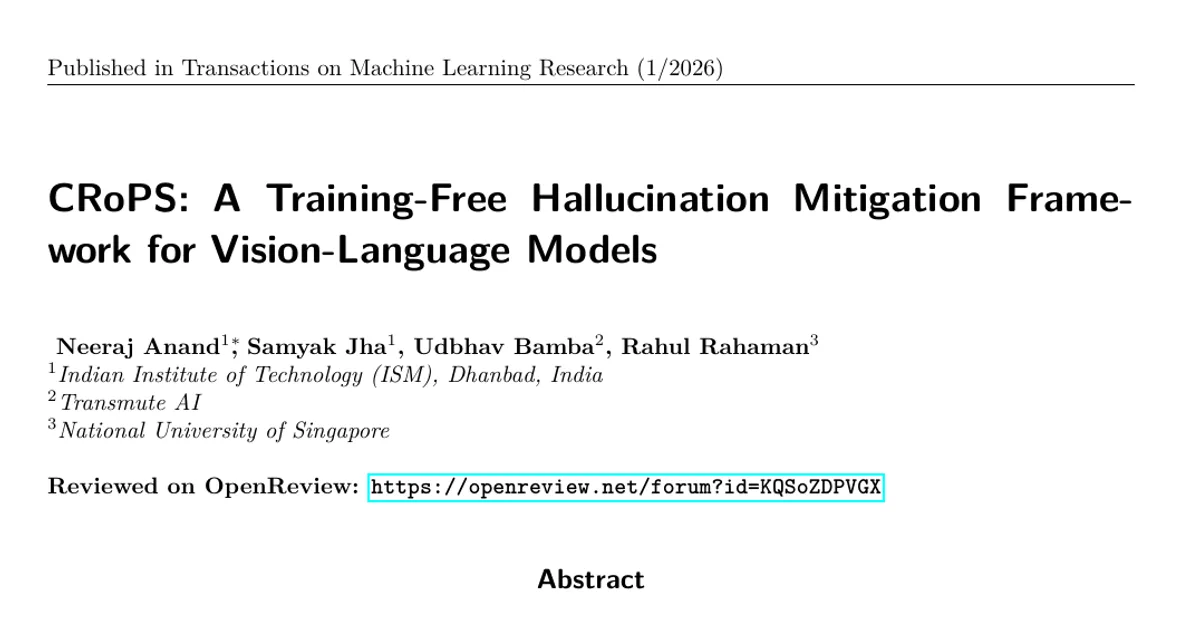
CRoPS: A Training-Free Hallucination Mitigation Framework for Vision-Language Models
Overview Research area: Computer Vision / multimodal AI — specifically hallucination mitigation in Large Vision-Language Models (LVLMs) at inference time. Technical level: Intermediate. The paper assu
- arXiv
- 2601.00659
- Published
- 2026-01-02
- Authors
- Neeraj Anand, Samyak Jha, Udbhav Bamba, Rahul Rahaman
AI summary
Overview
Research area: Computer Vision / multimodal AI — specifically hallucination mitigation in Large Vision-Language Models (LVLMs) at inference time.
Technical level: Intermediate. The paper assumes familiarity with transformer decoding, contrastive decoding, and attention weights, but the core idea is explainable without deep math.
Scope: The paper diagnoses why existing training-free contrastive decoding methods lose effectiveness late in generation, and proposes a two-model contrastive framework called CRoPS that requires no training or auxiliary models.
What This Paper Is About
Large Vision-Language Models frequently "hallucinate" — producing text that describes objects or details that are not actually in the image, which undermines their reliability as trustworthy AI assistants. The paper's goal is to reduce these hallucinations without retraining the model, by improving how a hallucinated "reference" model is constructed and contrasted against the original model during generation. The authors argue that prior training-free methods fail in two ways: they only capture one source of hallucination, and they become ineffective in the later stages of text generation, exactly when hallucinations are most likely.
Key Contributions
-
A late-stage failure analysis plus a new hallucinated model. The authors analyze how existing methods degrade as more tokens are generated, and show empirically and theoretically that previously generated text tokens carry as much or more importance than visual tokens late in generation. They therefore build a hallucinated model that removes important text tokens (from both the prompt and past generated tokens) rather than visual tokens, and show its dependency signal does not diminish over time.
-
Generalized Contrastive Decoding. The standard contrastive decoding formulation allows contrast against only one hallucinated model. The authors extend it to accommodate multiple models, each representing a different source of hallucination, with a stated limitation that the participating hallucinated models must be sufficiently distinct to justify inclusion.
-
CRoPS itself. The framework combines two hallucinated models — an image-deficit one (removing important visual tokens, inspired by SID, retaining all text tokens) and a vision-plus-text-deficit one (removing all visual tokens and the least important text tokens) — under the generalized contrastive decoding formulation, with a contrast weight that increases over time for the text-side model. Confidence and plausibility constraints are added during contrasting.
-
Broad evaluation. The paper evaluates against six benchmarks and three LVLM families, and reports efficiency relative to competing methods on an NVIDIA A100.
Main Findings
-
CHAIR (MS-COCO validation set, prompt "Please describe this image in detail"). CRoPS achieves the lowest CHAIR scores across all evaluated LVLMs. On LLaVA-1.5 (7B): C_S 39.5, C_I 10.2, Recall 76.3, versus Sampling at 57.0 / 17.0 / 75.0 and M3ID at 47.1 / 12.8 / 74.8. On LLaVA-1.5 (13B): 38.5 / 9.1 / 75.1 versus M3ID's 45.5 / 12.2 / 75.3. On LLaVA-NeXT: 33.2 / 8.1 / 66.2. On Qwen2-VL: 26.9 / 6.9 / 67.4. The abstract states a 20% improvement in CHAIR scores; the text describes a 15–25% reduction relative to M3ID on the LLaVA-1.5 series.
-
ClearSight trade-off on Qwen2-VL. ClearSight attains a lower C_S on Qwen2-VL (13.5) but with a much lower Recall (38.2) compared to CRoPS (67.4), which the authors attribute to over-suppression of visual details.
-
AMBER benchmark. CRoPS reports the best results on CHAIR, HAL, and Cog across models. For LLaVA-1.5 (7B): CHAIR 6.3, HAL 29.3, Cog 2.8, versus Sampling at 10.6 / 44.3 / 4.0. For LLaVA-1.5 (13B): 5.7 / 27.8 / 2.5. For LLaVA-NeXT: 7.2 / 44.6 / 2.6. For Qwen2-VL: 5.1 / 24.2 / 1.1. The text reports roughly 25–30% reduction in CHAIR and HAL and 10–15% reduction in Cog on LLaVA-1.5, and roughly 20–25% for LLaVA-NeXT and Qwen2-VL.
-
GPT-4o assisted benchmark. CRoPS achieves the lowest Sentence-Level Hallucination Ratio (SHR) across all model variants while maintaining superior 1-gram and 2-gram fluency and higher Words Per Image (WPI), i.e. it does not shorten outputs to hide hallucinations.
-
POPE. CRoPS reports the highest Accuracy and F1 across LVLMs: LLaVA-1.5 at 83.9 Acc / 84.6 F1, LLaVA-NeXT at 89.4 / 89.4, and Qwen2-VL at 86.1 / 85.3, described as an average gain of about 2% over the strongest baseline.
-
MME and MathVista. CRoPS reports MME of 1662 and MathVista of 28.9 on LLaVA-1.5; MME 1779 and MathVista 38.0 on LLaVA-NeXT; MME 2184 and MathVista 55.6 on Qwen2-VL — the top scores across most settings.
-
Efficiency (NVIDIA A100, LLaVA-1.5 7B, CHAIR). CRoPS uses 652 seconds and 16934 MB, with C_S 39.46. For comparison: Sampling 215 / 15699 / 57; Beam Search (5 beams) 531 / 16737 / 50.7; VCD 550 / 17864 / 53.3; SID 510 / 16574 / 48.93; OPERA 1947 / 21943 / 49.1. The authors note CRoPS adds minimal overhead despite an extra forward pass, and that this is a vanilla implementation.
-
Ablation on removal type (Table 6, left). Removing all image tokens while keeping text tokens gives C_S 45.4 / C_I 12.4 / Recall 73.3. Keeping all image tokens and removing least-important text tokens gives 47.8 / 13.2 / 73.8. Removing all image tokens plus least-important text tokens gives 43.2 / 10.8 / 73.3. Removing the same number of text tokens at random gives 50.7 / 13.8 / 76.4 — worse than selective removal.
-
Ablation on token retention policy (Table 6, right). Constant 43.6 / 10.9 / 75.0; All-but-one 46.8 / 13.1 / 73.6; Linear 41.2 / 10.7 / 74.6; the proposed policy 39.5 / 10.2 / 76.3.
-
Ablation on hallucination model choice (Table 7). Replacing the second hallucinated model with M3ID while keeping the rest of CRoPS unchanged yields C_S 45.1 / C_I 11.8 / Recall 78.3, inferior to CRoPS at 39.5 / 10.2 / 76.3.
-
Distinctiveness evidence. The Jensen-Shannon divergence over generation time between the two proposed hallucinated models is plotted against the maximum possible value, log(2), and against the divergence between hallucinated models used by prior work; the authors state that simply stacking prior methods' hallucinated models is sub-optimal.
Methodology in Plain English
Contrastive decoding works by generating text twice: once with the full model, and once with a deliberately degraded "hallucinated" version that is expected to be less grounded. The degraded model's predictions are then subtracted, suppressing whatever the degraded model liked. CRoPS changes what gets degraded.
First, the authors measure how much the model's output distribution changes when visual input is removed, a quantity they call Visual Dependency, VD(t), computed as a Hellinger distance between distributions. They report this dependence drops sharply as generation proceeds — so a model deprived only of images looks increasingly like the full model, making the contrast signal weak exactly when hallucinations tend to appear. They define a parallel metric, Visuotextual Dependency, VTD(t), for their text-deprived model and report that it does not diminish over time.
Second, they build a hallucinated model that keeps only the least important text tokens. Importance is estimated from mean attention weights across heads at an early transformer layer (l = 2), following the SID strategy but applied to text instead of vision. The number of retained tokens grows over time via a non-decreasing function η(μ,t) = β₀ + β₁(1 − e^(−μt)) to maintain sparsity as the token count grows.
Third, they generalize contrastive decoding to subtract multiple hallucinated models, with separate weights. In CRoPS the image-deficit weight α^(1) is constant, while the text-deficit weight α^(2)_t = (1 − e^(−γt))/e^(−γt) increases over time. Experiments use nucleus sampling with top-p 0.9, temperature 1, three random seeds, and evaluate LLaVA-1.5 (7B and 13B), LLaVA-NeXT (8B), and Qwen2-VL (7B).
Why This Matters
Impact on research: The paper argues that a single hallucinated model cannot cover all hallucination sources, and reframes contrastive decoding as a multi-model problem. It also contributes a diagnostic framing — dependency metrics that vary with generation step — for reasoning about when a mitigation method stops working, which is a departure from evaluating only end-of-caption metrics.
Real-world applications (the paper motivates these as reliability concerns for real-world LVLM deployment; it does not itself deploy these systems):
- Assistive tools for blind and low-vision users, where fabricated objects or scene details could cause direct harm.
- Medical or scientific image captioning and VQA, where describing non-existent findings is unsafe.
- Content moderation and accessibility captioning pipelines that process images at scale.
- Any agentic or conversational assistant grounded in camera or screen input, where hallucinated details propagate into downstream decisions.
Industry relevance: CRoPS is training-free and plug-and-play, so it can be added at inference time to existing deployed LVLMs without fine-tuning or auxiliary networks. On the reported A100 measurement it costs 652 seconds versus 215 for plain sampling and 1947 for OPERA on the same task, so the practical overhead is modest relative to other inference-time interventions, and the authors note an optimized implementation would reduce it further.
Future Directions
- Efficiency optimization. The authors explicitly state their latency analysis used a vanilla implementation and that an optimized version would further reduce overhead; reducing the cost of the additional forward passes is an obvious next step.
- Which and how many hallucinated models to combine. The paper states as a limitation that participating hallucinated models must be distinct enough to justify inclusion, and that adding similar models yields the same result as traditional contrastive decoding but with higher latency. How to select or construct complementary hallucinated models is left open.
- Hyperparameter and scheduling design. The ablation compares constant, all-but-one, linear, and the proposed retention policy, and the text-side contrast weight grows exponentially over time; whether other schedules for α^(2)_t and η(μ,t) perform better is not resolved.
- Extension beyond the evaluated settings. The paper evaluates captioning, VQA, POPE-style binary judgments, MME, and MathVista across three LVLM families; generalization to other architectures and to tasks such as video or multi-image reasoning is not reported.
Target Audience
Researchers and practitioners working on multimodal model reliability, hallucination mitigation, and inference-time decoding strategies, particularly those who cannot afford retraining or auxiliary supervision. It is also useful for engineers deploying LVLMs in safety-sensitive products who need a training-free mitigation option with measured latency and memory costs, and for students studying contrastive decoding who want a clear account of its limitations and a generalization of the framework.
Authors’ abstract
Despite the rapid success of Large Vision-Language Models (LVLMs), a persistent challenge is their tendency to generate hallucinated content, undermining reliability in real-world use. Existing training-free methods address hallucinations but face two limitations: (i) they rely on narrow assumptions about hallucination sources, and (ii) their effectiveness declines toward the end of generation, where hallucinations are most likely to occur. A common strategy is to build hallucinated models by completely or partially removing visual tokens and contrasting them with the original model. Yet, this alone proves insufficient, since visual information still propagates into generated text. Building on this insight, we propose a novel hallucinated model that captures hallucination effects by selectively removing key text tokens. We further introduce Generalized Contrastive Decoding, which integrates multiple hallucinated models to represent diverse hallucination sources. Together, these ideas form CRoPS, a training-free hallucination mitigation framework that improves CHAIR scores by 20% and achieves consistent gains across six benchmarks and three LVLM families, outperforming state-of-the-art training-free methods.