Research
Cropland PAtteRNS: Parallel Dimensional Attention Networks and Attention to Dataset Disparity for Crop Segmentation in Satellite Imagery Time Series Data
Cropland PAtteRNS: Parallel Dimensional Attention Networks for Crop Segmentation in Satellite Imagery Time Series Overview Research area: Computer vision applied to Earth observation — specifically se
- arXiv
- 2609.38165
- Published
- 2026-09-29
- Authors
- Joseph Metcalfe, Sara Sharifzadeh, Fabio Caraffini
AI summary
Cropland PAtteRNS: Parallel Dimensional Attention Networks for Crop Segmentation in Satellite Imagery Time SeriesOverview
Research area: Computer vision applied to Earth observation — specifically semantic segmentation of crop types and parcel boundaries from Sentinel-2 multispectral Satellite Imagery Time Series (SITS).
Technical level: Advanced. The paper assumes familiarity with vision transformers, factorised self-attention, convolutional segmentation networks, and remote sensing benchmark datasets.
Scope: The paper introduces Cropland PAtteRNS, a hybrid transformer-convolutional segmentation model that applies self-attention separately along the temporal, spectral, and spatial axes of SITS data, and evaluates it against state-of-the-art crop segmentation models across multiple tile-size variants of the PASTIS and MTLCC datasets while also auditing dataset construction practices.
What This Paper Is About
Crop segmentation models for satellite time series have grown rapidly in both complexity and the size of the datasets they train on, but two problems have been pushed aside: attention across the spectral axis of multispectral data remains under-studied, and the way crop datasets are built (which classes get merged, which tile sizes are used) is not standardised or well understood. The authors build a model that attends separately to time, spectrum, and space, then use it as a controlled instrument to measure how dataset design choices — class groupings and tile size — distort reported model performance.
Key Contributions
- The first crop segmentation model to apply factorised self-attention jointly over spatial, spectral, and temporal dimensions in SITS data. The model uses a novel parallel encoder architecture for the temporal and spectral branches, which makes this triple-factorised approach computationally viable and exposes raw unattended SITS signals to a larger proportion of the network.
- Evidence that hybridising attention with convolution remains valuable in segmentation networks. Adding a convolutional refinement head improved performance significantly, countering the trend toward purely attention-based architectures.
- A comparative study of state-of-the-art SITS crop segmentation models across an unprecedented coverage of tile-size variants from multiple datasets. The results show tile size strongly affects outcomes even within the same dataset, preventing fair comparison between models trained at different tile sizes, and that flawed crop class selections and aggregations degrade performance more than architectural choices do.
- Demonstrated state-of-the-art performance, particularly in parcel boundary quality measured by Boundary IoU, with the model made publicly available for use and adaptation.
Main Findings
- Triple-factorised attention works and is affordable. The parallel temporal and spectral branches let both transformers operate on the original embedded SITS data rather than on each other's processed output. The authors report that a sequential alternative without token reduction between transformers produced an approximate 5-fold increase in multiply-accumulate operations (MACs), which the parallel design avoids.
- Strong parcel delineation, not just class accuracy. The model outperformed all compared models on crop class segmentation across multiple segmentation metrics, with especially strong results on Boundary IoU — a metric the authors note is often under-reported in this field despite boundary quality mattering for verifying self-reported parcel boundaries.
- Tile size invalidates cross-study comparison. Alternate tile-size variants of crop segmentation datasets produced results the authors describe as incomparable to one another, meaning models trained at different tile sizes cannot be fairly compared. PASTIS is used at a 128px tile size; MTLCC 2016 is used at 24px and 48px variants.
- Taxonomic aggregation is a large hidden confounder in PASTIS. Of PASTIS's 18 crop classes, 4 are flagged as taxonomical aggregates, covering 11.2% of primary crop parcels but only 4.1% of crop class pixels. Combined with the non-homogenous 'Meadow' and 'Grapevine' classes, non-homogenous crop parcels reach 60.0% of parcels and 25.2% of pixels. PASTIS contains no seasonal aggregate groupings.
- MTLCC has a different but equally significant aggregation problem. Only 1 of its 17 crop classes is a taxonomic aggregate — 'Winter Wheat', which combines soft and hard winter wheats — yet it accounts for 24% of primary crop parcels and 14.1% of pixels. Together with 'Meadow', MTLCC reaches 37.6% by-parcel and 17.9% by-pixel coverage of non-homogenous crops. MTLCC also has a potential seasonal aggregate class, 'Rapeseed', over 3.8% of parcels and 2.5% of pixels, whose mix of spring, summer, and winter varieties is unclear.
- The PASTIS 'Void' class is a measurement hazard. Parcels lying mostly outside a tile, or belonging to classes not in the PASTIS label set, are labelled 'Void'. Though these are masked during training and evaluation, the authors argue that merging 'Void' with 'Background' would still leave valid crop-class parcel segments at tile boundaries labelled as background, inflating false positives. Models trained on PASTIS therefore have a theoretical performance advantage over those trained on MTLCC, where non-included crops remain labelled as 'Background'.
- Attention along the spectral axis is largely unexplored. Reviewing prior work, the authors found no earlier study using a fully factorised attention approach with spectral attention for SITS crop segmentation. Existing spectral-attention works either lack a temporal axis, target a single crop species, or use mismatched spatial resolutions from different satellites.
- Concrete metric values are not reported in the supplied text. The truncated content describes which metrics were used (Overall Accuracy, mean Intersection over Union, Boundary IoU) and the direction of results, but does not include the numeric performance tables.
Methodology in Plain English
The authors start from a known-good design (TSViT, which attends over time first and then over space) and keep that as their baseline. They then split the input SITS tile — a tensor with temporal, spectral, height, and width dimensions — into non-overlapping spatial patches and make two copies of it. One copy is reshaped so each patch becomes a sequence over time; the other is reshaped so each patch becomes a sequence over spectral bands. Both sequences are projected to the same embedding size and fed to separate transformers running in parallel, so temporal and spectral relationships are learned independently from the raw data rather than one on top of the other. Each branch keeps only a set of learned class tokens, which are then fused (the paper compares four fusion blocks, including concatenation and cross-attention where one branch queries the other), fed to a spatial transformer that lets patches exchange context, and finally "unpatched" back to full per-pixel class predictions.
They evaluate on Sentinel-2-derived datasets: PASTIS (France, 4 full-size Sentinel-2 tiles, 128px tiles, 5 folds) and MTLCC 2016 (Germany, denser parcels, 24px and 48px tiles, 10 folds). Both use a nominal 60/20/20 train/validation/test split. PASTIS has 20 total classes (18 crop classes), a capture date range of 406 days, S=10 spectral bands, and T_max=61; MTLCC 2016 has 18 total classes (17 crop classes), a 341-day capture range, S=13 bands, and T_max=45. The Sentinel-2 20m and 60m bands were bi-linearly interpolated to 10m. Shorter sequences were padded to T_max rather than interpolated, with pad-masking in the attention mechanisms. Because the MTLCC ground truth labels differ between years and are not cross-compatible, only the 2016 variant was used, for its larger sample size. They also conducted an in-depth ablation study, and standardised intersecting class names across both datasets using a unified hierarchical taxonomy of EU crop nomenclature and the French LIPS nomenclature.
Why This Matters
Impact on research: The paper argues that a drive for the most novel architecture or the largest dataset has pushed finer details aside, and shows that dataset construction choices — class aggregation and tile size — can affect reported performance more than architecture does. It also brings Boundary IoU into a field where the authors say no widely suitable metric for boundary quality has yet been adopted, and where most crop class segmentation studies omit boundary assessment entirely.
Real-world applications:
- Verifying per-parcel reported crop types under the European Union's Common Agricultural Policy, where satellite-derived tools support allocation of farming subsidies.
- Monitoring food security, agricultural sustainability, and environmental change by governmental and non-governmental organisations.
- Verifying self-reported parcel boundaries in crop subsidy and land management systems, which is why the authors stress boundary quality metrics.
- Fairness of subsidy distribution — the paper notes that farmers' average income is well below overall mean income, so tools must be accurate in both crop type and parcel boundaries.
Industry relevance: ESA's Sentinels for Common Agriculture Policy programme aims to build high-volume SITS data pipelines from Sentinel-1 and Sentinel-2 for crop type mapping, vegetation health assessment, and agricultural practice monitoring. Sentinel-2 is favoured over low-altitude UAVs and traditional aerial imagery because satellite data offer unmatched spatial and temporal coverage at favourable cost. SITS sources with revisit periods under 7 days are now commonly and openly available, providing over 50 temporal observations each year.
Future Directions
- Standardise best practices for building SITS crop segmentation datasets, particularly for involved crop classes, since flawed class selections and aggregations of multiple crop species were shown to degrade performance more than architectural choices.
- Identify relations enabling dynamic tile sizing so models can select tile dimensions for ideal performance rather than being locked to a fixed variant.
- Establish a suitable boundary quality metric for crop segmentation, given that neither segmentation metrics like Overall Accuracy and mean Intersection over Union nor the various agricultural boundary delineation studies have converged on one.
- Broaden spectral attention research, given that no prior work had applied fully factorised attention with spectral attention to SITS crop segmentation, and that existing spectral-attention methods are limited by missing temporal axes, single crop species targets, or mismatched multi-satellite resolutions.
Target Audience
Researchers and practitioners working on semantic segmentation of satellite imagery time series, remote sensing and Earth observation scientists building or curating crop mapping datasets, and machine learning engineers at agricultural technology companies or public agencies producing crop type maps for subsidy verification and land management. It is also relevant to dataset creators more broadly, since its findings about class aggregation and tile-size comparability apply to anyone benchmarking models across inconsistent data variants. The technical level is advanced: readers should be comfortable with transformer attention factorisation, convolutional segmentation heads, and remote sensing evaluation metrics.
Authors’ abstract
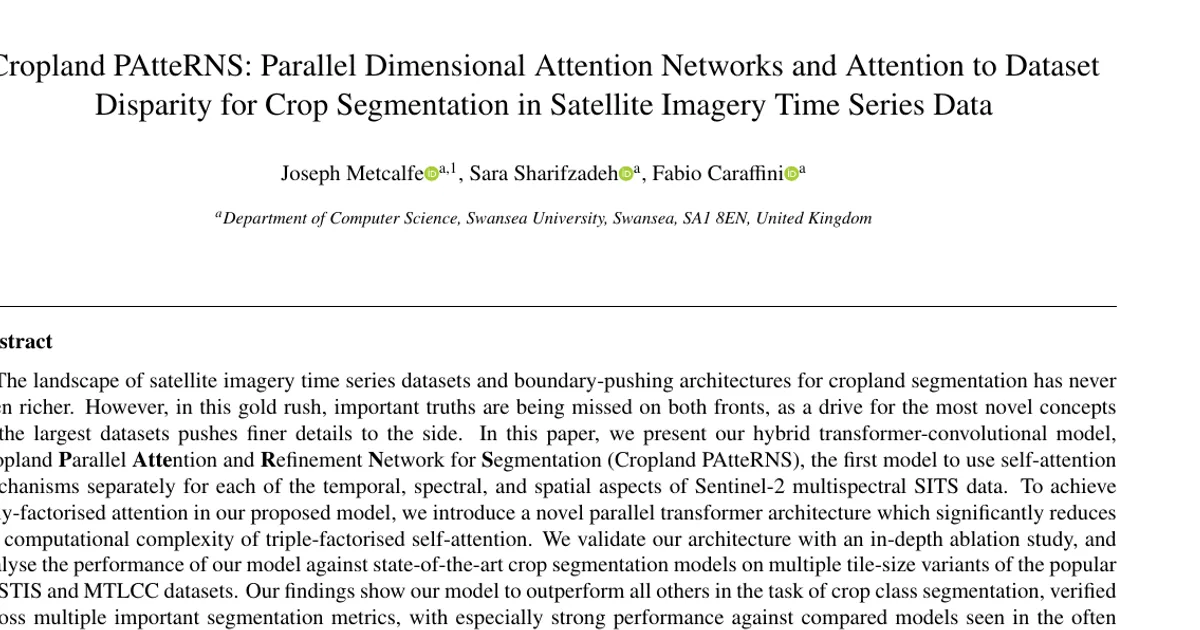
The landscape of satellite imagery time series datasets and boundary-pushing architectures for cropland segmentation has never been richer. However, in this gold rush, important truths are being missed on both fronts, as a drive for the most novel concepts or the largest datasets pushes finer details to the side. In this paper, we present our hybrid transformer-convolutional model, Cropland Parallel Attention and Refinement Network for Segmentation (PAtteRNS), the first model to use self-attention mechanisms separately for each of the temporal, spectral, and spatial aspects of Sentinel-2 multispectral SITS data. To achieve fully-factorised attention in our proposed model, we introduce a novel parallel transformer architecture which significantly reduces the computational complexity of triple-factorised self-attention. We validate our architecture with an in-depth ablation study, and analyse the performance of our model against state-of-the-art crop segmentation models on multiple tile-size variants of the popular PASTIS and MTLCC datasets. Our findings show our model to outperform all others in the task of crop class segmentation, verified across multiple important segmentation metrics, with especially strong performance against compared models seen in the often under-reported parcel delineation quality, for which we use the Boundary IoU metric. We also find that flawed class groupings within datasets can have a significant negative impact on model performance, and report that alternate tile-size variants of crop segmentation datasets produce results incomparable to one-another, invalidating fair comparison between model performance when trained on different tile-sizes. Based on these findings, we suggest further work is required to standardise best practices when constructing SITS crop segmentation datasets, and to enable future dynamic-tile-sizing for ideal model performance.