Research
CreativeFlow: A One-to-Many Analogical Relation Transfer Method for 3D Asset Generation
Overview Research area: Artificial intelligence for 3D content generation, specifically analogical creativity, computational design, and knowledge-graph-driven retrieval (CCS categories: Shape modelin
- arXiv
- 2610.05167
- Published
- 2026-10-04
- Authors
- Xuechen Li, Shuai Zhang, Nanxuan Zhao, Qing Chen
AI summary
Overview
Research area: Artificial intelligence for 3D content generation, specifically analogical creativity, computational design, and knowledge-graph-driven retrieval (CCS categories: Shape modeling, Artificial intelligence, Media arts).
Technical level: Intermediate. The paper is a SIGGRAPH Asia 2026 Posters contribution, so it presents a conceptual framework and a preliminary evaluation rather than a full technical treatment with exhaustive implementation detail or formal proofs.
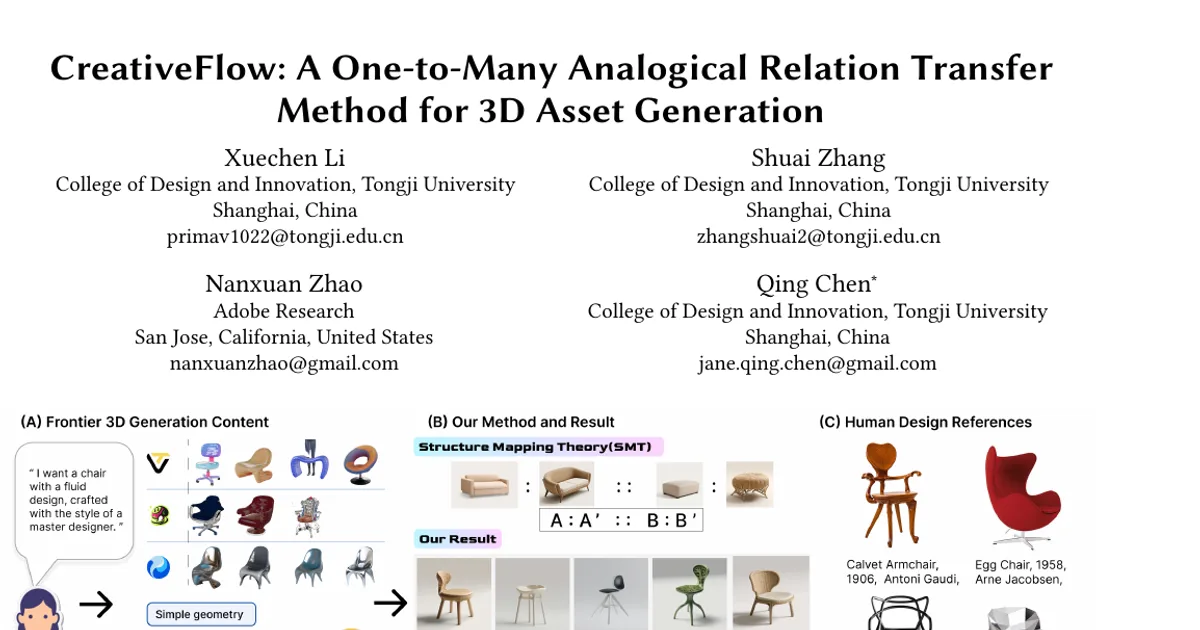
Scope in one sentence: CreativeFlow is a one-to-many analogical generation framework that maps a single 3D source asset to several relationally similar but structurally distinct target designs, aiming to counter creative homogenization in text-to-3D pipelines.
What This Paper Is About
Current text-to-3D systems produce high-fidelity assets but tend to collapse open-ended creative prompts into semantically conservative, homogenized forms, offering shallow style or color variations instead of novel structural deviations. The authors frame this as limited semantic transfer and address it by grounding creative prompts in analogical creativity and Structure Mapping Theory, expressing a prompt as the proportional relation A : A' :: B : B', where a source object A transfers attributes A' to a target design B' via an analogical concept B. The goal is a pipeline that transfers meaningful structural, functional, or material logic—rather than surface detail—and produces multiple diverse, relation-aware targets from one source.
Key Contributions
- A one-to-many analogical framework for 3D assets. CreativeFlow maps a single source object to diverse, relation-aware target designs rather than producing one homogenized output, and claims to theoretically enable infinite creative designs.
- A dual-path relational expansion module. The system combines structured retrieval from external knowledge graphs (Wikidata, Getty AAT, and AskNature) with the inherent associations of large language models to identify analogical concepts
B. - A multi-objective filtering and generation pipeline. Candidate mappings are scored on semantic novelty, 3D feasibility, and structural transferability, then converted into part-level instructions for 2D-prior-to-3D generation.
- A foundational dataset, benchmark, and preliminary expert validation. The workflow and its resulting assets are positioned as a dataset and benchmark for future relation-aware 3D model training, with two expert user studies reporting gains in novelty, identity preservation, and visual fascination.
Main Findings
- One-to-many expansion is qualitative. CreativeFlow expands a single source asset (comprising text, image, and mesh) into 5 to 10 relations carrying aesthetic and structural information, each yielding targets with diverse geometric deformations.
- Identity preservation and novelty scored well. In the identity-preservation and novelty study, the method achieved mean scores of 3.66 and 3.86 respectively on five-point scales, against three baselines (Hunyuan3D-2, TRELLIS-2, and SF3D).
- Visual fascination improved over the strongest baseline. In a controlled visual-fascination study, ten design experts rated CreativeFlow at 3.31 out of 5, compared with 2.84 for the strongest baseline.
- Qualitative results span multiple object categories. Reported one-to-many results cover stools, handbags, and frogs, with each row showing a source and multi-view renderings of generated targets.
- The claimed mechanism is relational, not stylistic. The authors attribute the improvement to transferring structural, functional, or material logic—exemplified by mapping
chair : support frame = coral : branching structure—rather than to surface-level style variation. - Not reported: the paper does not report the number of experts in the identity-preservation and novelty study, per-baseline scores for those two measures, dataset sizes, or quantitative diversity metrics beyond the scores above.
Methodology in Plain English
The framework runs a source asset through three stages:
- Attribute inference. Given a source
A(for example, a chair), a large language model parses its geometry and functional regions along the dimensions of function, material, structure, visuals, and affordances, extracting core transferable parts as seed termsA'—such as support frame, seat shell, backrest, or surface material. - Dual-path relational expansion. Seed terms are routed by category into two paths. The knowledge-graph path grounds the source asset and its attributes in Wikidata to find first-hop neighborhood nodes, then runs second-hop queries along Getty AAT and AskNature to retrieve hyponyms. Getty AAT expands
Bacross style, craft, material, ornament, and object type for aesthetic attributes, while AskNature focuses on biological structures and biomimetic mechanisms—support, protection, attachment, lightweight structure, and surface function—for physically grounded natural strategies. The second path is an LLM-internal knowledge transfer method based on prompt expansion of historical transfer cases. - Analogical mapping and generation. Creative transfer is solved as the proportional analogy
A : A' = B : B', whereB'is the transferable characteristic of the analogical sourceBmapping ontoA'. A multi-objective engine filters candidate mappings by balancing semantic novelty, 3D feasibility, and structural transferability; selected targets become explicit part-level instructions (for example, "coral-branch support frame"), which a 2D Generator turns into view-consistent visual priors before a 3D Reconstructor produces the final 3D meshes.
Evaluation used 3D assets generated from matched prompts, compared against three baseline pipelines through two expert user studies on five-point scales.
Why This Matters
The paper targets a specific failure mode—creative homogenization—arguing that current pipelines do not explicitly model transferable relations to map local components to cross-domain concepts, so different samples concentrate in similar local solution spaces. Its impact on research is to reposition creative 3D generation as a relation-mapping problem and to offer the workflow and its assets as a foundational dataset and benchmark for future relation-aware 3D model training, alongside a Knowledge-graph retrieval angle connecting biomimetic structures and art styles.
Real-world applications suggested by the framework:
- Design ideation tools. Generating structurally diverse concept variants from an existing prototype for industrial and product design.
- Biomimetic product development. Drawing on AskNature-grounded strategies such as lightweight structures, support, protection, and attachment mechanisms.
- Style- and craft-informed asset creation. Using Getty AAT expansions across style, craft, material, ornament, and object type.
- Collaborative human-AI design workflows. Integrating analogical expansion into interactive tools for controllable ideation.
Industry relevance is signaled by the collaboration between Tongji University's College of Design and Innovation and Adobe Research, and by the work's presentation at SIGGRAPH Asia 2026 Posters.
Future Directions
- Creativity-specific evaluation metrics. The authors plan to build robust metrics that quantify generative creativity and analogical structural rationality, addressing the gap in standardized creativity evaluation.
- A large-scale structured dataset. They intend to construct a source-relation-target dataset dedicated to training and benchmarking future models.
- Interactive creative tools. They plan next-generation human-computer interactive tools that embed the analogical expansion pipeline into collaborative design workflows for intuitive, controllable, and inspiring human-AI ideation.
- Open questions the work raises. How analogical structural rationality should be measured, whether relation-aware models trained on such data generalize beyond the reported categories (stools, handbags, frogs), and how much of the reported expert-rating gain comes from the knowledge-graph path versus the LLM-internal transfer path are not resolved in this poster.
Target Audience
Researchers and practitioners in 3D generative modeling, computational creativity, and AI-assisted design who are concerned with output diversity rather than fidelity alone; knowledge-graph and retrieval researchers interested in grounding generative pipelines in external sources such as Wikidata, Getty AAT, and AskNature; and designers, HCI researchers, and industry teams building concept-generation or collaborative ideation tools for 3D assets.
Authors’ abstract
Inspired by cognitive science, we present CREATIVEFLOW, an analogical generation framework that explicitly models analogical divergent thinking to mitigate creative homogenization in text-to-3D pipelines. Our method derives a series of meaningful yet relationally similar source-target asset pairs, each featuring distinct geometric configurations. Expert evaluations demonstrate that our framework substantially enhances creative novelty and visual fascination. This workflow and its resulting assets establish a foundational dataset and benchmark for future relation-aware 3D model training.