Research
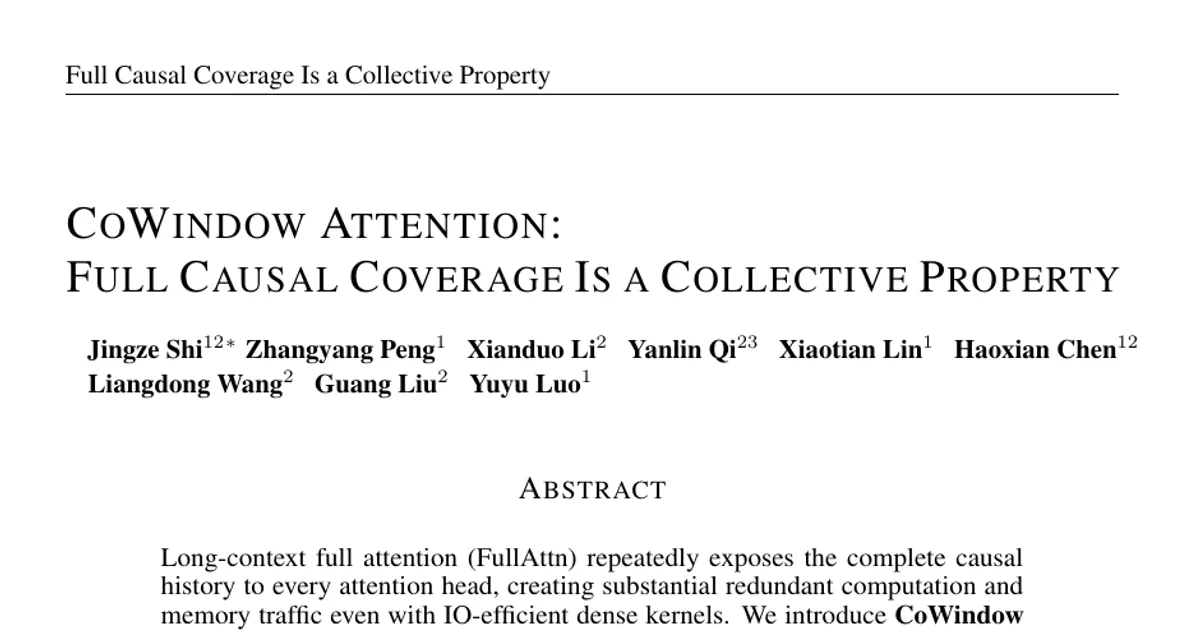
CoWindow Attention: Full Causal Coverage Is a Collective Property
CoWindow Attention: Full Causal Coverage Is a Collective Property Overview Research area: Efficient attention architectures for long-context large language models, spanning model design, kernel-level
- arXiv
- 2609.32704
- Published
- 2026-09-26
- Authors
- Jingze Shi, Zhangyang Peng, Xianduo Li, Yanlin Qi, Xiaotian Lin, Haoxian Chen, Liangdong Wang, Guang Liu, Yuyu Luo
AI summary
CoWindow Attention: Full Causal Coverage Is a Collective PropertyOverview
Research area: Efficient attention architectures for long-context large language models, spanning model design, kernel-level operator implementation, and distributed training/inference on tensor-parallel GPUs.
Technical level: Advanced. The paper assumes familiarity with grouped-query attention, FlashAttention-style tiled execution, online softmax, tensor parallelism, KV heads, scaling laws, and perplexity/FLOPs analysis. The core idea is conceptually simple, but the implementation and evaluation are systems-heavy.
Scope: The paper introduces CoWindow Attention (CoWA), a position-defined sparse attention pattern in which the full causal history is covered collectively by a group of KV heads rather than duplicated in every head, and evaluates it across associative recall, operator latency and memory, scaling laws from 0.6B to 14B parameters, and 14B/32B model benchmarks.
What This Paper Is About
Long-context full attention (FullAttn) gives every attention head access to the entire causal history, which repeats the same distant-token connections across heads and drives up computation and memory traffic even with IO-efficient kernels like FlashAttention. The paper asks whether an attention layer can keep access to every causal token position while letting each individual head attend only sparsely to distant tokens. CoWA answers this by having all KV heads share near-diagonal and prefix-sink windows while assigning complementary long-range windows to different heads, so that full causal coverage becomes a property of the head ensemble rather than of each head.
Key Contributions
-
The CoWA attention pattern. A structured attention design that distributes access to the causal history across KV heads: shared near-diagonal and prefix-sink windows plus complementary long-range windows whose union covers the entire causal prefix, reducing duplicated long-range access across heads.
-
A position-defined execution structure for training and inference. CoWA uses one window rule for the training forward and backward passes, inference prefill, and autoregressive decoding, requires no learned router or indexer, and uses global KV-head indexing so complementary window assignments align with KV-head tensor parallelism.
-
A window-matched ablation isolating collective coverage. By holding per-head window widths fixed and varying how many distinct long-range windows are assigned across eight KV heads, the authors separate the effect of complementary allocation from the effect of window size.
-
An end-to-end evaluation across retrieval, operator cost, scaling, and model quality. The evaluation covers controlled associative recall against several sparse baselines, a tensor-parallel attention-operator benchmark at 128K tokens, scaling-law training from 0.6B to 14B parameters, and model-level benchmarks at 14B and 32B.
Main Findings
-
Complementary windows drive the gain, not window width. In the window-matched ablation at 8K sequence length with
d_model = 512, 8K associative-recall accuracy rises monotonically as duplicated long-range windows are replaced by complementary ones: 21.32% (1 unique window, 12.5% long-range coverage), 32.92% (2 unique windows, 25%), 52.32% (4 unique windows, 50%), and 89.73% (CoWA, 8 windows × 1 head, 100% coverage). FullAttn reaches 89.97%, and the near-only SWA reference reaches 5.34%. -
CoWA tracks FullAttn as context grows in controlled associative recall. With 256 randomized key-value pairs and matched per-query token budgets of 1,024, 1,152, 1,408, and 1,920 tokens at sequence lengths 1K, 2K, 4K, and 8K respectively, CoWA reaches 89.73% at 8,192 tokens with
d_model = 512, essentially matching FullAttn at 89.97%. DSA reaches 53.71%, MoBA 50.12%, NSA 25.23%, and the remaining methods stay near 10%. -
Large operator-level speedups at 128K tokens. On 8 H100 GPUs with tensor parallelism
TP=8, at 128K tokens CoWA reduces training forward latency by 7.4 times and backward latency by 8.6 times relative to FullAttn, and decoding latency during inference by 3.0 times. -
Training peak memory matches FullAttn; decoding memory is much lower. CoWA's forward and backward peak per-rank allocations match those of the FullAttn implementation. Its decoding-operator peak allocation of 8.4 MiB is 7.6 times smaller than FullAttn's and substantially smaller than MoBA's and DSA's. MoBA's 128K backward pass exceeds the per-rank memory limit.
-
Scaling laws show comparable perplexity at lower FLOPs. Across five model scales from 0.6B to 14B parameters, CoWA closely tracks FullAttn in perplexity while using fewer total training FLOPs, including sequence-dependent attention and sparse-selection work. At 14B, CoWA reduces total training FLOPs by 3.1% during 4K pre-training and 28.5% during 32K long-context training, matches FullAttn's pre-training perplexity, and differs by less than 0.01 after long-context training, using a per-QO-head token budget of 4,992 with no router or indexer FLOPs.
-
Model-level benchmarks remain comparable at 14B and 32B. At 14B, CoWA scores 72.70 on knowledge and 64.87 on reasoning versus 72.32 and 64.46 for FullAttn. At 32B, CoWA scores 76.07 and 75.53 versus FullAttn's 75.62 and 75.67. On RULER at native 32K, CoWA achieves 89.13 (14B) and 92.58 (32B) versus 89.42 and 92.70 for FullAttn, remaining within 0.3 points at both scales. Under YaRN extrapolation to 128K, CoWA reaches 66.60 vs 65.84 at 14B and 81.78 vs 82.03 at 32B.
-
Position-defined sparsity avoids auxiliary structures. MoBA and DSA include routing, indexing, quantization, TopK, pooling, and merging costs in their measured latency, while CoWA derives visible blocks directly from sequence position and global KV-head index.
Methodology in Plain English
The authors start from a simple observation: an attention layer does not need every head to look at every past token, as long as every past token is visible to at least one head. CoWA defines a distance between a query position and a key position that is aligned to the bottom-right of the attention matrix, so a single definition works for training, for prefill, and for one-token-at-a-time decoding.
Each KV head then gets three windows. One window covers recent tokens and is shared by all heads. A second window covers the beginning of the sequence (prefix sinks) and is also shared. The remaining, more distant span is split into equal contiguous intervals, one per KV head, so the intervals are complementary rather than overlapping. Each head attends densely within its windows and skips everything else. Because the long-range intervals tile the distance range without gaps, the union of all heads' visible keys is the entire causal prefix.
Crucially, the pattern depends only on sequence positions and the global KV-head index, so no router, indexer, or learned selection is needed. The visible key blocks for each query block can be computed directly, then the kernel traverses only those blocks, using tiled execution and online softmax. The backward pass inverts the same relation and reconstructs probabilities from the saved logsumexp, so gradients are exact for the CoWA operator. The same rule is used at training time and inference time. Under tensor parallelism, the global KV-head index is used to compute breakpoints, so different ranks receive complementary long-range windows rather than duplicated ones.
The evaluation proceeds in layers: a window-matched ablation that changes only how many distinct long-range windows exist across heads; a controlled associative-recall task with randomized key-value bindings that leave no semantic shortcut; an operator benchmark at 128K tokens on 8 H100 GPUs with TP=8; and scaling-law plus model-level training on 128 H100 GPUs, with downstream evaluation on 8 H100 GPUs using the EleutherAI LM Evaluation Harness and Megatron-LM for distributed training. Across experiments, attention variants use matched model scales, depth, hidden size, data, and optimization settings.
Why This Matters
Impact on research. The paper reframes sparse attention as a coverage-allocation problem at the level of the head ensemble, rather than as a per-head budget or a content-based retrieval problem. It provides a controlled ablation showing that complementary long-range allocation, not simply wider windows, is what recovers recall. It also positions CoWA against head-specialization work such as SPAttention and against dynamic routers such as MoBA, NSA, and DSA, arguing that a position-defined rule can avoid the selection problem entirely. The finding that full coverage can be collective is a conceptual contribution that may influence how sparse attention patterns are designed and how heads are assigned work.
Real-world applications.
- Long-document understanding and summarization, where models must retain access to distant passages.
- Repository-level code generation, where relevant definitions may sit far from the point of use.
- Multi-turn reasoning and dialogue systems, where earlier turns must remain retrievable.
- Long-context retrieval-augmented generation and agentic workflows backed by long histories and document stores.
Industry relevance. The efficiency results are directly relevant to serving and training costs. At 128K tokens, the reported 7.4 times and 8.6 times training latency reductions and 3.0 times decoding latency reduction over FullAttn, together with a 7.6 times smaller decoding-operator peak allocation, target the memory and throughput bottlenecks of long-context deployment. The alignment with KV-head tensor parallelism and KV-cache partitioning means the pattern maps onto existing distributed training and serving layouts, and the 28.5% FLOP reduction at 14B during 32K-context training translates into lower training cost at long context. The stated limitation is that window-aware offloading and prefetching to reduce HBM-resident KV storage remain future work, and the operator-memory measurements are distinct from persistent KV-cache storage.
Future Directions
- Broader breakpoint schedules. The paper states that the same interface permits head-specific window widths and gaps, and that other breakpoint schedules redistribute long-range work under the same attention pattern; it notes that equal-area allocation for training is outside the scope of this work, leaving this as an open design axis.
- Window-aware KV-cache management. The authors explicitly list window-aware offloading and prefetching to reduce HBM-resident KV storage as future work, and note that cache compression and offloading remain orthogonal to CoWA.
- Extending collective coverage beyond the evaluated regime. The paper reports evaluations up to 32B models from a separate continued-training experiment and 128K context, and notes configurations with
TP > H_kreplicate logical KV heads and generally store more than a1/TPfraction of the global KV cache per rank. How the pattern behaves under different head-count and parallelism configurations is not resolved in the reported results. - Understanding the gap between coverage and computation. The paper states that full causal coverage guarantees direct access to token positions but does not imply the same head-specific interactions or outputs as FullAttn, which raises the question of how the head ensemble learns to combine information accessed by different heads.
Target Audience
This paper is most useful to researchers and engineers working on long-context language models, efficient attention kernels, and distributed training or inference. It suits readers with background in transformer attention, grouped-query attention, IO-aware attention kernels, and tensor parallelism. Practitioners focused on long-context serving cost and KV-cache memory will find the operator benchmark and memory results most actionable, while architecture researchers will find the collective-coverage principle and the window-matched ablation most relevant. Readers looking for a beginner-level introduction to sparse attention will need supporting background first, since the paper assumes familiarity with tiled online-softmax execution and parallel execution layouts.
Note: the provided paper content is truncated partway through Appendix A.1, so complete per-experiment configurations, per-task results, and uncertainty estimates referenced in Appendix A and Appendix B are not available in the text summarized above.
Authors’ abstract
FullAttn repeatedly exposes the complete causal history to every attention head, creating substantial redundant computation and memory traffic even with IO-efficient dense kernels. We introduce CoWA, a structured attention architecture that distributes access to the causal history across KV heads. All heads share near-diagonal and prefix-sink windows, while complementary long-range windows partition the remaining history. Their union provides full causal coverage although each head attends sparsely to distant tokens. This position-defined attention pattern requires no learned router or indexer, is used consistently during training and inference, and aligns with KV-head tensor parallelism. A window-matched ablation at 8K isolates the effect of complementary long-range allocation: CoWA with 100% collective coverage reaches 89.73% accuracy, compared with 89.97% for FullAttn, while duplicated long-range windows perform substantially worse. Across a broader controlled associative-recall comparison with matched token budgets, CoWA closely tracks FullAttn as the context grows, whereas other sparse patterns lose a substantial fraction of the associations. In an attention-operator benchmark at 128K tokens with tensor parallelism, CoWA reduces forward and backward latency during training by 7.4x and 8.6x and decoding latency during inference by 3.0x over FullAttn. Its per-rank peak operator memory matches FullAttn during training and is 7.6x lower during decoding. Across scaling-law training from 0.6B to 14B parameters, CoWA closely tracks FullAttn in perplexity while reducing total training FLOPs. The resulting 14B models and 32B models from separate continued training achieve comparable knowledge, reasoning, and long-context retrieval scores to FullAttn. These results show that full causal coverage can be a collective property of the head ensemble rather than a duplicated property of every head.