Research
Correction Training for Diffusion Models
Overview Research area: Generative modeling with diffusion models (image generation), specifically inference-time sample quality and the training–inference gap known as exposure bias. Technical level:
- arXiv
- 2610.14136
- Published
- 2026-10-09
- Authors
- Donghoon Ahn, Runqian Wang, Alexei A. Efros, Taesung Park, Yash Belhe
AI summary
Overview
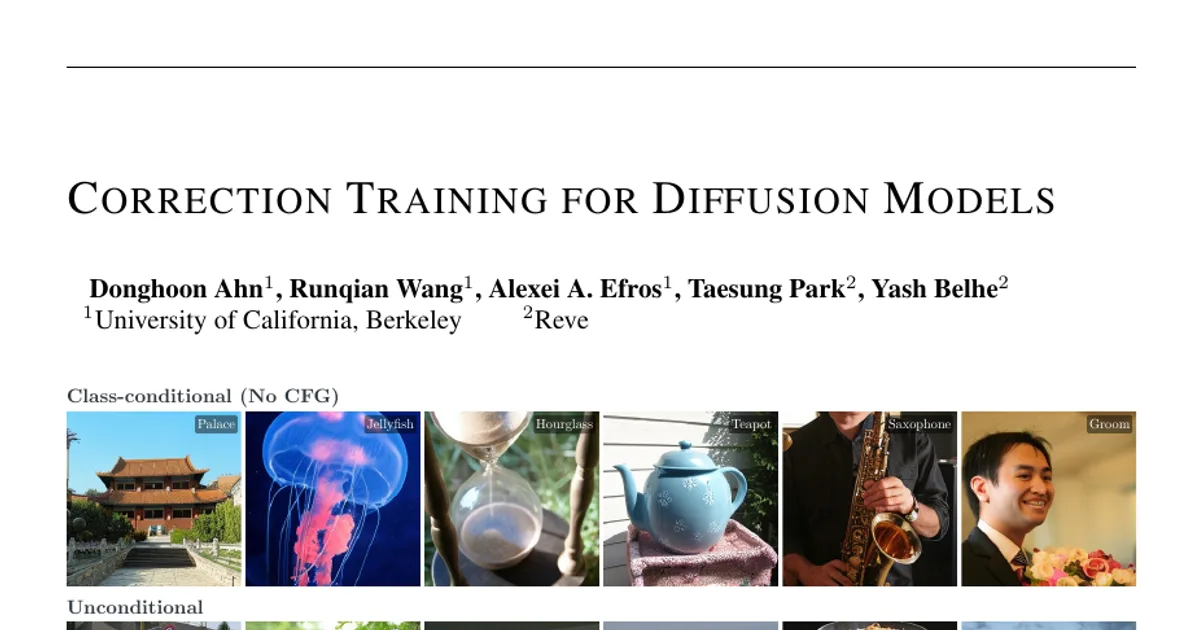
Research area: Generative modeling with diffusion models (image generation), specifically inference-time sample quality and the training–inference gap known as exposure bias. Technical level: Advanced — assumes familiarity with diffusion/flow-matching denoisers and classifier-free guidance. Scope: The paper introduces a small "corrector" network trained on a diffusion model's own predictions, applies it repeatedly at sampling time, and shows large FID gains on ImageNet class-conditional, unconditional, and text-to-image generation.
What This Paper Is About
Diffusion models are trained on real images mixed with noise, but at sampling time they are fed states built from their own imperfect earlier predictions, so errors accumulate along the denoising trajectory. The authors turn this mismatch into an explicit learning problem: train a second network to improve the base model's clean-image prediction, then apply that improvement repeatedly during sampling. The goal is to get higher-quality samples without relying on classifier-free guidance (CFG), and ideally without its diversity loss and oversaturation.
Key Contributions
- Correction as an explicit training task. A corrector takes the base denoiser's clean-sample prediction as input (with a stop-gradient so the correction loss does not flow back through the denoiser) and is trained against the same ground-truth image target. It is jointly fine-tuned with the denoiser, with corrector inputs generated online by the current model.
- Iterative correction at inference beyond what was supervised. Although training supervises a single correction step, the corrector is applied K times per denoising step at sampling time, and this extrapolation is identified as the key source of quality gains.
- Broad empirical evaluation without guidance. Correction is tested on DiT, SiT, SiT REPA, and JiT for ImageNet class-conditional and unconditional generation, and on a DiT with a DDT head in the FLUX.2 VAE latent space (NanoGen framework) for text-to-image, improving reported unguided FID and standard benchmarks.
- Efficiency options. A shared-backbone variant reduces parameter overhead, and distillation folds the corrected predictions back into the base model so the gains survive with one forward pass per step.
Main Findings
- Large unguided FID gains at matched compute (ImageNet-256, ~250 NFEs). DiT-XL/2: 9.58 → 2.07; SiT-XL/2: 8.55 → 1.92; SiT REPA-XL/2: 5.53 → 1.31; JiT-L/16: 14.86 → 2.96. Precision rises in all four cases (e.g., DiT 0.668 → 0.811); recall drops modestly (0.676 → 0.603 for DiT).
- Competitive with CFG, sometimes better on FID. Correction beats the reported CFG reference FID on DiT (2.07 vs 2.51), SiT (1.92 vs 2.11), and SiT REPA (1.31 vs 1.35), but not on JiT-L/16 (2.96 vs 2.35). CFG retains higher precision in all four rows.
- Unconditional generation improves substantially. Baseline FID 24.82; correction K=1 gives 17.80; correction K=4 gives 5.37; autoguidance gives 9.37 (at w=7, 250 NFE, 50K updates). Peak precision is higher for correction, at lower recall.
- Cheap in training. For SiT REPA, 50K updates are 1.25% of its 4M pretraining updates, and FID converges within relatively few corrector training steps.
- Text-to-image improves with and without CFG. Without CFG: GenEval 28.30 → 50.09 and DPG-Bench 70.71 → 76.82 (K=6, 245 NFE vs 250). With CFG: GenEval 68.08 → 70.48 and DPG-Bench 83.38 → 83.69 (K=2, 246 NFE).
- Human raters prefer CFG + correction. In a study on Rapidata with 80 GenEval single-object prompts, raters chose the corrected setting over the released CFG baseline on quality 60.75% vs 39.25% and diversity 60.25% vs 39.75%.
- Iterative correction, not extra parameters, drives the gain. Trained from scratch with LightningDiT on ImageNet 256×256 for 80K updates, a 28-layer denoiser (675M) reached FID@8K 8.93, while a 14-layer denoiser plus 14-layer corrector (681M) with K=1 reached 8.74 — nearly the same. With K=3 at halved denoising steps it reached 5.66.
- A smaller iterative pair beats a larger monolithic model. D7+C7 (346M, K=3, 240 steps, 6,720 layer evals) reached FID@50K 4.21 versus 4.88 for D28 (675M) at the same budget.
- Iterative correction increases denoising error yet improves samples. Measured error relative to real targets becomes positive for k ≥ 3, even though visual coherence improves; the authors attribute the quality gain to a smaller training–inference gap.
- Measurable shrinkage of the training–inference gap. Using a classifier two-sample test on 100K intermediate states with SiT, correction lowered AUROC and raised BCE, meaning training and inference states became harder to distinguish; iterative correction generally reduced the gap further.
- Extrapolation matters. The best inference K is typically about twice the maximum supervised correction depth K_train, and increasing K_train shifts the optimal K upward.
- Denoiser updates help robustness. With a frozen denoiser, FID is similar at K=5 but degrades at larger K, whereas joint training keeps improving; frozen-denoiser samples also change more abruptly and show slight oversaturation.
- Distillation removes the overhead. With k*=2, a 0.68B student reaches FID 2.04 at 250 NFE vs the 1.35B teacher's 1.92 at 249 NFE, and FID 2.26 when run at 83 NFE — roughly 67% fewer NFEs than the base model's 250-step sampling.
- Weight sharing is viable. A shared-backbone SiT-XL/2 corrector at 0.68B reaches FID 4.47 at K=1 and 2.14 at K=3 (248 NFEs), versus 1.92 for the 1.35B separate-corrector model.
Methodology in Plain English
A diffusion model is trained to remove noise: given a noisy image, it predicts the clean one. The trick is that during training the noisy image is made from a real photo plus noise, while during generation each step feeds the model a state built from its own earlier guesses.
The authors add a second network, the corrector, that looks at the base model's clean-image guess at a given noise level and tries to output a better guess of the same real image. Training is straightforward: jointly minimize the base denoising loss plus a weighted correction loss, where the corrector's input is the base model's prediction with gradients stopped so the correction loss does not reshape the denoiser's output. Because the input comes from the live model, the corrector sees realistic, imperfect inputs rather than clean data.
At sampling time, each denoising prediction is passed through the corrector K times before the sampler uses it to build the next noisy state. Total function evaluations count both denoiser steps and correction steps, and the authors reduce the number of denoising steps as K grows so comparisons are at roughly matched NFE. They start from public pretrained checkpoints and fine-tune briefly.
They then probe the mechanism: comparing against deeper monolithic denoisers at matched parameters and matched layer evaluations, measuring whether correction reduces error against ground-truth images (it often increases it), testing whether training and inference states become distinguishable using a classifier two-sample test, and varying how many correction steps are supervised during training. Finally, they distill repeatedly corrected predictions into the original architecture so no extra passes are needed at inference.
Why This Matters
Guidance-based sampling such as CFG is the default way to make diffusion samples look good, but it costs diversity and oversaturates colors. This work shows that a small learned refinement step can recover much of that quality without a guidance signal, and can even improve CFG samples when combined with it. It reframes a known theoretical problem — exposure bias — as something you can train against, and it suggests that inference compute may be better spent on correcting predictions than on adding denoising steps.
Real-world applications:
- On-device or cost-sensitive image generation, where distillation restores quality at the base model's original inference cost.
- Diverse dataset synthesis and augmentation, where CFG's collapse toward canonical samples is undesirable.
- Text-to-image product pipelines needing better prompt adherence and object structure (GenEval, DPG-Bench gains) plus more varied outputs.
- Unconditional and few-conditioning generation settings, such as creative tools or scientific image synthesis where labels or captions are unavailable.
Industry relevance: the method is a short fine-tune on existing checkpoints with no architecture change after distillation, which is attractive to teams that already have trained diffusion models and want quality gains without retraining from scratch or paying extra inference latency.
Future Directions
- A theory of why correction helps. The authors state that a theoretical understanding of its effectiveness and iterative behavior remains an open question.
- Predicting the right K. The best inference correction count varied with the supervised depth and often sat near twice K_train; a principled way to choose K, or to train so that large K stays stable, is unresolved.
- Avoiding over-correction. At high K the corrector can produce overly regular structures (regularly gridded seeds, disk-like toppings), which suggests a need for controls on how far refinement is pushed.
- Extending beyond images. The most related prior work applies repeated correction in discrete diffusion for language modeling, and stacked-generalization framing suggests broader applicability to other iterative generative and reasoning pipelines.
Target Audience
Researchers and practitioners working on diffusion and flow-matching models who already understand denoisers, sampling schedules, and guidance, and who want a low-cost way to improve unguided sample quality. It is also relevant to engineers deploying text-to-image systems who care about the quality–diversity trade-off and inference cost, and to students studying exposure bias and iterative refinement.
Authors’ abstract
Iterative sampling in diffusion models can lead to error accumulation due to exposure bias. The denoiser is trained on real images interpolated with noise, but at inference its inputs are constructed from its own imperfect predictions from the earlier steps, something it has never seen at training time. This might be one reason diffusion models often struggle without additional help, such as CFG. We introduce a correction step for diffusion models which attempts to reduce this training-inference gap. The corrector takes the base model's prediction as input and is trained against the same ground-truth target. This makes correction an explicit learning task, with training inputs provided by the base model. During sampling, at each denoising step, we iteratively refine the denoiser's clean-sample prediction. This allows us to correct predictions at intermediate denoising steps, preventing early artifacts from persisting into the final sample. Although the corrector is trained only on predictions from the base denoiser, it can be applied repeatedly to its own outputs at inference for better results. This simple framework leads to substantial improvement in sample quality while largely preserving diversity. We evaluate our method across DiT, SiT, and JiT. Our method substantially improves upon previously reported FID scores for unguided generation and, notably, unconditional generation, where producing high-quality samples without guidance has been particularly challenging. Our method achieves performance competitive with classifier-free guidance (CFG), and combining correction with CFG further improves diversity and reduces oversaturation typical of CFG. Finally, we show that the additional inference cost of correction can be amortized by distilling the refined predictions back into the base diffusion model, retaining the quality gains without additional inference-time overhead.