Research
Control Barrier Function for Aligning Large Language Models
Overview Research area: Natural Language Processing / AI alignment, specifically drawing on control theory (control barrier functions) to steer large language model text generation. Technical level: I
- arXiv
- 2511.03121
- Published
- 2025-11-05
- Authors
- Yuya Miyaoka, Masaki Inoue
AI summary
Overview
Research area: Natural Language Processing / AI alignment, specifically drawing on control theory (control barrier functions) to steer large language model text generation.
Technical level: Intermediate. Readers need some familiarity with how LLMs generate tokens (probability distributions over a vocabulary) and a basic grasp of control-theoretic safety concepts such as a constraint function and a safety filter.
Scope: The paper proposes CBF-LLM, an add-on safety filter built on control barrier functions that intervenes in an LLM's predicted token distribution to steer text generation toward a user-defined alignment goal without retraining the model.
What This Paper Is About
LLMs can produce harmful, biased, toxic, or unethical content, and most alignment methods (RLHF, its variants, and DPO) fix this by updating the model's parameters — a costly, slow, and hard-to-reverse process. This paper instead treats text generation as a dynamical system whose "trajectory" is the sequence of tokens, and applies a control barrier function safety filter to modify the next-token probability distribution so that only tokens satisfying a user-defined constraint are allowed. The goal is a "weak intervention" that keeps generation close to the baseline LLM's behavior while guaranteeing the output stays within a desired set, using existing evaluation models directly as the constraint function.
Key Contributions
-
A control-theoretic design methodology for LLMs. Prior work has analyzed LLMs theoretically, but the authors argue the design methodology has not been developed this way; they develop a design approach through the lens of control theory.
-
First application of CBF-based safe control to LLM alignment. CBF has been used in robotics, vehicle control, battery management, and learning-based systems, but this paper introduces it to text generation to enhance safety and reliability.
-
An add-on architecture (CBF-LLM). The filter is attached externally between the token predictor and the token selector without accessing or updating the baseline LLM's parameters, making it broadly applicable across alignment goals and LLMs.
-
A concrete implementation. CBF-LLM is implemented with Llama 3 (an open-source LLM from Meta) and a RoBERTa sentiment model, with experiments on positive-text generation and a multi-step-ahead extension.
Main Findings
-
The filter keeps the constraint value non-negative. In the trajectory plot, the "No Intervention" case let the language-constraint function value go negative, while the CBF filter cases kept it positive throughout generation, indicating desirable content was produced.
-
At γ = 1.0 the constraint value increased monotonically. Because the constraint reduces to h(x(k+1)) ≥ h(x(k)), the next text must be "more positive" than the current one.
-
There is a trade-off controlled by γ. Across the single-step experiment, naturalness was highest at γ = 0.4 (0.364), positiveness was highest at γ = 1.0 (0.660), and the number of disallowed tokens was lowest at γ = 0.2 (299). The authors describe this as a trade-off between task quality (positiveness) and intervention weakness (naturalness and disallowed tokens), calibrated by γ.
-
The baseline is more positive-neutral than the filter. "No Intervention" had 0 disallowed tokens, naturalness 0.375, positiveness 0.242, and 0.114 s per token — the best naturalness and fastest time, but the lowest positiveness.
-
γ = 1.0 is impractical. Its disallowed-token count was 1.05 × 10^4, vastly larger than other settings (575, 335, 469, 299, 368 for γ = 0.8, 0.6, 0.4, 0.2, 0.0 respectively), because the constraint was so strict that few word sequences satisfy it. The authors conclude γ should be chosen from within (0, 1) rather than 1, which they note is equivalent to a Blocklist.
-
Cost is modest. The CBF system takes about 0.03 seconds longer per token than the baseline, attributed to evaluating the L-CF.
-
Multi-step ahead outperforms Blockwise best-of-K on safety. With H = 3 and α = 0.8, the multi-step CBF-LLM had a non-positive generation rate of 0.00 for K = 2, 4, and 5, whereas Blockwise best-of-K had 0.30, 0.02, and 0.00. Naturalness was also higher for the CBF version at every K (0.722 vs 0.592 at K = 2; 0.718 vs 0.695 at K = 4; 0.727 vs 0.701 at K = 5).
-
Multi-step is slower. The multi-step ahead CBF-LLM takes longer than the single-step version because it must generate more candidate token sequences; time per token was 0.157 s, 0.333 s, and 0.419 s for K = 2, 4, 5, versus 0.309 s, 0.655 s, and 1.05 s for Blockwise best-of-K.
-
High γ can produce unnatural phrasing. The authors note the γ = 1.0 output contained expressions that appear unnatural, such as "#eaa."
-
Qualitative example. From the initial text "I agree with you on", the No Intervention output contained non-positive contexts, while the CBF outputs did not.
Methodology in Plain English
The authors model text generation as a discrete-time control system. A token predictor (the LLM plus softmax) produces a probability distribution over the vocabulary; a token selector (here, multinomial sampling) picks the next token; and the text so far acts as the system state. Adding the next token advances time by one step.
They then define a "language-constraint function," h, that scores a piece of text: positive values for desirable text, negative for undesirable. A sentiment-analysis RoBERTa model supplies this score — the function is the positive score minus the larger of the negative and neutral scores.
The CBF filter compares the constraint value of the current text against the value after tentatively appending each candidate token. Tokens whose resulting value falls below γ times the current value are zeroed out, and the remaining probabilities are renormalized. Formally, the filter solves a minimization of the KL divergence between the modified and original distributions subject to the constraint always holding; the paper proves the closed-form minimizer. Top-K sampling (K = 30) keeps the computation tractable by only examining the highest-probability tokens.
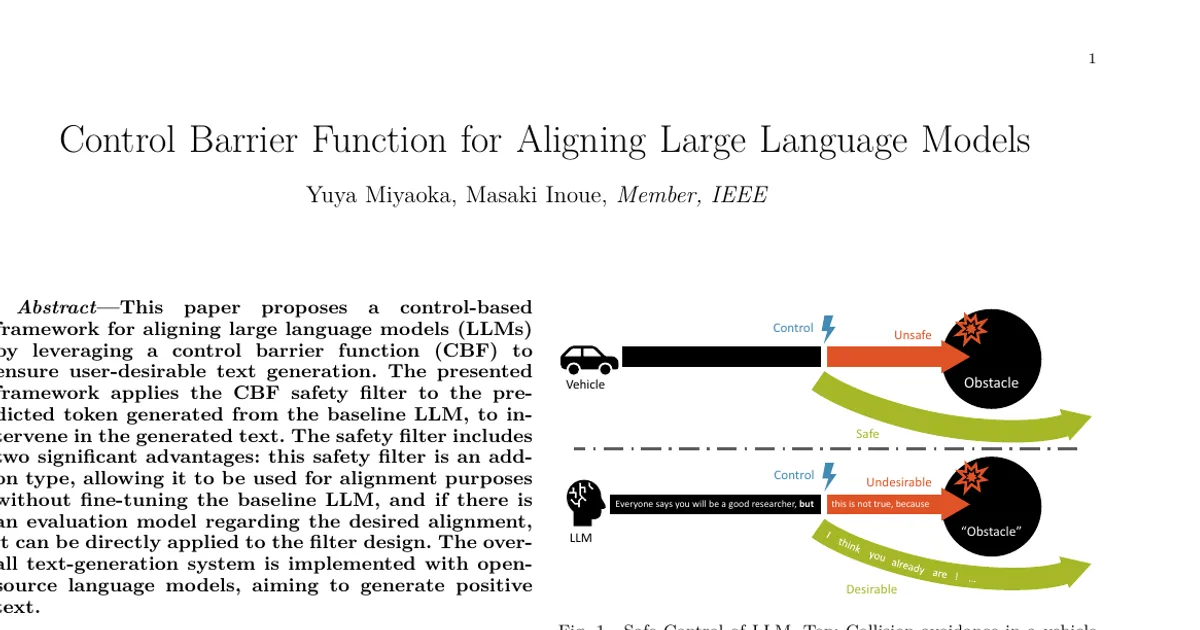
The logic mirrors collision avoidance: rather than just checking whether a candidate output is currently bad, the filter checks how much adding that token would degrade the score, blocking tokens that "give the conversation a dubious tone" even if they are not immediately undesirable.
A multi-step-ahead variant addresses the over-conservatism of single-step filtering — the problem that a phrase may look bad initially but read well in full (the paper's example: "You are clumsy, but you have high aspirations!"). Instead of one token at a time, it samples H-token continuations, keeps those satisfying the constraint, and samples among them by their joint probability under the baseline model.
For evaluation, the researchers used Llama 3 8b as the token predictor, a RoBERTa sentiment model as the constraint, and initial texts drawn from the reddit-corpus-small dataset. They randomly chose 50 utterance texts meeting three conditions: more than 10 tokens, a positive L-CF value for the first 5 tokens, and a negative L-CF value for the uncontrolled continuation. Only the first 5 tokens were used as the initial text. Temperature was 1, top-K was 30, and the maximum number of new tokens was 30. Quality was scored with G-Eval for naturalness and positiveness, plus counts of disallowed tokens and time per token.
Why This Matters
Impact on research. The paper reframes alignment as a safe-control problem, which opens the possibility of importing decades of CBF theory (robust CBF, multiple CBF, stochastic CBF, RL-integrated CBF) into LLM alignment. It also offers a conceptually different intervention point: rather than intervening based on the reward of generated text, CBF-LLM intervenes based on the change in reward caused by adding a token. The authors emphasize that an existing evaluation model can be plugged directly into the filter design, and that the filter is removable or swappable, unlike parameter updates.
Real-world applications:
- Moderating dialogue systems by blocking toxic or harmful continuations without retraining the underlying model.
- Sentiment or tone control, the demonstrated use case, steering generations toward positive context.
- Layered compliance filters, such as adding an independent readability filter for child-friendly content alongside an existing positivity filter, without retraining the LLM.
- Service continuity during policy changes. If an ethical issue is discovered in data used for alignment, an add-on filter can simply be disabled or modified while the service keeps running, whereas RLHF-based methods face harder challenges such as unlearning.
Industry relevance. The add-on nature, the modest ~0.03 seconds per token overhead, and the ability to swap filters as requirements change make this attractive for deployed systems where retraining is expensive, slow, or risky, and where specifications change over time.
Future Directions
-
More objective evaluation. The paper's text-quality assessment relied on another LLM via G-Eval; the authors state future work should prioritize more objective evaluation methodologies that reduce ambiguity.
-
Better language-constraint functions. The key challenge is incorporating human feedback and existing evaluation models into the L-CF to reflect human preferences. The authors note this design problem is similarly challenging to constructing a high-quality reward model in RLHF.
-
Handling mid-text evaluation limitations. The RoBERTa model was originally trained on whole texts but is applied to partial texts here, which the authors acknowledge may deteriorate accuracy.
-
Managing multi-step computational cost. The multi-step-ahead method guarantees no undesirable text across tested K values but takes longer than the single-step version, raising the question of how to reduce cost while keeping the safety guarantee.
Target Audience
This paper is most valuable to researchers and engineers working on LLM alignment and controlled text generation who are interested in non-parameter-updating, filter-based approaches; to control theorists looking for a novel application domain for CBF; and to practitioners who need a removable, swappable safety layer in a deployed language system. Readers without background in either control theory or token-level LLM mechanics will need to work through the preliminaries sections.
Authors’ abstract
This paper proposes a control-based framework for aligning large language models (LLMs) by leveraging a control barrier function (CBF) to ensure user-desirable text generation. The presented framework applies the CBF safety filter to the predicted token generated from the baseline LLM, to intervene in the generated text. The safety filter includes two significant advantages: this safety filter is an add-on type, allowing it to be used for alignment purposes without fine-tuning the baseline LLM, and if there is an evaluation model regarding the desired alignment, it can be directly applied to the filter design. The overall text-generation system is implemented with open-source language models, aiming to generate positive text.