Research
Continuum Dropout for Neural Differential Equations
Overview Research area: Regularization and uncertainty quantification for Neural Differential Equations (NDEs) — spanning Neural ODEs, Neural CDEs, and Neural SDEs — evaluated on time series classific
- arXiv
- 2511.10446
- Published
- 2025-11-13
- Authors
- Jonghun Lee, YongKyung Oh, Sungil Kim, Dong-Young Lim
AI summary
Overview
- Research area: Regularization and uncertainty quantification for Neural Differential Equations (NDEs) — spanning Neural ODEs, Neural CDEs, and Neural SDEs — evaluated on time series classification, clinical time series (PhysioNet Sepsis), and image classification. Posted under stat.ML (arXiv:2511.10446v2, 18 Nov 2025).
- Technical level: Intermediate. The paper assumes familiarity with neural ODEs, ResNets, dropout, and basic stochastic-process concepts (renewal theory, exponential distributions, Monte Carlo sampling), but it builds its central idea from a single intuitive analogy: dropout as a system that switches between "on" and "off" in continuous time.
- Scope: The paper introduces Continuum Dropout, a single regularization framework defined through alternating renewal processes, and empirically tests it against existing NDE regularization methods and across several NDE architectures.
What This Paper Is About
Dropout is the workhorse regularizer for ordinary neural networks, but NDEs cannot use it in the usual way: a neuron in a discrete network is a countable entity, whereas a latent variable in an NDE is the value of a continuous-time process at every moment, so there is no obvious set of units to switch off per training iteration. Existing workarounds (naïve dropout on the drift function, or a jump-diffusion formulation) are either ad-hoc or limited to specific NDE architectures.
The authors' goal is to define dropout for NDEs as a faithful continuous-time analogue of dropout in a ResNet — a process whose components randomly pause and resume over random time intervals — and to show that this construction both regularizes and provides a principled route to predictive uncertainty.
Key Contributions
- A continuous-time dropout formulation. The authors model the on-off mechanism of dropout as an alternating renewal process, where each component of the latent state alternates between an active (evolving) and inactive (paused) state, and the active/inactive durations are i.i.d. exponential random variables with rates λ₁ and λ₂. This yields a modified NDE, d𝐳(t)/dt = 𝐈_{λ₁,λ₂}(t) ∘ γ(t, 𝐳(t); θ_γ), with 𝐳(0) = 𝐳₀(0).
- A continuous-time definition of the dropout rate. The dropout rate is defined as p = 1 − A(T), where A(T) is the probability that a component of the latent process is in the active state at the terminal time T — known in renewal theory as instantaneous availability. Theorem 3.1 gives the closed form p = λ₁/(λ₁+λ₂) · (1 − e^{−(λ₁+λ₂)T}), and Corollary 3.2 supplies a second equation involving the expected number of renewals m on [0, T], so that a user-specified pair (p, m) uniquely determines (λ₁, λ₂). For large T, λ₁ ≈ m/((1−p)T) and λ₂ ≈ m/(pT).
- Uncertainty quantification via Monte Carlo sampling. Because Continuum Dropout makes the latent dynamics stochastic, the mechanism can be retained at test time. Multiple stochastic forward passes produce an empirical distribution over trajectories; the predictive mean is used as the point estimate and the sample covariance as the uncertainty proxy, in the spirit of Monte Carlo Dropout.
- A methodological comparison against prior NDE regularizers. A comparison table positions Continuum Dropout against naïve dropout, jump diffusion, STEER, and TA-BN. The paper argues the jump-diffusion approach is not a faithful continuous analogue (its discretization does not recover the ResNet-with-dropout update in the paper's Equation 3), is sensitive to the dropout rate (improving performance only for p < 0.1), and is limited to specific NDE structures, whereas Continuum Dropout is claimed to be architecturally general.
Main Findings
- Continuum Dropout beats existing NDE regularizers on time series classification. On SmoothSubspace, ArticularyWordRecognition, ERing, and RacketSports, Continuum Dropout reaches 0.629 (0.022), 0.884 (0.012), 0.881 (0.023), and 0.619 (0.033), compared with a Neural ODE baseline of 0.569 (0.040), 0.859 (0.005), 0.839 (0.018), and 0.565 (0.065), and higher than Naïve Dropout, Jump Diffusion, Jump Diffusion + TTN, STEER, and TA-BN on every listed dataset.
- The same advantage holds on image classification. On CIFAR-100 (top-5 accuracy), CIFAR-10, STL-10, and SVHN (top-1 for the latter three), Continuum Dropout scores 0.762 (0.002), 0.765 (0.007), 0.719 (0.005), and 0.925 (0.004), versus the Neural ODE baseline of 0.745 (0.012), 0.739 (0.008), 0.707 (0.007), and 0.913 (0.004), again exceeding Naïve Dropout, Jump Diffusion, Jump Diffusion + TTN, STEER, and TA-BN on each dataset.
- Improvements generalize across NDE architectures. On Speech Commands, applying Continuum Dropout raises Neural CDE from 0.910 (0.005) to 0.940 (0.001), ANCDE from 0.760 (0.003) to 0.794 (0.003), Neural LSDE from 0.927 (0.004) to 0.932 (0.000), Neural LNSDE from 0.923 (0.001) to 0.932 (0.001), and Neural GSDE from 0.913 (0.001) to 0.927 (0.001). GRU-ODE and ODE-RNN were excluded from this task because they failed in training.
- Gains on clinical time series under both observation regimes. On PhysioNet Sepsis AUROC, Continuum Dropout improves every listed model under both "OI" and "No OI" settings: GRU-ODE 0.852 (0.010) → 0.875 (0.006) and 0.771 (0.024) → 0.808 (0.010); ODE-RNN 0.874 (0.016) → 0.893 (0.004) and 0.833 (0.020) → 0.851 (0.013); Neural CDE 0.909 (0.006) → 0.918 (0.001) and 0.841 (0.007) → 0.860 (0.003); ANCDE 0.900 (0.002) → 0.910 (0.001) and 0.823 (0.003) → 0.840 (0.005); Neural LSDE 0.909 (0.004) → 0.927 (0.002) and 0.879 (0.008) → 0.892 (0.003); Neural LNSDE 0.911 (0.002) → 0.930 (0.001) and 0.881 (0.002) → 0.891 (0.003); Neural GSDE 0.909 (0.001) → 0.929 (0.003) and 0.884 (0.002) → 0.890 (0.002).
- State-of-the-art NDEs improve further. The authors highlight that Neural LSDE, Neural LNSDE, and Neural GSDE — which they describe as state-of-the-art for the time series classification tasks considered — all gain from Continuum Dropout.
- Sparse Monte Carlo sampling suffices. Accuracy stabilizes once the number of Monte Carlo samples exceeds 5, and the paper states that N_MC ≥ 5 simulations are enough for stable performance.
- Test-time overhead stays modest. Computation time per epoch on Speech Commands rises from 25.6 (0.3) to 27.1 (0.3) seconds for Neural CDE, 53.3 (0.2) to 58.9 (0.3) for ANCDE, 19.4 (0.1) to 21.6 (0.2) for Neural LSDE, 19.5 (0.1) to 21.7 (0.2) for Neural LNSDE, and 19.8 (0.1) to 22.5 (0.2) for Neural GSDE, since Monte Carlo simulations occur only at test time on a trained model.
- Better calibration. Reliability diagrams for CIFAR-100 and Speech Commands show that curves for models with Continuum Dropout track the diagonal more closely than their deterministic counterparts, indicating less overconfident — and more trustworthy — probability estimates. The authors explicitly frame this as a byproduct rather than a claim of state-of-the-art performance against specialized Bayesian UQ methods.
- Robustness to the extra hyperparameter. Continuum Dropout introduces two hyperparameters (p and m) rather than one, but the paper reports that performance is not highly sensitive to the choice of m. The experiments searched p ∈ [0.1, 0.2, 0.3, 0.4, 0.5] and m ∈ [5, 10, 50, 100], using five Monte Carlo samples at test time.
Methodology in Plain English
The authors start from a textbook observation: a ResNet layer update, 𝐙(k+1) = 𝐙(k) + γ(𝐙(k); θ_k), is the discrete cousin of a neural ODE, d𝐳₀(t)/dt = γ(t, 𝐳₀(t); θ_γ). Dropout in the ResNet inserts a Bernoulli mask: 𝐙(k+1) = 𝐙(k) + 𝐈_k ∘ γ(𝐙(k); θ_k), where each component is switched off with probability p.
To lift that mask into continuous time, the authors replace the per-layer Bernoulli draw with a process that switches between "evolving" and "paused" states over random durations. The natural mathematical object for such switching is an alternating renewal process, which is why they adopt exponentially distributed active and inactive periods: the memoryless property means the chance of switching does not depend on how much time has already elapsed, mirroring how discrete dropout is applied independently at each layer.
This gives an indicator function 𝐈(t) that multiplies the drift term; when a component is active, the latent trajectory follows the original NDE, and when it is inactive, that component freezes at its last value. Because ordinary dropout has a single knob (p), the authors need a definition of dropout rate that makes sense in continuous time. They define it as the probability that a component is inactive at the terminal time T, which yields Theorem 3.1's formula. Since many rate pairs (λ₁, λ₂) give the same p, they add a second user-specified quantity m — the expected number of on/off renewals during [0, T] — and solve a two-equation system for the rates.
Training then follows the standard NDE pipeline (encode the input, solve the ODE with the stochastic mask applied to the drift, decode with an MLP, compute the loss, backpropagate). At test time, they run several stochastic forward passes, average the resulting terminal latent states for the prediction, and take the sample covariance as the uncertainty estimate. Baseline comparisons cover naïve dropout on the drift network and on the MLP classifier, the jump-diffusion approach, STEER, and TA-BN, with significance assessed by two-sample t-tests (p < 0.05 marked with one asterisk, p < 0.01 with two).
Why This Matters
Impact on research. NDEs are powerful for irregularly sampled, missing, or noisy data, but they overfit readily on limited data or complex architectures, and until now they lacked a principled, architecture-agnostic dropout mechanism. Continuum Dropout supplies both a theory-grounded regularizer and a free uncertainty-quantification channel, and the paper's comparison table positions it as the only listed method that is simultaneously tailored for NDEs, a discrete analogue of standard dropout, capable of quantifying uncertainty, and architecturally general.
Real-world applications.
- Clinical time series: the PhysioNet Sepsis experiments target mortality prediction from irregular, incomplete patient records, where calibrated risk estimates matter as much as raw accuracy.
- Human activity and sensor streams: UEA-style time series benchmarks here include SmoothSubspace, ArticularyWordRecognition, ERing, and RacketSports, mirroring wearable and motion-sensing settings.
- Speech and audio: the Speech Commands benchmark reflects wake-word and command-recognition pipelines.
- Vision with continuous-depth models: CIFAR-100, CIFAR-10, STL-10, and SVHN results speak to image classifiers built on Neural ODEs and Neural SDEs.
- The introduction also cites physics (Greydanus et al. 2019) and finance (Yang et al. 2023) as domains where NDEs are used.
Industry relevance. The method is a drop-in change to the drift term rather than a new architecture, applies to Neural ODEs, Neural CDEs, and Neural SDEs alike, adds only a small per-epoch cost, and requires as few as five Monte Carlo passes at inference. That combination — no architectural redesign, modest compute, usable uncertainty estimates — is what makes it a plausible production technique rather than a purely theoretical contribution. Code is released at https://github.com/jonghun-lee0/Continuum-Dropout.
Future Directions
- Extending beyond exponential holding times. The paper deliberately restricts attention to exponential alternating renewal processes because of the memoryless property; whether other active/inactive duration distributions improve performance is left open.
- Reducing hyperparameter dependence. Continuum Dropout replaces dropout's single hyperparameter with the pair (p, m). The reported insensitivity to m mitigates this, but a principled default or automatic tuning scheme for m is not established.
- Closing the gap with dedicated UQ methods. The authors explicitly decline to claim state-of-the-art uncertainty quantification and position calibration as a byproduct; comparing against specialized Bayesian approaches for NDEs is a natural next step.
- Broadening the architecture and task coverage. The experiments cover time series classification, PhysioNet Sepsis, and image classification; regression tasks, generative Neural ODE models, and other NDE variants are not tested in the reported results.
Target Audience
Researchers and practitioners working with neural differential equations — neural ODEs, neural CDEs, and neural SDEs — who need to regularize models trained on limited, irregularly sampled, or noisy data, and who also want usable predictive uncertainty without adopting a full Bayesian treatment. The paper is also relevant to applied machine learning engineers in healthcare, sensing, and audio who care about calibrated confidence alongside accuracy, and to methodologists interested in how discrete deep learning constructs (dropout, Monte Carlo dropout) can be transplanted into continuous-time models. Readers without prior exposure to neural ODEs or renewal theory will want to start with the paper's preliminaries and the appendix overview of alternating renewal processes.
Authors’ abstract
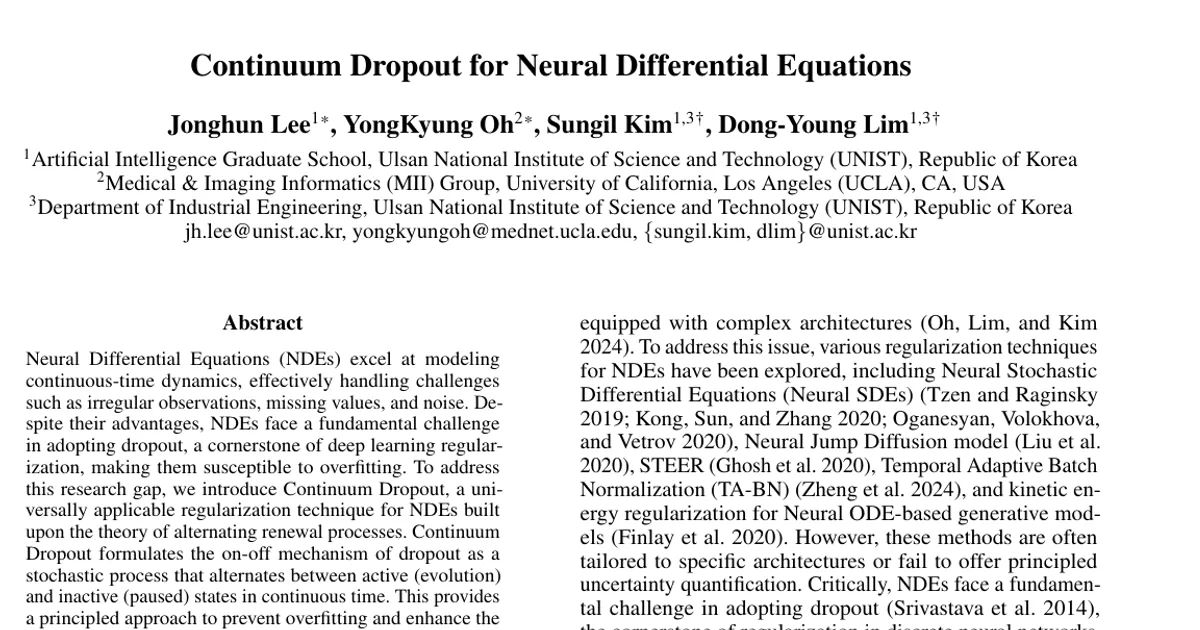
Neural Differential Equations (NDEs) excel at modeling continuous-time dynamics, effectively handling challenges such as irregular observations, missing values, and noise. Despite their advantages, NDEs face a fundamental challenge in adopting dropout, a cornerstone of deep learning regularization, making them susceptible to overfitting. To address this research gap, we introduce Continuum Dropout, a universally applicable regularization technique for NDEs built upon the theory of alternating renewal processes. Continuum Dropout formulates the on-off mechanism of dropout as a stochastic process that alternates between active (evolution) and inactive (paused) states in continuous time. This provides a principled approach to prevent overfitting and enhance the generalization capabilities of NDEs. Moreover, Continuum Dropout offers a structured framework to quantify predictive uncertainty via Monte Carlo sampling at test time. Through extensive experiments, we demonstrate that Continuum Dropout outperforms existing regularization methods for NDEs, achieving superior performance on various time series and image classification tasks. It also yields better-calibrated and more trustworthy probability estimates, highlighting its effectiveness for uncertainty-aware modeling.