Research
Continuum Attention
Overview Research area: Machine learning, specifically Transformer attention mechanisms and language modeling architecture. Technical level: Advanced. The paper is built on integral calculus, exponent
- arXiv
- 2610.20586
- Published
- 2026-10-14
- Authors
- Afshin Khadangi
AI summary
Overview
Research area: Machine learning, specifically Transformer attention mechanisms and language modeling architecture.
Technical level: Advanced. The paper is built on integral calculus, exponential moments, and analytical differentiation; the derivations are heavy even though the empirical setup is small-scale.
Scope: The paper introduces Continuum Attention (CA), a causal attention operator that integrates over a continuous piecewise linear memory curve instead of summing over discrete key-value pairs, and evaluates it against softmax attention in byte-level language modeling on TinyStories with roughly five-million-parameter models.
What This Paper Is About
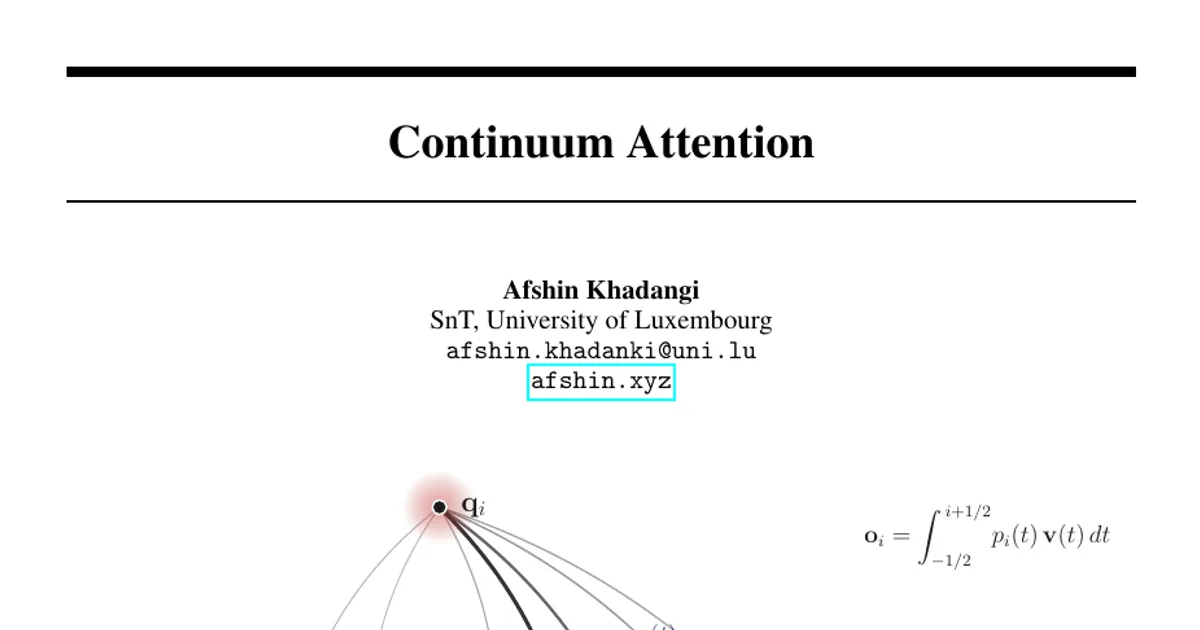
Standard Transformer attention treats memory as a finite set of discrete key and value vectors: each query assigns a weight to each stored token and aggregates the corresponding value. This paper asks what happens if adjacent keys and values are instead connected into a continuous trajectory, and each query induces a continuous exponential "relevance density" along that trajectory. The goal is an attention operator whose retrieval positions are chosen adaptively by the query, whose integrals can be computed in closed form, and which can be dropped into a standard causal Transformer decoder without changing the surrounding architecture.
Key Contributions
-
An exact formulation of causal attention over interpolated memory trajectories. Adjacent key and value vectors are connected by piecewise linear interpolation into continuous functions k(t) and v(t), and the attention output is a normalized integral of the value curve against an exponential relevance density, including constant half-token extensions at both ends of the visible memory domain.
-
Closed-form segment integration via exponential moments. Moment functions J_0, J_1 and J_2 of the endpoint score difference give exact expressions for each segment's probability mass and value contribution, with series expansions used near zero score difference for numerical stability.
-
Analytical forward and backward expressions with a query-adaptive retrieval geometry. Each segment contributes both a mass M_ij (how strongly the interval contributes) and an effective retrieval position μ(Δ_ij) (where inside the interval information is drawn from). Gradients with respect to scores, values, queries, keys and the learned gain all follow from exponential moments of order at most two.
-
Controlled empirical comparison against softmax attention. A six-layer, roughly five-million-parameter byte-level model on TinyStories, five training seeds, two context lengths (192 and 512 tokens), matched parameter counts and training budgets, with paired confidence intervals and a Metal implementation validated against a double-precision CPU reference.
Main Findings
-
Lower validation NLL than matched softmax at both context lengths. With a fixed temperature of 0.30, CA variant P improves over the softmax baseline B_0.30 by 0.020016 nats per byte at T=192 and 0.048045 nats per byte at T=512, corresponding to relative NLL reductions of approximately 1.94% and 4.09%. The paired 95% confidence intervals are [0.013779, 0.026253] and [0.033504, 0.062587], and CA wins 5/5 paired seeds at each length.
-
Temperature adjustment matters more than the operator choice in some comparisons. CA variant S (learned gain initialized at effective temperature 1) beats the correspondingly initialized softmax control F, but fixed-temperature softmax B_0.30 achieves lower NLL than S at both context lengths. The paper reports mean development NLL of 1.009888 (P) and 1.029903 (B_0.30) at T=192, and 1.126540 (P) and 1.174585 (B_0.30) at T=512.
-
Learned gain does not clearly help CA. CA variant H improves over softmax variant G by 0.012389 nats per byte at T=192 (interval [-0.004571, 0.029349], which includes zero) and 0.072698 at T=512 (interval [0.030012, 0.115383]). Directly comparing the two CA variants, fixed-temperature P outperforms learned-gain H by 0.003820 at T=192 (interval [-0.003918, 0.011558]) and 0.001149 at T=512 (interval [-0.014050, 0.016348]) — neither establishes a clear advantage for learning the gain.
-
Consistent advantage on a disjoint validation slice at 512 tokens. On a separate 4-million-byte portion of the TinyStories validation stream, fixed-temperature CA improves over the development-selected softmax B_0.30 by 0.045741 nats per byte at T=512, interval [0.031634, 0.059848], winning all five seeds; learned-gain CA H improves by 0.046990, interval [0.024375, 0.069606], also winning five of five. At T=192 the improvement of P is 0.016368, interval [-0.000134, 0.032870], with five of five seeds favoring CA but the interval including zero. The paper labels these results exploratory because the validation slice had been examined before the H and P ablations were introduced.
-
Comparable speed at short context, a clear slowdown at long context. On Apple Silicon with PyTorch 2.8 and Metal, at T=192 CA P reaches 40,715 training tokens/second versus 40,547 for softmax B_0.30, and 131,599 versus 153,136 forward tokens/second. At T=512, CA P is approximately 7.3% slower in training throughput and 39.1% slower in forward throughput than the matched softmax control.
-
Numerical agreement with an independent reference. Before training, the Metal kernels were checked against a double-precision CPU reference; the recorded maximum absolute deviation for the analytical score gradients across preflight checks is below 6 × 10⁻⁷.
-
Complexity is unchanged in scaling terms. The operator keeps quadratic sequence complexity, requiring O(T² d_h) operations per head and O(T²) attention storage if the attention matrix is materialized.
Methodology in Plain English
Instead of treating the stored keys and values as separate points, the method draws a straight line between each consecutive pair of key vectors and between each consecutive pair of value vectors. Because each small segment of the key line is linear, the query-key score along it is a simple straight ramp from one endpoint score to the other. Exponentiating that ramp gives a density whose integral over the segment has a closed-form answer built from three standard "exponential moment" functions, J_0, J_1 and J_2.
Those moments do two jobs. They say how much total weight the segment receives, and they say where inside the segment the query effectively looks — a position μ(Δ) that slides toward whichever endpoint has the higher score, and sits at the midpoint when the two scores are equal. Half-width constant extensions at the beginning and end of the visible sequence keep the token weighting convention consistent and make the operator reduce to uniform causal attention when all scores are equal.
Because everything is expressed with finite algebraic formulas, the whole attention operator can be parallelized on a GPU, and backpropagation needs only the same moments rather than extra adaptive quadrature. The researchers then trained a small byte-level language model on TinyStories — six Transformer blocks, model width 256, four heads with head dimension 64, RMS normalization, SwiGLU feedforward with hidden dimension 720, learned absolute positional embeddings — at context lengths 192 and 512, using roughly 3,840,000 training tokens at each length, five seeds, and comparing eight attention configurations. Development validation used 128 sampled batches with evaluation seed 9090; the extra evaluation used 256 batches with seed 121212. In total the study reports 80 completed training runs.
Why This Matters
Impact on research. The paper is a concrete instance of an idea that has been discussed mathematically — attention as integration over a continuous domain — but rarely carried all the way through to an exact forward pass, exact gradients, a GPU kernel, and controlled training experiments. It shows that continuous memory retrieval can be made numerically stable and competitive in a small-scale setting, and it argues that attention temperature must be controlled carefully before attributing gains to a new attention operator, since a poorly temperature-matched comparison can reverse the apparent ranking.
Real-world applications.
- Long-context language modeling, where retrieving interpolated information between adjacent stored states may be more useful than snapping to discrete token positions.
- Edge and on-device inference, given the paper's use of Metal kernels on Apple Silicon and the operator's unchanged quadratic scaling with sequence length.
- Any sequence-modeling task dominated by short contexts — the paper's own throughput numbers show parity with softmax at T=192 — such as lightweight autocomplete, transcription post-processing, or embedded text interfaces.
- As a drop-in architectural component in existing Transformer decoders, since residual connections, normalization, feedforward layers, positional embeddings, and the language modeling objective are all retained.
Industry relevance. The result is a single-table, small-model study, not a scaling result; the paper explicitly leaves larger-scale generalization open. Its practical value at present is as evidence that a continuous-attention alternative is implementable and numerically well-behaved, plus a clear accounting of where the current kernel loses time — the forward pass at longer context, where the CA implementation is 39.1% slower than softmax at T=512.
Future Directions
- Scaling to larger models and datasets. The authors state that larger-scale generalization is left open, and that further evaluation at larger model sizes and on additional datasets is needed.
- Closing the forward-pass performance gap. The paper identifies the 39.1% forward throughput deficit at T=512 as an important optimization target and notes that tiled implementations could accumulate segment contributions without materializing the full attention matrix.
- Isolating the effect of the interpolation geometry. The authors suggest further comparisons with alternative continuous attention parameterizations to determine how much of the benefit comes from this particular piecewise linear construction.
- Extending to other memory representations. The paper notes that comparisons with alternative formulations of continuous attention would help separate the influence of the memory geometry from the influence of the exponential moment machinery.
Target Audience
This paper is aimed at machine learning researchers working on attention mechanisms and Transformer architecture, particularly those interested in continuous or integral formulations of attention and in the numerical implementation of such operators on accelerators. It will also interest practitioners who need a careful example of how attention temperature and matched parameter counts can confound comparisons between attention variants. It is not beginner-friendly reading: the method section depends on exponential moment identities and analytical differentiation, and the empirical section is a small-scale study whose exploratory results are explicitly labeled as such.
Authors’ abstract
We introduce Continuum Attention (CA), a causal Transformer attention operator that replaces discrete key and value lookup with integration over a continuous, piecewise linear memory curve. Each query induces an exponential relevance density along the curve. Integrating the density and interpolated values yields exact normalized attention from closed form exponential moments, including half token boundary contributions. The gradients follow analytically from moments of order at most two, enabling parallel GPU implementations while retaining quadratic sequence complexity and the standard Transformer decoder. Compared with ordinary softmax and focal attention, CA reduces mean validation negative log likelihood by 0.0200 and 0.0480 nats per byte, respectively, winning all paired comparisons. An additional disjoint validation slice yields a 0.0457 nats per byte advantage over the strongest selected softmax baseline, with a paired 95% confidence interval. These findings motivate continuous integration as a promising attention alternative while leaving larger scale generalization open.