Research
Continuous Degradation Modeling via Latent Flow Matching for Real-World Super-Resolution
Overview Research area: Computer vision — real-world single-image super-resolution (SR) and generative degradation modeling. Technical level: Intermediate. The paper assumes familiarity with super-res
- arXiv
- 2602.04193
- Published
- 2026-02-04
- Authors
- Hyeonjae Kim, Dongjin Kim, Eugene Jin, Tae Hyun Kim
AI summary
Overview
Research area: Computer vision — real-world single-image super-resolution (SR) and generative degradation modeling.
Technical level: Intermediate. The paper assumes familiarity with super-resolution architectures, latent generative models, and ordinary differential equations (ODEs), though its core idea can be understood without deriving the flow-matching math.
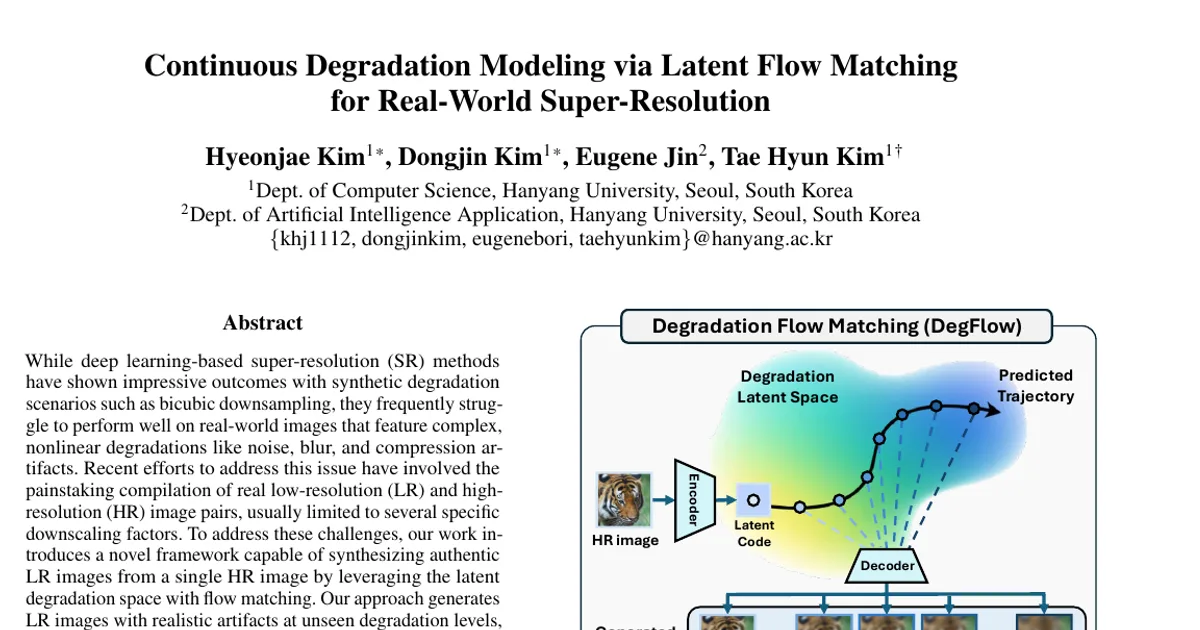
Scope: The paper introduces DegFlow, a two-stage framework (Residual Autoencoder + Latent Flow Matching) that learns a continuous latent degradation trajectory from discrete real-world HR–LR image pairs and synthesizes realistic low-resolution images at arbitrary, unseen scale factors using only a high-resolution input.
What This Paper Is About
Super-resolution models trained on synthetic degradations like bicubic downsampling fail on real photographs, where blur, noise, and compression artifacts combine in complex, nonlinear ways. Collecting real LR–HR pairs with DSLR cameras is expensive and only yields a handful of discrete downscaling factors, while existing learned degradation models either lack explicit scale control or require paired LR images at two scales at inference. DegFlow addresses this by learning a continuous degradation manifold in latent space, so realistic LR images can be generated at any scale from a single HR image.
Key Contributions
-
DegFlow, a continuous latent degradation model. A framework that learns degradation trajectories directly in a learned latent space from a small, discrete set of real HR–LR pairs (e.g., ×2 and ×4) and synthesizes realistic LR images at unseen continuous scales (e.g., ×2.55, ×3.78) at inference time.
-
A natural cubic spline degradation trajectory. Instead of piecewise linear interpolation in latent space, the deterministic mean path is a natural cubic spline with continuous first and second derivatives, which better captures the nonlinear latent geometry and satisfies the smoothness required by the ODE formulation of flow matching.
-
Perceptual supervision without ground truth at the target scale. A third-order Taylor expansion extrapolates the predicted latent at an intermediate timestep to the nearest available training degradation level, allowing an LPIPS loss to be applied even when no ground-truth LR image exists at the exact target scale.
-
Single-input, arbitrary-scale generation. Table 1 contrasts DegFlow with prior methods: unlike Real-ESRGAN and BSRGAN (handcrafted operators) it produces realistic LR; unlike DeFlow and RealDGen it offers arbitrary-scale generation; and unlike InterFlow it requires only an HR image, not paired LR observations at two scales.
Main Findings
-
Continuous degradation is learned successfully. On the RealSR ×3 test set, normalized PSNR and FID peak around timestep t ≈ 0.73 (corresponding to degradation level s ≈ 3.2), and CLIP peaks around t ≈ 0.70 (s ≈ 3.1) — the point where synthesized degradations most closely match real ×3 characteristics.
-
Fixed-scale SR improves over baselines and InterFlow. On the RealSR ×3 test set, training on DegFlow-synthesized data at ×2~×4 gave higher PSNR and SSIM than training on RealSR ×2, ×4 or on InterFlow ×2~×4 data for RCAN, HAN, SwinIR, HAT, and MambaIR. For example, HAT reached 30.86 PSNR / 0.8668 SSIM / 0.3186 LPIPS with DegFlow versus 30.65 / 0.8645 / 0.3135 with InterFlow and 30.39 / 0.8607 / 0.3248 with RealSR ×2, ×4. The ×3 oracle setting for HAT was 30.71 PSNR / 0.8645 SSIM / 0.3221 LPIPS.
-
DegFlow occasionally exceeds the ×3 oracle in PSNR. RCAN (30.72 vs 30.68), HAN (30.82 vs 30.76), SwinIR (30.78 vs 30.69), HAT (30.86 vs 30.71), and MambaIR (30.73 vs 30.62) all scored higher PSNR with DegFlow-synthesized ×2~×4 data than with the ground-truth ×3 training set. InterFlow retained the best LPIPS among the learned methods in Table 2 (e.g., 0.3135 for HAT versus 0.3186 for DegFlow).
-
Arbitrary-scale SR also improves. In Table 3, DegFlow-trained MetaSR, LIIF, and CiaoSR outperformed InterFlow on PSNR and LPIPS across RealSR ×3 and RealArbiSR ×2.5, ×3, and ×3.5. For example, MetaSR reached 30.58 PSNR on RealSR ×3 (InterFlow 30.42, oracle 30.43) and 29.63 on RealArbiSR ×3 (InterFlow 29.40, oracle 29.58). Handcrafted baselines were far behind — Real-ESRGAN gave MetaSR only 26.90 PSNR on RealSR ×3.
-
Ablation confirms each component. Using HAT on the RealSR ×3 test set, the piecewise-linear baseline scored 30.58 PSNR / 0.8640 SSIM / 0.3214 LPIPS; adding the natural cubic spline improved this to 30.68 / 0.8652 / 0.3209; adding the LPIPS third-order Taylor approximation to 30.81 / 0.8662 / 0.3200; and adding the RAE's HR feature skip connections to 30.86 / 0.8668 / 0.3186.
-
External HR data helps. Augmenting training with synthetic LR images generated from DIV2K HR images (scales ×2 to ×4) improved HAT from 30.86 PSNR / 0.8668 SSIM / 0.3186 LPIPS to 31.00 / 0.8673 / 0.3180 on RealSR ×3. The paper notes this is possible only because DegFlow needs only HR images, unlike InterFlow.
Methodology in Plain English
DegFlow is trained in two sequential stages.
Stage 1 — Residual Autoencoder (RAE). An encoder compresses an image into a compact latent code using a spatial compression factor r, and a decoder reconstructs it. Because heavy compression discards high-frequency detail, multi-scale skip connections carry hidden features from the HR image into the decoder. Both HR and LR images are embedded, but only HR features are injected through the skips. This is deliberate: the latent ends up encoding the residual, degradation-specific information that differs between LR and HR. The RAE is trained with an ℒ2 reconstruction loss (Equation 8) for 200k iterations using Adam, a cosine-annealed learning rate from 1×10⁻⁴ to 1×10⁻⁷, and batches of 16 randomly cropped 256×256 patches with horizontal and vertical flips.
Stage 2 — Latent Flow Matching (LFM). With the RAE frozen, HR and LR images are embedded as latent points, and each degradation level s is min-max normalized into a timestamp t in [0, 1]. For the scale set {1, 2, 4}, this gives t₁ = 0, t₂ = 1/3, and t₄ = 1. A natural cubic spline interpolates these sparse latent points across time, and a flow-matching network learns the velocity field (the spline's first derivative) using the conditional flow matching loss. The LFM is trained for 400k iterations with Adam, a cosine-annealed learning rate from 2×10⁻⁴ to 1×10⁻⁷, and batches of 32 randomly cropped 256×256 patches.
Perceptual loss. At an intermediate timestep between two known degradation levels, the predicted latent is extrapolated forward to the next level using a third-order Taylor expansion, decoded, and compared against the available ground-truth LR image with an LPIPS loss. The total objective is ℒ_CFM + λ·ℒ_LPIPS with λ = 0.1.
Training and evaluation setup. DegFlow is trained on RealSR-V2 at degradation levels ×1, ×2, and ×4, using the Canon-train split and generating LR images from Nikon-train HR images to test robustness. SR performance is evaluated on RealSR and RealArbiSR. Fixed-scale models (RCAN, HAN, SwinIR, HAT, MambaIR) are trained with an ℒ1 loss and Adam at an initial learning rate of 1×10⁻⁴ halved at 50%, 75%, and 87.5% of 300k iterations, using 16 randomly cropped 128×128 patches, with pixel-unshuffle applied to LR inputs. Arbitrary-scale models (MetaSR, LIIF, CiaoSR) follow InterFlow's training settings, with bicubic downsampling by factor s applied to the synthesized LR images.
Inference. Given one HR image, the encoder embeds it, the flow-matching network evolves the latent over continuous timesteps, and the decoder maps latents at any timestep back to image space — yielding LR outputs at degradation levels never seen during training.
Why This Matters
Impact on research. The work reframes real-world degradation modeling as a continuous latent trajectory problem rather than a collection of discrete downscaling operators. It shows that scale-continuous synthetic data can substitute for — and in PSNR terms, sometimes surpass — oracle ground-truth pairs at the target scale, which is a strong argument for learned degradation models over handcrafted pipelines. It also removes InterFlow's requirement for paired LR observations at two scales, a constraint the paper describes as potentially inapplicable in real-world scenarios.
Real-world applications:
- Smartphone and camera photo enhancement, where zoom levels are continuous and degraded captures rarely come with matching high-resolution ground-truth pairs.
- Archival and historical photo restoration, where only degraded scans exist and no clean reference is available for supervised training.
- Medical or satellite imaging pipelines, where sensor noise, blur, and compression vary continuously with acquisition conditions.
- Surveillance and consumer video upscaling, where the same degradation model must handle many effective scales without retraining per scale factor.
Industry relevance. Generating large-scale, realistic SR training datasets from HR images alone lowers the cost of building SR systems, since DSLR-based paired-data collection is described as costly and labor-intensive. The released code at https://github.com/present091/DegFlow makes the approach directly testable in production pipelines.
Future Directions
- Scaling and generalizing the training data. The ablation shows DIV2K augmentation helps; it is not reported how far this scaling can go, or whether other external HR corpora would yield similar gains.
- Reducing the residual gap in perceptual metrics. InterFlow still achieved lower LPIPS than DegFlow in several fixed-scale settings, so closing this perceptual gap while retaining the PSNR/SSIM advantage remains open.
- Extending beyond the trained scale range. DegFlow is trained on ×1, ×2, and ×4 and evaluated on ×2.5, ×3, and ×3.5; it is not reported how the trajectory behaves far outside this range or at extreme degradation levels.
- Validating on more diverse real-world benchmarks. Evaluation is limited to RealSR and RealArbiSR, both captured with DSLR equipment; generalization to other sensors, domains, and unpaired settings is untested in the reported results.
Target Audience
Researchers and engineers working on super-resolution, image restoration, and generative modeling — particularly those interested in flow matching or in producing training data when paired LR–HR captures are unavailable. It will also interest practitioners building arbitrary-scale or continuous-zoom SR systems, and readers tracking the shift from handcrafted degradation pipelines (BSRGAN, Real-ESRGAN) toward learned, controllable degradation models.
Authors’ abstract
While deep learning-based super-resolution (SR) methods have shown impressive outcomes with synthetic degradation scenarios such as bicubic downsampling, they frequently struggle to perform well on real-world images that feature complex, nonlinear degradations like noise, blur, and compression artifacts. Recent efforts to address this issue have involved the painstaking compilation of real low-resolution (LR) and high-resolution (HR) image pairs, usually limited to several specific downscaling factors. To address these challenges, our work introduces a novel framework capable of synthesizing authentic LR images from a single HR image by leveraging the latent degradation space with flow matching. Our approach generates LR images with realistic artifacts at unseen degradation levels, which facilitates the creation of large-scale, real-world SR training datasets. Comprehensive quantitative and qualitative assessments verify that our synthetic LR images accurately replicate real-world degradations. Furthermore, both traditional and arbitrary-scale SR models trained using our datasets consistently yield much better HR outcomes.