Research
Context-Enriched Contrastive Loss: Enhancing Presentation of Inherent Sample Connections in Contrastive Learning Framework
Overview Research area: Contrastive learning / self-supervised representation learning in computer vision, specifically the design of contrastive loss functions. Technical level: Intermediate. The con
- arXiv
- 2512.02152
- Published
- 2025-12-01
- Authors
- Haojin Deng, Yimin Yang
AI summary
Overview
Research area: Contrastive learning / self-supervised representation learning in computer vision, specifically the design of contrastive loss functions.
Technical level: Intermediate. The conceptual framing (four types of sample pairs in latent space) is accessible, but the paper includes a formal upper-bound analysis with LogSumExp arguments and gradient derivations that assume familiarity with contrastive learning math.
Scope: The paper proposes a single new loss function, called ConTeX (Context-Enriched Contrastive Loss), that combines a label-aware contrastive term with a self-supervised-style term, and evaluates it on image classification, transfer learning, and bias-mitigation benchmarks.
What This Paper Is About
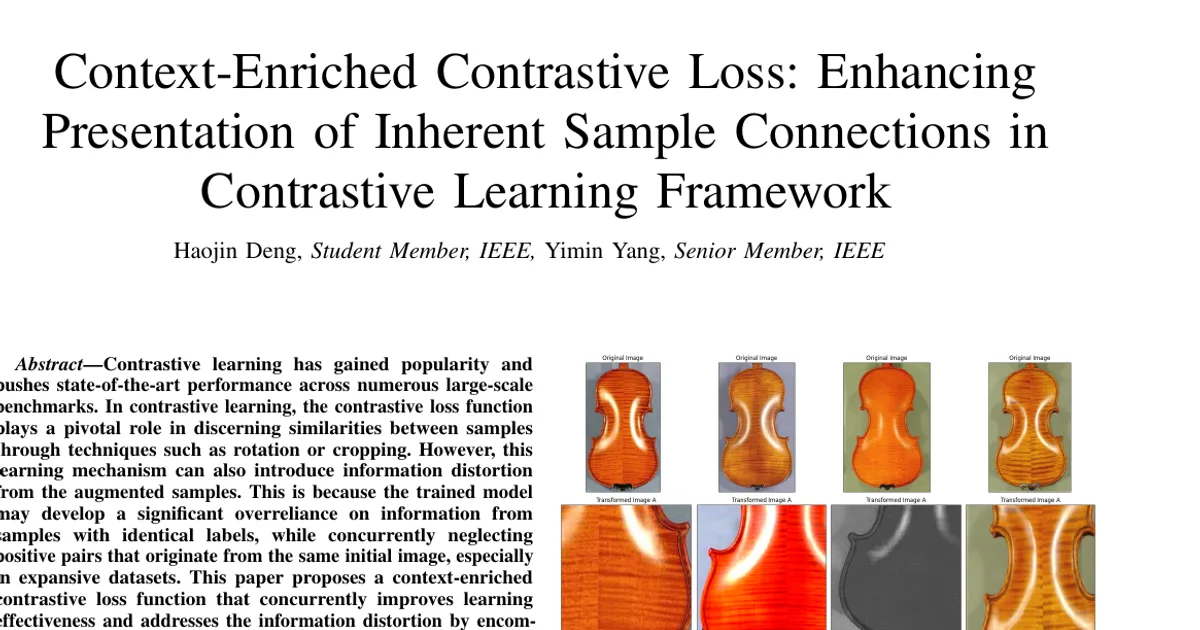
Standard supervised contrastive learning (SupCon) treats every same-label sample as a positive and everything else as a negative. This is slow to converge and can let a model latch onto label-correlated shortcuts — such as texture or background — instead of learning the features that actually define a class. The authors propose ConTeX, a loss with two parts: one that contrasts same-label against different-label samples, and one that pulls together the two augmentations of the same original image while pushing away everything else, so that the self-positive pair remains the closest point in the batch.
Key Contributions
- A two-part context-enriched loss. ConTeX splits the objective into a label-sensitive term (Eq. 6) and a self-supervised-style term (Eq. 7), combined with a weight parameter λ (Eq. 8). The first term deliberately excludes context positives from the denominator, so that same-label and different-label similarities are contrasted directly; the second term treats the anchor's paired augmentation as the only positive.
- An upper-bound analysis. The authors prove a lemma stating that at least two positive pairs correspond to one representation in a mini-batch once the batch size n exceeds the number of label classes m, and then show this gives ConTeX a lower upper bound than NT-Xent when more than one positive pair exists in the batch.
- A gradient comparison against SupCon. The gradient derivation (Eq. 27 vs. Eq. 28) is used to argue that ConTeX adds self-positive and self-negative interactions on top of SupCon's context-based ones, producing a larger class margin; the combined gradient is shown with λ = 0.5.
- Evaluation on eight benchmark datasets. CIFAR10, CIFAR100, Caltech-101, Caltech-256, ImageNet, BiasedMNIST, UTKFace, and CelebA, positioned against 16 state-of-the-art contrastive learning methods by the abstract's count.
Main Findings
- Image classification accuracy (Table I, ResNet-50, top-1 linear evaluation): ConTeX reaches 95.9 on CIFAR10, 75.8 on CIFAR100, and 78.4 on ImageNet. Comparators are SupCon (95.3*, 74.8*, 78.1*), Cross Entropy (95.0*, 72.3*, 77.8*), SimCLR (93.6, 70.7, 70.2), and Max Margin (92.4, 70.5, 78.0). Asterisked numbers are the authors' re-implementations.
- Bias mitigation on BiasedMNIST (Table II, unbiased accuracy with standard deviation in parentheses): Gains are largest at extreme target-bias correlations. At correlation 0.9999, ConTeX reports 44.7 (0.42) versus 10.0 (0.00) for Vanilla, 18.0 (0.00) for LNL, 10.9 (0.02) for DI, 11.1 (0.03) for EnD, 17.6 (0.30) for BiasBal, and 17.7 (0.21) for BiasCon. At 0.9997 it reports 90.4 (0.67); at 0.9995, 92.17 (0.71). At the looser correlations 0.999 through 0.9, the methods converge — for example, 0.99 gives ConTeX 98.1 (0.10) versus BiasCon 97.7 (0.20), and 0.9 gives 98.9 (0.10) versus 99.1 (0.09).
- Headline improvement claim: The abstract states a 22.9% improvement over original contrastive loss functions on the downstream BiasedMNIST dataset.
- Convergence speed: The abstract claims improvements over 16 state-of-the-art contrastive learning methods in both generalization performance and learning convergence speed, without escalation of computational complexity during pretraining.
- Theory: The lower upper bound relative to NT-Xent holds only when more than one positive pair exists in the mini-batch; the bound can be reduced further if one of the same-label pairs is more similar than NT-Xent's single positive pair.
- Not reported in the available text: The numeric transfer-learning results for Caltech-101 and Caltech-256, and the numerical outcomes for UTKFace and CelebA, are described in the experimental setup but the corresponding result tables are not present in the provided content.
Methodology in Plain English
The authors recast the data relationships inside a training batch into four groups instead of the usual two. For any anchor image: the self positive is the other augmentation of the same original image; self negatives are everything from other original images; context positives share the anchor's label; and context negatives have different labels.
They then build a loss with two targets. The first target compares the anchor's similarity to context positives against its similarity to context negatives only — by leaving context positives out of the denominator, the loss stops fighting itself, which the authors argue is why SupCon converges slowly. The second target is closer to self-supervised learning: the anchor's paired augmentation must be its nearest neighbor in the batch, and all 2N − 2 other augmented samples act as negatives. A weight λ blends the two terms into the final ConTeX loss (Eq. 8).
Training follows a standard two-stage recipe. Each batch of images gets two random augmentations, passes through a randomly initialized ResNet-50 encoder (2048-dimensional output) and a 2-layer MLP projection head with ReLU (128 neurons per layer, producing 128-dimensional features). Augmentations include random resized cropping between 20% and 100% of the original size, random horizontal flip, color jitter at 80% probability, and conversion to grayscale at 20% probability, followed by tensor conversion and normalization. After pretraining, the projection head is discarded, the encoder is frozen, and a linear classifier is trained on ground-truth labels for evaluation. A compact theoretical section backs the design with a lemma, an upper-bound comparison to NT-Xent, and gradient expressions for both loss parts, with a separate comparison against the SupCon gradient.
Why This Matters
Research impact. The paper targets two frequently cited weaknesses of supervised contrastive learning at once — slow pretraining convergence and sensitivity to spurious correlations — and offers a loss that drops into existing frameworks (SimCLR, SupCon) without changing the architecture. The upper-bound argument gives a formal reason to prefer multi-positive objectives in large batches, and the gradient comparison sketches why adding a self-positive constraint changes the margin structure. The bias results at very high target-bias correlation, where baselines collapse to near-chance while ConTeX stays well above them, are the most striking evidence that the self-supervised term acts as a regularizer against label-driven shortcuts.
Potential real-world applications (inferred from the paper's problem framing and benchmark choices, not claimed as deployed results):
- Fair or robust image classifiers for datasets where a label is strongly correlated with an irrelevant attribute, such as background color or texture.
- Facial-attribute analysis on datasets like UTKFace and CelebA, where demographic attributes can be entangled with the prediction target.
- Transfer-learning pipelines (the Caltech-101 and Caltech-256 experiments) where a pretrained encoder must adapt to a small downstream dataset.
- Resource-constrained pretraining, since the paper stresses accelerated convergence without increased computational complexity.
Industry relevance. Faster convergence directly reduces GPU hours in pretraining, and the loss requires no architectural change, so it can be swapped into an existing contrastive pipeline. The fairness angle matters for any product where protected attributes correlate with labels — hiring, lending, medical imaging, or content moderation — although the paper's evidence is on image benchmarks rather than deployed systems.
Future Directions
- Complete the reported evaluations. Transfer results for Caltech-101 and Caltech-256, and the fairness results for UTKFace and CelebA, are set up in the methodology but not visible in the provided text; publishing these at full detail would test the generalization claim beyond the two CIFAR sets and ImageNet.
- Tune and study the λ trade-off. The gradient derivation fixes λ = 0.5 for convenience, and the paper does not report a sweep over λ. How the balance between label contrast and self-similarity behaves across dataset sizes and label granularities is an open question.
- Test the upper-bound prediction directly. The theory says the advantage over NT-Xent appears only when there is more than one positive pair in a mini-batch, which depends on batch size relative to the number of classes. Experiments that vary this ratio could confirm or bound the practical regime of the claim.
- Extend beyond image classification. The loss is formulated generically over (data, label) pairs and similarity in latent space, but the paper only evaluates vision benchmarks; multimodal and compositional settings referenced in the related work are untested territory.
Target Audience
Researchers and graduate students working on contrastive or self-supervised representation learning, particularly those interested in loss-function design, convergence efficiency, and debiasing. Practitioners who pretrain vision encoders at scale and care about training cost or robustness to spurious correlations will also find the method actionable, given that the code is released at https://github.com/hdeng26/Contex and the loss integrates with SimCLR and SupCon pipelines. Readers looking for a low-mathematics treatment should expect to skim the upper-bound and gradient sections.
Authors’ abstract
Contrastive learning has gained popularity and pushes state-of-the-art performance across numerous large-scale benchmarks. In contrastive learning, the contrastive loss function plays a pivotal role in discerning similarities between samples through techniques such as rotation or cropping. However, this learning mechanism can also introduce information distortion from the augmented samples. This is because the trained model may develop a significant overreliance on information from samples with identical labels, while concurrently neglecting positive pairs that originate from the same initial image, especially in expansive datasets. This paper proposes a context-enriched contrastive loss function that concurrently improves learning effectiveness and addresses the information distortion by encompassing two convergence targets. The first component, which is notably sensitive to label contrast, differentiates between features of identical and distinct classes which boosts the contrastive training efficiency. Meanwhile, the second component draws closer the augmented samples from the same source image and distances all other samples. We evaluate the proposed approach on image classification tasks, which are among the most widely accepted 8 recognition large-scale benchmark datasets: CIFAR10, CIFAR100, Caltech-101, Caltech-256, ImageNet, BiasedMNIST, UTKFace, and CelebA datasets. The experimental results demonstrate that the proposed method achieves improvements over 16 state-of-the-art contrastive learning methods in terms of both generalization performance and learning convergence speed. Interestingly, our technique stands out in addressing systematic distortion tasks. It demonstrates a 22.9% improvement compared to original contrastive loss functions in the downstream BiasedMNIST dataset, highlighting its promise for more efficient and equitable downstream training.