Research
ConsistEdit: Highly Consistent and Precise Training-free Visual Editing
ConsistEdit: Highly Consistent and Precise Training-free Visual Editing Overview Research area: Computer vision — training-free text-guided image and video editing via attention control in diffusion g
- arXiv
- 2510.17803
- Published
- 2025-10-20
- Authors
- Zixin Yin, Ling-Hao Chen, Lionel Ni, Xili Dai
AI summary
ConsistEdit: Highly Consistent and Precise Training-free Visual EditingOverview
- Research area: Computer vision — training-free text-guided image and video editing via attention control in diffusion generative models, specifically Multi-Modal Diffusion Transformers (MM-DiT).
- Technical level: Intermediate (the paper assumes familiarity with attention mechanisms, diffusion/flow-matching sampling, inversion, and MM-DiT architectures).
- Scope: The paper analyzes MM-DiT attention behavior, derives three insights, and builds an attention-control editing method (ConsistEdit) evaluated on image editing benchmarks, real-image multi-round editing, and video editing. Note that the paper content provided here is truncated at the beginning of the "Compatibility and Application" section.
What This Paper Is About
Training-free attention-control editing methods let users edit images and videos with text prompts without retraining a model, but they struggle to change content strongly while keeping everything else faithful to the source — especially in color and material edits, multi-round editing, and video. The authors study how MM-DiT's attention differs from U-Net's, and use those findings to build ConsistEdit, which edits only the vision tokens across all attention layers and all inference steps. The goal is to get both strong prompt-aligned edits and high fidelity to the source, with a knob for how much structural consistency to enforce.
Key Contributions
- Three insights about MM-DiT attention derived from visualization and experiments: (a) attention control must be applied to vision tokens only, since interfering with text tokens destabilizes generation; (b) unlike U-Net, every MM-DiT layer retains rich semantic content, so control must be applied to all layers; (c) controlling only the vision parts of Q and K gives strong structural controllability.
- ConsistEdit, an attention-control method for MM-DiT with three operations: vision-only attention control, mask-guided pre-attention fusion, and differentiated manipulation of Q, K, and V (Q and K for structure, V for content).
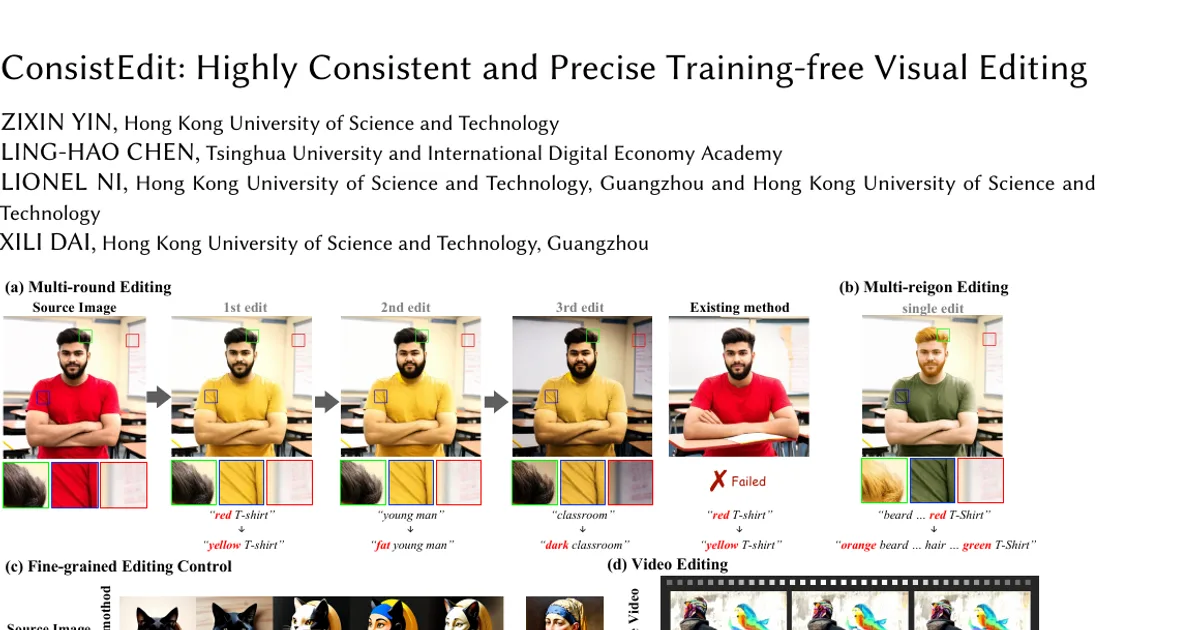
- The first approach to edit across all inference steps and attention layers without manual selection of steps or layers, which the authors state improves reliability and consistency and enables robust multi-round and multi-region editing.
- Progressive control of structural consistency through a "consistency strength" ratio, allowing fine-grained disentanglement of structure from texture rather than enforcing global consistency.
Main Findings
- Structural consistency in edited regions: On the Canny SSIM metric, ConsistEdit scores 0.8714 against 0.6225 for RF-Solver and 0.8776 against 0.5136 for FireFlow. Fixed-seed reference numbers are 0.5507 and 0.5557. Because the baselines' scores closely match fixed-seed generation, the authors conclude those methods cannot preserve structural consistency and exclude them from later structure-consistent comparisons.
- Full benchmark on Change Color and Change Material (80 image pairs from PIE-Bench): ConsistEdit achieves 0.8811 Canny SSIM, 36.76 BG-preservation PSNR, 0.9869 BG-preservation SSIM, 27.19 whole-image CLIP similarity, and 23.73 edited-region CLIP similarity. The baselines are SDEdit (0.6795 / 23.99 / 0.8697 / 26.59 / 22.80), UniEdit-Flow (0.8029 / 30.56 / 0.9554 / 26.55 / 22.59), and DiTCtrl (0.8235 / 29.54 / 0.9632 / 26.63 / 22.97).
- Non-edited region preservation ablation: DiffEdit's hard replacement scores 51.49 PSNR and 0.9972 SSIM but introduces visible boundary artifacts; swapping only V vision tokens scores 37.98 PSNR and 0.9905 SSIM; swapping only Q and K vision tokens scores 24.32 PSNR and 0.9286 SSIM due to color shifts; swapping Q, K, and V together (ConsistEdit) scores 38.85 PSNR and 0.9917 SSIM, the best overall.
- Q/K swapping ablation: Swapping all (text and vision) Q and K tokens preserves structure somewhat but severely damages text-driven editability; swapping only the vision parts of Q and K across all blocks preserves layout while retaining editability; restricting the swap to the latter half of blocks substantially weakens structural control and can corrupt generation.
- Vision-only swapping matters most at high consistency strength: Under high consistency strength, original (all-token) control often fails while vision-only edits better preserve source content; at low consistency strength both behave similarly.
- Structure-inconsistent editing: With consistency strength α = 0.3, the method moderates structural editing for prompt alignment while preserving overall layout and unedited content better than the compared methods.
- Consistency strength is smoothly adjustable: High α enforces strict structure preservation even under shape-altering prompts while still allowing texture/color changes; low α permits prompt-driven shape changes. Color appearance stays similar across α values, which the authors attribute to effective disentanglement.
- Generalization: The method works not only with SD3 (Stable Diffusion 3 Medium) but also FLUX.1-dev, and extends to video via CogVideoX-2B, where small inconsistencies that go unnoticed in still images become amplified.
- Sampler independence: ConsistEdit is applied under each baseline's native sampler while using its own attention-control strategy, and produces the best structure-preserving results across those samplers.
Methodology in Plain English
The authors start by comparing how MM-DiT processes information versus U-Net. In U-Net, cross-attention handles text guidance and self-attention handles visuals, so editing is confined to certain decoder stages. MM-DiT has no cross-attention at all — text and vision tokens are concatenated and processed by a single self-attention operation, so Q, K, and V each contain both text and vision parts. The authors visualize these projections (using PCA at the 15th sampling step for the prompt "A standing horse") and observe that every layer carries semantic content, so editing cannot be limited to selected layers.
Their pipeline works like this: invert a real image or video to recover the starting noise, then run generation again with the new prompt while a user-specified mask marks editing versus non-editing regions. During the early steps (t > (1 − α)T), the method fuses the source's vision Q and K into the edited region so the structure holds, while the target's own Q and K drive the rest. In non-edited regions, the source's vision V tokens are fused in to prevent color shifts — a step the authors call Content Fusion, complementing the Structure Fusion on Q and K. This fusion happens before the attention computation rather than blending attention outputs afterward. All of this applies only to the vision parts of the tokens; text parts are left untouched.
Evaluation uses SD3 for images and CogVideoX-2B for video, with the Euler sampler and UniEdit-Flow for inversion. Metrics are Canny-edge SSIM for structural similarity, PSNR and SSIM on manually annotated non-edited regions, and CLIP similarity over whole images and edited regions.
Why This Matters
The work reframes how training-free editing should be adapted when the underlying generative architecture changes from U-Net to MM-DiT. Because it requires no manual selection of inference steps or attention layers, it removes a source of fragility that the authors say limits earlier methods, and it makes multi-round and multi-region editing practical rather than a cascade of accumulating errors. It also shows the approach transfers across MM-DiT variants (SD3, FLUX.1-dev) and to video (CogVideoX-2B), suggesting the insights are architectural rather than model-specific.
Real-world applications demonstrated or directly implied by the paper's experiments:
- Interactive photo retouching, where a consistency-strength slider lets a user decide how much of the original structure to keep while changing color, material, or lighting.
- Multi-round iterative editing workflows, such as the paper's example of sequentially changing clothing color, motion, and hair starting from a real image.
- Video post-production, where consistent and controllable edits across spatial and temporal domains matter because inconsistencies get amplified over frames.
- Pipeline integration with newer MM-DiT generators, since the method is shown to work on both SD3 and FLUX.1-dev without retraining.
Industry relevance: the method is training-free, meaning it can be layered onto existing generative model deployments rather than requiring new training runs, which lowers the cost of adding precise, mask-guided editing to commercial image and video tools.
Future Directions
- Designing a controllable consistency slider for interactive interfaces — the authors explicitly point to this as a potential use of the smooth consistency-strength behavior.
- Extending beyond the tested backbones — the paper demonstrates SD3, FLUX.1-dev, and CogVideoX-2B; whether the three insights hold for other MM-DiT variants is left open.
- Understanding when structure-inconsistent edits need a different consistency strength — the paper fixes α = 0.3 for those experiments without reporting how sensitive results are to other values.
- Deeper analysis of boundary behavior — the DiffEdit comparison shows hard replacement creates visible transition artifacts at boundaries, suggesting mask blending and boundary handling remain an open area.
Target Audience
Researchers and practitioners working on diffusion-transformer-based generative models, training-free image and video editing, and attention-control methods. It is most useful to readers who already understand attention mechanisms, inversion, and sampling in diffusion or rectified-flow models, and who want to adapt or extend editing capabilities on MM-DiT backbones. Readers looking for a beginner-level introduction to image editing, or for training-based comparisons, will find less here — the paper compares exclusively against MM-DiT-based baselines (plus SDEdit, which can be adapted), explicitly excluding U-Net methods from its main comparisons.
Authors’ abstract
Recent advances in training-free attention control methods have enabled flexible and efficient text-guided editing capabilities for existing generation models. However, current approaches struggle to simultaneously deliver strong editing strength while preserving consistency with the source. This limitation becomes particularly critical in multi-round and video editing, where visual errors can accumulate over time. Moreover, most existing methods enforce global consistency, which limits their ability to modify individual attributes such as texture while preserving others, thereby hindering fine-grained editing. Recently, the architectural shift from U-Net to MM-DiT has brought significant improvements in generative performance and introduced a novel mechanism for integrating text and vision modalities. These advancements pave the way for overcoming challenges that previous methods failed to resolve. Through an in-depth analysis of MM-DiT, we identify three key insights into its attention mechanisms. Building on these, we propose ConsistEdit, a novel attention control method specifically tailored for MM-DiT. ConsistEdit incorporates vision-only attention control, mask-guided pre-attention fusion, and differentiated manipulation of the query, key, and value tokens to produce consistent, prompt-aligned edits. Extensive experiments demonstrate that ConsistEdit achieves state-of-the-art performance across a wide range of image and video editing tasks, including both structure-consistent and structure-inconsistent scenarios. Unlike prior methods, it is the first approach to perform editing across all inference steps and attention layers without handcraft, significantly enhancing reliability and consistency, which enables robust multi-round and multi-region editing. Furthermore, it supports progressive adjustment of structural consistency, enabling finer control.