Research
Conditional Trajectory Peaks: Single-Pass Multimodal Policies over Action Chunks
Overview Research area: Robotics — multimodal imitation learning and closed-loop manipulation policies built on action chunking. Technical level: Advanced. The paper assumes familiarity with mixture d
- arXiv
- 2610.06104
- Published
- 2026-10-05
- Authors
- Di Wu, Rongtian Shen, Ping Liu, Xuhua Chen, He Zheng, Lingfeng Zhang, Tao Zhang
AI summary
Overview
Research area: Robotics — multimodal imitation learning and closed-loop manipulation policies built on action chunking.
Technical level: Advanced. The paper assumes familiarity with mixture density networks, winner-takes-all multi-hypothesis regression, diffusion and flow-matching policies, action chunking, and vision-language-action (VLA) backbones.
Scope: The paper introduces Conditional Trajectory Peaks (CTP), a framework that predicts complete action-chunk candidates, their probability masses, and trajectory scales in a single network forward pass, and tests it on Push-T, three D3IL tasks, all four LIBERO suites, and three real-world dual-arm tasks.
What This Paper Is About
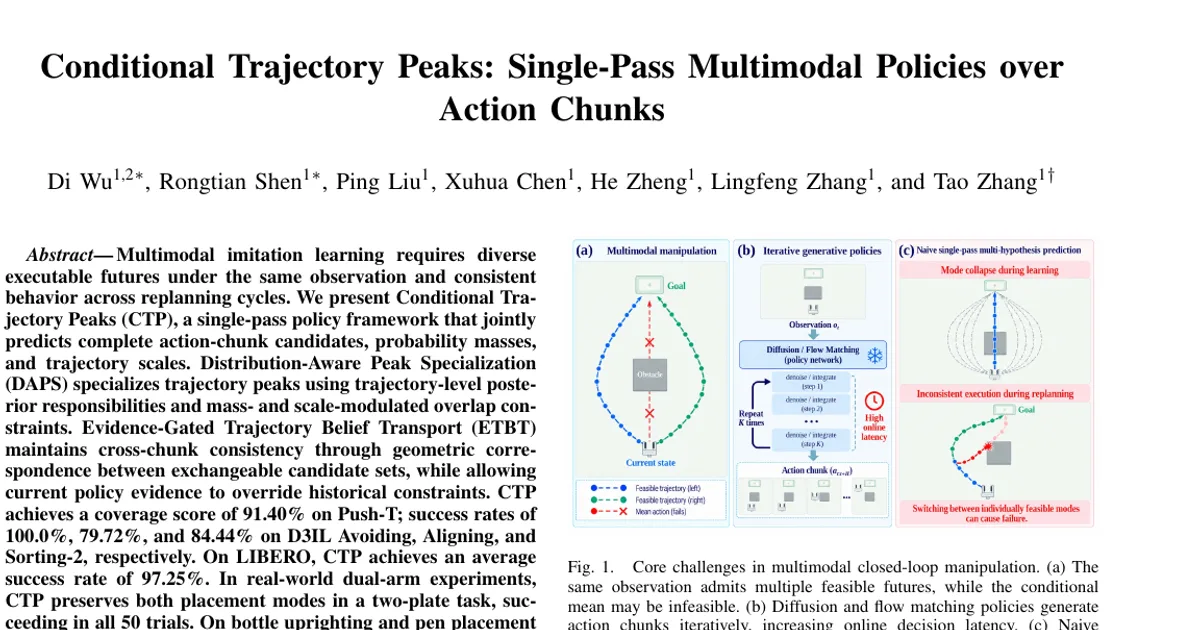
Robot demonstrations are often multimodal: the same observation can be consistent with several different valid behaviors, such as avoiding an obstacle on the left or right, or placing an object in either of two bins. Standard squared-error behavioral cloning collapses these into a single averaged action, while diffusion and flow-matching policies can represent them but require many network evaluations per replanning cycle.
The authors ask whether one policy can produce trajectory-level multimodal actions with a single forward pass per replanning step, while also keeping behavior consistent across replanning cycles as chunks are executed and replanned. CTP answers this with a finite conditional mixture over complete action chunks, plus two auxiliary mechanisms: Distribution-Aware Peak Specialization (DAPS) for training and Evidence-Gated Trajectory Belief Transport (ETBT) for execution.
Key Contributions
- CTP framework. A single-pass framework for multimodal closed-loop control that jointly predicts multiple trajectory candidates, their probabilities, and their scales with NFE = 1 per replanning cycle.
- Distribution-Aware Peak Specialization (DAPS). A training mechanism that mitigates mode collapse through trajectory-level posterior responsibility assignment and probability- and scale-aware inter-peak regularization, without clustering or predefined mode assignments.
- Evidence-Gated Trajectory Belief Transport (ETBT). An inference mechanism that improves cross-chunk behavioral consistency by propagating beliefs across replanning cycles through geometric trajectory correspondence, while adaptively releasing those constraints when current policy evidence is strong enough or when correspondence is unreliable.
- Empirical validation. Evaluation on Push-T, three D3IL tasks, all four LIBERO suites (Spatial, Object, Goal, Long), and three real-world dual-arm tasks, including component ablations and latency measurements.
Main Findings
-
Push-T coverage: CTP reaches a coverage score of 91.40% on Push-T and a unified-evaluation score of 0.9140 — the highest among compared methods. Under the same unified protocol, IMLE Policy scores 0.8874 and Diffusion Policy-C scores 0.8790. CTP improves over IMLE Policy by 0.0266 and over a trajectory-level MDN by 0.1177.
-
Inference efficiency on Push-T: With K = 4, CTP has 74.041 M parameters versus 65.783 M for the compared Diffusion Policy, so the speedup is not attributable to a smaller model. On the same RTX 5070, CTP's mean and P95 invocation latencies are 0.9507 ms and 0.9745 ms; Diffusion Policy with NFE = 100 requires 902.8522 ms and 904.8401 ms.
-
D3IL results: CTP achieves 100.0%, 79.72%, and 84.44% success on Avoiding, Aligning, and Sorting-2 respectively. The 100.0% on Avoiding exceeds the best previously reported result of 95.0% (BESO); on Sorting-2, 84.44% is close to the best prior result of 88.2% (DDPM-ACT). Prior results are described as performance references because protocols are not fully matched.
-
Candidate count matters on Aligning: Under strictly matched training and evaluation, increasing K from 1 to 4 raises success from 69.17% to 79.72%, a 10.56 percentage-point gain with a stratified 95% confidence interval of [0.28, 21.11] percentage points.
-
LIBERO transfer: With a frozen π0.5 vision-language backbone, K = 4, 50-step action chunks, and replanning every 10 steps, CTP reaches 98.0%, 100.0%, 98.0%, and 93.0% on Spatial, Object, Goal, and Long, averaging 97.25%. This is close to Motus (97.70%) and Fast-WAM (97.60%), below LingBot-VA (98.45%), and above the locally reevaluated π0.5 baseline (96.75%). The authors note these cross-model comparisons are not protocol-matched.
-
LIBERO latency: CTP reduces mean latency for a complete policy invocation from 218.24 ms to 75.80 ms — a 2.88x speedup and 65.27% latency reduction — with P95 falling from 219.64 ms to 76.15 ms. The local π0.5 baseline uses 10 flow integration steps per action chunk, while both predict 50 steps and execute 10, so the speedup is not from lower replanning frequency. Latencies were measured at batch size 1 on an NVIDIA GeForce RTX 4090 GPU and two Intel Xeon Gold 6530 CPUs.
-
Real-world mode preservation: In a two-plate placement task built from 300 demonstration episodes (150 per mode), CTP selected the left plate 31 times and the right plate 19 times (62% and 38%) across 50 real-world trials, and all 50 placements succeeded. No trial showed trajectories converging between the targets.
-
Real-world success parity: On bottle uprighting, both π0.5 and CTP achieve 95% success. On pen placement, success rates are 85% for π0.5 and 83% for CTP, while per-call policy inference latency falls from 218.24 ms to 75.80 ms (2.88x) on the same NVIDIA RTX 4090 GPU.
-
Component ablation (Push-T mean score): The single-peak baseline (K = 1) scores 77.34%; multi-peak (K = 4) scores 80.30% (a 2.96 percentage-point gain); adding DAPS reaches 85.67% (5.37 points); the full CTP reaches 91.40% (5.73 further points).
-
Qualitative Avoiding example: From the same initial state, a deterministic MSE-trained MLP collides with an obstacle while full CTP reaches the goal.
Methodology in Plain English
Trajectory-level mixture instead of per-step mixtures. Rather than predicting a distribution over single actions at every timestep, CTP defines a finite conditional mixture over complete action chunks. A shared backbone encodes the observation history into a context vector, and one trajectory head outputs, in a single pass, K trajectory parameter sets, K probability logits, and K scale parameters. Each trajectory center is built by combining low-rank coefficients with a fixed trajectory basis (the basis may also be the identity for direct time-domain prediction), and the probability logits pass through a softmax. Each component therefore explains an entire horizon at once, so mode identity belongs to the whole chunk rather than varying independently step by step.
Training with DAPS. The core loss is the mixture negative log-likelihood, which requires computing a trajectory-level posterior responsibility for each demonstration and each candidate — a soft assignment that weighs fitting error, probability mass, and scale jointly, unlike hard winner-takes-all assignment based only on trajectory distance. Because exchangeable candidates can still drift toward the same dominant high-density region, DAPS adds a pairwise inter-peak overlap constraint. That constraint is weighted by the product of the two components' probabilities and by their scales, so separation pressure concentrates on high-probability pairs that are mutually redundant. Unsupported redundant candidates can simply reduce their probability mass instead of being forced into artificial extra modes. No clustering or predefined mode quotas are used.
Execution with ETBT. At inference, the model picks the highest-probability candidate and executes only its first E steps before replanning. To keep behavior consistent between cycles, ETBT compares the unexecuted suffix of each previous candidate with the prefix of each current candidate using a geometric correspondence cost, normalizes it by a robust trajectory scale, and turns it into a similarity kernel and then into conditional correspondence probabilities (row-wise normalization or Sinkhorn normalization, depending on the task). Believing-prior propagation then produces a historical behavioral prior, which is fused multiplicatively with current policy probabilities. Crucially, history is only a soft prior: if the candidate best supported by the current policy has substantially stronger evidence than the historical continuation (a ratio threshold), or if the best cross-cycle correspondence is too weak (a threshold), the historical constraint is released and selection reverts to current policy evidence. This happens without any additional backbone forward pass, keeping NFE = 1.
Evaluation setup. On Push-T, policies receive two historical states, predict 16 x 2 action chunks, and use the same Transformer backbone, training data, and 40-epoch configuration; results come from the final EMA weights of five training runs evaluated on 200 fixed initial conditions. On D3IL, three state-based tasks (Avoiding, Aligning, Sorting-2) exercise obstacle-avoidance paths, inner- versus outer-side alignment, and object sorting order. On LIBERO, the π0.5 vision-language backbone is frozen and 40 tasks across four suites are evaluated.
Why This Matters
Impact on research. The paper separates two failure modes that single-pass multi-hypothesis policies often conflate: training-time mode collapse, where nominally distinct candidates become redundant, and cross-chunk mode stitching, where replanning switches between individually feasible but mutually incompatible routes. Framing cross-chunk consistency as behavioral identity correspondence over permutation-symmetric candidate sets, rather than as index tracking or action smoothing, is the paper's most distinctive conceptual move.
Real-world applications:
- Dual-arm pick-and-place where the instruction underdetermines the target location (for example, placing an object in either of two bins) and both outcomes are acceptable.
- Object reorientation tasks such as uprighting fallen bottles at varied positions and orientations.
- Precise placement tasks such as inserting tabletop pens into a holder.
- Any high-frequency closed-loop manipulation deployment where per-decision compute budget is tight but multimodal behavior is required.
Industry relevance. The headline industry argument is the success-latency trade-off. CTP retains LIBERO performance close to π0.5 (97.25% versus 96.75% locally reevaluated) while cutting a full policy invocation from 218.24 ms to 75.80 ms, a 2.88x speedup, and while doing so on top of a frozen large vision-language backbone rather than replacing it. That combination — multimodal expressiveness, closed-loop continuity, and one forward pass per replanning step — matters for real-time robot control on fixed compute.
Future Directions
- Threshold and hyperparameter sensitivity. The gating thresholds and fusion strengths in ETBT (the evidence ratio threshold, the correspondence reliability threshold, the history retention coefficient, the evidence exponent) are not numerically reported in the provided content. Systematic sensitivity analysis would clarify how much closed-loop behavior depends on tuning them.
- Generalization beyond the evaluated backbones. CTP is demonstrated with a frozen π0.5 vision-language backbone on LIBERO. Whether the same trajectory-peak head transfers to other VLA architectures and to tasks beyond the 40 LIBERO tasks is an open question.
- Protocol-matched cross-model comparison. The authors repeatedly note that published success rates come from non-matched protocols, so the LIBERO comparisons only contextualize performance. Head-to-head evaluations under one protocol, including with Motus, Fast-WAM, and LingBot-VA, would sharpen the claim.
- Where CTP still lags. CTP scores 79.72% on D3IL Aligning against a best prior result of 89.1% (VAE-ACT) and 84.44% on Sorting-2 against 88.2% (DDPM-ACT). Understanding which multimodal structures the fixed-capacity K-peak mixture represents less well, and whether K or the trajectory basis should adapt per task, is a natural next step.
Target Audience
Robotics and imitation-learning researchers working on multimodal action distributions, action chunking, and closed-loop replanning; engineers deploying manipulation policies under real-time compute constraints; and readers interested in VLA models who want to see how structured single-pass action heads can be layered on a frozen vision-language backbone. Because the paper leans on mixture-density, winner-takes-all, and flow/diffusion terminology without deriving them from scratch, it is best suited to readers already comfortable with those ideas.
Authors’ abstract
Multimodal imitation learning requires diverse executable futures under the same observation and consistent behavior across replanning cycles. We present Conditional Trajectory Peaks (CTP), a single-pass policy framework that jointly predicts complete action-chunk candidates, probability masses, and trajectory scales. Distribution-Aware Peak Specialization (DAPS) specializes trajectory peaks using trajectory-level posterior responsibilities and mass- and scale-modulated overlap constraints. Evidence-Gated Trajectory Belief Transport (ETBT) maintains cross-chunk consistency through geometric correspondence between exchangeable candidate sets, while allowing current policy evidence to override historical constraints. CTP achieves a coverage score of 91.40% on Push-T; success rates of 100.0%, 79.72%, and 84.44% on D3IL Avoiding, Aligning, and Sorting-2, respectively. On LIBERO, CTP achieves an average success rate of 97.25%. In real-world dual-arm experiments, CTP preserves both placement modes in a two-plate task, succeeding in all 50 trials. On bottle uprighting and pen placement into a holder, it maintains success rates comparable to $π_{0.5}$ while reducing policy inference latency from 218.24 ms to 75.80 ms. These results demonstrate that single-pass trajectory modeling can combine multimodal behavior, closed-loop consistency, and efficient inference.