Research
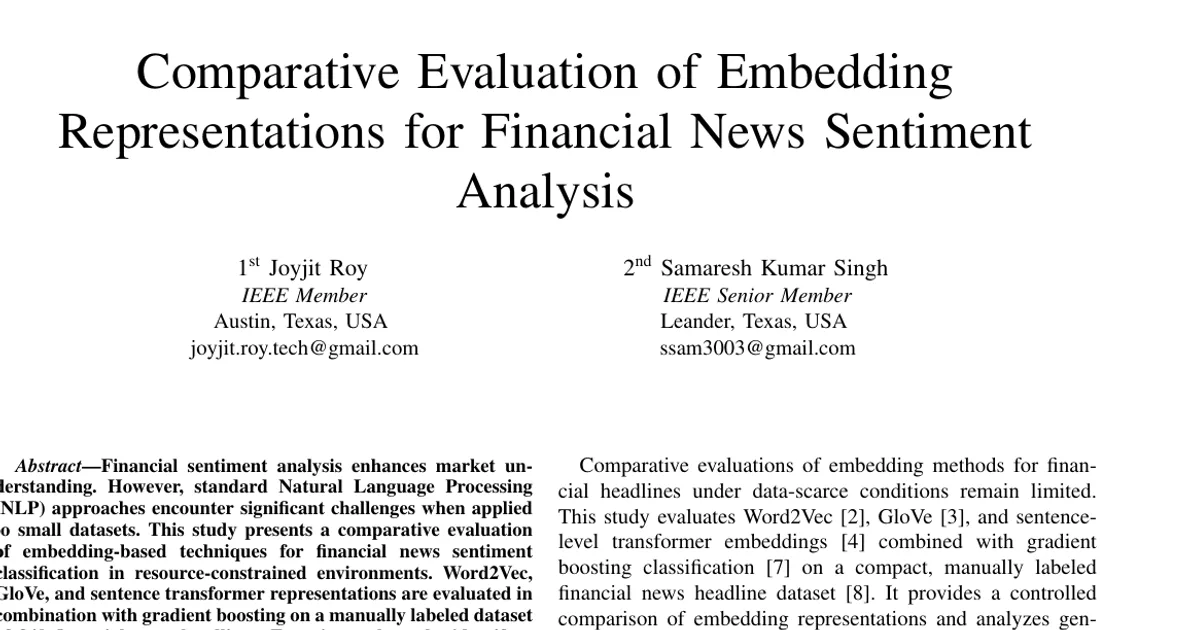
Comparative Evaluation of Embedding Representations for Financial News Sentiment Analysis
Overview Research area: Natural language processing for finance — specifically sentiment classification of financial news headlines using embedding-based representations under severe data constraints.
- arXiv
- 2512.13749
- Published
- 2025-12-15
- Authors
- Joyjit Roy, Samaresh Kumar Singh
AI summary
Overview
Research area: Natural language processing for finance — specifically sentiment classification of financial news headlines using embedding-based representations under severe data constraints.
Technical level: Intermediate. The methods (Word2Vec, GloVe, sentence transformers, gradient boosting) are standard, and the paper is written accessibly, but interpreting the validation/test gap and class-imbalance effects requires some background in supervised learning evaluation.
One-sentence scope: A controlled comparison of three embedding representations (Word2Vec, GloVe, and a sentence transformer) combined with gradient boosting on a manually labeled dataset of 349 financial news headlines, plus an LLM-based weekly sentiment aggregation extension.
What This Paper Is About
Practitioners in finance would like to automatically score news headlines as positive, neutral, or negative, but labeled financial data is expensive and scarce. This paper asks whether better embedding representations can rescue sentiment classification when the labeled dataset is tiny — in this case, 349 headlines. The answer the authors report is largely no: all embedding variants ended up underperforming a trivial majority-class baseline on the held-out test set.
Key Contributions
- A controlled, like-for-like comparison of three embedding families — Word2Vec (300-d), GloVe (100-d pretrained), and a sentence transformer (384-d, all-MiniLM-L6-v2) — all paired with the same gradient boosting classifier and identical data splits, so that representation quality is isolated as the experimental variable.
- A demonstration and analysis of a large validation-to-test performance gap on a compact financial headline dataset, tracing it to an undersized validation set (21 samples) used for grid-search model selection.
- A detailed error analysis of confusion matrices showing a persistent positive-prediction bias, including quantified misclassification rates for negative and neutral headlines.
- An extension to weekly sentiment aggregation, where 349 headlines are grouped into 18 weekly periods and processed by a Mistral-7B instruction-tuned model to extract the most significant positive and negative market events in JSON format.
Main Findings
-
Embedding choice did not overcome data scarcity. Test accuracy ranged from 23.8% (Word2Vec base) to 47.6% (Sentence Transformer tuned). Word2Vec test accuracy spanned 23.8% to 31.0%; the authors attribute this to the 349-headline corpus being too small for effective word embedding learning.
-
The best validation model generalized poorly. Tuned GloVe achieved the highest validation accuracy at 71.4% (validation F1 0.694), but its test accuracy fell to 42.9% — a 28.5% decline. Its test precision, recall, and F1 were 0.392, 0.429, and 0.388.
-
Nothing beat the majority baseline. The majority-class baseline (always predicting "Positive") scored 47.6% test accuracy. The tuned Sentence Transformer matched it exactly at 47.6%. GloVe-tuned and GloVe-base underperformed the baseline by 4.7% and 2.4% respectively.
-
The tuned sentence transformer matched the baseline through bias, not understanding. It predicted positive for 95% of test samples, which the authors interpret as reliance on class distribution rather than semantic comprehension.
-
Negative sentiment was nearly unclassifiable. Roughly 69% of negative test samples were misclassified as positive, and 43% of neutral samples were also labeled positive. Headlines mentioning company names without clear sentiment markers were mislabeled positive 72% of the time.
-
Domain terminology defeated the models. Explicitly negative indicators such as "lowered guidance," "missed estimates," and "reduced forecast" were frequently classified as positive.
-
Perfect training accuracy across the board. All models reached 1.0 training accuracy, which the authors treat as direct evidence of overfitting given the 286 training samples.
-
Validation-set size is the mechanism. With only 21 validation samples, grid search selected configurations that fit validation noise; the authors connect this to the observed collapse from validation to test performance.
-
The dataset sits below a suspected sufficiency threshold. The paper notes that domain-specific transformers such as FinBERT have reported over 80% accuracy with thousands of labeled samples, and places the threshold for stable sentiment classifiers at roughly 1,000 to 2,000 labeled samples. The 349-sample dataset falls well below it; fine-tuning was not attempted with 286 training samples.
-
LLM-based aggregation illustrates a workaround. Weekly summaries produced by the Mistral-7B model (for example, the week of January 6, 2019, covering Roku's premium channel plans, FDIC reassurance on volatility, and a Chinese central bank reserve ratio reduction freeing 116.5 billion yuan, against Apple's revenue forecast cut, a Goldman price target reduction from $182 to $140, and Delta Air Lines' lowered Q4 revenue growth forecast) bypass the classifier entirely by leaning on pretrained LLM knowledge. The authors state these LLM outputs were not formally validated for accuracy or completeness.
Methodology in Plain English
The authors took a publicly available financial news sentiment dataset of 349 daily stock-related headlines, manually labeled positive (1), neutral (0), or negative (-1), along with OHLCV market indicators, and focused only on the text. The label distribution is imbalanced: 48% positive, 31% neutral, 21% negative.
Preprocessing lowercased headlines, stripped punctuation, and tokenized with NLTK's word tokenizer. Stop-words were removed only for the Word2Vec and GloVe paths; the sentence transformer used its own WordPiece tokenization.
Each headline was converted into a fixed-length vector three ways: Word2Vec using Gensim 4.x skip-gram (300 dimensions, window 5, min_count 1, 100 epochs) trained on the 349-headline corpus itself and mean-pooled; pretrained GloVe glove.6B.100d vectors (100 dimensions, trained on 6 billion tokens from Wikipedia 2014 and Gigaword 5) mean-pooled with out-of-vocabulary words mapped to zero vectors; and a 384-dimensional all-MiniLM-L6-v2 sentence transformer producing sentence-level embeddings without fine-tuning.
Vectors were precomputed, then fed to scikit-learn's Gradient Boosting Classifier. Two configurations per embedding were tested: a default baseline (n_estimators=100, learning_rate=0.1, max_depth=3) and a tuned version chosen by grid search over n_estimators {50, 100, 200}, learning rate {0.05, 0.1, 0.2}, and max depth {3, 5, 7}, with subsample=0.8 and min_samples_split=2 fixed and seed=42 for reproducibility.
Data was split chronologically: 286 training samples (82%), 21 validation samples (6%), and 42 test samples (12%), to prevent temporal leakage. Evaluation used accuracy plus macro-averaged precision, recall, and F1, with macro-averaging chosen to give equal weight across the imbalanced classes.
For the practical extension, the 349 headlines were grouped into 18 weekly periods, concatenated with delimiter tokens, and passed to a Mistral-7B instruction-tuned model with a structured prompt asking for the three most significant positive and three negative market events per week, returned as JSON.
Why This Matters
Impact on research. This is a negative-results paper. It documents that pretrained embedding quality alone does not compensate for data scarcity, and that small validation sets can make hyperparameter selection actively harmful. It argues explicitly for the value of reporting negative results, and it cautions against assuming contextual embeddings will dominate simpler methods in low-data financial NLP.
Real-world applications:
- Setting realistic expectations for teams building sentiment classifiers on small proprietary headline or social datasets, where a majority-class baseline may already be hard to beat.
- Weekly market-monitoring dashboards, where the paper's aggregation approach produces structured JSON summaries of positive and negative events suitable for programmatic integration with risk platforms and trading dashboards.
- Deciding on data-collection budgets: the paper locates the useful threshold at roughly 1,000 to 2,000 labeled samples, informing whether to invest in annotation or switch paradigms.
- Error-pattern awareness for risk systems, since a model biased toward positive predictions will systematically miss negative corporate news — the exact signals that matter most for downside risk.
Industry relevance. The paper's practical message for resource-constrained financial practitioners is to establish baselines early, consider lexicon-based or hybrid methods, and treat validation metrics with suspicion when the validation set is small.
Future Directions
- Benchmark lexicon-based methods. The authors identify the absence of Loughran-McDonald and VADER baselines as a limitation, and propose comparing hand-crafted lexicons against learned embeddings across dataset sizes to locate where learned representations actually win. They estimate that crossover at 1,000 to 2,000 labeled samples but note empirical validation is needed.
- Test alternative classifiers. Support Vector Machines, Random Forests, and logistic regression are offered as unexplored options, to disentangle whether failures stem from embedding quality, classifier limitations, or data insufficiency.
- Explore data-scarce paradigms. Few-shot learning, data augmentation, and lexicon-enhanced hybrid models are proposed as directions that may outperform purely embedding-based pipelines.
- Improve validation protocols. Nested cross-validation or stratified k-fold could improve robustness, though the authors note these may conflict with the temporal ordering required for financial time series; they also suggest aspect-based sentiment analysis or confidence-weighted classification to better handle neutral and factual language.
- Validate LLM aggregation outputs. Future implementations should include validation protocols comparing LLM-generated weekly summaries against expert analyst assessments, since no formal validation was performed here.
Target Audience
This paper is most useful to applied machine learning practitioners and financial NLP engineers working with small labeled datasets — particularly those deciding whether to invest in embedding-based pipelines or in more labeled data. It is also valuable to researchers interested in negative results, benchmark realism, and the gap between validation and deployment performance, as well as to quantitative analysts and market-monitoring teams considering LLM-based summarization as a workaround for classification under data scarcity.
Authors’ abstract
Financial sentiment analysis enhances market understanding. However, standard Natural Language Processing (NLP) approaches encounter significant challenges when applied to small datasets. This study presents a comparative evaluation of embedding-based techniques for financial news sentiment classification in resource-constrained environments. Word2Vec, GloVe, and sentence transformer representations are evaluated in combination with gradient boosting on a manually labeled dataset of 349 financial news headlines. Experimental results identify a substantial gap between validation and test performance. Despite strong validation metrics, models underperform relative to trivial baselines. The analysis indicates that pretrained embeddings yield diminishing returns below a critical data sufficiency threshold. Small validation sets contribute to overfitting during model selection. Practical application is illustrated through weekly sentiment aggregation and narrative summarization for market monitoring. Overall, the findings indicate that embedding quality alone cannot address fundamental data scarcity in sentiment classification. Practitioners with limited labeled data should consider alternative strategies, including few-shot learning, data augmentation, or lexicon-enhanced hybrid methods.