Research
Collaborative Personalized Preference Alignment for LLMs under Data Deficiency
Overview Research area: Personalized multi-objective preference alignment for large language models (LLMs), combining personalized federated learning, Pareto multi-objective optimization, and few-shot
- arXiv
- 2610.05898
- Published
- 2026-10-05
- Authors
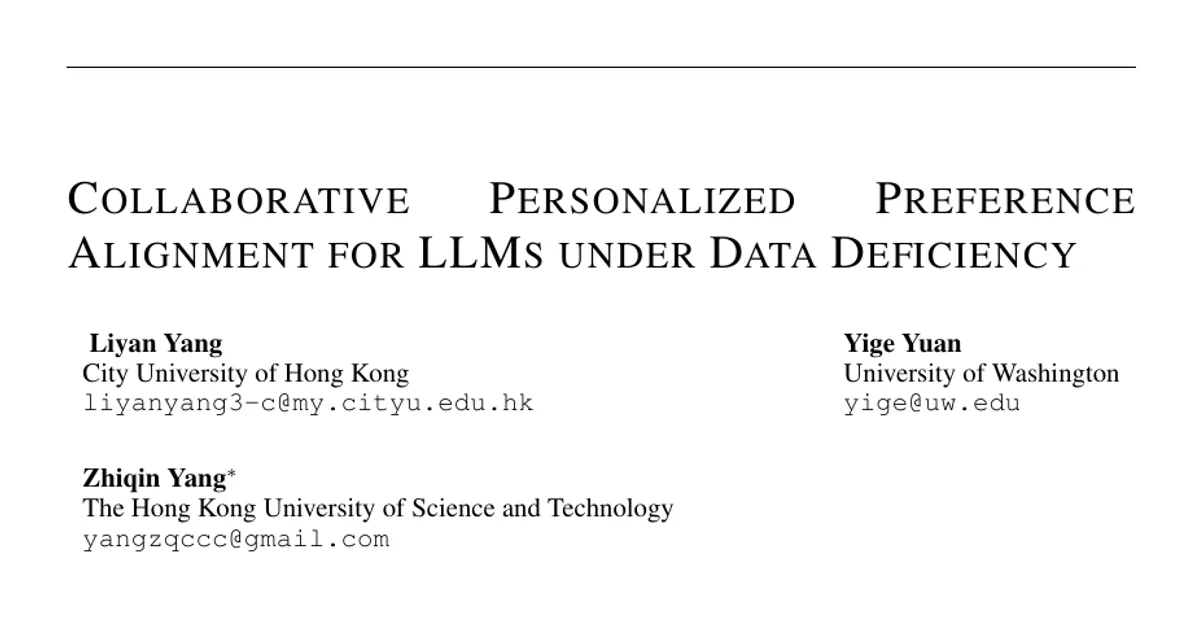
- Liyan Yang, Yige Yuan, Zhiqin Yang
AI summary
Overview
- Research area: Personalized multi-objective preference alignment for large language models (LLMs), combining personalized federated learning, Pareto multi-objective optimization, and few-shot meta-learning.
- Technical level: Advanced. The paper assumes familiarity with DPO-style alignment losses, Pareto optimality and Pareto fronts, federated averaging, gradient conflict (PCGrad/MGDA-style reasoning), and meta-learning of shared initializations (MAML/Per-FedAvg).
- Scope (one sentence): The paper proposes APO (Approximate Pareto Optimality), a collaborative framework that learns cluster-level aligner initializations for preference-conditioned few-shot personalization, and supports it with convergence and adaptation-gap bounds plus experiments on Fed-ChatbotPA and UltraFeedback with two 3B-scale instruction-tuned models.
What This Paper Is About
Real users want LLM responses balanced differently across objectives such as helpfulness, harmlessness, humor, honesty, and truthfulness, but each user supplies very little preference feedback, so training a personalized aligner locally from scratch is unreliable. The paper asks how multiple users can collaboratively learn a shared starting point (an initialization) that a new or existing user can then adapt with only a handful of local examples. The obstacle is that heterogeneous user preferences create gradient conflicts both between users (inter-client) and between objectives inside a single user (intra-client), which corrupts naive aggregation.
Key Contributions
- Problem formalization and framework: The paper formalizes collaborative personalized preference alignment of LLMs under data scarcity and proposes APO, which learns a shared initialization for preference-conditioned few-shot adaptation.
- Conflict-resolution machinery: It introduces bottleneck-adjustment clustering (to handle inter-client conflicts) and preference gradient descent combined with controlled ascent (to handle intra-client conflicts), plus adaptation-aware meta-training to refine the initialization.
- Theory: It establishes an asymptotic Chebyshev suboptimality bound (ε₀) for single-local-step collaborative updates, and an expected suboptimality bound (δ₀) for preconditioned stochastic adaptation to unseen preferences over shared objective functions. A cluster solution is shown to approximate every local optimum under a stated descent-margin condition.
- Empirical validation: Experiments on Fed-ChatbotPA and UltraFeedback with Llama-3.2-3B-Instruct and Qwen2.5-3B-Instruct are reported to show superiority over state-of-the-art methods using only 20 local examples.
Main Findings
- Collaboration beats local-only training under scarcity: The illustrative results (Figure 1) on UltraFeedback with Llama-3.2-3B-Instruct, using 15 clients with 20 samples each over helpfulness, honesty, and truthfulness, show that a collaboratively learned initialization raises Pareto hypervolume from 0.728 to 0.820, a +12.6% increase, and its frontier dominates the local-only frontier in the 2D projections.
- Bottleneck ordering is a sufficient condition for interference-free aggregation: Theorem 3.2 shows that if, for every client in a cluster, the local correction gain γᵢ* exceeds Δᵢ‖d_bal,i‖ + L₀B²τη, then the shared aggregated direction is a simultaneous balancing direction and decreases every client's Preference Uniformity for sufficiently small step size.
- Clustering reduces the convergence radius: The radius ε₀,ᵢ in the cluster contraction bound is horizon-independent and governed by Δ̄ᵢ ≤ sqrt(sup_t H_{Cₙ}(wᵗ)/ρ_min) — the preference-conditioned direction dispersion that Bottleneck-Adjustment Clustering is designed to reduce — as well as by the step size η and the tolerance term bᵢ/c_d.
- Few-shot gap decomposes into collaborative quantities: Theorem 3.4 bounds the expected K-step adaptation suboptimality δ₀ as (1 − αμ_PL p₋)^K Δ₀ + (L₀αp₊²)/(2μ_PL p₋) · σ₀²/S, where Δ₀ is the initialization's suboptimality, expressed in terms of Δ̄ᵢ, δ_λ, η, η_II, and bᵢ/c_d. The paper states that this gap vanishes as the cluster tightens only in the strict form bᵢ = 0.
- Direction dispersion bounds the LP multipliers: Under an assumed common non-degenerate optimal basis for the clients' linear programs, H_{Cₙ}(w) ≤ κ_LP² σ_max(GᵀG) V_{Cₙ}(A^ref), tying within-cluster variance of the Preference Adjustment Vectors to dispersion of local update directions.
- Experimental claims: The abstract reports "consistent improvements over existing methods using only 20 local examples" on Fed-ChatbotPA and UltraFeedback, and the introduction states APO achieves the strongest overall performance among evaluated methods in both preference-specific utility and Pareto-front coverage across datasets. The numeric values of the main results table (Table 1: cluster-level Score, HV, and IGD on Fed-ChatbotPA with 4 clusters and UltraFeedback with 8 clusters) are not present in the provided content.
Methodology in Plain English
- Set up as a multi-objective problem. Each user (client) has m preference dimensions, each with its own alignment loss (a DPO loss in the implementation). A client expresses its trade-off with a preference vector λᵢ on the simplex; a larger λᵢ⁽ʲ⁾ means the client tolerates a smaller loss on dimension j. The guiding objective is the weighted Chebyshev scalarization max_j λᵢ⁽ʲ⁾lᵢ⁽ʲ⁾(w).
- Measure how balanced a client's losses are. The paper defines Preference Uniformity βᵢ as a KL divergence between the preference-weighted normalized losses and the uniform distribution. It is zero exactly when the weighted losses are perfectly balanced along the client's preference ray.
- Turn that measure into a direction. Differentiating βᵢ yields a Preference Adjustment Vector Aᵢ, which points along the steepest increase of the KL divergence; moving against it pushes the model toward the balanced ray. The corresponding parameter-space direction is d_bal = G Aᵢ.
- Cluster clients in two stages. Stage 1 sorts clients by "bottleneck ordering" — the descending order of their preference-weighted losses at a fixed reference state; clients with identical orderings form a coarse cluster. Stage 2 refines each coarse cluster by hierarchical clustering with Euclidean distance on the clients' Aᵢ vectors, cutting the dendrogram at a preset cluster budget b (b = 4 on Fed-ChatbotPA and b = 8 on UltraFeedback). The goal is to reduce within-cluster direction dispersion.
- Train a shared initialization per cluster. Phase I combines preference gradient descent with controlled ascent (in the style of EPO). When βᵢ = 0 the scheme switches to uniform descent; otherwise balancing descent is used. The linear program maximizes the inner product of the step with either Aᵢ or the all-ones vector depending on an indicator, subject to constraints allowing non-bottleneck objectives to degrade by no more than the balancing direction, and requiring bottleneck objectives not to worsen.
- Refine with meta-training. Phase II (in the style of Per-FedAvg/MAML-style adaptation-aware learning) meta-trains the Phase I result on S-shot episodes so it can be adapted within K steps. It uses the same clients, the same local data (S-shot episodes are subsamples of each client's own dataset), the same objectives, and the same FedAvg aggregation as Phase I.
- Adapt at test time. A new client with preference λ_new is assigned to a cluster by its adjustment vector and runs K steps from the shared initialization using the same balancing linear program, without participating in collaborative training.
- Evaluate. Scores are computed with ArmoRM-Llama3-8B-v0.1, using preference-weighted normalized score, hypervolume (HV), and inverted generational distance (IGD). Baselines are the Base model, RIC, Rewarded Soup, FSPO, DITTO, and FedAvg. Training used NVIDIA RTX PRO 6000 Blackwell (96 GB GDDR7) and NVIDIA A100 80GB (SXM4) hardware.
Why This Matters
- Research impact: The paper connects two lines that have been largely separate — personalized federated learning of shared initializations and Pareto/multi-objective alignment under gradient conflict — and provides convergence and adaptation-gap bounds rather than only empirical evidence. It also reframes clustering itself as a conflict-mitigation device with a quantified effect (reducing the direction dispersion that appears in the radius Δ̄ᵢ).
- Real-world applications:
- Personalizing assistant tone and content balance (helpfulness versus safety) for individual users with only a few feedback examples each.
- Enterprise deployments where many teams or business units share an LLM but have different acceptable-risk and helpfulness trade-offs, while user data must stay local.
- Regulated domains where per-client preference data cannot be centralized, so collaborative learning must respect data-locality constraints.
- Cross-cultural or cross-region products where users differ in values and objectives and where subjective style and tone are hard to synthesize faithfully.
- Industry relevance: The claim of strong performance with only 20 local examples per client targets the practical bottleneck of collecting preference labels, and the federated formulation matches privacy-motivated deployments. The use of lightweight plug-and-play aligners over 3B-scale instruct models keeps the approach within reach of modest serving budgets.
Future Directions
- Relaxing the theoretical assumptions: The convergence results rely on the descent-margin condition (Assumption H.19), a Polyak–Łojasiewicz-type requirement on ψᵢ along the actual LP direction, which the paper explicitly states is not implied by smoothness, bounded gradients, preference balance, or the LP constraints. Deriving it from realistic loss geometry, or replacing it with a weaker condition, is a natural next step.
- Closing the strictness gap in the personalization bound: The paper notes that the few-shot gap vanishes as the cluster tightens only in the strict form bᵢ = 0. Removing that qualification is an open question.
- Choosing the cluster budget: The cluster counts b = 4 on Fed-ChatbotPA and b = 8 on UltraFeedback are presented as presets rather than derived from a criterion. Whether an adaptive or theoretically grounded rule exists, and how cluster count interacts with the dispersion bound and with per-cluster client counts, is unresolved in the provided content.
- Realistic adaptation analysis: The δ₀ bound is derived for an idealized preconditioned stochastic adaptation with fresh samples (S per step, K·S total). Extending the analysis to reuse of the same few-shot examples, varying S, or asynchronous client participation is not covered here.
Target Audience
This paper is most useful to researchers and engineers working on LLM personalization, preference optimization beyond a single scalar reward, federated or privacy-preserving fine-tuning, and multi-objective optimization with gradient conflict. It also suits readers interested in the theory side of federated meta-learning, since it provides contraction-style bounds and an adaptation-gap decomposition. Practitioners seeking a drop-in recipe should note that the key empirical details — the full main results table with cluster-level Score, HV, and IGD values for each baseline — are not included in the provided content, so the reported numeric evidence available here is limited to the Figure 1 hypervolume comparison and the qualitative claims in the abstract and introduction.
Authors’ abstract
Real-world users often exhibit highly heterogeneous preferences over multiple objectives for LLM responses. A lightweight aligner can tailor these responses to individual preferences, but scarce user-specific feedback makes personalized training difficult. Learning shared initializations across users can support few-shot adaptation. However, heterogeneous preferences and competing objectives cause gradient conflicts across users and within each user, hindering effective initialization learning. This raises a central question: \textbf{how can we collaboratively learn aligner initializations that support few-shot adaptation to diverse user preferences?} To answer this question, we propose \textbf{A}pproximate \textbf{P}areto \textbf{O}ptimality (APO). We first group users whose updates are compatible, so that their information can be combined with less interference. Within each group, we combine gradient descent with controlled ascent to coordinate competing objectives and move towards preference-specific points on the Pareto front. This produces an initialization that is close to the optima of the users in the group. We then iteratively refine it using updates from few-shot local adaptation, making it more effective for personalization. Furthermore, we establish conditional suboptimality bounds for a one-local-step collaborative update and characterize how initialization error affects subsequent stochastic adaptation. Experiments on Fed-ChatbotPA and UltraFeedback show consistent improvements over existing methods using only 20 local examples.