Research
Cognitively-Inspired Episodic Memory Architectures for Accurate and Efficient Character AI
Overview Research area: Natural Language Processing — dialogue systems and character AI, specifically retrieval-augmented and memory-based architectures for embodying historical figures. Technical lev
- arXiv
- 2511.10652
- Published
- 2025-11-01
- Authors
- Rafael Arias Gonzalez, Steve DiPaola
AI summary
Overview
Research area: Natural Language Processing — dialogue systems and character AI, specifically retrieval-augmented and memory-based architectures for embodying historical figures.
Technical level: Intermediate. The paper assumes familiarity with large language models, retrieval-augmented generation (RAG), and LLM-based evaluation, but the abstract describes the design at a conceptual level.
Scope: The paper proposes and evaluates an episodic-memory architecture that aims to give character dialogue both the depth of multi-stage reflection and the speed of simple retrieval, using Vincent van Gogh as a test case.
What This Paper Is About
Dialogue systems built on large language models struggle with a trade-off: the simplest approach, retrieval-augmented generation, tends to produce shallow responses, while richer approaches that involve multiple stages of reflection produce deeper character portrayals at a latency cost the authors call prohibitive. The paper's goal is an architecture that escapes this trade-off by preparing memory data ahead of time and retrieving from it efficiently, so that a character can respond with depth without slow, multi-stage processing at inference time.
Key Contributions
- An offline data augmentation pipeline that transforms biographical source material into 1,774 enriched first-person memories, each carrying affective-semantic metadata — that is, tags relating to both emotion and meaning.
- A two-stage retrieval method operating over that structured episodic memory, reported to generate prompts in 0.52 seconds.
- An evaluation using LLM-as-judge and RAGAs metrics that compares the approach against traditional RAG on GPT-4, GPT-3.5, and GPT-3.
- A set of visualization tools that the structured memory makes possible: spatiotemporal heatmaps, emotional trajectory analysis, and interactive path tracking — extending the system beyond dialogue into a research instrument for biographical analysis.
Main Findings
-
The depth-versus-latency trade-off is resolved, as claimed by the authors. The abstract presents the combination of offline augmentation and parallel retrieval as avoiding both the shallowness of simple RAG and the prohibitive latency of multi-stage reflection. The abstract does not state how latency was measured or against which specific systems.
-
Parity with traditional RAG on GPT-4. On the largest model tested, the approach performed comparably to conventional RAG rather than better. The abstract gives no numerical margins for this comparison.
-
Significant improvement on smaller models. On GPT-3.5 and GPT-3, the approach is reported to outperform traditional RAG significantly. Again, no effect sizes or per-metric breakdowns appear in the abstract.
-
Particular value for resource-constrained deployment. The authors read the model-size pattern as evidence that the architecture matters most where compute or model capability is limited, rather than at the top of the model range.
-
The memory structure supports analysis, not just conversation. Because memories carry affective and spatial metadata, the same representation can drive visualizations of a person's movements, emotional arcs, and narrative paths over time.
-
Generalizability is claimed but the abstract reports only one test case. The system is demonstrated with Van Gogh; the authors argue the architecture extends to any historical figure with substantial textual records. The abstract does not describe validation on other figures.
Methodology in Plain English
The approach separates work that is expensive but can be done once from work that must happen quickly during a conversation.
First, biographical material is processed ahead of time into a large set of first-person memories — written as if the character were recalling them — and each memory is annotated with information about emotion and meaning. This is the offline augmentation step, and it is where the depth comes from: the character's knowledge is pre-shaped into a form that already supports rich responses.
Second, at conversation time, the system retrieves from this memory store in two stages and does so in parallel, rather than running the query through several sequential rounds of reflection. That parallel structure is what keeps prompt generation fast. The retrieved memories are then handed to the language model to produce a response.
Evaluation used an LLM acting as a judge alongside RAGAs, a set of retrieval and generation quality metrics, comparing the system with traditional RAG across three OpenAI model sizes. The same structured memory was separately used to produce the visualizations.
Why This Matters
The paper targets a practical bottleneck in character AI: making historically grounded dialogue both faithful and responsive. If depth can be moved into offline preparation rather than paid for at every turn, then accurate character systems become viable in settings where latency or model size is constrained.
Real-world applications:
- Museums and cultural institutions, where an interactive version of a historical figure could answer visitor questions with grounded, source-derived detail.
- Education, where students could converse with a historical or artistic figure and also inspect visualizations of that figure's movements and emotional life.
- Biographical and humanities research, using the spatiotemporal heatmaps, emotional trajectory analysis, and path tracking as analytic instruments rather than conversational ones.
- Resource-constrained deployments, where the reported advantage on smaller models makes accurate character dialogue feasible without access to the largest available models.
Industry relevance: The paper speaks to the cost structure of deployed conversational AI. Teams building digital humans, educational products, or heritage experiences often must choose between a retrieval-only design that feels flat and a multi-step reasoning design that is too slow or too expensive to serve. An architecture that shifts quality into offline data preparation and keeps inference cheap is directly relevant to that decision, and the finding that gains concentrate on smaller models is relevant to teams serving at scale on modest hardware.
Future Directions
- Testing the claimed generalizability. The architecture is argued to work for any historical figure with substantial textual records, but only Van Gogh is reported as a test case. Applying it to additional figures would clarify what "substantial textual records" actually requires and where the approach breaks down.
- Moving beyond LLM-as-judge. The evaluation relies on an LLM judge and RAGAs metrics. Human evaluation, and especially expert assessment of historical fidelity, would test whether the measured quality corresponds to what the authors call accuracy.
- Characterizing the latency claim more fully. The abstract reports 0.52 seconds for prompt generation but does not describe the conditions, so the boundary at which the approach stops being efficient remains open.
- Extending the visualization layer. The spatiotemporal, emotional, and path-tracking tools are presented as an opening rather than a finished instrument; their use in actual biographical scholarship is untested in the abstract.
- Deployment studies. The educational, museum, and research applications are framed as opportunities, and the abstract reports no field deployments.
Target Audience
Researchers and practitioners working on character AI, persona-driven dialogue, and retrieval-augmented generation will find the architectural argument most useful, particularly those concerned with inference cost and model-size constraints. The paper also speaks to digital humanities and heritage-technology audiences interested in interactive historical figures and in computational analysis of biographical material, and to industry teams building educational or museum-facing conversational products. Readers looking for detailed benchmark tables or human-evaluation results will not find them in the abstract, which reports comparisons only in qualitative terms.
Authors’ abstract
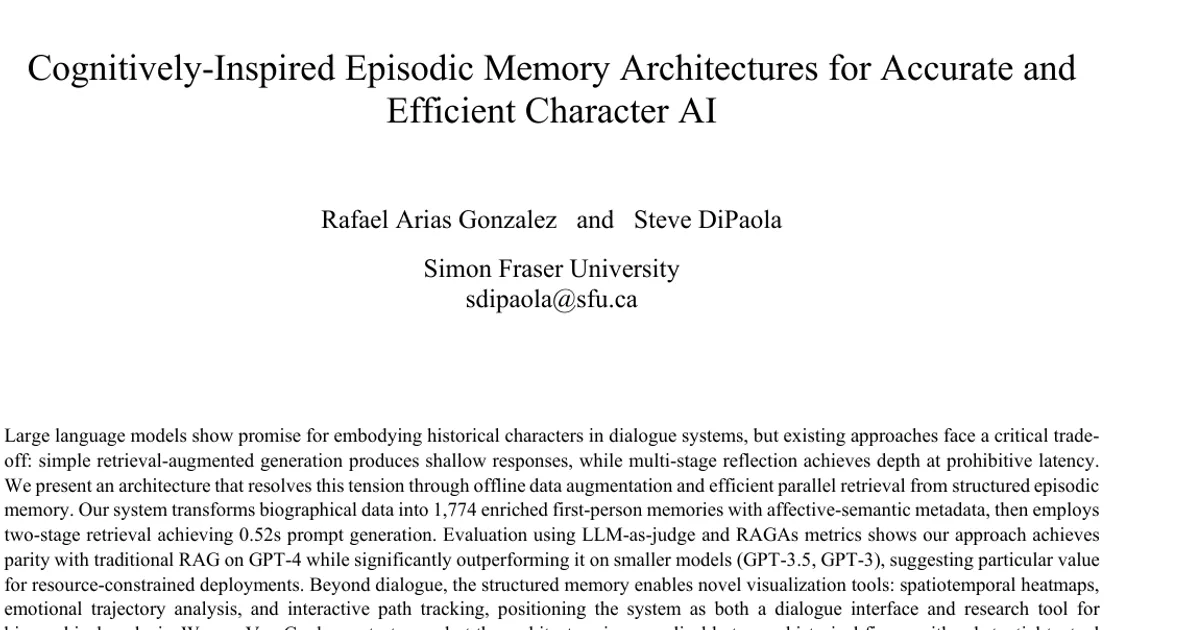
Large language models show promise for embodying historical characters in dialogue systems, but existing approaches face a critical trade-off: simple retrieval-augmented generation produces shallow responses, while multi-stage reflection achieves depth at prohibitive latency. We present an architecture that resolves this tension through offline data augmentation and efficient parallel retrieval from structured episodic memory. Our system transforms biographical data into 1,774 enriched first-person memories with affective-semantic metadata, then employs two-stage retrieval achieving 0.52s prompt generation. Evaluation using LLM-as-judge and RAGAs metrics shows our approach achieves parity with traditional RAG on GPT-4 while significantly outperforming it on smaller models (GPT-3.5, GPT-3), suggesting particular value for resource-constrained deployments. Beyond dialogue, the structured memory enables novel visualization tools: spatiotemporal heatmaps, emotional trajectory analysis, and interactive path tracking, positioning the system as both a dialogue interface and research tool for biographical analysis. We use Van Gogh as a test case, but the architecture is generalizable to any historical figure with substantial textual records, offering a practical framework for educational, museum, and research applications requiring both accuracy and efficiency