Research
Chronicals: A High-Performance Framework for LLM Fine-Tuning with 3.51x Speedup over Unsloth
Overview Research area: Efficient training and fine-tuning of large language models (LLM), specifically kernel-level optimization, memory-efficient loss computation, and parameter-efficient fine-tunin
- arXiv
- 2601.02609
- Published
- 2026-01-06
- Authors
- Arjun S. Nair
AI summary
Overview
- Research area: Efficient training and fine-tuning of large language models (LLM), specifically kernel-level optimization, memory-efficient loss computation, and parameter-efficient fine-tuning (LoRA/LoRA+).
- Technical level: Advanced. The paper mixes empirical benchmarks with formal derivations (online softmax correctness proofs, gradient derivations for SwiGLU/RMSNorm/attention, IO complexity bounds, and a LoRA+ learning-rate proof).
- Scope: One sentence: the paper presents Chronicals, an integrated fine-tuning framework combining FlashAttention, fused Triton kernels, Cut Cross-Entropy, LoRA+, and sequence packing, and benchmarks it against Unsloth on Qwen2.5-0.5B with an A100-40GB.
Note: the supplied paper content is truncated mid-way through the proof of the Cut Cross-Entropy memory reduction theorem, so later sections (benchmarks, limitations, future work) are only visible through the introduction's roadmap and contribution list, not in full.
What This Paper Is About
Fine-tuning even a modest language model is bottlenecked by memory, not compute: the paper states that fine-tuning a 7-billion parameter model requires 84GB (14GB weights, 14GB gradients, 56GB FP32 optimizer states), which exceeds an A100-40GB by a factor of two. The goal is to show that this bottleneck is avoidable by combining several known but individually partial optimizations into one coherent system. Chronicals is that system, and the headline claim is a 3.51x speedup over Unsloth's verified throughput on Qwen2.5-0.5B.
Key Contributions
- An integrated training system. Chronicals combines FlashAttention, fused Triton kernels, LoRA+ optimization, Cut Cross-Entropy, and sequence packing. On Qwen2.5-0.5B with an A100-40GB it reports 41,184 tokens/second for full fine-tuning (3.51x over Unsloth's verified 11,736 tokens/second), 11,699 tokens/second for LoRA at rank 32 (4.10x over Unsloth MAX's 2,857 tokens/second), and 3.34 tokens/second/MB memory efficiency versus Unsloth's 2.11 tokens/second/MB.
- Mathematical foundations for each optimization. Derivations include the online softmax algorithm underlying Cut Cross-Entropy with proof of correctness and numerical stability analysis, IO complexity bounds for FlashAttention showing O(N²d²M⁻¹) memory accesses for SRAM size M, the LoRA+ ratio η_B = 16 η_A derived from gradient magnitude analysis at initialization, and Best-Fit Decreasing approximation bounds for sequence packing of at most 11/9 · OPT + 6/9 bins.
- Novel kernel implementations. Fused QK-RoPE (2.3x speedup over separate operations), Fused LoRA Linear (computing Wx + BAx without materializing intermediates), and zero-sync gradient clipping that removes a 50-100 microsecond bottleneck per step.
- Discovery of a benchmarking bug in Unsloth, plus an open-source release and ablation study. Unsloth's reported 46,000 tokens/second exhibited gradient norms of exactly zero (the model was not training). Chronicals is released at https://github.com/Ajwebdevs/Chronicals with Triton kernels, training scripts, and benchmark code.
Main Findings
- Full fine-tuning throughput: 41,184 tokens/second on Qwen2.5-0.5B with an A100-40GB at batch size 16, a 3.51x speedup over Unsloth's 11,736 tokens/second under identical conditions with verified gradient flow.
- LoRA throughput: 11,699 tokens/second at rank 32 versus Unsloth MAX's 2,857 tokens/second (4.10x improvement).
- A benchmarking red flag: Unsloth's reported 46,000 tokens/second figure occurred with gradient norms of exactly zero. The paper attributes this to Unsloth's "fast" mode disabling gradient computation for certain layers, inflating throughput without real training.
- Cut Cross-Entropy memory reduction: Logit memory drops from 5GB to 135MB; the method reduces memory from O(BNV) to O(BNC) with chunk size C, which the paper states is a 37x reduction for a vocabulary of 151,936 with C = 4096.
- Ablation breakdown: FlashAttention contributes 1.9x, torch.compile adds 1.5x, fused Liger kernels provide 1.4x, sequence packing gives 1.2x, and fused optimizers add 1.07x.
- Fused kernel speedups: 7x for RMSNorm, 5x for SwiGLU, 2.3x for QK-RoPE over naive implementations.
- Memory accounting: A 1B-parameter transformer (24 layers, hidden dimension 2048, 16 heads, batch size 4, sequence length 4096) needs 2GB weights in BF16, 2GB gradients, 8GB AdamW optimizer states in FP32, 134MB of activations per layer (3.2GB across 24 layers), 4.3GB for attention scores (doubling to 8.6GB in standard attention), and 9.9GB for logits — exceeding 40GB in total before temporary buffers. For Qwen2.5-0.5B at batch 8 and sequence 1024, the single logit tensor alone consumes 4.97GB.
- Reference points: FlashAttention reduces attention memory from O(N²) to O(N), turning 4.3GB for a 4096-token sequence into a few megabytes; FlashAttention-3 reaches 740 TFLOPS (75% utilization) on H100. Liger Kernel reports 3x memory reduction and 20% throughput improvement. LoRA at rank 16 on a 4096×4096 matrix cuts trainable parameters from 16.8 million to 131,072 (128x reduction).
- LoRA+ convergence claim: The abstract states LoRA+ with differential learning rates achieves 2x faster convergence; Corollary 0.17 states convergence in approximately T/√λ = T/4 steps, i.e. up to 4x faster convergence in the feature learning regime, under the optimal ratio λ = 16.
- Hardware context: A100 peak is 312 TFLOPS (BF16) with a ridge point of 156 FLOPs/byte at 2 TB/s HBM bandwidth. Kernel launches cost 5-10 microseconds each; roughly 50 launches per layer across 24 layers means about 1,200 launches per forward pass, consuming 6-12 milliseconds in overhead. Sequence packing recovers 60-75% of compute wasted on padding.
Methodology in Plain English
The paper's approach is compositional rather than a single new algorithm. It first diagnoses three bottlenecks — memory (logits, attention scores, optimizer states, activations), wasted compute (padding), and launch overhead — then matches each bottleneck to a known remedy and works out the mathematics in detail. Cross-entropy is replaced by a chunked algorithm that never materializes the full vocabulary-sized logit tensor; instead it processes the vocabulary in chunks and accumulates the log-sum-exp with a running maximum and running sum (online softmax), keeping only the target logit. Attention uses FlashAttention so the N×N score matrix is never stored. Element-wise operations (RMSNorm, SwiGLU, QK-RoPE, LoRA linear layers) are fused into single Triton kernels to cut memory traffic and launch count. LoRA+ applies a 16x higher learning rate to the B matrix than the A matrix, grounded in the observation that at initialization B = 0 makes the A gradient exactly zero, so only B receives signal. Short sequences are concatenated with Best-Fit Decreasing packing instead of being padded. Benchmarking is done against Unsloth, Liger Kernel, and baseline PyTorch, with a deliberate check of gradient norms — which is how the Unsloth zero-gradient issue surfaced.
Why This Matters
- Research impact: The paper's framing is that individual optimizations give 2-3x each but combining them correctly delivers 10x or more, and it explicitly names the integration gap — fused kernels conflicting with torch.compile, quantization destabilizing convergence, sequence packing requiring custom attention masks — as the real obstacle rather than any single missing technique.
- Verification practice: The finding that a widely used framework reported 46,000 tokens/second with zero gradient norms is a methodological warning for the field: throughput numbers without gradient-flow verification can describe a model that is not learning.
Real-world applications:
- Single-GPU fine-tuning on constrained hardware: The stated motivating case is a practitioner whose LLaMA-7B fine-tune fails to launch on one A100-40GB because 84GB is required, forcing them to rent larger hardware or abandon the attempt.
- Long-context training: Because attention scores grow quadratically, the FlashAttention and IO-complexity work targets the 8192-token regime where a single attention layer at 32 heads would otherwise consume 8.6GB.
- Large-vocabulary and multilingual/code models: The paper notes multilingual models may have 250,000+ tokens and code models include thousands of identifier patterns, making the vocabulary-logit bottleneck worse than the 151,936-token Qwen case.
- Parameter-efficient fine-tuning in memory-tight settings: LoRA at rank 32, combined with LoRA+ differential learning rates that the paper says neither Unsloth nor Liger implements, targets teams that cannot afford full-parameter updates.
Industry relevance: the framework is described as integrating with HuggingFace Transformers with minimal code changes (typically replacing the optimizer and enabling kernel backends), and it is released open-source with unit tests for numerical correctness and reproducible benchmark scripts.
Future Directions
- Closing the integration gap further: The paper itself flags that naive composition of fused kernels, quantization, sequence packing, and torch.compile often fails, implying more work is needed on making these components compose cleanly.
- Extending fused kernels beyond the current set: Chronicals extends Liger's approach to fused QK-RoPE and fused LoRA linear layers, leaving open which other operations admit similar fusion with verifiable speedups such as the 7x (RMSNorm), 5x (SwiGLU), and 2.3x (QK-RoPE) figures.
- FP8 training stability: FP8 training is listed as a keyword and covered by the roadmap in Section 7 alongside sequence packing, but the supplied content does not report FP8 results — including whether quantization destabilizes convergence remains an open question here.
- Independent verification of benchmark claims and of the Unsloth bug: The zero-gradient finding raises the question of how widespread this benchmarking issue is, and whether the reported 3.51x and 4.10x speedups hold under third-party reproduction. Sections 9 (limitations) is referenced but its content is not present in the supplied text.
Target Audience
- Practitioners and ML engineers fine-tuning models on constrained GPU memory (for example a single A100-40GB) who need concrete throughput and memory-efficiency numbers.
- Kernel and systems researchers interested in Triton fusion, IO complexity, and the trade-offs of combining FlashAttention, chunked loss, and packing.
- Optimization theorists who want the LoRA+ 16x learning-rate derivation, the online softmax correctness proof, and the Best-Fit Decreasing packing bound.
- Benchmarking and reproducibility reviewers, who will find the Unsloth gradient-norm verification methodology the most actionable part of the paper.
Authors’ abstract
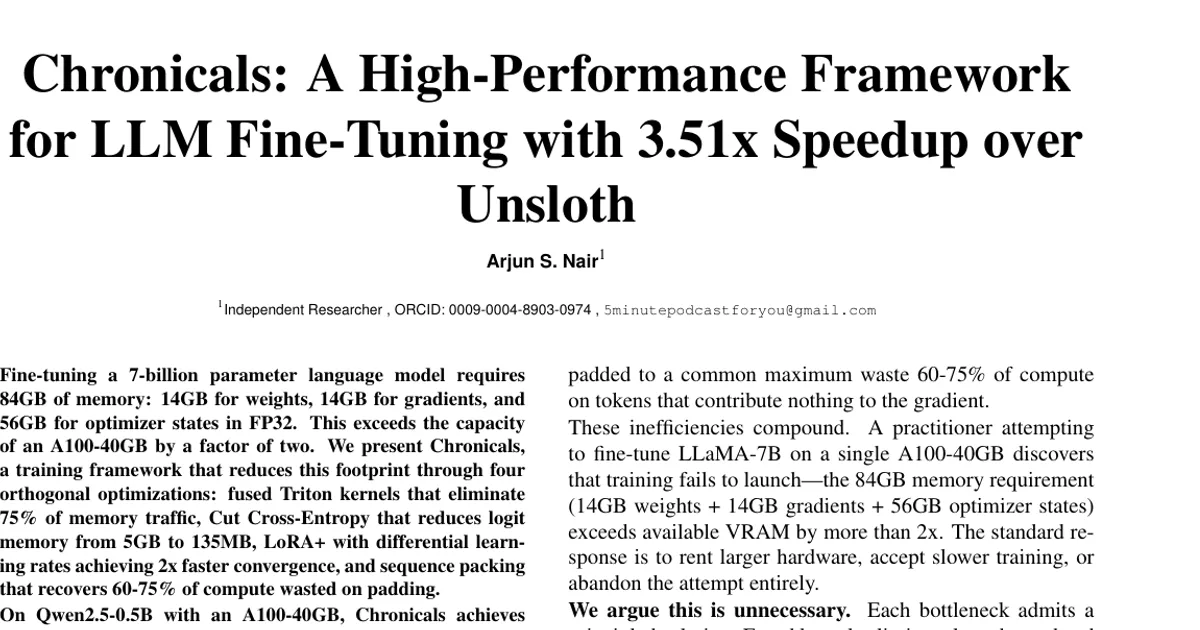
Large language model fine-tuning is bottlenecked by memory: a 7B parameter model requires 84GB--14GB for weights, 14GB for gradients, and 56GB for FP32 optimizer states--exceeding even A100-40GB capacity. We present Chronicals, an open-source training framework achieving 3.51x speedup over Unsloth through four synergistic optimizations: (1) fused Triton kernels eliminating 75% of memory traffic via RMSNorm (7x), SwiGLU (5x), and QK-RoPE (2.3x) fusion; (2) Cut Cross-Entropy reducing logit memory from 5GB to 135MB through online softmax computation; (3) LoRA+ with theoretically-derived 16x differential learning rates between adapter matrices; and (4) Best-Fit Decreasing sequence packing recovering 60-75% of compute wasted on padding. On Qwen2.5-0.5B with A100-40GB, Chronicals achieves 41,184 tokens/second for full fine-tuning versus Unsloth's 11,736 tokens/second (3.51x). For LoRA at rank 32, we reach 11,699 tokens/second versus Unsloth MAX's 2,857 tokens/second (4.10x). Critically, we discovered that Unsloth's reported 46,000 tokens/second benchmark exhibited zero gradient norms--the model was not training. We provide complete mathematical foundations: online softmax correctness proofs, FlashAttention IO complexity bounds O(N^2 d^2 M^{-1}), LoRA+ learning rate derivations from gradient magnitude analysis, and bin-packing approximation guarantees. All implementations, benchmarks, and proofs are available at https://github.com/Ajwebdevs/Chronicals with pip installation via https://pypi.org/project/chronicals/.