Research
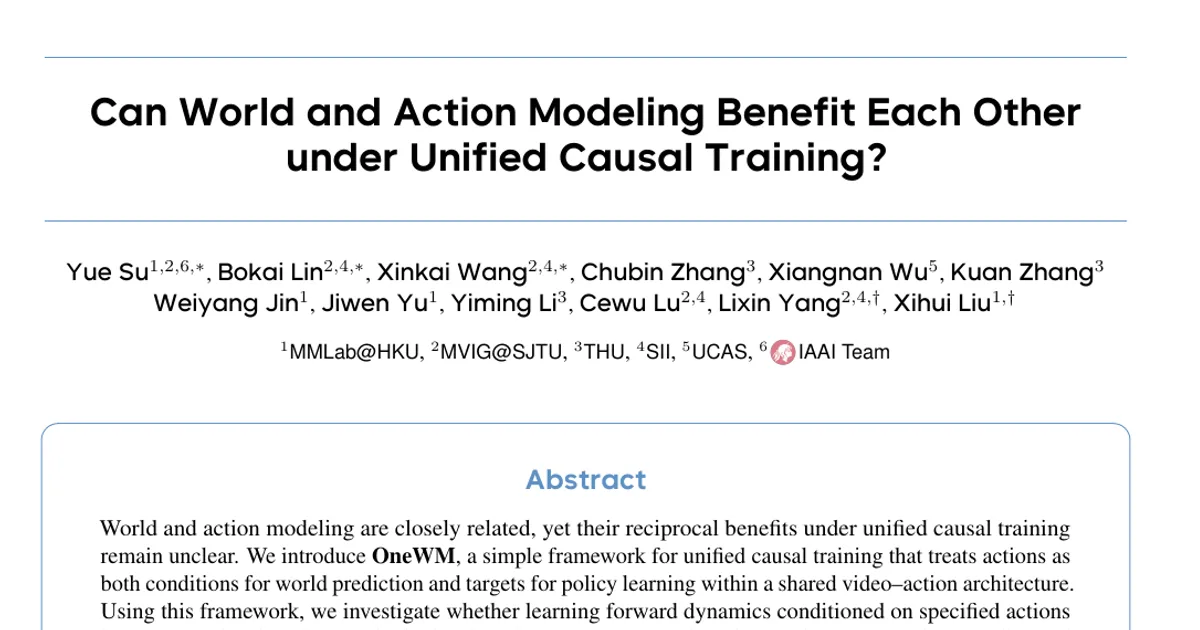
Can World and Action Modeling Benefit Each Other under Unified Causal Training?
Overview Research area: Robot learning / embodied AI — specifically world-action models (WAMs) that combine video-based world modeling with visuomotor policy learning. Technical level: Advanced. The p
- arXiv
- 2610.21095
- Published
- 2026-10-15
- Authors
- Yue Su, Bokai Lin, Xinkai Wang, Chubin Zhang, Xiangnan Wu, Kuan Zhang, Weiyang Jin, Jiwen Yu, Yiming Li, Cewu Lu, Lixin Yang, Xihui Liu
AI summary
Overview
Research area: Robot learning / embodied AI — specifically world-action models (WAMs) that combine video-based world modeling with visuomotor policy learning.
Technical level: Advanced. The paper assumes familiarity with diffusion/flow-matching generative models, mixture-of-transformers (MoT) architectures, causal attention masking, and robot policy benchmarks.
Scope: A controlled empirical study of whether action-conditioned world modeling and action generation produce reciprocal benefits when trained together in a single temporally causal video–action model, evaluated on LIBERO, LIBERO-Plus, RoboCasa365, and three real-world manipulation tasks.
What This Paper Is About
Robotics research has produced two related but usually separate capabilities: world models that predict future video given specified actions, and policies that generate actions from observations. Recent "world-action models" mix these, but it has remained unclear whether each task actually helps the other — especially when the model is forced to respect temporal causality rather than using bidirectional attention over noisy variables.
The paper introduces OneWM, a framework that trains both objectives in one shared causal architecture and directly tests two questions: does learning the visual consequences of clean, specified actions improve action learning, and does learning to generate actions in turn improve action-conditioned video prediction? The authors answer both positively through controlled, architecture-matched comparisons.
Key Contributions
-
A unified causal training framework (OneWM). A temporally causal mixture-of-transformers model in which a video expert and an action expert exchange information through causal joint attention, with actions appearing in three roles within each batch: all-clean (conditioning only), partial-clean (clean prefix plus noisy suffix), and all-noisy (pure generation target).
-
A direct answer to the "does world modeling help actions?" question. By comparing OneWM against two architecture-matched WAM variants — one that masks actions from video prediction (WAM_mask) and one conditioned on noisy actions (WAM_noisy) — the paper isolates the effect of learning forward dynamics from clean actions.
-
A direct answer to the converse question. By comparing OneWM against a world-model-only baseline (WM) sharing the same MoT backbone and clean-action inference conditions, the paper isolates the effect of adding an action-prediction objective to video prediction.
-
An analysis of the conditioning mixture and a compositional "endless dream" rollout. The authors sweep all-noisy/partial-clean/all-clean ratios (60/25/15, 50/35/15, 30/45/25) and show the two inference modes can be chained for 16 rounds without extra training.
Main Findings
-
Clean-action world modeling improves policies. On LIBERO, OneWM reaches 94.95% average success versus 92.45% (WAM_mask) and 92.60% (WAM_noisy), with gains in spatial, object, and long-horizon suites and parity on goal tasks.
-
The generalization gain is larger than the in-distribution gain. On LIBERO-Plus, OneWM scores 59.27% overall versus 53.37% (WAM_mask) and 52.50% (WAM_noisy), with the strongest improvement under sensor noise (67.08% versus 50.41%). Benefits are uneven under lighting changes and robot-initialization shifts.
-
OneWM beats a strong bidirectional baseline only out of distribution. Fast-WAM scores 97.60% on LIBERO versus OneWM's 94.95%, but OneWM outperforms it across all seven LIBERO-Plus perturbation categories (59.27% versus 49.70% overall).
-
Complex and mobile manipulation improve substantially. On RoboCasa365, OneWM reaches 36.68% overall versus 28.32% (WAM_mask), 21.90% (GR00T N1.6), 20.70% (GigaWorld-Policy), 16.90% (π0.5), and 14.80% (π0). Atomic-seen success rises to 68.78% from 55.89%, and composite-seen to 30.25% from 19.63%.
-
Real-world manipulation confirms the policy benefit. Over three tasks (block stacking, block insertion, breakfast arrangement), OneWM's overall success is 66.7% versus 48.9% for WAM_mask, with the paper highlighting insertion and breakfast arrangement as the largest gains; each model was evaluated over 15 trials per task.
-
Action learning improves world prediction. OneWM achieves the best PSNR, SSIM, and LPIPS on all three benchmarks among the compared world models. On LIBERO: PSNR 22.95 versus 22.33 (WM), SSIM 0.8423 versus 0.8325, LPIPS 0.1458 versus 0.1529. On LIBERO-Plus: PSNR 21.05 versus 20.54. On RoboCasa365: PSNR 25.21 versus 24.72.
-
Distributional metrics are more mixed. The AdaLN-based baseline (WM_AdaLN) achieves better FID/FVD in some settings — for example, LIBERO-Plus FID 15.91 and FVD 29.53, and RoboCasa365 FVD 15.98 — which the authors attribute to the difference between paired prediction metrics and marginal feature-distribution metrics.
-
The training mixture is only moderately sensitive. Moving from 60/25/15 to 50/35/15 gives a small in-distribution policy gain (95.95% versus 94.95% on LIBERO) while slightly weakening LIBERO-Plus (56.98% versus 59.27%). A larger shift to 30/45/25 keeps world-prediction metrics roughly stable but collapses policy performance to 87.80% on LIBERO and 38.01% on LIBERO-Plus.
-
The two capabilities compose. In the "endless dream" loop, the model alternates action generation and action-conditioned prediction for 16 rounds, producing 512 actions and a modeled horizon of 25.6 seconds without additional environment observations or training.
Methodology in Plain English
The authors build one model with two "experts" — one for video and one for actions — connected by an attention scheme that enforces time order. A video query at a future frame can look at past and current video frames plus actions up to that frame; an action query can look at the observed (clean) video context and its own earlier actions. Tokens inside the same frame or action segment interact freely, but nothing looks ahead. The video expert is initialized from a pretrained Wan2.2-TI2V-5B model and reuses its VAE and text encoder; each expert has its own text cross-attention for the language instruction.
The central trick is how actions are fed in. Each training example picks a clean-prefix length r: if r equals the full chunk, all actions are clean and only the video loss applies (pure forward-dynamics learning). If r is zero, all actions are noisy and must be denoised from the visual context (pure action generation). If r is in between, a clean prefix conditions denoising of the remaining noisy suffix. Both experts are trained with flow matching, with independently sampled noise levels and a weighted sum of video and action losses. The default batch mixes 60% all-noisy, 25% partial-clean, and 15% all-clean examples.
To attribute any gains correctly, every comparison uses the same data, batch size, and training budget. WAM_mask blocks action-to-video attention; WAM_noisy conditions video on noisy actions; WM drops the action loss entirely; WM_AdaLN injects actions via adaptive layer normalization on the same backbone. At inference, the model runs in one of two modes — clean actions fixed while video is denoised, or actions denoised from noise conditioned on the observation — and for closed-loop control a new action chunk is generated at each replanning step. World-prediction quality is measured on video sets built from 100 expert-rollout episodes per benchmark (π0.5 for LIBERO/LIBERO-Plus, Xiaomi-Robotics-1 for RoboCasa365), scoring eight future frames per chunk across external and wrist cameras.
Why This Matters
The paper turns a vague intuition — "video pretraining helps policies" — into a controlled causal-training experiment with architecture-matched controls, and it shows the benefit runs in both directions rather than one. For research, it clarifies that what matters is not merely adding a video branch but making specified actions the conditioning signal for forward-dynamics prediction, distinguishing this from joint denoising where actions are noisy variables. It also adds a data point to a live disagreement in the literature: WorldVLA reports mutual benefits under discrete autoregressive modeling, while Cosmos 3 reports a small decline in video fidelity from co-training, and this work shows reciprocal gains are achievable under temporal causality with the right conditioning mixture.
Real-world applications:
- General-purpose manipulation policies that must stay reliable when backgrounds, camera placement, layouts, and robot initializations change between training and deployment.
- Mobile manipulation in cluttered and articulated environments, such as the RoboCasa365 kitchen-style settings involving base motion and fixtures.
- Learned simulators for policy evaluation, where predicted futures must actually follow the supplied commands rather than merely look plausible.
- Long-horizon imagination-based rollouts for task rehearsal or planning, using the demonstrated 16-round closed-loop generation.
Industry relevance: the recipe is architecture-level and does not require new sensors or human-in-the-loop labeling beyond ordinary demonstrations, making it attractive for robot foundation-model teams. The mixture study gives a practical tuning signal — pushing too much clean-action conditioning erodes policy generalization, so the deployment-style all-noisy share should be preserved.
Future Directions
- Scaling the reciprocal effect. The authors explicitly call for studying how mutual benefit scales with more diverse data and longer interaction horizons.
- From joint training to planning. A stated next step is using the learned dynamics for planning and policy improvement, extending prediction–control interaction beyond shared training.
- Better mixture schedules. The 30/45/25 result shows policy degradation under heavy clean conditioning while world-prediction metrics hold; how to schedule or adapt the mix (rather than fix it) remains open.
- Reconciling metric families. Because paired metrics (PSNR, SSIM, LPIPS) favor OneWM while FID/FVD sometimes favor the AdaLN baseline, the relationship between action-faithful prediction and distributional realism needs further characterization; the appendix sketches a start via local geometry and action-dependent motion.
Target Audience
Robotics and embodied-AI researchers working on world-action models, video-based policy learning, or diffusion/flow-matching architectures for control. It is most useful to readers who want a carefully controlled ablation of why video co-training helps policies, and to practitioners deciding how to condition a video branch on actions in their own models. Readers without background in generative video models or transformer attention masking will find the method sections demanding, though the experimental logic is legible on its own.
Authors’ abstract
World and action modeling are closely related, yet their reciprocal benefits under unified causal training remain unclear. We introduce OneWM, a simple framework for unified causal training that treats actions as both conditions for world prediction and targets for policy learning within a shared video-action architecture. Using this framework, we investigate whether learning forward dynamics conditioned on specified actions improves action learning, and whether learning to generate actions in turn improves action-conditioned world modeling. We use LIBERO, LIBERO-Plus, and RoboCasa365 as embodied testbeds to evaluate both policy learning and world modeling, complemented by real-world policy experiments. Learning the visual consequences of specified actions improves policy performance and generalization across changing scenes. In turn, action learning improves multi-view world-prediction fidelity under the same architecture. Together, these results answer both questions positively, supporting reciprocal benefits between world modeling and action generation under unified causal training.