Research
Calibration as a First-Class Criterion in LLM Evaluation
Overview Research area: Natural Language Processing — evaluation methodology for large language models, specifically model calibration (the alignment between expressed or implicit confidence and empir
- arXiv
- 2609.26489
- Published
- 2026-09-22
- Authors
- Mario Sanz-Guerrero, Katharina von der Wense
AI summary
Overview
Research area: Natural Language Processing — evaluation methodology for large language models, specifically model calibration (the alignment between expressed or implicit confidence and empirical correctness).
Technical level: Beginner-Friendly. This is a position paper that argues for a change in evaluation conventions; it explains calibration metrics from first principles rather than presenting new experiments.
Scope: A position paper arguing that calibration should be reported as a standard, first-class criterion alongside accuracy, F1, BLEU, and ROUGE in all LLM evaluation, rather than remaining a niche subfield topic.
What This Paper Is About
NLP research routinely releases new models, datasets, and benchmarks that report accuracy, F1, BLEU, or ROUGE — but almost never report whether the model's confidence is meaningful. This paper argues that the barrier is not a lack of methods (calibration metrics have existed for decades) but a lack of adoption, and that this gap undermines trustworthy evaluation both at deployment time and inside the research pipeline itself. The authors' goal is to make calibration a standard evaluation criterion: paired with the primary metric on every task, reported on leaderboards, and treated as an essential model property rather than a specialized curiosity.
Key Contributions
- A diagnosis of the adoption gap, backed by a review of model releases. The authors reviewed the public technical reports and model cards for GPT-5.5, Claude Sonnet 4.6, Gemini 3.5 Flash, DeepSeek V3.2, Llama 3, Qwen3, Gemma 3, GPT-OSS, and OLMo 3. All report results on dozens of capability and safety benchmarks; none reports calibration. The GPT-4 technical report is named as a notable earlier exception that documented how RLHF affects calibration, a practice later releases did not continue.
- A two-part taxonomy of harm from miscalibration. The paper separates deployment harms (overconfident errors in high-stakes domains and agentic pipelines) from research-pipeline harms (LLM-as-a-judge, synthetic data generation, active learning, data filtering, and uncertainty-guided retrieval, all of which assume confidence is meaningful without checking it).
- A clarification that existing metrics are sufficient for most benchmarks. The paper shows that ECE, Brier score, and AUROC each require only two inputs per example — a confidence score and a correctness judgment — and that most current benchmarks already supply both. The obstacles are definitional (which confidence signal to use) rather than mathematical.
- Concrete reporting proposals and an agenda for the open problem. The authors propose adding a calibration column to every benchmark result and major leaderboard, treating its absence in review as a methodological gap comparable to omitting basic training settings, and outline research directions for open-ended generation where the two inputs are still undefined.
Main Findings
- Calibration is distinct from accuracy, and both matter. A model that always predicts with confidence 0.7 and is correct 70% of the time is perfectly calibrated even though we cannot know in advance which individual answers are right. Two models that are right 90% of the time are not interchangeable: a calibrated model's 10% errors are flagged rather than looking identical to its correct answers.
- LLMs express confidence in at least three non-interchangeable ways. Token and sequence probabilities (including length-normalized sequence probability), verbalized confidence ("I am 80% sure"), and behavioral signals such as hedging, refusing to answer, or expressing doubt. A model can be well calibrated on one and poorly calibrated on another. Users and downstream agents only see generated text, so verbalized and behavioral calibration are what they actually rely on, while token-level calibration remains important for model analysis, training, and selective-prediction systems with direct access to log-probabilities.
- Two sources of uncertainty are treated identically by standard metrics but call for different responses. Aleatoric uncertainty is irreducible and comes from ambiguity in the input; epistemic uncertainty is reducible and reflects a lack of knowledge. The paper argues abstention suits aleatoric uncertainty while retrieval or further training suits epistemic uncertainty.
- Post-training degrades calibration. Base models are reasonably well calibrated on multiple-choice tasks, but instruction tuning and RLHF hurt calibration even when accuracy improves. The conversational format itself contributes: instruction-tuned models are significantly more confident in an answer when it is presented to them as their own output than when the same answer is provided by the user. RLHF can also increase sycophancy, where models adjust confidence to agree with the user's beliefs.
- Zero-scoring "I don't know" rewards confident guessing. The paper cites Kalai et al. (2025) on the observation that most benchmarks give the same zero score to saying "I don't know" as to an incorrect answer, making blind guessing strictly preferable to abstaining and directly promoting hallucinations.
- Each standard metric has a specific limitation for LLMs. ECE estimates are bin-sensitive and statistically biased, and reported values depend on rarely justified binning choices; it also assumes a single numerical confidence score over a fixed set of classes. The Brier score is a proper scoring rule (minimized only when predicted probabilities match true empirical frequencies, unlike ECE, which can be pushed toward zero by predicting overall dataset accuracy) but still assumes discrete outcomes and requires reducing free-form text to a binary correct-or-incorrect label. AUROC depends only on the ranking of confidence scores rather than their numerical values, so a model that inflates every confidence by the same amount keeps the same AUROC — measuring ranking rather than calibration.
- Miscalibration harms high-stakes users who take confidence at face value. Legal evaluations show hallucinated case citations and fabricated court decisions delivered with complete confidence, and medical question answering shows hallucinated clinical facts and incorrect drug dosages that non-expert users cannot easily detect. The danger is not only that the model errs but that it gives no warning; a model that hedges on every response is equally a calibration failure.
- Agentic and reasoning systems propagate the problem. In chained pipelines (planner, retriever, executor), overconfident mistakes in one component propagate into subsequent steps, and frontier models can take actions at very low probabilities that standard calibration metrics will not see. In step-by-step reasoning, an overconfident error early in a trace often leads to an incorrect final response, so measuring only the final answer misses internal mistakes.
- Standard metrics already apply to most benchmarked tasks. Correctness criteria are established in subfields — exact match in question answering, unit test pass rates in coding, verified final answers in mathematics — so wherever correctness is binary or can be made binary with a standard threshold, existing calibration metrics work directly. This covers most benchmarks in the reviewed technical reports, which focus on multiple-choice, short-answer, math, and code generation.
- Open-ended generation is the unresolved case. When many different answers are valid, there is no single target sequence whose probability can be measured, making both confidence and correctness harder to define. Verbalized estimates can be elicited on almost any task, but they are sensitive to prompt phrasing, lack standardization across benchmarks, and conflate whether the model internally knows it is uncertain with whether it expresses that uncertainty accurately in words.
Methodology in Plain English
This is a position paper with no new empirical experiments; the arguments build on findings from existing literature. The authors proceed in four steps. First, they define calibration for LLMs, distinguishing the three channels through which a model expresses confidence and the two sources of uncertainty (aleatoric and epistemic). Second, they motivate the problem by identifying where miscalibration causes harm — deployment settings such as law and medicine, agentic and reasoning pipelines, and the research pipeline practices that silently depend on trustworthy confidence. Third, as evidence for the adoption gap, they review public technical reports and model cards across nine recent model families to check whether calibration is reported at all. Fourth, they take stock of existing metrics (ECE, Brier score, AUROC, accuracy-rejection curves), identify exactly where each breaks down, and separate what can be adopted immediately from what still requires research — arguing the two tracks should proceed in parallel rather than sequentially.
Why This Matters
Impact on research. If calibration were reported alongside primary metrics, evaluation would answer not only "did the model produce the correct output?" but "should we trust this output?" The paper argues the absence of calibration reporting propagates bias through the research pipeline: miscalibrated judges distort rankings, win rates, and reported improvements in LLM-as-a-judge evaluation; miscalibrated generators produce confident errors that the next round of training learns from in synthetic data generation; and miscalibrated confidence scores cause active learning, data filtering, and uncertainty-guided retrieval to select the wrong data points. Training optimizes what is measured, so leaving calibration unmeasured means standard training pipelines will continue to degrade it.
Real-world applications.
- Legal assistance: hallucinated case citations and fabricated court decisions delivered with full confidence, where practitioners may act on them.
- Medical question answering: hallucinated clinical facts and incorrect drug dosages that non-expert users cannot detect.
- Autonomous agents and tool-use pipelines: confidence is the signal that tells a system whether to act, ask for user input, or stop, so miscalibration at any component propagates into subsequent steps.
- Reasoning and chain-of-thought systems: overconfident errors early in a trace lead to incorrect final responses, so evaluating only the final answer hides the failure.
Industry relevance. Model developers already publish results on dozens of capability and safety benchmarks, so adding a calibration score is a reporting convention change rather than a new capability requirement. The paper argues the reason it is not standard practice is convention, not difficulty. Deployment teams, leaderboard maintainers, and reviewers are the levers: benchmark results would carry a calibration column, major leaderboards would add one, and reviewers would treat its absence as a methodological gap comparable to omitting basic training settings.
Future Directions
- Define confidence and correctness for free-form generation. The paper identifies this as the central open research problem, since most modern LLM applications involve open-ended output. Grouping generated responses by meaning rather than surface wording is offered as a starting point, but standardizing approaches and analyzing how they perform across tasks remains open.
- Adopt reporting norms on tasks where metrics already work. Every subfield should pair its primary metric — BLEU and COMET in machine translation, ROUGE in summarization, F1 in information extraction, win rates in instruction following, accuracy in QA — with a calibration score. Machine translation already has a viable confidence signal in quality estimation, which predicts translation quality without a reference, yet quality estimation scores are rarely reported alongside BLEU as an intrinsic property of the translation model. This track should proceed in parallel with, not after, research on harder tasks.
- Standardize verbalized confidence as an evaluation target in its own right. This requires standardized prompt formats, consistent scoring methods, and analyses that distinguish between what a model internally knows and what it actually says. The paper cites Ulmer et al. (2026), who argue verbalized uncertainty should reflect natural human communication, since users interpret model statements the way they interpret human conversation.
- Extend the same treatment to attribution. Calibration answers when to believe an output; attribution answers why by identifying which training examples most influenced it. Attribution methods are not yet as mature as calibration metrics but face the same adoption challenge, and the authors argue they should also become standard reported properties of every model once practical.
Target Audience
NLP and machine learning researchers who design benchmarks, evaluate models, or build pipelines on top of LLM outputs; model developers and technical-report authors deciding what to publish; benchmark and leaderboard maintainers; and area chairs or reviewers who shape methodological expectations. It is also useful for practitioners deploying LLMs in high-stakes domains such as law, medicine, and autonomous agents, and for readers new to calibration who want a clear, complete framing of what the property means, how it is measured, and why it is currently missing from mainstream evaluation.
Authors’ abstract
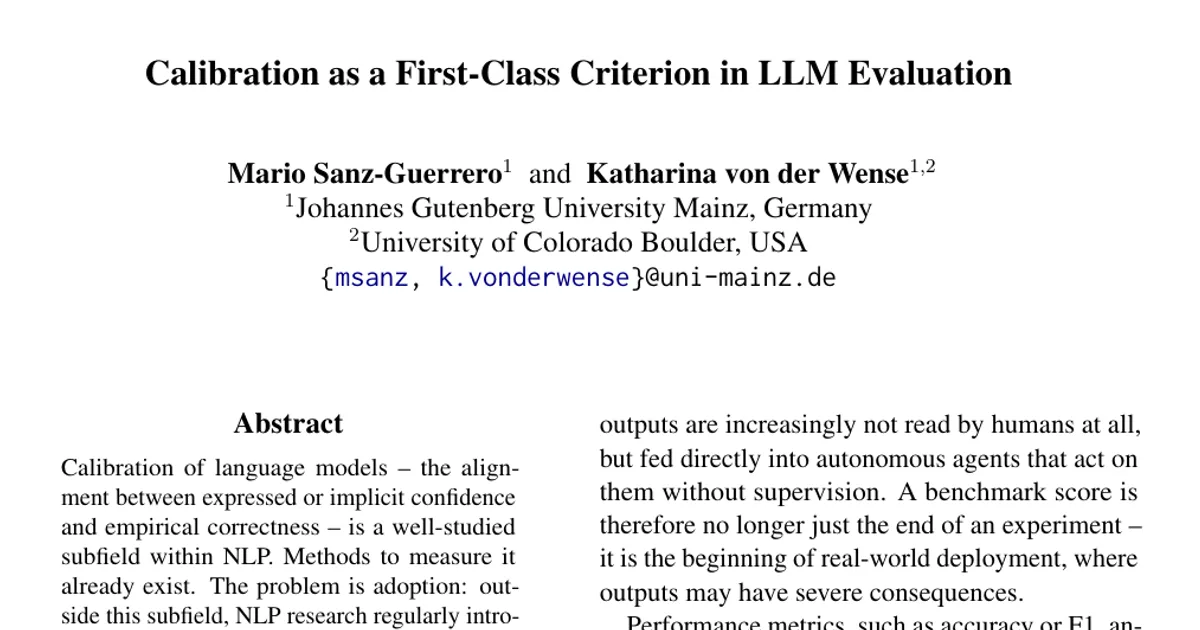
Calibration of language models -- the alignment between expressed or implicit confidence and empirical correctness -- is a well-studied subfield within NLP. Methods to measure it already exist. The problem is adoption: outside this subfield, NLP research regularly introduces new models, datasets, and benchmarks without checking whether the model's confidence scores are meaningful. We argue that this adoption gap is a major obstacle to trustworthy LLM evaluation. Miscalibration causes problems in two distinct areas: at deployment, where overconfident mistakes cause real harm, and inside the research pipeline, where methods like LLM-as-a-judge, synthetic data generation, and active learning rely on calibrated confidence without verifying it. Standard calibration metrics only require two inputs per example: a confidence score and a correctness judgment. Most benchmarks in use today already provide both, meaning calibration can be reported immediately. For open-ended generation, however, defining these two inputs is still an open challenge. We argue that each NLP subfield should pair its main performance metric with a calibration score and call for treating calibration as an essential property of every model rather than a niche topic.