Research
Bridging the Basilisk Astrodynamics Framework with ROS 2 for Modular Spacecraft Simulation and Hardware Integration
Overview Research area: Space robotics and astrodynamics simulation tooling — specifically, interoperability between a high-fidelity orbital dynamics simulator (Basilisk) and the Robot Operating Syste
- arXiv
- 2512.09833
- Published
- 2025-12-10
- Authors
- Elias Krantz, Ngai Nam Chan, Gunnar Tibert, Huina Mao, Christer Fuglesang
AI summary
Overview
Research area: Space robotics and astrodynamics simulation tooling — specifically, interoperability between a high-fidelity orbital dynamics simulator (Basilisk) and the Robot Operating System 2 (ROS 2) middleware.
Technical level: Intermediate. The paper is readable by anyone familiar with robotics middleware, but the formation control section assumes prior exposure to orbital mechanics (Hill frame, Clohessy-Wiltshire equations) and nonlinear model predictive control (NMPC).
Scope in one sentence: The paper presents an open-source, non-invasive ZeroMQ-based communication bridge that connects Basilisk simulations to ROS 2 nodes, and validates it by running the identical NMPC formation-flying controller in both Basilisk and on the KTH ATMOS planar microgravity testbed.
What This Paper Is About
Spacecraft autonomy development needs both high-fidelity orbital dynamics (which general robotics simulators like Gazebo and Isaac Sim lack) and modular, reusable control software (which Basilisk does not natively provide in the ROS 2 ecosystem). The paper's goal is to remove the friction between these two worlds by building a lightweight bridge that lets autonomy stacks run as ordinary ROS 2 nodes while Basilisk handles the physics, without editing Basilisk's core. The authors then check that a single, unmodified control implementation behaves comparably in simulation and on real hardware.
Key Contributions
- A lightweight, scalable communication interface connecting ROS 2 nodes to Basilisk simulations without modifying Basilisk's internal architecture.
- A demonstration in a leader-follower spacecraft formation flying scenario using Nonlinear Model Predictive Control, fully implemented as ROS 2 nodes.
- Comparative validation in both simulation and hardware using the KTH ATMOS free-flyers, showing consistent control performance across platforms.
The authors also release three open-source repositories: BSK-ROS2-Bridge, bsk-msgs (ROS 2 message definitions generated from Basilisk's native message types), and bsk-ros2-mpc (the demo MPC).
Main Findings
- Bridge architecture: The bridge consists of a ROS 2 node plus a Basilisk-side Python handler module. They exchange JSON-formatted byte messages over ZeroMQ on three ports — receive, transmit, and heartbeat (used for monitoring connection health). Basilisk's simulation time is published to ROS 2 on the
/clocktopic, keeping all ROS 2 nodes synchronized in both real-time and accelerated simulation modes. - Topic convention: Message routing is registered programmatically in the Basilisk script, using topics of the form
/[ns]/bsk/[direction]/[topic], where[direction]isin(ROS 2 to Basilisk) orout(Basilisk to ROS 2). A single bridge-handler pair can manage any number of spacecraft with namespace-aware topics. - Formation tracking accuracy: Followers maintained formation within 0.17 m in simulation and 0.35 m on hardware. On the ATMOS platforms a steady-state offset appeared across all agents, attributed to unmodeled disturbances such as floor unevenness and actuation asymmetries.
- Controller transferability: Without changes to the controller implementation or architecture, the same ROS 2-based control nodes operated in both high-fidelity simulation and hardware. The transition to ATMOS required only substituting Basilisk topics with those used by PX4, a remapping the authors note can be automated.
- Communication performance (AMD Ryzen 5 5600X, Ubuntu 24.04): At nominal load the bridge sustained 100 Hz per agent with low jitter (standard deviation 1.3 ms for one spacecraft, 6.5 ms for 100 spacecraft). Single-agent high-load tests reached about 4,390 Hz at 1x speed and 4,270 Hz at 100x speed when targeting 10,000 Hz. With 100 spacecraft and a 1,000 Hz target under 100x speed, it saturated near 270 Hz per agent with 2.4 ms standard deviation. The similarity of limits under 100x accelerated simulation indicates CPU-bound throughput rather than timing constraints.
Methodology in Plain English
The authors built a translator, not a modification. On the Basilisk side, a handler module follows the standard Python module structure and is imported into a simulation script like any other module; it uses Basilisk's existing ZeroMQ support (the same messaging protocol the Vizard visualization tool relies on). On the other side, a ROS 2 node joins the ROS 2 network like any other node and needs no manual topic configuration. Data flows both ways as JSON messages, and simulation time is broadcast on /clock so every node stays in step with the simulation.
To test the bridge, the team set up a formation flying task with one leader and two followers. Each agent runs its own decentralized NMPC, solved in real time with the ACADOS solver over a prediction horizon of N = 30 steps with a timestep of 0.2 s. Controllers ran at 5 Hz, each producing a 13-dimensional state (relative position, velocity, unit quaternion, angular velocity) and a 6-dimensional control input (body-frame force and torque). The cost penalizes position, velocity, attitude and angular-velocity error, plus control effort, with terminal weighting P = 20 Q. Each agent shares its predicted trajectory each control step so others can enforce pairwise collision-avoidance separation constraints — predictive conflict resolution without centralized planning.
The leader follows a cyclic waypoint sequence, transitioning every 20 s; followers hold fixed offsets of −1.0 m in the Hill-frame x-axis and ±0.3 m in the Hill-frame y-axis relative to the leader, while aligning attitude with it. In simulation, three spacecraft are placed in a near-circular Low-Earth orbit with semi-major axis a = 6778.0 km, eccentricity e = 0.001, inclination i = 45°, right ascension of the ascending node Ω = 270°, and argument of periapsis ω = 90°.
The hardware and simulation share parameters: each spacecraft has a mass of 17.8 kg and moment of inertia J_zz = 0.315 kg m², with the simulation assuming J_xx = J_yy = J_zz for simplicity. Each ATMOS free-flyer has eight solenoid thrusters using compressed air for holonomic 3-degree-of-freedom motion (planar x, y, and yaw θ_z), while the simulation expands this to twelve symmetrically arranged thrusters for full 6-degree-of-freedom actuation in 3D. Because the hardware is thruster-only, reaction wheels are excluded in both. Maximum thrust is 3.0 N in the body x and y axes, and maximum torque about body yaw is 0.51 N m. Thrusters are actuated by pulse width modulation at 10 Hz, each producing approximately 1.5 N when active; the simulation enforces a minimum on-time of 1 ms to mimic hardware limits.
Why This Matters
Research impact: The bridge decouples control logic from the simulation engine, letting researchers iterate on autonomy algorithms in ROS 2 while retaining orbital dynamics fidelity that general-purpose robotics simulators do not offer. It also gives the space robotics community a route to reproducible workflows: the same code that runs in simulation can run on a testbed, which strengthens the link between published results and hardware verification.
Real-world applications:
- Formation flying and distributed spacecraft missions, which require precise relative control and coordination (demonstration missions cited include PRISMA and PROBA-3, with recent efforts targeting sub-meter accuracy).
- Ground-based hardware-in-the-loop testing of planning and control algorithms in microgravity-analog facilities.
- Free-flying robotic platforms aboard orbital stations, in the lineage of NASA's Astrobee free-flyers on the ISS.
- Future contact-dynamics work such as spacecraft docking, articulated manipulators, deployable structures, and flexible appendages, which the authors name as candidates for the bridge plus Basilisk's module library.
Industry relevance: ROS 2 has become the standard for modular, real-time robotics software, and Space ROS is a safety-focused fork developed by NASA and collaborators for mission-critical space robotics. A bridge that keeps Basilisk's core untouched and works with existing Basilisk message infrastructure lowers the barrier for teams already fluent in robotics middleware to adopt high-fidelity astrodynamics simulation, and helps avoid maintenance overhead tied to specific message definitions or ROS 2 versions — a problem the authors attribute to earlier tightly coupled integrations.
Future Directions
- Software-in-the-loop and hardware-in-the-loop pipelines. The current setup was executed in open-loop configuration, with no SIL or HIL feedback between Basilisk and the hardware; the authors state the bridge architecture inherently supports closed-loop setups and call enabling them a promising avenue.
- Scaling to larger constellations. The formation demo was intentionally constrained to a planar 2D setting with one leader and two followers. Bridge stress tests already probed 100 spacecraft, but larger, more realistic formations remain to be exercised end to end.
- Contact dynamics and articulated systems. Leveraging Basilisk's broader module library — realistic sensors, actuator models, environmental disturbances, flight software architectures — for docking, manipulators, deployable structures, and flexible appendages.
- Automating topic remapping. The authors note that the Basilisk-to-PX4 topic substitution performed manually for the ATMOS deployment could be easily automated.
Target Audience
Spacecraft autonomy and controls engineers who already work in ROS 2 and want high-fidelity orbital dynamics without rewriting their stacks inside a simulator; astrodynamics researchers who need to test flight-software-style control architectures; testbed operators running planar or microgravity-analog facilities; and robotics researchers generally interested in how to bridge domain-specific physics engines with general-purpose middleware. Readers looking for new NMPC theory or new orbital dynamics formulations will not find them here — the controller formulation is standard, and the contribution is the integration layer and its cross-platform validation.
Authors’ abstract
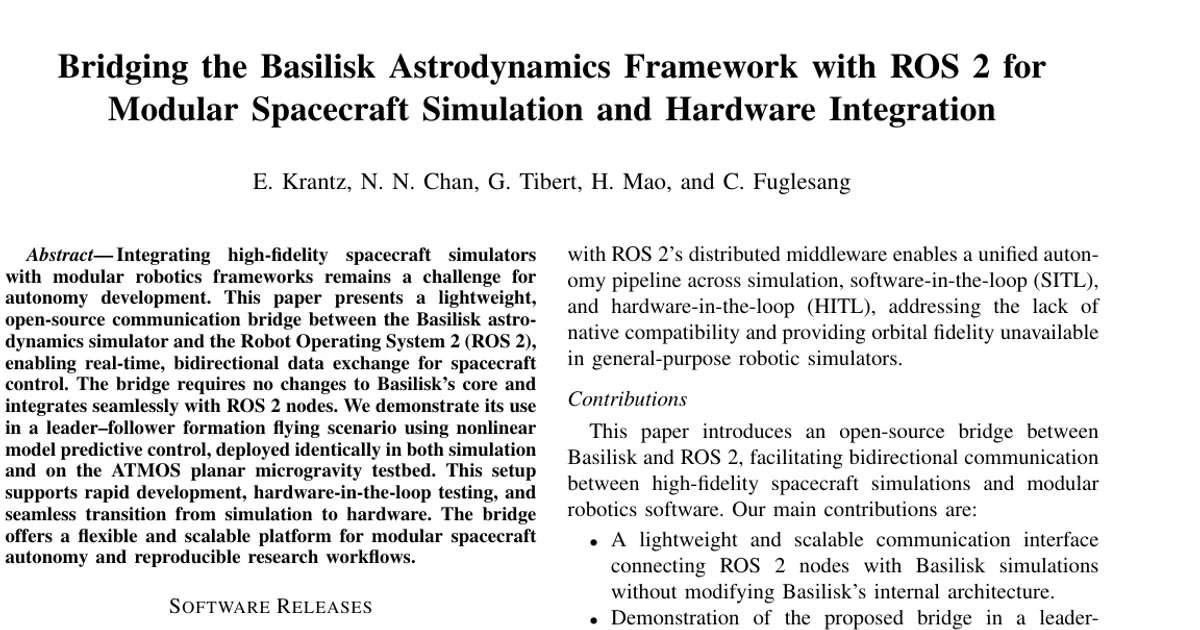
Integrating high-fidelity spacecraft simulators with modular robotics frameworks remains a challenge for autonomy development. This paper presents a lightweight, open-source communication bridge between the Basilisk astrodynamics simulator and the Robot Operating System 2 (ROS 2), enabling real-time, bidirectional data exchange for spacecraft control. The bridge requires no changes to Basilisk's core and integrates seamlessly with ROS 2 nodes. We demonstrate its use in a leader-follower formation flying scenario using nonlinear model predictive control, deployed identically in both simulation and on the ATMOS planar microgravity testbed. This setup supports rapid development, hardware-in-the-loop testing, and seamless transition from simulation to hardware. The bridge offers a flexible and scalable platform for modular spacecraft autonomy and reproducible research workflows.