Research
Breaking the Vision-Action Shortcut: Latent Interface Training for Generalizable Robotics Foundation Models
Overview Research area: Robot learning and robotics foundation models, specifically vision–language–action (VLA) and world–action model (WAM) architectures for manipulation. Technical level: Intermedi
- arXiv
- 2609.12641
- Published
- 2026-09-11
- Authors
- Jianman Lin, Shailesh Shailesh, Zhongyi Luo, Jiafei Duan
AI summary
Overview
Research area: Robot learning and robotics foundation models, specifically vision–language–action (VLA) and world–action model (WAM) architectures for manipulation.
Technical level: Intermediate. The paper assumes familiarity with robot foundation model architectures, action chunking, flow-matching objectives, SE(3) end-effector poses, and attention mechanisms.
Scope: The paper proposes and evaluates Latent Interface Training (LIT), a two-stage, model-agnostic training strategy intended to reduce "vision–action shortcuts" in robot foundation models while preserving task-relevant spatial information.
What This Paper Is About
Robot foundation models perform well on the data distribution they are trained on, but degrade when the visual world changes — different camera angles, lighting, backgrounds, or added distractors. The authors argue this happens because action experts can latch onto task-irrelevant visual cues that happen to correlate with actions in the training data, a phenomenon they call "vision–action shortcuts." The goal of the paper is to restructure how visual information reaches the action expert so that the model cannot exploit those spurious correlations, while still retaining the spatial information genuinely needed to produce correct actions.
Key Contributions
- Latent Interface Training (LIT): A model-agnostic two-stage training strategy that combines image-free, spatial-goal-conditioned action pretraining with a pose-supervised latent interface that serves as the action expert's only visual conditioning pathway.
- Cross-architecture evaluation: LIT is integrated into four architectures — π_0.5 and MolmoAct2 (VLAs) and FAST-WAM and ImageWAM (WAMs) — improving overall LIBERO-Plus success by 3.87%–10.70% while preserving or improving average LIBERO success.
- Ablations and counterfactual analyses supporting the claim that LIT mitigates vision–action shortcuts while preserving task-relevant spatial information, including attention visualization and goal-changing/task-preserving visual interventions.
- Real-world evaluation demonstrating robustness to unseen camera configurations, lighting variations, and distractors, with gains of 13.3–16.7 percentage points in success aggregated across three manipulation tasks.
Main Findings
-
In-distribution performance is preserved or improved: On LIBERO, average success goes from 87.75% to 91.80% for π_0.5, from 93.50% to 94.10% for MolmoAct2, from 97.60% to 98.10% for FAST-WAM, and from 98.10% to 98.40% for ImageWAM. No architecture shows an average degradation.
-
Zero-shot LIBERO-Plus generalization improves across all four architectures: Overall success rises from 68.97% to 79.67% (+10.70) for π_0.5, from 63.62% to 71.92% (+8.30) for MolmoAct2, from 51.44% to 60.63% (+9.19) for FAST-WAM, and from 83.02% to 86.89% (+3.87) for ImageWAM. LIT improves 26 of the 28 architecture–perturbation comparisons, with no decrease exceeding 2.11 percentage points.
-
The largest gains appear under viewpoint and sensing shifts: π_0.5 gains 22.01 points under Camera Viewpoints, 12.05 under Sensor Noise, 19.35 under Language Instructions, and 9.11 under Object Layout. MolmoAct2 gains 21.74 under Sensor Noise and 15.71 under Object Layout, but drops 2.11 points under Language Instructions. FAST-WAM gains 27.43 under Camera Viewpoints and 19.19 under Sensor Noise. ImageWAM gains 12.38 under Robot Initial States, 5.98 under Background Textures, and 5.95 under Object Layout, with a 0.92-point decrease under Language Instructions.
-
Real-world gains transfer across three OOD conditions: Aggregated across Keep LEGOs, Wipe trash, and Transfer egg, LIT improves in-distribution success from 74.7% to 88.0%, Lighting OOD from 53.3% to 70.0%, Camera OOD from 30.0% to 46.7%, and Distractors OOD from 50.0% to 63.3%.
-
Task-level real-world results vary in magnitude: On Transfer egg, LIT raises ID success from 52.0% to 92.0%, Lighting OOD from 30.0% to 90.0%, and Distractors OOD from 20.0% to 90.0%. On Wipe trash, LIT matches the baseline under ID conditions while improving Camera OOD from 10.0% to 80.0%.
-
Every component contributes: Removing Stage 1 drops MolmoAct2 OOD success from 71.92% to 68.23% (3.69 points); removing pose supervision drops it to 68.86% (3.06 points, with a 10.75-point drop under Sensor Noise); allowing direct visual access drops it to 67.74% (4.18 points) while LIBERO success stays comparable (94.25% vs. 94.10%).
-
Simpler explanations fall short: Latent-token aggregation without Stage 1 or pose supervision reaches 65.70% OOD (2.08 points above baseline, 6.22 below LIT). An LA4VLA-inspired staged-training alternative reaches 65.46% (6.46 below LIT). Adding pose supervision to the baseline reaches 65.45% (6.47 below LIT).
-
Training dynamics match the intended roles of the two stages: Stage 1 action loss falls to 0.029 after 10K steps; Stage 2 pose-reconstruction loss reaches 0.003 after 20K steps. LIT uses 10K Stage 1 and 20K Stage 2 steps, matching the baseline's 30K-step total budget, and reaches a lower action loss in 20K visual training steps than the baseline reaches in 30K steps (a 0.63× ratio comparing losses at 20K visual training steps).
-
Behavioral evidence suggests reduced shortcut reliance: Attention maps show the baseline's action-to-image attention shifting across perturbations while LIT remains concentrated on task-relevant robot–object regions. Under task-preserving visual interventions (distractor added, image blurred) LIT trajectories stay close to clean counterparts; under a goal-changing intervention, LIT redirects toward the new goal while the baseline continues toward the original one.
Methodology in Plain English
LIT splits training into two stages on top of an existing architecture's frozen pretrained backbone (a VLM or video model) and an embodiment-specific action expert.
Stage 1 — learn to act without seeing. The action expert is trained from scratch to generate action chunks using only the language instruction, the robot state, and the terminal SE(3) end-effector pose of the demonstrated chunk. That pose is an 8-dimensional goal — 3 for world-frame position, 3 for axis-angle orientation, and 2 for gripper joint positions. A small three-layer MLP with GELU activations turns this goal into goal tokens that are concatenated with the backbone's language/state representations to condition each action expert layer. Only the action expert and the pose encoder are updated. Because no image is ever shown, the expert cannot pick up visual shortcuts; it learns goal-directed action generation purely from the spatial target.
Stage 2 — let vision in, but only through one narrow, supervised door. The Stage 1 action expert is used as initialization. A set of 100 learnable latent tokens is introduced. At every coupling layer, these tokens are updated by self-attention, cross-attention to the backbone's semantic (language/state) representations, and cross-attention to the backbone's visual representations — the tokens act as queries while the backbone supplies keys and values. The updated tokens are the action expert's only visual conditioning pathway. An MLP decoder then tries to reconstruct the very same terminal pose that conditioned Stage 1, with the loss weighted at λ_pose = 0.3 and added to the action loss. Stage 2 jointly optimizes the backbone and its modality encoders, the action expert, the latent tokens and interface attention modules, and the decoder. To save parameters, every m consecutive coupling layers share interface attention parameters, indexed by q(ℓ) = ⌈ℓ/m⌉, while still reading their own layer's backbone representations.
Inference. The latent interface stays active; the Stage 1 pose encoder and Stage 2 pose decoder are dropped. The policy needs only visual observations, language, and robot state, and follows each framework's native sampling and execution procedure. The spatial goal is never required at test time.
Evaluation setup. LIBERO covers 40 tasks across LIBERO-Spatial, LIBERO-Object, LIBERO-Goal, and LIBERO-Long, with 50 rollouts per task for 2,000 episodes. LIBERO-Plus evaluates zero-shot generalization under seven task-preserving perturbations — camera viewpoints, sensor noise, robot initial states, language instructions, object layout, lighting conditions, and background textures — over all 10,030 perturbed instances with one rollout each and a fixed seed; "Overall" is the unweighted mean across the seven dimensions. All models are trained only on original LIBERO demonstrations and evaluated on LIBERO-Plus without adaptation. Baselines and LIT start from the same pretrained backbone and randomly initialized action experts, and the authors state they do not fine-tune pretrained VLA or WAM policy checkpoints — so their baseline numbers are not directly comparable to published results from fine-tuning such checkpoints. Real-robot evaluation uses a single multi-task MolmoAct2 policy trained on 300 demonstrations (100 per task), evaluated with 25 rollouts per task under ID conditions (75 total) and 10 rollouts per task per OOD condition (90 OOD rollouts total).
Why This Matters
The paper reframes generalization in robot foundation models from "add more information" (richer representations, depth, traces, reasoning) to "constrain how the action expert is allowed to use visual information." If vision must pass through a narrow, spatially supervised bottleneck, the model is structurally discouraged from depending on incidental visual cues. Demonstrating this across two VLAs and two WAMs, and showing it holds on physical hardware under changed lighting, camera configuration, and distractors, suggests the idea is a general training recipe rather than a single-architecture trick.
Real-world applications:
- Warehouse and logistics manipulation, where cameras are frequently repositioned or replaced and lighting varies between shifts but the task itself is unchanged.
- Home and service robots, which face unpredictable clutter, moved objects, and changing illumination that are irrelevant to the instructed task.
- Agricultural and field robotics, where outdoor lighting and viewpoint change continuously while picking or handling tasks stay the same.
- Manufacturing and lab automation, where cells are re-tooled, backgrounds change, or new distractors enter the workspace without the underlying manipulation changing.
Industry relevance: teams fine-tuning or training VLA/WAM policies on their own demonstration data face exactly the failure mode LIT targets — a policy that works in the demo cell and collapses when the setup changes. Because LIT is framework-agnostic, requires no goal at inference, and matches the baseline's total training step budget, it is a plausible drop-in change to existing training pipelines rather than requiring a new architecture.
Future Directions
- Scaling real-world evaluation. The authors explicitly state that evaluation at larger real-world scales remains open, and that future work will scale LIT to larger and more diverse robot demonstration datasets and a broader range of tasks and environments.
- Understanding the two architectures that gained least. ImageWAM improved overall by 3.87 points, and both MolmoAct2 and ImageWAM showed small decreases under Language Instructions (−2.11 and −0.92), which the paper reports but does not explain in depth.
- Isolating the interface design. The ablations show that latent-token aggregation, staged training, or pose supervision alone cannot reproduce LIT's gains; which aspect of the combination is most critical — and how sensitive results are to choices such as the 100 latent tokens or λ_pose = 0.3 — is not established by the reported experiments.
- Generalization beyond the evaluated benchmarks. All simulation results come from LIBERO and LIBERO-Plus with training only on original LIBERO demonstrations, and the real-robot study uses only the MolmoAct2 baseline across three tasks; whether the recipe holds on other benchmarks, embodiments, and larger model scales is untested here.
Target Audience
Robotics and embodied-AI researchers working on VLA and WAM architectures, imitation learning, and distribution-shift robustness; engineers deploying manipulation policies where cameras, lighting, and scene contents change between training and deployment; and graduate students who want a concrete example of a training-time intervention aimed at shortcut learning, combining action pretraining, latent attention interfaces, and auxiliary spatial supervision.
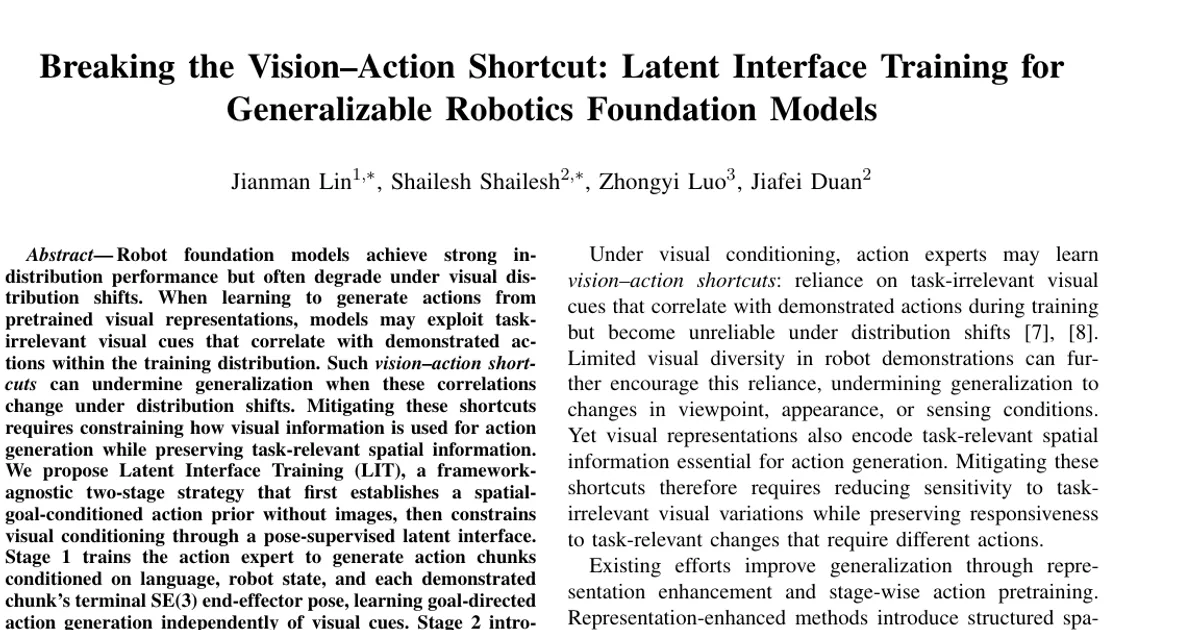
Authors’ abstract
Robot foundation models achieve strong in-distribution performance but often degrade under visual distribution shifts. When learning to generate actions from pretrained visual representations, models may exploit task-irrelevant visual cues that correlate with demonstrated actions within the training distribution. Such vision-action shortcuts can undermine generalization when these correlations change under distribution shifts. Mitigating these shortcuts requires constraining how visual information is used for action generation while preserving task-relevant spatial information. We propose Latent Interface Training (LIT), a framework-agnostic two-stage strategy that first establishes a spatial-goal-conditioned action prior without images, then constrains visual conditioning through a pose-supervised latent interface. Stage 1 trains the action expert to generate action chunks conditioned on language, robot state, and each demonstrated chunk's terminal SE(3) end-effector pose, learning goal-directed action generation independently of visual cues. Stage 2 introduces a latent interface that aggregates visual and semantic representations and serves as the pretrained action expert's only visual conditioning pathway. The interface is supervised to reconstruct the terminal pose previously used to condition Stage 1, encouraging it to retain the goal-relevant spatial information needed for action generation. Across four vision-language-action and world-action architectures (Pi0.5, MolmoAct2, FAST-WAM, and ImageWAM), LIT improves overall LIBERO-Plus success by 3.87-10.70 percentage points while preserving or improving average LIBERO success. Real-world evaluations show 13.30-16.70 percentage-point gains in success aggregated across three tasks under unseen camera configurations, lighting variations, and distractors.