Research
Branching On-Policy Distillation
Overview Research area: Large language model distillation and post-training — specifically on-policy distillation (OPD) for mathematical reasoning and multi-turn LLM agent tasks. Technical level: Inte
- arXiv
- 2610.13481
- Published
- 2026-10-09
- Authors
- Dongyang Chen, Shudong Liu, Shubo Li, Duoxun Tang, Jinwei Liang, Zehuan Wu, Lewei Lu
AI summary
Overview
Research area: Large language model distillation and post-training — specifically on-policy distillation (OPD) for mathematical reasoning and multi-turn LLM agent tasks.
Technical level: Intermediate. The paper assumes familiarity with policy-gradient / PPO-style objectives and KL-based distillation, but its central idea (branch from a shared prefix instead of resampling whole trajectories) is easy to grasp without the math.
Scope: The paper introduces BranchOPD, a shared-prefix sampling scheme that spends a fixed rollout budget on informative decision points rather than on redundant full trajectories, plus an auxiliary "protocol-boundary repair" loss, and evaluates both on mathematics benchmarks and three agent benchmarks.
What This Paper Is About
On-policy distillation trains a small student model on trajectories it generates itself, with a larger teacher scoring every token. The catch is that each trajectory commits to only one continuation at every decision point, so the student never receives supervision on the many alternative histories it could have produced. Simply sampling more independent trajectories mostly regenerates identical or near-identical prefixes, wasting budget. BranchOPD instead forks a few student trajectories at the decisions that look most informative and resamples continuations from those shared prefixes, so the same token budget covers more distinct behavior.
Key Contributions
-
Branching on-policy distillation (BranchOPD). A shared-prefix sampling scheme that scores candidate fork points with student uncertainty and teacher–student disagreement, resamples student-policy continuations from the selected prefixes, and applies token-level teacher supervision to both the main trajectory and the branches. It operates at token-level decisions in mathematics and at turn-then-token decisions in agent tasks.
-
Protocol-boundary repair (PBR). An auxiliary loss over detected protocol events — encouraging beneficial ones (e.g., emitting an end-of-sequence token after a complete mathematical answer) and suppressing harmful ones (e.g., a stray leading closing-thought tag in an agent response) — to reduce repetition and wasted generation. PBR is applied to the baselines as well, so comparisons isolate the effect of branching.
-
Efficiency accounting for shared prefixes. The paper quantifies how much student-generated text is saved by reusing the prefix: approximately 19% on ALFWorld and 31% on WebShop relative to seven independent trajectories.
-
Theoretical and empirical analysis of fork selection. A conditional-unbiasedness proposition for resampled suffixes, a coverage argument with diminishing returns in the number of branches per fork, and ablations showing that where you branch matters (mixed entropy + disagreement beats random, single-signal, and turn-initial branching).
Main Findings
-
Best results across the board. BranchOPD outperforms Vanilla OPD and Multi-Rollout OPD (n = 7) on every evaluated benchmark, including when every method uses PBR. It improves over Vanilla OPD by 18.55 percentage points in mathematics Avg and 13.83 points in mean ALFWorld ID/OOD success.
-
Mathematics (avg@16, %). BranchOPD reaches 81.24 on MATH-500, 26.04 on AIME 2024, 25.83 on AIME 2025, for an Avg of 44.37. For comparison: Vanilla OPD 25.82, Multi-Rollout OPD (n = 7) 27.84, Entropy-Weighted OPD 29.73, EOPD 37.97, SPOT 38.43, KD 33.10, GRPO 35.56. The Qwen3-8B teacher scores 64.64 and the Qwen3-4B-Base student 21.72.
-
Gains over other distillation families. BranchOPD beats KD, GRPO, EOPD, and SPOT by 11.27, 8.81, 6.40, and 5.94 Avg points respectively. Gains are concentrated on the harder benchmarks: over SPOT it improves MATH-500 by 1.36 points but AIME24 by 8.54 and AIME25 by 7.91. GRPO and SPOT use answer verification; BranchOPD uses only teacher supervision.
-
PBR-only comparisons. With PBR applied to every method, BranchOPD's 44.37 mathematics Avg is 5.43 points above Vanilla OPD (+PBR, 38.94) and 5.28 points above Multi-Rollout OPD (+PBR, 39.09), and also above Entropy-Weighted OPD (+PBR, 40.98).
-
Agent tasks. BranchOPD reaches 46.39 average SR across ALFWorld, WebShop, and Search-QA, beating KD, GRPO, and TCOD by 12.87, 2.62, and 2.60 points. On ALFWorld it raises mean success from 49.27% (Vanilla OPD +PBR) to 56.54%, which is 4.75 points above its teacher (51.79%) and achieved without any task reward. On WebShop it raises SR from 30.47% to 33.59%, above the teacher's 31.25%. On Search-QA the gain over Vanilla OPD (+PBR) is 0.47 points.
-
Fork selection matters more than fork count. With B = 3 and k = 2, the mixed score (α = 0.5) gives 57.86 / 55.22 ALFWorld ID/OOD and 44.37 mathematics Avg. Random forks give 50.71 / 46.27 and 40.11 — a gap of 7.14 / 8.96 ALFWorld points and 4.26 mathematics points. Entropy only gives 55.71 / 52.99 and 43.24; disagreement only gives 55.00 / 52.24 and 42.97. Turn-initial branching trails the default by 2.14 / 1.49 ALFWorld points.
-
Budget shape. Going from k = 1 to k = 2 at B = 3 improves all three metrics (54.29 / 50.75 and 42.18 at k = 1; 57.14 / 54.48 and 43.91 at k = 3, which brings no further gain). With k = 2, moving from two to three forks adds 0.43 mathematics points and 0.73 ALFWorld points — several decisions with few continuations each beats concentrating the budget.
-
Coverage is real, not just theoretical. At the selected forks (step 100), the probability mass left to alternatives is about 0.63 on ALFWorld and 0.69 on WebShop, and branches do diverge: 74.2% and 47.7% take a different action sequence from the main trajectory, and 55.5% and 37.5% contain an action absent from it. When the main trajectory fails, at least one branch succeeds in 5.0% (WebShop) to 42.7% (mathematics) of cases.
-
Token efficiency. One ALFWorld trajectory costs 2,813 student tokens on average, so seven independent trajectories would cost 19,691 tokens; the seven-trajectory branching setting uses 15,924 (19.1% saving). On WebShop the corresponding figures are 4,824 versus 7,014 tokens (31.2% saving). These counts exclude teacher scoring, backpropagation, and environment replay — wall-clock and teacher-side costs are not reported.
-
PBR is doing targeted work. On mathematics, PBR alone lifts Vanilla OPD from 25.82 to 38.94 Avg; on ALFWorld it improves ID/OOD SR by 7.14 / 5.97 points and removes extra leading tags entirely. Generic remedies are weaker: repetition penalties reach 28.70–30.40 Avg, filtering overlong samples 33.20, and early stopping 22.05, versus 38.94 for PBR. A teacher that does not repeat in its own rollouts can still reinforce repetition when conditioned on a repetitive student prefix.
Methodology in Plain English
The pipeline is: generate once, fork a few times, supervise everything, count prefixes once.
-
Generate a main trajectory. The student (frozen at the start of each sampling group, sampled at temperature one without truncation) produces one full trajectory for an input.
-
Score candidate decision points. Two signals are computed at each candidate position: the student's own uncertainty (entropy over its top-20 next-token probabilities) and teacher–student disagreement (how much more the student likes the sampled token than the teacher does, averaged over a 128-token window). Both are rank-normalized within the trajectory and blended with weight α = 0.5.
-
Pick forks. In mathematics, the top B = 3 eligible token positions are used directly. In agent tasks, turns are scored first by averaging the top 20% of position scores within each turn, the top B turns are chosen subject to a minimum gap, and each fork is placed at a position drawn uniformly from the three highest-scoring eligible positions in that turn.
-
Resample from the shared prefix. From each fork, k = 2 new suffixes are drawn from the same student policy, giving at most 1 + Bk = 7 trajectories per input. In agent tasks the environment must first be restored to its state at the fork (by snapshot or action replay) so the resumed continuation is distributed like an uninterrupted rollout. Every suffix is kept, even ones whose first token matches the original, because they can still diverge later.
-
Train with dense teacher supervision. The teacher scores every generated token on the main trajectory and on the branch portions; the shared prefix enters the loss once. The advantage is the detached log-probability gap between teacher and student, clipped to ±δ, optimized with a PPO-style clipped surrogate that averages over valid tokens.
-
Add protocol-boundary repair. Fixed (non-differentiated) detection rules scan each trajectory and emit constraints of the form "at prefix s, the next token should / should not lie in set C." A binary cross-entropy-style term raises or lowers the probability of that event set, added to the main loss with weight λ and an optional cap c_PBR. The same term applies to main and branch trajectories.
The theoretical backing is deliberately modest: resampled suffixes are conditionally unbiased estimates of the expected suffix statistic given the main trajectory, fork selection cannot bias this because it depends only on the main trajectory, and the probability that a branch starts differently from the main token is 1 − π(a₀ | s)ᵏ, which grows with k at a diminishing rate — the formal reason for spreading the budget across several forks.
Experimental setup: mathematics distills Qwen3-8B into Qwen3-4B-Base on DAPO-Math-17K and evaluates on MATH-500, AIME 2024, and AIME 2025 with avg@16. Agent experiments use Qwen3-4B as student and Qwen3-30B-A3B as teacher on ALFWorld (140 seen, 134 unseen tasks), with a GRPO-trained checkpoint of the same teacher on WebShop (128 held-out tasks) and Search-QA. Additional runs in Tables 4 and 5 distill Qwen3-4B into Qwen3-1.7B and Qwen2.5-7B-RL into Qwen2.5-3B on ALFWorld. Agents are evaluated with one trajectory per task and no branching.
Why This Matters
Research impact. The paper reframes a question that most OPD work treats as fixed — which tokens get supervised — into which trajectories get sampled in the first place. It shows that rollout budget allocation, not just loss weighting, is a first-order lever in on-policy distillation, and it delivers that result without task rewards, outcome verifiers, or expert corrections. The finding that student-generated branches (rather than teacher-proposed or refined continuations) are sufficient, and that a generic anti-repetition penalty is a poor substitute for event-specific supervision, are both useful correctives for the distillation literature.
Real-world applications (as motivated by the paper's task settings):
- Tool-using and environment-interacting agents (ALFWorld-style household instruction following, WebShop-style product search and purchase) where an early action changes every later observation and a single failed rollout teaches the student nothing about the alternatives.
- Cost-constrained agent deployment, where the 19.1% (ALFWorld) and 31.2% (WebShop) student-token savings translate directly into cheaper rollouts and shorter training jobs.
- Mathematical and multi-step reasoning assistants, where the largest accuracy gains appear on the hardest evaluations (AIME24/AIME25) rather than on the saturated one.
- Small-model deployment via distillation, since the method is demonstrated on 4B-class and 3B/1.7B-class students trained from 8B and 30B teachers — the regime where inference cost actually matters.
Industry relevance. Branching requires environment snapshot or action-replay support, which production agent-training stacks increasingly have; PBR is a cheap, rule-based post-hoc fix for the exact failure modes (runaway generation, stray formatting tokens) that plague deployed agent models. The token-efficiency framing speaks directly to the compute budget line item that dominates LLM post-training.
Future Directions
-
Learned fork selection. The current scorer is a hand-tuned blend (α = 0.5) of entropy and disagreement over fixed windows and eligibility rules. Whether a learned or adaptive selector outperforms the fixed heuristic — and how sensitive results are to α, η, and the minimum turn gap — is left to the appendices and to future work.
-
Extending beyond B = 3, k = 2. The ablations show k = 3 adds nothing and a third fork adds only 0.43 mathematics / 0.73 ALFWorld points, but the paper does not establish whether that saturation is intrinsic or an artifact of task difficulty and trajectory length.
-
Full cost accounting. Reported token counts exclude teacher scoring, backpropagation, and environment replay, and no wall-clock or teacher-FLOPs comparison is reported. Whether the approach is a net compute win end-to-end — especially for agent tasks where environment restoration has its own cost — remains open.
-
Portability of PBR and of branching to other domains. PBR's constraints are hand-written per protocol (end-of-sequence after a final math answer; no leading closing-thought tag in agent turns). How much engineering this requires for new task protocols, and whether branching transfers to domains with longer horizons or denser tool use, is not addressed.
Target Audience
Machine learning researchers and engineers working on model distillation, LLM post-training, and agent training — particularly those who already run on-policy distillation and are looking for a way to get more supervision per rollout token. It will also interest practitioners building tool-using agents who need cheaper rollouts and a principled fix for repetitive or non-terminating generation. Readers without background in policy-gradient methods will find the results accessible but should read Sections 3 and 4.2 slowly.
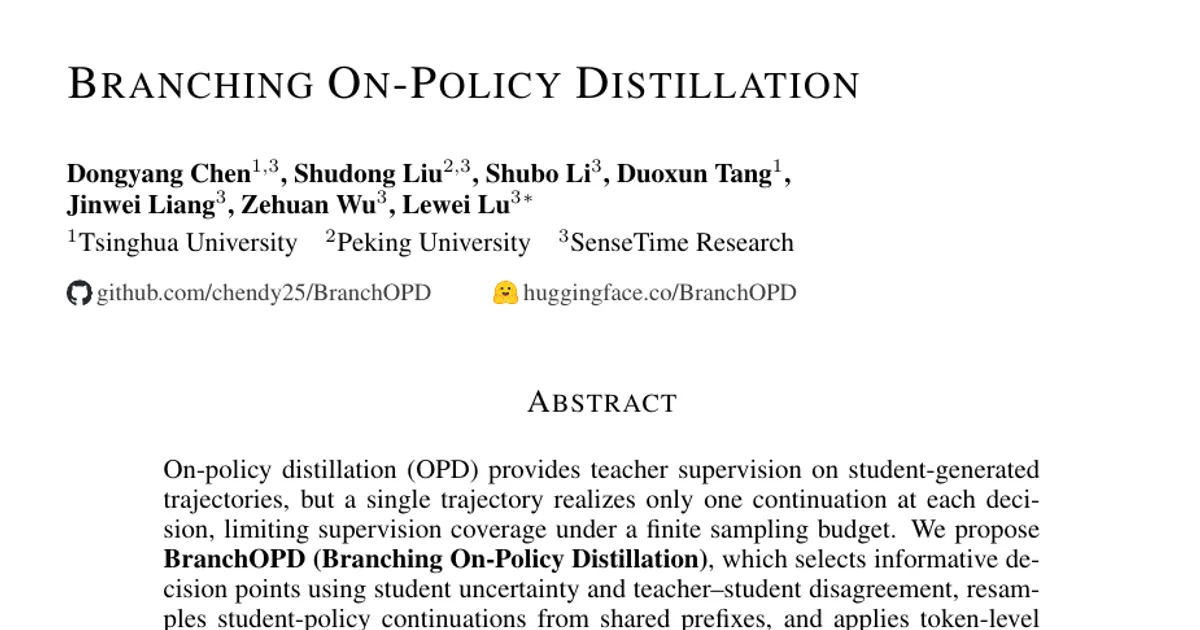
Authors’ abstract
On-policy distillation (OPD) provides teacher supervision on student-generated trajectories, but a single trajectory realizes only one continuation at each decision, limiting supervision coverage under a finite sampling budget. We propose BranchOPD (Branching On-Policy Distillation), which selects informative decision points using student uncertainty and teacher-student disagreement, resamples student-policy continuations from shared prefixes, and applies token-level teacher supervision to both main trajectories and branches. BranchOPD operates at token-level decisions in mathematics and within-turn decisions in agent tasks. Shared-prefix reuse reduces student-generated token costs by approximately 19% on ALFWorld and 31% on WebShop relative to seven independent trajectories. We also introduce protocol-boundary repair (PBR), which uses targeted supervision under protocol constraints to mitigate repetition and wasted generation. BranchOPD outperforms Vanilla OPD and Multi-Rollout OPD (n=7) across all evaluated benchmarks, with gains over Vanilla OPD of 18.55 percentage points in mean mathematics accuracy over 16 sampled answers (avg@16) and 13.8 points in mean ALFWorld ID/OOD success. Mechanistic analyses and selection ablations show that branching at uncertain decisions expands subsequent behavior coverage and outperforms random selection and turn-initial branching.