Research
Bilevel Coordinated Reflection: A Game-Theoretic Approach to Multi-Agent LLM Systems
Overview Research area: Multi-agent LLM systems — specifically the theory of orchestrator–worker coordination, textual memory ("reflection") updates, and the role of external verification. Technical l
- arXiv
- 2609.02750
- Published
- 2026-09-02
- Authors
- Yihang Chen, Yuxiang Chen, Yuxuan Huang, Meng Fang, Weilin Luo, Jun Wang
AI summary
Overview
Research area: Multi-agent LLM systems — specifically the theory of orchestrator–worker coordination, textual memory ("reflection") updates, and the role of external verification.
Technical level: Advanced. The paper is primarily a theory contribution, using game theory (potential games), stochastic approximation, Foster–Lyapunov drift arguments, and randomised-search-heuristic drift theorems. The experimental section is more accessible but assumes familiarity with multi-agent LLM frameworks and agent benchmarks.
Scope in one sentence: The paper builds a unified game-theoretic and stochastic-process account of why orchestrator–worker LLM pipelines stabilise, when free-form reflection plateaus instead of converging, and why an environment-grounded verifier can succeed where even an ideal text-only critic provably cannot — then instantiates the resulting algorithm (Stochastic Reflective Memory Ascent, SRMA) on two controlled environments and on SWE-bench.
What This Paper Is About
Multi-agent LLM systems typically work by having an orchestrator split a task among worker models, with the team improving over time by writing critiques and lessons into a shared textual memory. Existing frameworks describe who talks to whom and which buffer gets updated, but not what the agents converge to or what reflection actually improves. This paper supplies that missing theory: it models the pipeline as a bilevel coordination game, models reflection as a stochastic process over semantic memory states, and proves that a gate seeing only the generated text cannot uniformly help — motivating an algorithm that accepts a memory edit only when a grounded evaluation risk strictly decreases.
Key Contributions
-
A bilevel coordination game linking decomposition quality to follower equilibrium slack. Under a weakly-coupled decomposability assumption, the workers' subgame is shown to be an η_c-approximate potential game with slack η_c ≤ 2 d_max κ, where d_max is the maximum number of coupled neighbours and κ bounds the pairwise interaction term. The leader's objective is then shown to trade achievable local utility against coupling: E[U(x*(τ))] ≥ J_loc(τ) − (5/2) N C(τ), with C(τ) = d_max(τ) κ(τ).
-
A two-sided drift analysis of free-form reflection. A one-sided drift condition yields a finite-time upper bound e_T ≤ (1−γ̲)^T e_0 + (ν̄/γ̲)(1−(1−γ̲)^T), with limsup ≤ min{1, ν̄/γ̲}. This is proved tight in the worst case (a construction attains limit ν/γ), and a genuinely universal positive floor e_T ≥ ν̲/γ̄ > 0 requires an additional, explicitly testable persistent-harmful-commitment condition. When both bounds match, the mean error converges exactly to ν/γ.
-
An impossibility theorem for self-contained (text-only) gates, with a grounded comparator. In a pair of environments with identical text-generation laws but opposite meanings for the same reflections, any possibly randomised, history-dependent gate observing only the transcript satisfies max{e_T^{ε+}, e_T^{ε−}} ≥ e_0 for every horizon T — so it cannot improve both environments, even with unlimited text-processing capacity. A grounded gate observing the environment signal accepts only the corrective class and achieves e_T = e_0(1−κμ)^T → 0 in both.
-
Stochastic Reflective Memory Ascent (SRMA), with exact convergence, order-tight rates, and extensions. SRMA commits a candidate memory only when a fixed grounded evaluation protocol certifies a strict decrease in verifier risk. Under verifier calibration (V_i ≤ L R_i) and non-degenerate corrective mass, the risk converges almost surely and at geometric rate (1−c)^T when β = 0, or polynomial rate (r_0^{−β} + cβT)^{−1/β} when β ∈ (0,1], with c = c_1 c_2 and order-tightness established by matching constructions. A confidence gate handles stochastic probes, and re-anchoring restores per-segment convergence in piecewise-stationary environments.
-
Mechanism-level and end-to-end validation. Controlled environments (Resource Contest, Overcooked with an exact BFS value table) expose the strategic, memory, and drift quantities directly without an LLM judge; SWE-bench provides end-to-end results.
Main Findings
-
Grounding is theoretically necessary, not merely helpful. The self-gating impossibility shows that the free-form rule (accept everything) drives error to 1/2 in both indistinguishable environments, while the grounded gate drives error to 0 in both. The paper states the theorem is minimax over text-indistinguishable environments, and that textual self-evaluation remains useful when the transcript itself certifies correctness (e.g., a fully checkable proof).
-
Decomposition quality controls coordination slack. The slack bound η_c ≤ 2 d_max κ makes explicit that when κ = 0 the system reduces to the independent case; a good decomposition simultaneously raises achievable local utility J_loc and shrinks the coupling term C(τ). The leader's bound is E[U(x*(τ))] ≥ J_loc(τ) − (5/2) N C(τ).
-
Unconditional reflection has a worst-case floor. The upper bound ν̄/γ̲ cannot be uniformly improved over the one-sided drift class; a universal positive lower bound requires the persistent-harmful-commitment condition. The two together give a two-sided "error tube": ν̲/γ̄ ≤ liminf e_T ≤ limsup e_T ≤ ν̄/γ̲.
-
SRMA converges exactly and at order-tight rates. Geometric when β = 0, polynomial T^{−1/β} when β ∈ (0,1]. The tightness construction gives E[R_T] ≥ (r_0^{−β} + 4cβT)^{−1/β} for every T, and for β = 0, E[R_T] = (1−c)^T r_0 exactly. With calibration, task sub-optimality converges at the same rate up to factor L.
-
Overcooked: grounded SRMA beats every alternative on every layout. Score (deliveries × 20, five seeds, frozen MiniMax-M2.7 agents, horizon 200):
- cramped_room: greedy 120±40, no memory 180±40, free-form 240±60, self-gated 280±40, grounded SRMA 320±20.
- asymmetric_advantages: 80±40, 140±40, 180±40, 220±40, 280±20.
- centre_pots: 40±0, 100±40, 160±60, 200±40, 260±20. Relative to the text-only self-gate, grounded SRMA raises score by 14.3%, 27.3%, and 30.0%, and reaches first delivery in 22±2, 26±3, and 32±4 steps versus 26±5, 35±6, and 45±8.
-
Gate quality: grounding sharply improves selectivity. Across five seeds, final risk: no reflection 0.65±0.05, free-form 0.42±0.12, self-gate 0.28±0.08, grounded SRMA 0.14±0.03. Accepted harmful proposals fall to 6.2±1.8% and accepted helpful proposals rise to 85.4±3.6%, versus 34.5±4.2% and 72.8±5.1% for self-gating. The residual 6.2% harmful rate is described as verifier–oracle miscalibration, not a violation of monotonicity in the verifier's own risk.
-
Resource Contest: memory turns fragmented evidence into a coordination channel. SRMA reaches 98.5%–99.5% of oracle reward across easy/hard/many settings: easy 118.4±2.2 (oracle 120, ε-greedy 113.1±3.0, no memory 115.0±5.2); hard 159.2±0.9 (oracle 160, 157.4±1.1, 158.0±2.3); many 177.3±1.9 (oracle 180, 170.9±4.0, 174.0±3.7). Execution memory adds 2.6 reward points on average and reduces mean regret from 4.33 to 1.70 (60.8%).
-
Drift theory predicts held-out trajectories. From 412 gate events across five seeds, using three seeds for calibration and holding out two entire trajectories, the estimates are β̂ = 0.52±0.04, ĉ_1 = 1.25, ĉ_2 = 0.38, with p_acc(R) ≈ min{1, ĉ_1 R^β̂}. The parameter-free plug-in prediction R̂_T = (R_0^{−0.52} + 0.247 T)^{−1/0.52} tracks held-out risk with Pearson r = 0.94 and RMSE = 0.032, implying decay near O(T^{−1.92}). Bootstrap lower bounds c̲_1 = 0.92 and c̲_2 = 0.25 yield an envelope above the empirical mean risk at every recorded step — described as an empirical certificate on the observed range, not a claim about unobserved states.
-
Stochastic evaluation needs multiple probes. A one-shot stochastic verifier falsely accepts 28.4±5.2% of worsening proposals (score 245.2±38.4); fixed K = 5 cuts this to 6.8±1.5% (score 312.0±18.2) at 225 verifier calls. The paper states the adaptive gate matches that reliability, but the provided text is truncated at that point, so the remaining figures are not reported here.
-
SWE-bench end-to-end result. On 500 SWE-bench instances, the complete Kimi-based system resolves 361/500 (72.2%) versus 70.8% for the public mini-SWE-agent v2 reference. The paper does not report a statistical significance test or confidence interval for this comparison in the provided text.
-
Scope limits the authors explicitly acknowledge. The leader's outer loop is given only as a finite-episode bound, with no asymptotic leader-regret claim. On incomplete test suites, the convergence theorem concerns verifier risk only, not task sub-optimality. Exact convergence requires deterministic or exact expected-risk evaluation.
Methodology in Plain English
The authors start from the observation that orchestrator–worker LLM setups have no theory of what they settle into. They assume each worker's usefulness depends mostly on its own subtask, with a bounded amount of "spillover" to neighbouring workers — a weakly coupled structure. Under that assumption they show the workers' interaction is almost a potential game: each worker improving its own subtask essentially improves a single shared score, and the mismatch is bounded by the number of neighbours times the spillover size. That mismatch becomes the "slack" of the resulting near-equilibrium, and because the slack depends on how the task was decomposed, decomposition quality becomes an explicit term in the orchestrator's objective.
For reflection, they treat memory as a discrete set of semantic states and track the expected error (the gap to optimal task utility) step by step. They separate two regimes: free-form reflection, where every generated critique is written to memory, and gated reflection, where a candidate edit is evaluated before being committed. For free-form reflection they derive an upper bound on the error, show it is the best possible bound by constructing a recursion that hits it exactly, and then show a positive floor requires an additional assumption that harmful content keeps being committed.
The impossibility result is an argument by construction: they build two environments with identical text-generation laws in which the same text is corrective in one and harmful in the other. Any gate reading only text produces the same acceptance sequence in both, so coupling the two environments shows it must do badly in at least one. A gate that reads a reward, simulator state, test result, or checker output can tell the two apart.
This motivates SRMA: reuse a fixed evaluation protocol (an exact planner, or decoding with fixed randomness) plus a deterministic verifier and score, compute the current risk, propose a reflection, compute the candidate risk, and accept only a strict improvement. Because the risk is non-increasing and non-negative, it converges; the rate depends on how often acceptable edits appear and how much each accepted edit reduces risk, which are exactly the two assumptions quantified in the theorems. When evaluation is stochastic rather than exact, they add a Hoeffding-style confidence gate requiring the candidate to beat the current memory by more than the estimation slack.
The experiments deliberately choose environments where the relevant quantities are measurable from ground truth rather than from another LLM: a hidden-cap allocation game where the oracle reward is a maximum over unknown caps, and Overcooked with an exact breadth-first-search value table giving the number of joint-action steps to the next delivery. These isolate the mechanism; SWE-bench checks that the whole thing still helps end-to-end.
Why This Matters
Impact on research. The paper reframes multi-agent LLM design from a procedural question (who writes to which buffer) to a strategic and statistical one (what do agents stabilise to, and what does reflection monotonically improve). It gives the first informative negative result in this space — an impossibility theorem showing the limits of text-only self-evaluation — and it supplies a falsifiable interface between theory and practice: the exponent β, the acceptance frequency c_1, the decrement c_2, and the free-form drift parameters are all estimable from logs, and the paper demonstrates a parameter-free prediction on held-out trajectories with r = 0.94. It also connects otherwise separate literatures (approximate potential games, Foster–Lyapunov drift, multiplicative drift from randomised search heuristics) into a single framework for agent memory.
Real-world applications:
- Software engineering agents. SWE-bench-style agents whose memory is filtered by the repository's own test harness, rather than by an LLM judging its own critique.
- Robotics and multi-robot coordination. The Overcooked setup is a proxy for shared-workspace tasks where a simulator or planner supplies the ground signal (role specialisation, congestion over shared resources).
- Resource allocation under unknown constraints. The Resource Contest is a proxy for scheduling and budgeting where the true capacities are hidden and only clipping feedback is observable.
- Tool-using and API-driven agents. Any setting where truth depends on external state — API responses, evolving repositories, simulator state — which the paper's Remark 1 identifies as exactly the regime where grounding is irreplaceable.
Industry relevance. The practical claim is cheap and checkable: do not commit a memory edit without a grounded check, and do not gate on two uncontrolled one-shot samples. The reported costs are concrete — 225 verifier calls for K = 5 — and the confidence-gating proposition gives a principled way to spend more probes when the decision is close. The 72.2% versus 70.8% SWE-bench result is modest in absolute terms, but the paper's own framing is that the theory, not the headline number, is the contribution.
Future Directions
- Closing the gap between verifier risk and task sub-optimality. Convergence to zero verifier risk transfers to task sub-optimality only under the calibration assumption V_i ≤ L R_i, which the paper states is appropriate for exact value tables and complete formal checkers but not for incomplete test suites. What can be guaranteed when the verifier is an incomplete proxy is left open.
- Leader-level guarantees. The paper deliberately states only a finite-episode bound for the orchestrator's slower timescale and makes no asymptotic leader-regret claim. A regret analysis over decompositions, and how it interacts with the follower timescale, remains unresolved.
- Non-stationarity beyond piecewise stationarity. Re-anchoring covers finitely many risk changes with a final stationary segment. Continuously drifting risks, and how re-evaluation cost scales with drift rate, are not treated.
- Making grounding cheaper and more reliable. The residual 6.2% accepted-harmful rate is attributed to verifier–oracle miscalibration, and the confidence-gate result requires K_t → ∞ with summable δ_t for exact convergence. Reducing verifier calls while preserving the certificate, and characterising when a partially grounded signal still yields a rate guarantee, are natural next steps.
Target Audience
Researchers in multi-agent LLM systems and agentic AI who want a formal account of coordination and memory rather than another framework description; theorists working on potential games, stochastic approximation, or drift analysis looking for a new application domain; and engineers building verifier-gated reflection loops who want concrete design rules (ground the gate, use a fixed evaluation protocol, require a strict risk decrease, average multiple probes). The experimental sections on Resource Contest and Overcooked are readable by practitioners without the theory, but the impossibility theorem and the convergence rates require comfort with the underlying mathematical machinery.
Authors’ abstract
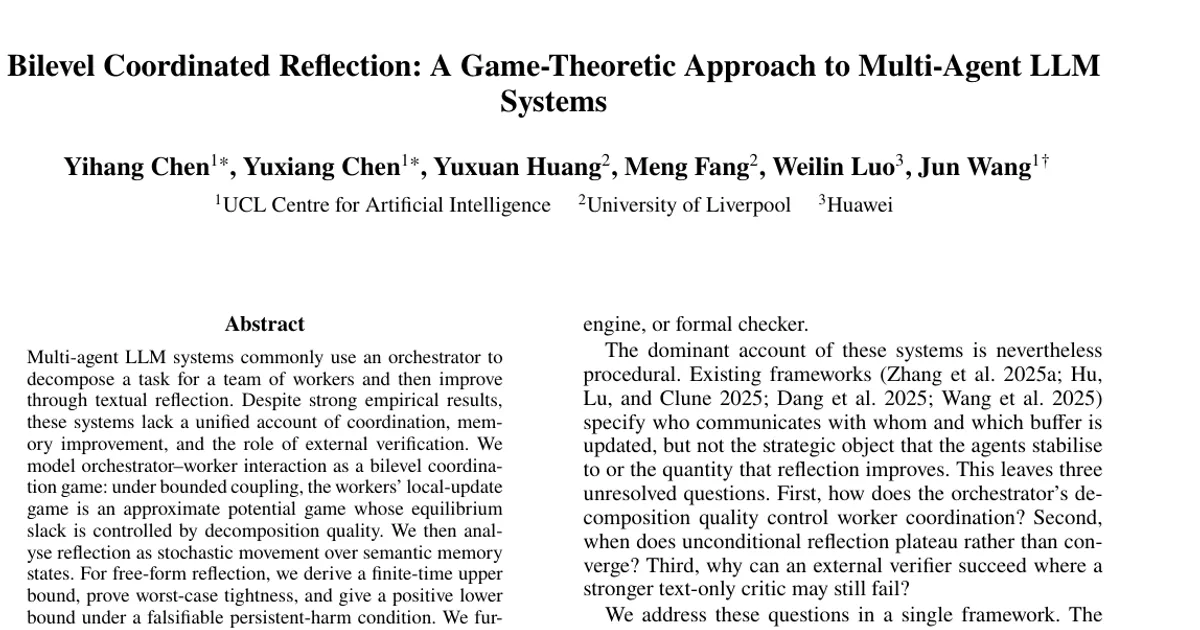
Multi-agent LLM systems commonly use an orchestrator to decompose a task for a team of workers and then improve through textual reflection. Despite strong empirical results, these systems lack a unified account of coordination, memory improvement, and the role of external verification. We model orchestrator-worker interaction as a bilevel coordination game: under bounded coupling, the workers' local-update game is an approximate potential game whose equilibrium slack is controlled by decomposition quality. We then analyse reflection as stochastic movement over semantic memory states. For free-form reflection, we derive a finite-time upper bound, prove worst-case tightness, and give a positive lower bound under a falsifiable persistent-harm condition. We further prove an information-theoretic impossibility result: no gate that observes only the generated transcript can improve uniformly over text-indistinguishable environments, whereas an environment-grounded gate can. Motivated by this separation, we introduce Stochastic Reflective Memory Ascent (SRMA), which accepts a candidate memory only after a grounded evaluation risk strictly decreases. Under calibration and non-degenerate corrective mass, SRMA converges exactly, geometrically or polynomially; matching constructions show that both rate regimes are order-tight. We also provide confidence gating for stochastic evaluation and re-anchoring guarantees for piecewise-stationary environments. Experiments instantiate these objects with environment-grounded metrics and test the predicted coordination and drift laws. On 500 SWE-bench instances, the complete Kimi-based system resolves 72.2% versus a 70.8% public mini-SWE-agent reference. Code: https://github.com/YihangChen9/Bilevel-Coordinated-Reflection