Research
Big AI is accelerating the metacrisis: What can we do?
Overview Research area: Ethics and policy of natural language processing, specifically the societal, ecological, and linguistic impacts of large language models (LLMs) and "Big AI," framed through the
- arXiv
- 2512.24863
- Published
- 2025-12-31
- Authors
- Steven Bird
AI summary
Overview
Research area: Ethics and policy of natural language processing, specifically the societal, ecological, and linguistic impacts of large language models (LLMs) and "Big AI," framed through the concept of the "metacrisis."
Technical level: Beginner-Friendly. This is a policy paper, not an empirical or technical contribution. It contains no experiments, datasets, benchmarks, or model results; it is an argument built from a broad cross-section of cited literature.
Scope: The paper argues that Big AI is accelerating interconnected ecological, meaning, and language crises, that current AI safety and self-governance efforts perpetuate the status quo, and that the Association for Computational Linguistics (ACL) should take coordinated action as a professional community.
What This Paper Is About
The world is in the grip of converging ecological, meaning, and language crises that the paper calls a metacrisis, and the author argues that Big AI — the corporations, state capture, and automation sold as AI — is accelerating all of them, with LLM engineering at the core. The central puzzle is professional: ACL authors warrant that their work complies with the ACL Code of Ethics and that "the public good is the paramount consideration," yet their work is being leveraged to create unprecedented wealth and power for a handful of individuals and corporations while causing harm to life on earth.
The goal is to compile evidence for that argument, to explain why "more business as usual" and voluntary Big AI self-governance will not work, and to propose concrete actions the ACL could take to design a life-affirming future for NLP centered on human flourishing on a living planet.
Key Contributions
-
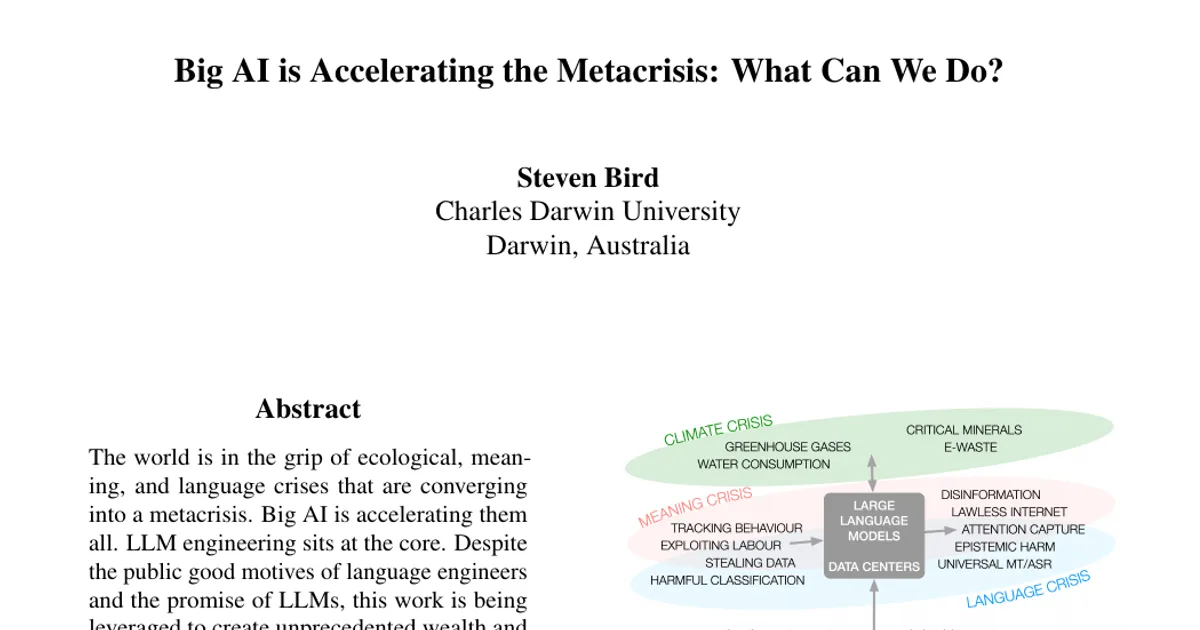
A synthesis of evidence that LLMs are implicated in three crises. The paper links LLMs and data centres to ecological crisis (greenhouse gas emissions, e-waste, water usage, mineral extraction), meaning crisis (undermining critical thinking, creative work, knowledge diversity, and democracy; generating fake news, education, and healthcare), and language crisis (the collapse of linguistic diversity).
-
An account of how the three crises amplify each other. The paper describes bidirectional interactions — ecological ↔ meaning, meaning ↔ language, and language ↔ ecological — and argues that Big AI additionally accelerates itself through AI hype.
-
An argument that AI safety and ethics efforts serve to preserve an unregulated space. The paper contends that Big AI's interest in ethics, politically motivated "philanthropy," and ethics washing produce a "mirage of algorithmic governance" and a façade justifying deregulation, self-regulation, or market-driven governance.
-
Seven proposals for action at the level of the ACL, covering the code of ethics, protection from corporate influence, shaping the field, protected spaces for critical NLP, a policy research track, leadership statements, and articulating a vision for life-sustaining research.
Main Findings
-
Six of nine "planetary boundaries" have been breached (citing Richardson et al., 2023), and the paper states there is a real prospect of ecosystem, economic, and geopolitical collapse (citing Lenton et al., 2023).
-
Efficiency under Big AI means scaling up, not saving resources. Reductions in consumption attract new investment in a rebound effect leading to greater consumption (citing Alcott, 2008; Weidinger et al., 2022), while Big AI is described as ever "reinventing itself in the public image as socially responsible."
-
The three crises interact in both directions. For example, LLM content uses eco-anxiety to capture attention while doomscrolling numbs it; the avalanche of attention-grabbing LLM content from dominant languages crowds out local languages; and language loss undermines indigenous capacity to care for species-rich ancestral lands and accelerates loss of medicinal knowledge.
-
Multilingual LLM claims neglect three realities: most of the world's population is multilingual and already uses a few dozen contact languages for information access and economic participation; 90% of the world's languages outside the most populous do not have standardised writing; and there will never be enough data to create robust models for such languages. The paper states the problems are sociopolitical and are not solved by language technologies.
-
Big AI will not govern itself. Regulation initiatives exist, but the paper cites Bashir et al. (2024) that the social and environmental impacts of Gen-AI are complex and hinder targeted regulations, and ÓhÉigeartaigh et al. (2020) that implementing AI ethics frameworks in practice to constrain the behaviour of those with disproportionate power will be far from straightforward.
-
The scalability story is a myth. Data centres cannot keep growing on a planet facing climate catastrophe; AI safety is described as inherently not scalable (citing Slee, 2020, p12), leading to a "perpetual game of Whac-a-Mole." The paper highlights annotation sweatshops and cites Crawford (2021, p69) that the myth of AI as affordable and efficient depends on layers of exploitation, including extraction of mass unpaid labor.
-
The benefits do not justify the harms. The paper calls the grand promises (from eliminating poverty to sustainable cities and quality education for all, citing McKinsey, 2024) imaginary, argues sequence models are far removed from natural language, and describes SOTA-chasing and endless "tables with numbers" as superficial and fashion-driven. It argues only a minority of researchers can access SOTA tools and must use exponentially more resources for only linear performance gains (citing Schwartz et al., 2020).
-
The field's attributes are not hallmarks of "good science." The paper notes that LLM research receives scholarly recognition in spite of its harms, and that Big AI can "police its own use of artificial intelligence," citing the sponsorship of the Fairness, Accountability, and Transparency conference by Google, Facebook, and Microsoft (citing Ochigame, 2022), which the paper likens to the Big Tobacco playbook.
-
Individual ethical compliance is an unrealistic standard. Using Kohlberg's Levels of Moral Development, the paper argues that expecting individuals to follow universal ethical principles regardless of peer expectations and local norms is Level 3 (postconventional), held by a minority of adults, whereas most adolescents and adults are at Level 2 (conventional). The paper therefore proposes anchoring behavior to membership in a prestigious group — the ACL.
-
No recourse to law is available. The paper states that software engineering is not a recognised profession and that ethical codes of conduct have little bite in determining legal duties of care (citing Choi, 2021).
Methodology in Plain English
This is a policy paper, so the approach is argumentation rather than experimentation. The author compiles evidence from a broad cross-section of literature — spanning environmental science, linguistics, anthropology, law, ethics, media studies, and NLP — to support the claim that Big AI accelerates the metacrisis. He then reasons about why existing responses (AI safety work and voluntary ethics) fail, drawing on concepts such as the rebound effect, the "mirage of algorithmic governance," the myth of technological inevitability, and the problem of many hands. Finally, he turns to moral development theory to argue that expecting individual virtue is less pragmatic than shaping group norms, and proposes a set of actions for the ACL as a professional community. A figure illustrates how Big AI is accelerating the metacrisis; a second figure adapts Kohlberg's three levels of moral development. The paper includes a Limitations section addressing definitional scope, the choice of three crises, omitted government–university links, and the choice to target the ACL, plus an Ethical Considerations section disclosing a 2022 Google Research Australia small grant to Charles Darwin University, a May 2024 seminar at Google Research in San Francisco, and input into the decision to select Aboriginal English as the target for data collection work (Hutchinson et al., 2025), stating that Google sponsorship has not affected the work.
Why This Matters
Impact on research: The paper challenges the assumption that LLM research is apolitical and value-free, and questions how the ACL reconciles its Code of Ethics obligation — that the public good is paramount — with work that enables Big AI. It raises unresolved questions about peer review, corporate participation in conference processes, bias in what counts as prestigious research, and the fact that Big AI research involving human subjects is not subject to the kind of independent ethical oversight required for university research.
Real-world proposals (as stated in the paper):
- Adopting public good as the paramount consideration, and rejecting rationales such as the myth of technological inevitability, the problem of many hands, and the myth of technology solving social ills.
- Protecting the ACL from corporate influence, including questioning whether companies such as Meta should sponsor the conference, and flagging apprehended bias, conflict of interest, and corporate capture when Big AI employees participate in conference processes.
- Shaping the field of computational linguistics by re-asserting the scope of computational linguistics in calls for papers, requiring deeper ethical engagement, encouraging degrowth and small language models, and using evaluation as a force to drive change.
- Establishing protected spaces for critical NLP with a separate track and review process, and creating a publication track for NLP policy research that could inform regulatory activity.
- Providing leadership through public statements and policies, articulating a vision for life-sustaining research, and promoting frameworks such as the Ethics of Care, the 7 principles of data feminism, the 10 Point Plan to Address the Information Crisis, community-centric approaches, decolonising methods, and 5 steps for rewiring the machine.
Industry relevance: The paper directly targets Big AI corporations, their business models, their sponsorship of academic venues, and their role in data centre expansion, labour exploitation, and data extraction. It anticipates that Big AI will be regulated or socialised, and suggests encouraging research at the intersection of NLP and law, while noting that intergovernmental organisations — not examined in the paper — will ultimately be the ones to regulate Big AI.
Future Directions
-
How should the ACL reconcile the obligation to treat the public good as paramount with work that enables Big AI? The paper frames this as a pressing open question for the professional body.
-
Should Big AI research involving human subjects face independent ethical oversight comparable to what is required for university research?
-
What legal and regulatory structures could apply to LLM development, given that software engineering is not a recognised profession and ethical codes have little bite in determining legal duties of care?
-
What is the field's vision for language technology in the context of human flourishing on a living planet, and could new conference themes, workshops, journal special issues, and value frameworks replace the conventional scalability ethic?
-
How would the ACL's Four Ends be re-read as social ends, with End 1 ("promoting research and development in computational linguistics") understood as social because language is relational, and End 2 used to promote cooperation with related professional societies, including at the intersection of NLP and law?
Target Audience
This paper is aimed most directly at ACL members and leadership, NLP researchers and graduate students, conference organizers and reviewers, and anyone in the field who does LLM research or works for Big AI companies. It is also relevant to researchers in AI ethics, science and technology studies, linguistics and language documentation, indigenous data sovereignty, and technology policy, as well as policymakers and members of the public interested in the societal and environmental costs of large-scale AI. Because it is a non-technical policy paper, it is accessible to readers without a machine learning background.
Authors’ abstract
The world is in the grip of ecological, meaning, and language crises that are converging into a metacrisis. Big AI is accelerating them all. LLM engineering sits at the core. Despite the public good motives of language engineers and the promise of LLMs, this work is being leveraged to create unprecedented wealth and power for a handful of individuals and corporations while causing existential harm to life on earth. As a profession, we urgently need to come together to explore alternatives and to design a life-affirming future for our field of natural language processing that is centered on human flourishing on a living planet.