Research
Beyond Generation: Multi-Hop Reasoning for Factual Accuracy in Vision-Language Models
Overview Research area: multimodal AI, specifically knowledge-grounded reasoning and factual accuracy in vision-language models (VLMs), applied to image captioning. Technical level: Intermediate. The
- arXiv
- 2511.20531
- Published
- 2025-11-25
- Authors
- Shamima Hossain
AI summary
Overview
Research area: multimodal AI, specifically knowledge-grounded reasoning and factual accuracy in vision-language models (VLMs), applied to image captioning.
Technical level: Intermediate. The paper assumes familiarity with VLMs, knowledge graphs, named entity recognition (NER), and embedding-based fuzzy matching, but the framework itself is described in modular terms that a reader with basic machine learning background can follow.
Scope: A single-author arXiv preprint (arXiv:2511.20531v1, cs.AI, 25 November 2025, CC BY 4.0) by Shamima Hossain (Department of Computer Science, Brac University, Bangladesh; bKash Limited, Dhaka, Bangladesh) that proposes a modular, multi-hop pipeline combining a pre-trained VLM with a curated knowledge graph to verify and correct factual claims in generated image captions, tested on a small curated landmark-centric dataset.
What This Paper Is About
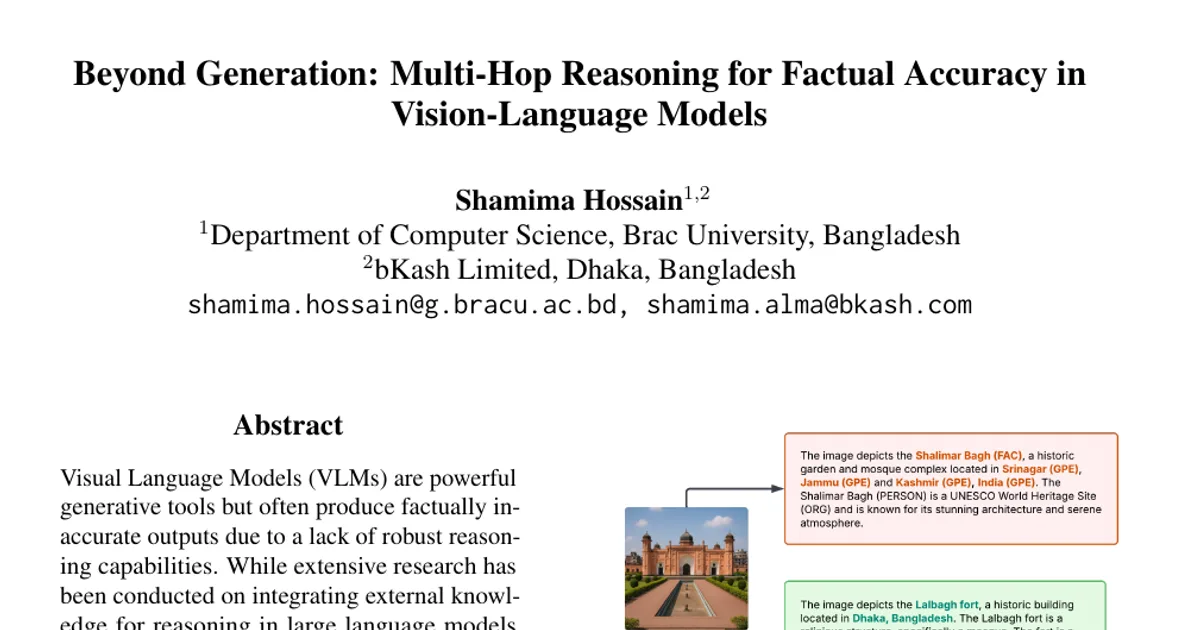
VLMs such as Qwen2-VL-2B-Instruct produce fluent image captions but frequently state facts that are wrong or invented, because they have no structured mechanism for checking what they say against real-world knowledge. The paper builds a five-component pipeline that recognizes visual entities, looks them up in a knowledge graph, verifies claims across three different knowledge representation formats, and then rewrites the caption using only verified facts. The goal is not merely better generation but explicit, interpretable fact verification that traces a reasoning path from image to knowledge graph to corrected text.
Key Contributions
- A straightforward integration of knowledge graphs with VLMs, illustrated through the landmark-identification and image-captioning use case.
- A framework that combines both pre-generation knowledge integration and post-generation correction, decomposed into discrete, independently inspectable hops.
- New methods for comparing different knowledge representation formats (triple-based relations, hierarchical knowledge trees, and bullet-point facts) for fact verification in captioning.
- A quantitative analysis of factual accuracy improvements, including custom evaluation metrics (Entity Accuracy, Fact Verification Rate, Caption Coherence) and an ablation across representation formats on the 2-billion-parameter Qwen variant.
Main Findings
- Factual accuracy improvement: The framework produced a 31.8% improvement in factual accuracy, measured as the relative reduction in hallucinated entities (the abstract describes this as "approximately 31%").
- Absolute counts: On an evaluation set of 100 images, baseline VLM captions contained 55 hallucinated entities versus 38 in corrected captions, which yields the 31.8% figure via the paper's Factual Improvement formula.
- Baseline hallucination rate: The authors observed that approximately 69% of entity mentions in the base VLM captions were either incorrect or hallucinated.
- Multi-format verification gain: Combining triple-based, hierarchical, and bullet-point representations achieved a 27% reduction in hallucinated entities compared to using the triple-based representation alone.
- Best format for factual verification: Hierarchical representation performed best in isolation (Entity Accuracy 78.1%, Fact Verification Rate 73.2%), particularly for spatial-reasoning image understanding, but it limited the model's free-format generation and lowered caption coherence (4.1 on the 1–5 coherence scale).
- Best format for coherence: Bullet-point facts, the simplest representation, maintained the highest caption coherence (4.3) while posting the lowest Entity Accuracy (65.7%) and Fact Verification Rate (61.8%); the authors hypothesize this may be due to under-constraining the model (the sentence trails off in the text).
- Triples-only middle ground: Triple-based representation alone reached 72.3% Entity Accuracy, 68.5% Fact Verification Rate, and 4.2 coherence.
- Hallucination criteria: Entities were flagged as hallucinated when (1) absent from the domain-specific knowledge graph, (2) failing the entity-matching confidence threshold (< 0.85), or (3) unable to be verified through any knowledge representation format; all entities were manually annotated for reliability.
- Knowledge graph properties: The curated graph has an average node degree of 2.5, a path length of ≤ 3 between any related entities, and a hierarchical clustering coefficient of 0.67.
Methodology in Plain English
The pipeline proceeds through five coordinated components:
- Vision-language understanding. A pre-trained Qwen2-VL-2B-Instruct model generates a base caption for the input image.
- Entity extraction. spaCy's NER model pulls named entities out of that caption, covering categories such as locations, organizations, and facilities.
- Knowledge graph navigation. Each extracted entity is matched against the knowledge graph, first exactly and then fuzzily using sentence embeddings (all-MiniLM-L6-v2) when exact matches fail. This splits entities into a verified set and a potentially hallucinated set.
- Fact verification. Relationships among verified entities are checked using three complementary formats: (subject, relation, object) triples for direct relationships, ancestor-descendant hierarchical paths for containment claims, and bullet-point key-value facts for direct attributes. The system consults triples first, then the hierarchy, then bullet facts.
- Caption correction. Verified facts are fed back into a prompt for the VLM, which regenerates a caption that keeps the original fluent language while aligning with verified facts, using template-based correction strategies depending on the error type.
The evaluation dataset mixes images from Google Landmarks Dataset v2 (GLDv2), Conceptual Captions, and COCO Captions, split into Seen Landmarks (60%, present in the knowledge graph), Unseen Landmarks (20%, absent but linked to related higher-level entities), and Distractor Scenes (20%, non-landmark or ambiguous scenes that test hallucination detection). Evaluation uses three custom metrics: Entity Accuracy, Fact Verification Rate, and human-rated Caption Coherence.
Why This Matters
The work targets trustworthiness in multimodal systems: a VLM that confidently misstates where a landmark is or what it is remains unusable in settings where factual precision is required. Its distinctive angle is treating fact-checking as an explicit, modular reasoning chain rather than hoping a bigger model hallucinates less.
Real-world applications named or implied by the paper:
- Education, where incorrect visual descriptions misinform learners.
- Cultural heritage and historical archiving, where landmark identity and context must be accurate.
- Healthcare, cited as a domain where confident but incorrect assertions are unacceptable.
- Safety-critical domains generally, plus geographical and administrative fact checking (the knowledge graph explicitly models relationships such as Located_In and Capital_Of).
Industry relevance: the modular hop design is intended to allow swapping or adding knowledge sources and reasoning strategies, which maps onto enterprise needs for auditable, knowledge-grounded generative systems. The author's affiliation with a fintech company (bKash Limited) alongside an academic department hints at interest from applied industry settings, though the paper itself does not elaborate on that connection.
Future Directions
- Expand beyond the current small, domain-specific landmark dataset to broader coverage, since the paper describes the system as a prototype.
- Move from a manually curated knowledge graph to large-scale, dynamic knowledge sources so the approach can handle open-domain captioning.
- Evaluate the framework on other VLMs for image captioning; the paper states it is not currently evaluated on models beyond the Qwen family tested here.
- Investigate the format-specific trade-off the authors observed: hierarchical representations help factual and spatial verification but reduce caption coherence, while bullet-point facts preserve fluency at the cost of fact verification strength. The authors also flag that the reason bullet points maintain coherence is only hypothesized.
Target Audience
Researchers and practitioners working on multimodal reasoning, knowledge-grounded generation, and hallucination mitigation in VLMs; engineers building fact-checking or retrieval-augmented pipelines who want a modular template; and readers interested in interpretable, step-by-step verification pipelines rather than end-to-end model scaling. Readers should note the paper's own caveats: it presents prototype-scale results on a small, domain-specific dataset with a manually curated knowledge graph, and detailed numbers are shared only for the 2-billion-parameter model variant.
Authors’ abstract
Visual Language Models (VLMs) are powerful generative tools but often produce factually inaccurate outputs due to a lack of robust reasoning capabilities. While extensive research has been conducted on integrating external knowledge for reasoning in large language models (LLMs), such efforts remain underexplored in VLMs, where the challenge is compounded by the need to bridge multiple modalities seamlessly. This work introduces a framework for knowledge-guided reasoning in VLMs, leveraging structured knowledge graphs for multi-hop verification using image-captioning task to illustrate our framework. Our approach enables systematic reasoning across multiple steps, including visual entity recognition, knowledge graph traversal, and fact-based caption refinement. We evaluate the framework using hierarchical, triple-based and bullet-point based knowledge representations, analyzing their effectiveness in factual accuracy and logical inference. Empirical results show that our approach improves factual accuracy by approximately 31% on preliminary experiments on a curated dataset of mixtures from Google Landmarks v2, Conceptual captions and Coco captions revealing key insights into reasoning patterns and failure modes. This work demonstrates the potential of integrating external knowledge for advancing reasoning in VLMs, paving the way for more reliable and knowledgable multimodal systems.