Research
Beyond Downstream QA: Rethinking How We Evaluate Agent Memory
Overview Research area: Evaluation methodology for LLM agent memory systems (Natural Language Processing / agent memory benchmarks). Technical level: Intermediate to Advanced — readers should be comfo
- arXiv
- 2610.22209
- Published
- 2026-10-15
- Authors
- Sebastian-Antonio Toma, Jean de Kernier, Mike Ply, Oliviu Matei
AI summary
Overview
Research area: Evaluation methodology for LLM agent memory systems (Natural Language Processing / agent memory benchmarks).
Technical level: Intermediate to Advanced — readers should be comfortable with retrieval pipelines, embeddings, and benchmark design, though the core argument is stated in plain terms.
Scope: The paper argues that measuring agent memory only through downstream question-answering accuracy is incomplete, and introduces FEB-30, a 30-trajectory benchmark that inspects the memory store directly against known ground truth.
What This Paper Is About
Almost every existing agent-memory benchmark asks the agent questions and grades its answers, treating response accuracy as a proxy for memory quality. The authors show this conflates three different things — what the memory stores, what retrieval surfaces, and what the generator writes — so a correct answer can hide a broken memory store, and an incorrect answer can unfairly blame a correct one. Their goal is to add a direct, "intrinsic" check of the memory store at every stage of a fact's evolution, and to demonstrate empirically how far that check diverges from the standard question-answering score.
Key Contributions
- FEB-30, a benchmark of 30 fact-evolution trajectories with deterministic ground truth, spanning 6 diagnostic categories (LLM Compensation, Retrieval Bottleneck, Classification, Synthesis Quality, Temporal Correctness, Multi-Author Attribution) and 3 difficulty levels (10 trajectories each). Its 147 generated documents comprise 127 trajectory state documents and 20 noise documents (4 per C2 trajectory).
- A paradigm-inversion document generation pipeline that generates documents from known fact trajectories rather than annotating ground truth on real documents, using 6 generator models across 5 providers (no single model above 30% of documents) and 3 independent judge models requiring unanimous verification.
- An intrinsic evaluation methodology for agent memory: direct comparison of the fact store against expected atomic claims after each ingestion step, with metrics for claim coverage, fact accuracy, update detection recall, false update rate, fact count, and confidence MAE — enabling diagnostic decomposition by pipeline stage.
- Empirical evidence of divergence: intrinsic and extrinsic scores differ by an average of 16 percentage points (MAD = 0.168 ± 0.025), with 43.6% of trajectories exceeding the τ = 0.15 threshold, and the benchmark, generation pipeline, and scoring framework are released.
Main Findings
- The two evaluations measure largely different things: Across 330 paired trajectory evaluations (N = 11 runs), mean absolute divergence is 0.168 ± 0.025 (over 16 percentage points), with a divergence rate of 43.6% above τ = 0.15. Pearson correlation is r = 0.423 (p < 10⁻¹⁵), so r² ≈ 0.18 — only 18% of variance is shared.
- Intrinsic scores run consistently higher: Signed mean divergence is +0.118 ± 0.029, and a Wilcoxon signed-rank test (W = 4042, p < 10⁻¹⁶) confirms significance. Overall intrinsic accuracy is 60.6% ± 1.6 versus extrinsic 48.8% ± 2.9, meaning QA-based evaluation systematically understates memory quality in this system.
- Pass/fail conclusions often disagree: Under a ≥ 0.5 pass criterion, 21 ± 4% of trajectories have one method passing while the other fails (Cohen's κ = 0.118, barely above chance) — a practitioner using extrinsic scores alone would reach the wrong conclusion roughly one time in five.
- LLM compensation is the largest gap: Category C1 shows intrinsic 82.2% ± 2.9 versus extrinsic 54.5% ± 10.8 (MAD 0.295 ± 0.084, divergence rate 67.3%), directly demonstrating correct answers built on wrong memory.
- Hardest dimensions are masked extrinsically: C6 (Multi-Author) has the lowest intrinsic accuracy at 41.5% ± 4.8 and the highest miss rate (87.5% ± 3.5), and C5 (Temporal) scores 59.3% ± 5.2, yet extrinsic scores stay near-uniform across categories.
- Divergence persists across difficulty but changes shape: Divergence rate falls from 55% (L1) to 50% (L2) to 26% (L3), and MAD is .178, .224, and .103 respectively. At L1 intrinsic (68.0 ± 3.2) far exceeds extrinsic (50.9 ± 4.2); at L3 the two converge near 47% but diverge in opposite directions per trajectory.
- Classification of memory operations is the hidden failure: The system labels actions (create, update, reinforce, supersede) correctly only 20.1% ± 2.7% of the time, dropping from 33.8% at L1 to 16.5% at L2 and 10.1% at L3, with C2 at 4.5% and C5 at 0.4%. This is invisible to extrinsic evaluation.
- Other diagnostics: False update rate is 22.2% ± 1.2%, update detection recall is 73.6% ± 2.6%, confidence MAE is 0.106 ± 0.002, and overall claim miss rate is 71.4% ± 2.1. Fact count inflates with difficulty (Table 4: 9.6 at L1, 14.7 at L2, 22.4 at L3), indicating fragmentation into redundant facts.
- The effect is robust across configurations: Four configurations (simpler vs. main system, pre-release vs. public corpus, plus an upgraded backbone) all keep intrinsic accuracy in a 57.6%–61.4% band while extrinsic accuracy stays flat at 48.5%–49.2%; divergence rates range from 39.7% to 49.4% and signed divergence stays positive throughout.
Methodology in Plain English
Instead of hunting for real documents and paying humans to mark up the correct answers, the authors work backwards. They first write down how a fact should evolve — for example, a customer runs PostgreSQL on-premise, later evaluates Aurora and AlloyDB, then chooses Aurora — as a sequence of states, each holding a set of small, self-contained claims. Those claims are the answer key.
They then generate documents that carry only the new information for each state, so the system under test must actually remember earlier facts rather than re-reading them. Documents are written by rotating through 6 different models to mimic different human authors, styled after 12 AMI meeting summaries and 12 Enron emails, and at the hardest level inserted into real human-written documents from unrelated domains (roughly 90% authentic text). Three judge models must unanimously agree that every target claim is inferable and that no extra facts leaked in; human review then flagged 11% of documents for content corrections and 28% for removal of leftover generation scaffolding.
To score, the authors run a representative memory system (the common extract–embed–classify–synthesize pattern shared by Hindsight, Mem0, AriadneMem, and similar services) over each trajectory. Intrinsic scoring compares the fact store against the expected claims after every document, using embedding similarity above 0.8 followed by an LLM entailment check. Extrinsic scoring asks diagnostic questions and grades answers as YES (1.0), PARTIAL (0.5), or NO (0.0). The headline number is the mean absolute divergence between those two scores, plus the share of trajectories exceeding a 0.15 threshold.
Why This Matters
Impact on research: The paper shows that the dominant evaluation paradigm can be actively misleading, not merely incomplete. It supplies a reusable construction recipe (paradigm inversion applied to temporal fact evolution) and a diagnostic vocabulary — extraction, synthesis, update, and conflict failures — that lets researchers attribute a failure to a specific pipeline stage rather than a single opaque score. The embedding analogy (intrinsic analogy and similarity tasks complementing downstream evaluation in the 2010s) frames this as a methodological correction rather than a new leaderboard.
Real-world applications:
- Customer-support and CRM agents that must track account facts across emails, meeting notes, and tickets from multiple colleagues, where a stale or contradictory record is a business risk.
- Enterprise knowledge assistants ingesting multi-author documentation, where distinguishing corroboration by different authors from repetition by one author changes how much a fact should be trusted.
- Long-running operational or incident-response agents that must correctly retract and supersede outdated runbook facts rather than reinforcing them.
- Memory-vendor and platform procurement, where a buyer needs to know whether a system's memory is genuinely correct or whether a strong generator is papering over defects at answer time.
Industry relevance: The finding that action classification is right only about 20% of the time, and that false updates occur 22.2% of the time, points to a concrete engineering target for anyone shipping a memory layer. The result that end-to-end pass/fail agreement is near chance (κ = 0.118) is a direct argument for adding store-level checks to internal evaluation suites, in the same way unit tests sit alongside end-to-end tests.
Future Directions
- Validate synthetic-document transfer: the authors explicitly call for testing rank correlation between FEB-30 results and human-annotated sequences of real multi-author documents, since generated text may not capture every property of real corpora.
- Scale beyond 30 trajectories: the current set is described as sufficient for diagnostic evaluation but not for fine-grained statistical comparisons, so a larger version is an open need.
- Extend beyond factual evolution: the benchmark does not cover episodic memory, procedural memory, or single-turn conversational recall, all of which are handled by existing benchmarks and could receive the same intrinsic treatment.
- Reduce measurement noise and broaden coverage: scoring depends on embedding similarity thresholds and LLM judges, and the paper evaluates one architectural pattern, leaving open how the diagnostics behave across the wider space of published memory architectures (over a dozen since 2023, per the paper's citations) and across domains other than the 6 technical domains used here.
Target Audience
Researchers and engineers building or evaluating LLM agent memory systems; benchmark designers interested in ground-truth construction without human annotation; ML platform and infrastructure teams deciding how to test a memory layer before shipping; and practitioners who currently judge memory quality solely by downstream QA accuracy and want to know what that score hides. Readers focused on episodic or procedural memory, or on conversational recall, will find the scope deliberately narrower than their interests.
Authors’ abstract
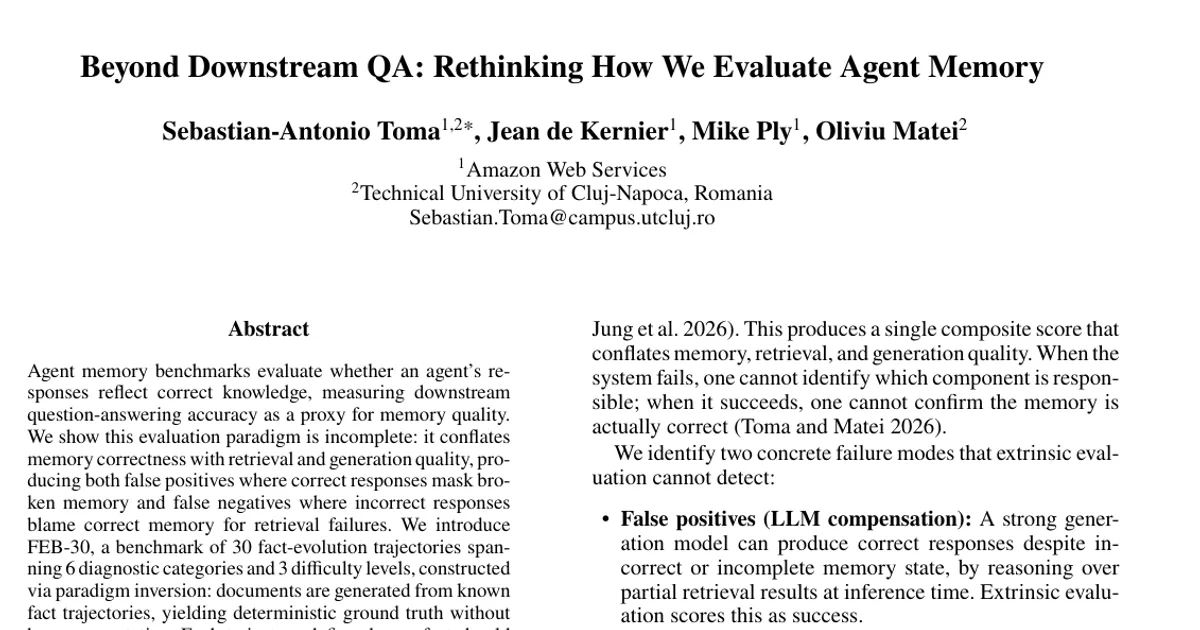
Agent memory benchmarks evaluate whether an agent's responses reflect correct knowledge, measuring downstream question-answering accuracy as a proxy for memory quality. We show this evaluation paradigm is incomplete: it conflates memory correctness with retrieval and generation quality, producing both false positives where correct responses mask broken memory and false negatives where incorrect responses blame correct memory for retrieval failures. We introduce FEB-30, a benchmark of 30 fact-evolution trajectories spanning 6 diagnostic categories and 3 difficulty levels, constructed via paradigm inversion: documents are generated from known fact trajectories, yielding deterministic ground truth without human annotation. Each trajectory defines how a fact should evolve across multi-author artifacts (documents, emails, conversations), enabling direct inspection of the memory store after each ingestion step. Applying FEB-30 to a representative memory system, we demonstrate that intrinsic and extrinsic evaluation diverge by an average of 16 percentage points, with 44% of trajectories exceeding meaningful divergence thresholds. Diagnostic decomposition reveals that the system correctly classifies memory operations (create, update, reinforce, supersede) only 20% of the time, a failure entirely invisible to extrinsic evaluation, and that failure modes differ systematically by category and difficulty. We release the benchmark, document generation pipeline, and scoring framework to support reproducible evaluation of agent memory systems.