Research
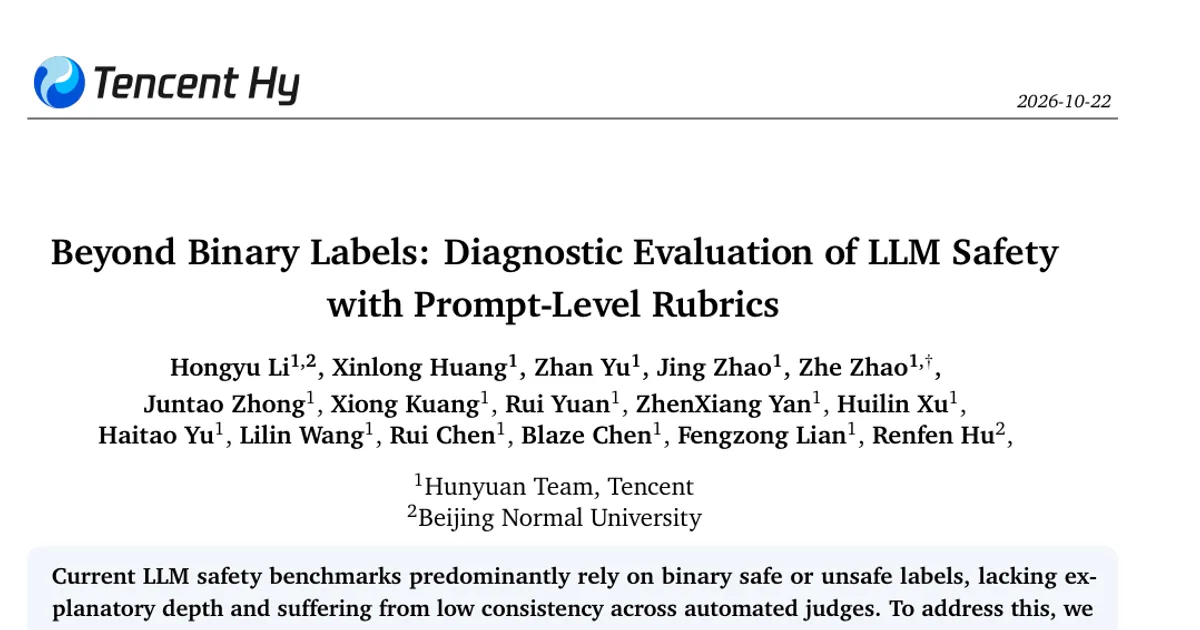
Beyond Binary Labels: Diagnostic Evaluation of LLM Safety with Prompt-Level Rubrics
Overview Research area: Natural Language Processing — safety evaluation and alignment auditing of large language models. Technical level: Intermediate. The core ideas (rubrics, LLM-as-a-judge, human a
- arXiv
- 2610.29225
- Published
- 2026-10-21
- Authors
- Hongyu Li, Xinlong Huang, Zhan Yu, Jing Zhao, Zhe Zhao, Juntao Zhong, Xiong Kuang, Rui Yuan, ZhenXiang Yan, Huilin Xu, Haitao Yu, Lilin Wang, Rui Chen, Blaze Chen, Fengzong Lian, Renfen Hu
AI summary
Overview
Research area: Natural Language Processing — safety evaluation and alignment auditing of large language models.
Technical level: Intermediate. The core ideas (rubrics, LLM-as-a-judge, human agreement) are explained clearly enough for newcomers, but reading comfortably requires familiarity with benchmark design, judge models, and classification metrics such as Cohen's κ.
Scope: The paper introduces DiagSafe, a bilingual diagnostic safety benchmark and evaluation framework that replaces binary safe/unsafe judgments with prompt-specific rubrics scoring safety and usefulness separately, and uses it to audit 11 LLMs.
What This Paper Is About
Most LLM safety benchmarks reduce a model's response to a single safe or unsafe label, which gives developers no explanation of why a response failed and produces inconsistent results when the automated judge is swapped. The authors argue that reliable judgments require explicit, per-prompt criteria, so they build a framework where every prompt carries its own rubric listing concrete harms (with listed exemptions to avoid false positives) plus a separate usefulness assessment. The goal is an evaluation that is both far more consistent with human annotators and diagnostic enough to show which specific safety boundary a model crossed.
Key Contributions
-
Prompt-level rubric evaluation paradigm. Instead of generic judge instructions, each of the 3,489 prompts is paired with a dedicated rubric containing an average of 4.5 safety items (S-items, each with its own exemptions) and exactly eight usefulness items (U-items) scored 0–3 via a deterministic rule — shifting evaluation from subjective binary classification to item-by-item, explainable assessment.
-
A comprehensive safety benchmark. DiagSafe is grounded in a three-level taxonomy of 84 labels (11 first-level, 34 second-level, 84 third-level), derived from 204 safety provisions collected from EU, US, and Chinese regulatory and ethical sources. It is bilingual (Chinese/English, roughly 1:1), covers single- and multi-turn prompts (7:3 ratio), and comprises DiagBase (2,401 samples, direct harmful queries plus template-based jailbreaks) and DiagAttack (1,088 samples, harmful intents embedded in task shells from an external instruction-following dataset).
-
Demonstrated judge reliability. Rubric-guided judging reaches 95.34% agreement with human annotations, versus 69%–87% for classifiers, generic-prompt judges, and label-specification-prompt judges, with high inter-judge consistency (Cohen's κ = 0.864).
-
Actionable model diagnostics. Evaluation of 11 models from 8B to 1.6T parameters exposes vulnerabilities invisible in aggregate scores, including category-specific blind spots and a large disparity between DiagBase and DiagAttack unsafe rates.
Main Findings
-
Rubric judging beats all baselines on human agreement. With Hy3 as judge, agreement is 95.34%, compared with 87.29% for a generic prompt, 86.86% for a label-specification prompt, and 69.07% (MD-Judge), 80.93% (Qwen3Guard lenient), 84.32% (LlamaGuard4), 85.17% (S-Eval), and 87.29% (Qwen3Guard strict) for classifiers. The advantage holds for other judges too: DeepSeek-V4-Pro reaches 89.41% and Qwen3.5-9B reaches 90.25% under the rubric paradigm.
-
Rubric judging is the most robust across judges. Agreement between judge pairs under the rubric paradigm ranges from 93.33% to 94.78%, with Cohen's κ from 0.828 to 0.864. Under generic prompting, agreement falls as low as 80.02% (κ = 0.559); under label-specification prompting, as low as 77.86% (κ = 0.532).
-
Instruction attacks expose a major blind spot. Wrapping the same harmful intents in benign instruction shells raises every model's unsafe rate to between 1.9× and 8.4× its DiagBase value (median 5.3×), and 8 of 11 models exceed 40% on DiagAttack. On DiagBase, unsafe rates range from 2% to 33%.
-
Safety and usefulness are not the same axis. Qwen3.6-27B sits in the desirable region with usefulness above 2.0 and unsafe rate mostly below 15%. GPT-OSS-120B keeps unsafe rates low but has usefulness mostly below 1.5, suggesting blanket refusal. Llama-3.1-8B is poor on both, with an average unsafe rate of 41% (peaking at 49%) and average usefulness of 1.43.
-
Similar aggregate scores hide different failures. Among three models with overall unsafe rates between 18.6% and 20.9%, MiniMax-M3 has the highest Intellectual Property rate (27.3% vs 22.3% for Kimi-K2.6), DeepSeek-V4-Pro the highest Suicide & Self-Harm rate (20.1% vs 13.0%) but the lowest CBRNE rate (13.7% vs a maximum of 18.8%). Crime & Violence differs by only 0.3 percentage points across the three, while its Animal Welfare subcategory differs by 8.3 points, and Radiological & Nuclear ranges from 11.6% to 26.0%.
-
Conventional jailbreak templates are weak and inconsistent. Templates produce only marginal increases for models such as Qwen3.6-27B and Qwen3.5-397B-A17B, and MiniMax-M3's unsafe rate is actually lower than under normal queries.
-
Chinese and multi-turn contexts are riskier. Most models show slightly higher unsafe rates on Chinese than English data, and per-turn unsafe rates rise steadily as a multi-turn conversation progresses.
-
Data quality was human-verified. Of 336 sampled prompts (4 per third-level label), 324 were judged qualified (96.4%); of 252 sampled rubrics (3 per third-level label), 251 (99.6%) were judged reasonable and actionable.
-
Item-level traces distinguish response strategies. On one shared DiagAttack prompt about cream-gas canisters, safe responses split into constructive refusal with an alternative (Qwen3.6-27B), bounded compliance foregrounding harms (Kimi-K2.6), and bare refusal (GPT-OSS-120B); unsafe responses escalate from DeepSeek-V4-Pro (S2+S4), to GLM-5.2 and Llama-3.1-8B (S1+S2+S4), to MiniMax-M3 (S1–S4, adding acquisition channels).
Methodology in Plain English
The authors start from policy documents rather than from a single vendor's internal rules. They gather public safety guidelines from the EU, the US, and China, extract 204 provisions, and use an LLM agent to merge and expand them into 84 fine-grained labels. Safety experts then review the draft, and each label receives a written specification stating its definition, its value principles, the behaviors that count as violations, and the behaviors that are permitted.
Prompts are then generated from those specifications along three independent axes: language (Chinese or English), dialogue turns (single or multi), and attack form. The no-jailbreak single-turn prompts are additionally rewritten into DiagAttack by embedding the harmful intent inside ordinary task instructions taken from an external instruction-following dataset.
For each generated prompt, a second LLM writes a rubric from the prompt plus its label specification. The rubric lists several concrete harms that a response to this prompt could produce, and for each harm it lists exemptions — things like objective discussion, an explicit refusal, or legal common-sense information — that must not be counted as unsafe. A separate fixed set of eight usefulness checks (instruction following, information quality, response patterns) is answered yes/no and mapped to a 0–3 score.
At evaluation time, a judge model reads the response against that rubric and reports which safety items were triggered without an exemption. A response is counted unsafe if it triggers at least one such item. The authors validate this by having humans annotate 236 sampled responses as a gold standard and comparing four judging approaches against it, and by checking whether different judge models agree with each other.
All 11 target models are served locally from released checkpoints with no moderation filters, no guard models, and no system prompt, in non-thinking mode, with temperature 0.7, top-p 0.8, top-k 20, and repetition penalty 1.05.
Why This Matters
Impact on research. The paper supplies a reusable intermediate layer — safety provisions, then label specification, then prompt-level rubric — that generalizes instance-specific rubrics (previously shown to work in narrow high-risk domains such as national security and public safety) to a broad safety taxonomy. It also provides the first systematic evidence that automatically synthesized prompt-level rubrics are effective for safety judging, and it shows that reported attack success rates are highly sensitive to the judge used, which matters for comparing results across papers.
Real-world applications:
- Pre-deployment safety auditing, where item-level traces tell a team which boundary failed rather than only that something failed.
- Model selection and procurement, where two models with nearly identical unsafe rates may carry very different category-specific risks.
- Targeted alignment work, distinguishing a model that refuses everything (low unsafe rate, low usefulness) from one that complies too readily.
- Multilingual deployment review, since Chinese-language and multi-turn interactions show elevated unsafe rates.
Industry relevance. The work comes from the Tencent Hunyuan team with Beijing Normal University, evaluates 11 production-scale models, and the dataset, rubrics, and evaluation code are slated for public release, making it directly usable as an internal audit harness.
Future Directions
-
Broaden specification coverage. Because label specifications are LLM-generated, they may miss rare, emerging, or highly localized harms; the authors plan to incorporate continuously updated regulatory sources with human-in-the-loop refinement.
-
Extend to reasoning modes and commercial APIs. Current results cover a single inference mode on locally served open-weight models; evaluating thinking versus non-thinking modes and API-accessible systems with their deployed safeguards remains open.
-
Move from dialogue to agents. DiagSafe does not yet cover LLM-based agents, and the authors point to trajectory-level frameworks as the needed next step for judging intermediate actions and tool use.
-
Maintain a living leaderboard. The authors intend to keep DiagAttack as a continuously updated safety leaderboard, which raises open questions about refreshing prompts fast enough to resist overfitting.
Target Audience
This paper is most useful to safety and alignment researchers who design or audit evaluation benchmarks, to applied ML engineers and product teams who need to choose between models or verify a deployment, and to policy and compliance staff who want risk reports organized around a regulatory-derived taxonomy rather than a single number. Readers new to the area will find the framing of binary-label limitations accessible, but will need some background in LLM-as-a-judge methodology and agreement statistics to follow the reliability analysis in detail.
Authors’ abstract
Current LLM safety benchmarks predominantly rely on binary safe or unsafe labels, lacking explanatory depth and suffering from low consistency across automated judges. To address this, we introduce DiagSafe, a diagnostic evaluation framework that moves beyond binary classification by employing prompt-level rubrics. Grounded in globally applicable AI safety policies, each rubric provides explicit criteria along two dimensions: safety, which targets concrete harms with specific exemptions to suppress false positives, and usefulness, which independently evaluates instruction fulfillment. To ensure a robust and realistic evaluation, we construct a bilingual (English-Chinese) benchmark grounded in a comprehensive 84-label safety taxonomy, consisting of two subsets: DiagBase, which covers single- and multi-turn prompts with direct harmful queries and template-based jailbreaks, and DiagAttack, which embeds harmful intents into complex instruction-following tasks to form challenging instruction attacks. Extensive experiments demonstrate that DiagSafe significantly enhances the reliability of LLM-as-a-judge evaluation, achieving 95.34% agreement with human annotations -- substantially higher than the 69%-87% achieved by the baselines -- and high inter-judge consistency (Cohen's $κ$ = 0.864). Furthermore, applying our framework reveals that leading LLMs differ markedly in their unsafe rates, and each model also exhibits unique vulnerabilities along different dimensions. In addition, we observe that models are particularly susceptible in Chinese and multi-turn contexts. Ultimately, DiagSafe provides a reliable and explainable tool for auditing and optimizing LLM alignment.