Research
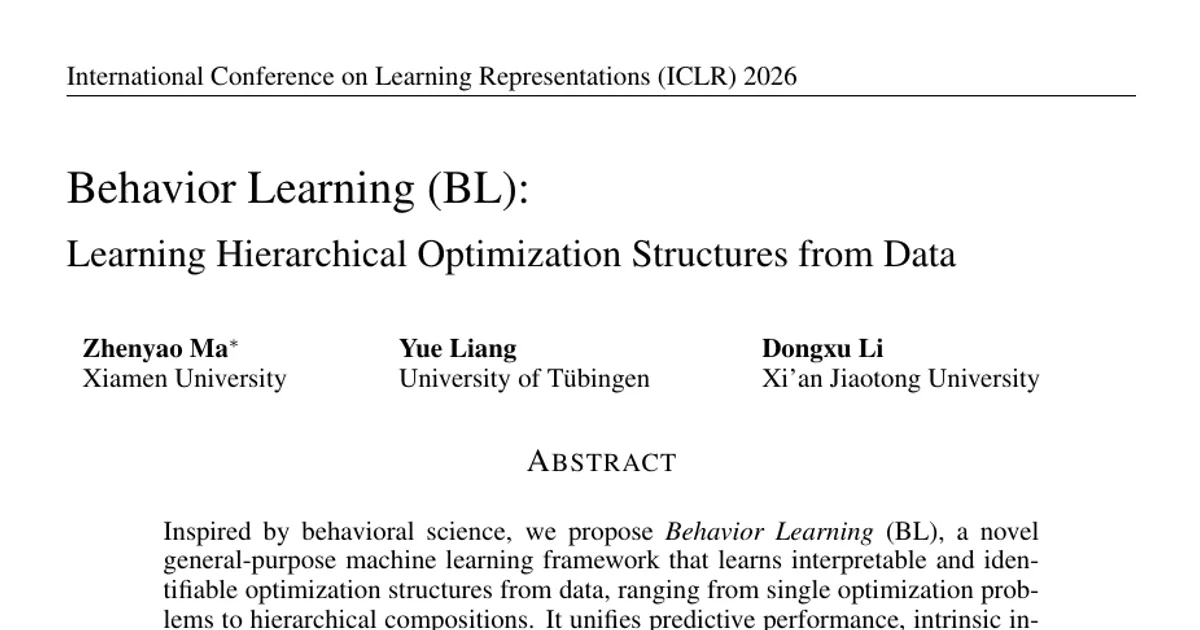
Behavior Learning (BL): Learning Hierarchical Optimization Structures from Data
Overview Research area: Interpretable machine learning, inverse optimization, and behavioral/decision-theoretic modeling. Technical level: Advanced. The paper is built on optimization theory (penalty
- arXiv
- 2602.20152
- Published
- 2026-02-23
- Authors
- Zhenyao Ma, Yue Liang, Dongxu Li
AI summary
Overview
Research area: Interpretable machine learning, inverse optimization, and behavioral/decision-theoretic modeling.
Technical level: Advanced. The paper is built on optimization theory (penalty reformulations, UMPs), statistical learning theory (M-estimation, identifiability, consistency, asymptotic normality and efficiency), and energy-based/distributional modeling (Gibbs distributions, score matching).
Scope: The paper proposes Behavior Learning (BL), a general-purpose framework that learns an optimization structure — a single utility maximization problem (UMP) or a hierarchical composition of them — from data, and proves identifiability and asymptotic statistical guarantees for its smooth monotone variant (IBL).
What This Paper Is About
Machine learning faces a persistent performance–interpretability trade-off: high-performing models such as deep neural networks are opaque, while intrinsically interpretable models struggle with complex nonlinear patterns. The authors argue that existing interpretable methods also suffer from two scientific limitations — they are rarely grounded in scientific theory (such as optimization problems), and their interpretations are usually non-identifiable, meaning they are not uniquely determined by observable predictions. The paper's goal is a framework that learns interpretable, identifiable optimization structures directly from data while retaining strong predictive performance.
Key Contributions
- The BL framework. A general-purpose machine learning framework inspired by behavioral science in which responses are modeled as drawn from a conditional Gibbs distribution induced by a compositional utility function, built from intrinsically interpretable modular blocks. Each block is a learnable penalty-based formulation of a utility maximization problem (UMP) and can be written in symbolic form.
- Hierarchical and identifiable variants. BL supports three architectures — BL(Single) (one block), BL(Shallow) (one or two intermediate layers, L ≤ 2), and BL(Deep) (L > 2) — with the deeper variants representing hierarchical optimization structures. Refining the block penalties into smooth and monotone forms yields Identifiable BL (IBL), which guarantees a unique intrinsic interpretation.
- Theoretical guarantees. The paper proves that any optimization problem can be equivalently written as a UMP (Theorem 2.2), establishes universal approximation for BL (Theorem 2.3), and for IBL proves identifiability, loss identifiability, consistency, universal consistency, asymptotic normality, and asymptotic efficiency (Theorems 2.4–2.7 and Appendix Theorems B.9–B.10).
- A new methodology for data-driven inverse optimization. At the paradigm level, BL learns from data the optimization structure of either a single optimization problem or a hierarchical composition of problems, positioning itself as a general-purpose framework for data-driven inverse optimization across scientific disciplines.
Main Findings
- Universality of the UMP formulation: Any optimization problem of the form max or min over y of f(x, y), subject to equality and inequality constraints, is equivalent to a UMP (Theorem 2.2). This is what makes BL domain-general rather than domain-specific.
- Exact penalty reformulation: Under a Han–Mangasarian constraint qualification at a strict local maximizer, a constrained UMP has an unconstrained penalty form combining an increasing function of utility, a ReLU-style inequality penalty ρ(z) = max{z, 0}, and an absolute-value equality penalty ψ(z) = |z| (Theorem 2.1).
- Universal approximation of BL: For any continuous conditional density p⋆(y|x) positive on a compact set, and any τ > 0 and ε > 0, a finite BL architecture and parameter θ⋆ exist such that the supremum over x of the KL divergence between p⋆(·|x) and the Gibbs distribution p_τ(·|x; θ⋆) is below ε.
- Identifiability of IBL: Under Assumption B.1 (injectivity of the map from the quotient space of atomic parameters to functions, linear independence of any finite set of distinct atoms, and minimal representations with fixed canonical ordering), IBL(Single), IBL(Shallow), and IBL(Deep) are identifiable in the parameter quotient space. The population loss has a unique minimizer in that quotient space when γ_c > 0, and in a scale-invariant quotient space when γ_c = 0.
- Consistency and ground-truth recovery: The empirical IBL minimizer converges in probability to a population minimizer and the loss converges in probability to the population loss; if the model is correctly specified, it converges to the ground-truth parameter θ⋆. Universal consistency holds even under misspecification when capacity grows with sample size, with the learned conditional distributions converging in KL to the true distribution uniformly over x.
- Asymptotic behavior: IBL estimators are asymptotically normal (Theorem B.9) and, under additional regularity conditions, attain the efficient information bound (Theorem B.10), which the authors describe as statistical optimality.
- Standard prediction performance: BL was evaluated on 10 datasets against 10 baseline models drawn from five methodological families (neural networks, tree-based models, gradient boosting, Bayesian methods, and linear regressors). BL attained first-tier predictive performance and the best results among intrinsically interpretable models; BL(Shallow) surpassed MLP and showed no statistically significant difference from state-of-the-art models, while BL variants ranked second and third in mean F1-Macro rank.
- Symbolic interpretability demonstrated: On the Boston Housing dataset, a trained BL(Single) with a degree-2 polynomial basis was written as the UMP of a "representative buyer." The utility term reduced to p_u = −0.56·P² − 0.6·RM + 0.57·RM·P + R̃_u ≈ (1−P)(1+P−RM) + R̃_u, keeping only the monomials with the largest (2–5) absolute coefficients and collecting the rest into a residual term R̃. Median housing price (MEDV) and average number of rooms (RM) dominated across all terms; proportion of lower-income residents (LSTAT) featured prominently in the budget constraint; crime rate (CRIM) appeared only in the belief term.
- Hierarchical interpretation demonstrated: In the BL[2,1] model, Layer 1 identified an "Economic-sensitive Buyer" (loading on ZN, large-lot residential share, and LSTAT) and a "Location-sensitive Buyer" (driven mainly by CHAS, the Charles River indicator, and RAD, highway accessibility); Layer 2 aggregated them into an effective representative buyer. In the BL(Deep) [5,3,1] model, Layer 1 recovered five distinct micro-level housing preference types, Layer 2 identified three macro-level trade-off types, and Layer 3 aggregated them into the overall representative buyer. The authors state these recovered preferences and trade-offs align with established findings in the economics literature (Table 11).
- High-dimensional scalability: Against an energy-based MLP (E-MLP) baseline at depths d ∈ {1, 2, 3} without skip connections, on four image and text datasets and six metrics (in-distribution accuracy, ECE, NLL, AUROC, AUPR, FPR@95). On image datasets the two models had comparable in-distribution accuracy, and BL generally achieved stronger out-of-distribution detection on Fashion-MNIST at similar accuracy levels. On text datasets, the paper reports BL consistently improving ID accuracy over E-MLP across depths. Reported values from the image table include: MNIST accuracy 98.15 ± 0.07 (E-MLP, depth 1) versus 97.97 ± 0.18 (BL, depth 1), and Fashion-MNIST OOD AUROC 90.57 ± 1.39 (E-MLP, depth 1) versus 91.89 ± 0.71 (BL, depth 1); at depth 3, MNIST OOD AUROC was 87.76 ± 2.55 (E-MLP) versus 92.92 ± 1.69 (BL). On text datasets at depth 1, AG News accuracy was 88.74 ± 0.26 (E-MLP) versus 89.52 ± 0.16 (BL) and Yelp accuracy 91.16 ± 0.02 (E-MLP) versus 91.56 ± 0.04 (BL). The paper states OOD detection behavior varied by dataset — BL outperformed E-MLP on Yelp, while E-MLP showed better OOD discrimination on AG News. BL also achieved better calibration (ECE and NLL, Table 2).
- Downward shift of the Pareto frontier: The two models had highly comparable parameter sizes, and BL exhibited slightly higher training time than E-MLP across datasets. Combined with comparable predictive performance and BL's intrinsic interpretability versus the black-box E-MLP, the authors characterize this as a downward shift of the Pareto frontier.
- Not reported in the available content: The specific names of the 10 datasets and 10 baselines (listed in Tables 4 and 5), the exact parameter counts (Table 13), and the runtime figures (Table 3) are referenced but not included in the truncated text, nor are the full BL depth-3 text results.
Methodology in Plain English
The starting point is a classic idea from behavioral science: people behave as if they are solving a utility maximization problem — maximizing an objective subject to constraints on resources and consistency. The authors show that any optimization problem can be rewritten as such a UMP, and that a constrained UMP can be relaxed into an unconstrained "penalty" form with three pieces: a term for utility, a penalty for violating inequality constraints, and a penalty for violating equality constraints.
BL takes that penalty form and makes each piece a learnable neural-style function. A single block is built from polynomial feature maps plus three nonlinearities — a bounded tanh for utility (reflecting diminishing marginal utility), ReLU for inequality violations, and absolute value for equality violations — combined with learnable weights λ₀, λ₁, λ₂. Because the pieces are polynomials, each trained block can be read off in symbolic form as an optimization problem, in the same way a linear regression's coefficients can be read directly.
Instead of predicting y directly, BL defines a Gibbs distribution over the response, p_τ(y|x; Θ) ∝ exp(BL_Θ(x, y)/τ). The compositional utility function acts like an energy, and the temperature τ controls randomness; as τ → 0 the distribution collapses to the deterministic best response of the composed optimization problems. Blocks are stacked into layers to form BL(Single), BL(Shallow), and BL(Deep), with only the final layer passed through a learnable affine transformation.
Training uses two losses with nonnegative weights: cross-entropy on discrete components of the response and denoising score matching on continuous components, both derived from the same underlying distribution. For IBL, the nonlinearities are tightened — tanh, softplus, and an elementwise square — so that the functions are strictly increasing (and symmetric for the equality term) and continuously differentiable, which is what makes the model identifiable.
Why This Matters
Impact on research. The paper reframes interpretability as a structural question — what optimization problem generated this data? — rather than a post-hoc explanation question. Because every block is itself a UMP and any optimization problem is equivalent to a UMP, the framework connects machine learning directly to the mathematical objects used in economics, physics, and biology. The identifiability and asymptotic-efficiency results give the learned interpretations a statistical footing that most interpretable models lack, and the authors argue this also matters for Popperian falsifiability.
Real-world applications the paper points to:
- Macroeconomics and consumer behavior: recovering interpretable preference, budget, and belief structures from observed choices, as demonstrated on Boston Housing median home values.
- Statistical physics: treating a compositional utility function as an energy function, and interpreting deep layers as coarse-grained or renormalization-style aggregation (the paper cites the coarse-graining principle in this connection).
- Evolutionary biology: modeling outcomes that arise as solutions to latent optimization problems, such as fitness-related trade-offs.
- Data-driven inverse optimization: recovering the objective and constraints of an optimization problem from observed solutions across any scientific domain, including social and organizational systems the authors say resist precise formalization.
Industry relevance. Practitioners in regulated or high-stakes settings (credit, insurance, healthcare, energy, and policy modeling) often need models whose reasoning can be written down and audited. BL's symbolic output — an explicit objective with inequality and equality terms — offers a form of transparency closer to a written economic model than to a feature-attribution chart. The reported comparable parameter counts and only slightly higher training time versus an E-MLP baseline suggest the approach is not prohibitively expensive, and the released code (pip install blnetwork) lowers the barrier to trying it.
Future Directions
- Closing the identifiability gap across architectures. Identifiability is proven for IBL(Single), IBL(Shallow), and IBL(Deep), but BL itself uses general nonlinearities; whether identifiability-like guarantees can be extended to broader BL variants, including designs with skip connections, remains open.
- Empirical recovery of ground-truth structures. The consistency and universal consistency results are theoretical, and the available content does not report experiments in which a known ground-truth optimization structure is recovered from simulated data. Such tests would directly validate the identifiability claims.
- Scaling hierarchical interpretation. The largest case study uses a [5,3,1] BL(Deep) architecture on Boston Housing. Whether the same bottom-up interpretation procedure (raw features → micro-level blocks → macro-level aggregation) remains readable at much greater depth and width, and how automated the parsimonious symbolic extraction should be, is unresolved.
- Comparing against other interpretable and inverse-optimization methods. The prediction experiments compare BL against 10 general baselines; a head-to-head comparison with established inverse optimization and structured interpretable models would clarify where the framework is most distinctive.
Target Audience
Researchers and graduate students in interpretable machine learning, inverse optimization, and statistical learning theory who are comfortable with optimization and estimation theory; behavioral, economic, and computational social scientists who want a data-driven way to recover optimization structures; and applied scientists in physics, biology, or policy modeling whose phenomena can be framed as solutions to optimization problems. Practitioners seeking an interpretable alternative to black-box models will find the results useful but should expect to engage with a substantial theoretical appendix to use the framework rigorously.
Authors’ abstract
Inspired by behavioral science, we propose Behavior Learning (BL), a novel general-purpose machine learning framework that learns interpretable and identifiable optimization structures from data, ranging from single optimization problems to hierarchical compositions. It unifies predictive performance, intrinsic interpretability, and identifiability, with broad applicability to scientific domains involving optimization. BL parameterizes a compositional utility function built from intrinsically interpretable modular blocks, which induces a data distribution for prediction and generation. Each block represents and can be written in symbolic form as a utility maximization problem (UMP), a foundational paradigm in behavioral science and a universal framework of optimization. BL supports architectures ranging from a single UMP to hierarchical compositions, the latter modeling hierarchical optimization structures. Its smooth and monotone variant (IBL) guarantees identifiability. Theoretically, we establish the universal approximation property of BL, and analyze the M-estimation properties of IBL. Empirically, BL demonstrates strong predictive performance, intrinsic interpretability and scalability to high-dimensional data. Code: https://github.com/MoonYLiang/Behavior-Learning ; install via pip install blnetwork.