Research
BD-Net: Has Depth-Wise Convolution Ever Been Applied in Binary Neural Networks?
Overview Research area: Model compression for computer vision — specifically Binary Neural Networks (BNNs) applied to lightweight, depth-wise separable architectures (MobileNet, ShuffleNet). Technical
- arXiv
- 2511.17633
- Published
- 2025-11-19
- Authors
- DoYoung Kim, Jin-Seop Lee, Noo-ri Kim, SungJoon Lee, Jee-Hyong Lee
AI summary
Overview
Research area: Model compression for computer vision — specifically Binary Neural Networks (BNNs) applied to lightweight, depth-wise separable architectures (MobileNet, ShuffleNet).
Technical level: Advanced. The paper assumes familiarity with binary quantization, XNOR-bitcount operations, batch normalization, and Hessian conditioning arguments.
Scope: This paper proposes BD-Net, a set of architectural changes (a 1.58-bit convolution and a pre-BN residual connection) that enable, for the first time according to the authors, successful binarization of depth-wise convolutions in BNNs.
What This Paper Is About
Binary Neural Networks compress weights and activations to 1-bit, but previous binarization methods only worked on regular convolutions. When applied to depth-wise convolutions — the core building block of lightweight models like MobileNet — they cause large accuracy drops and unstable training (the authors measured a drop from 69.4% to 60.7% Top-1 on ImageNet when applying ReActNet with depth-wise convolutions).
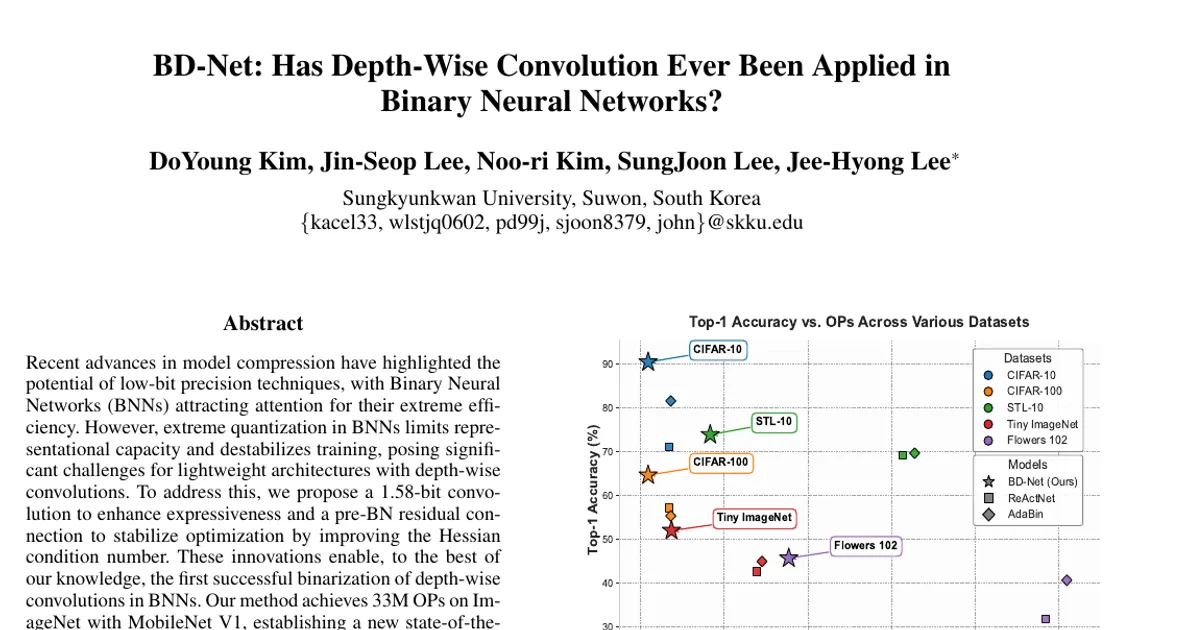
The paper's goal is to make binary depth-wise convolutions trainable and accurate, so that BNNs can actually deliver the computational savings they promise on compact architectures. The authors report the first successful binarization of depth-wise convolutions in BNNs, reaching 33M OPs on ImageNet with MobileNet V1 and accuracy improvements of up to 9.3 percentage points across five smaller datasets.
Key Contributions
-
Pre-BN residual connection. A connection linking the input of the binary depth-wise convolution directly to the input of the subsequent BN layer. The authors prove analytically that this reduces the Hessian condition number, flattening the loss landscape, and it adds no learnable parameters.
-
1.58-bit convolution. A dual binary convolution structure — two binary convolutions connected in parallel with their outputs summed — that raises the effective representational precision to M = log₂(N+1) ≈ 1.58 when N = 2, without abandoning bitwise operations.
-
First binarization of depth-wise convolutions. The combination of the two techniques above enables, per the authors, the first successful binarization of depth-wise convolutions in BNNs, verified on ReActNet and AdaBin backbones.
-
Broadcast residual connections for other architectures. Because ShuffleNet V1 and MobileNet V3 vary channel dimensions across layers, layer-wise residual connections fail. The authors replicate previous-layer channels to match the next layer's dimensions, extending BD-Net to these architectures.
Main Findings
-
Operation counts motivate the problem. For a layer with 56×56 resolution and 128 input/output channels, a full-precision 3×3 regular convolution requires 462M operations and a full-precision 3×3 depth-wise convolution only 3.61M. In binary form, the regular convolution still requires 7.23M while the depth-wise version requires just 56K — meaning binary regular convolutions cost more than 32-bit depth-wise convolutions.
-
Prior BNNs left most of the savings untapped. ReActNet reduced full-precision MobileNet V1 from 569M OPs to 87M OPs, only a 6.5-fold reduction against a theoretical 64-fold possibility.
-
ImageNet result. BD-Net-B (ReActNet) with MobileNet V1 achieves 65.3% Top-1 and 85.8% Top-5 accuracy at 33M OPs, roughly three times fewer operations than MobileNet V1 with regular convolutions. ReActNet 0.5× reaches 60.7% Top-1 at 30M operations, so BD-Net delivers over 4.6 percentage points more at similar cost.
-
Small/medium-scale datasets. BD-Net-B (ReActNet) reaches 89.93% on CIFAR-10 (1.83M OPs), 63.83% on CIFAR-100 (1.83M OPs), 77.03% on STL-10 (16.4M OPs), 52.06% on Tiny ImageNet (7.31M OPs), and 45.18% on Oxford Flowers 102 (34.6M OPs). BD-Net-B (AdaBin) reaches 90.48%, 64.66%, 73.90%, 52.01%, and 45.70% respectively.
-
Accuracy gains and OP reductions. BD-Net-B improves accuracy by +4.22 to +9.31 percentage points across CIFAR-10, CIFAR-100, STL-10, Tiny ImageNet, and Oxford Flowers 102 while reducing OPs by a factor of 2.68 to 8.47. BD-Net-A (ReActNet) cuts computational cost by roughly 3× to 4.5× versus ReActNet. BD-Net-A (AdaBin) improves accuracy by +3.27, +2.93, and +0.50 percentage points on CIFAR-10, CIFAR-100, and Oxford Flowers 102 while reducing OPs by 26%, 22%, and 34%.
-
Ablation study (MobileNet V1, CIFAR-100). A naive binary depth-wise convolution baseline reaches 54.94%. Adding the Pre-BN residual raises this to 56.93% (+1.99 p.p.); replacing the naive convolution with the 1.58-bit convolution raises it to 56.18% (+1.24 p.p.); combining both gives 58.28% (+3.34 p.p.), confirming the two techniques are complementary.
-
Hessian analysis. The binarized MobileNet V1 baseline shows a much higher maximum Hessian eigenvalue than the full-precision network. BD-Net reduces the maximum eigenvalue and produces an eigenvalue distribution similar to ReActNet (which has more parameters) and to full-precision MobileNet.
-
Loss landscape visualization. The landscape of binarized MobileNet V1 is rough; the 1.58-bit convolution alone smooths it noticeably, and the pre-BN residual alone also smooths it. BD-Net's combined landscape approaches the smoothness of the full-precision network.
-
Extension to ShuffleNet V1 and MobileNet V3. Without broadcast residual connections, ReActNet training is highly unstable (MobileNet V3 on Tiny ImageNet is reported as FAIL). With broadcast residual connections, accuracy improves by 1.01 to 62.47 percentage points on ShuffleNet V1 and by 32.44 to 67.13 percentage points on MobileNet V3. BD-Net-B improves accuracy by 4.89 to 64.24 percentage points on ShuffleNet V1 and 42.21 to 66.84 percentage points on MobileNet V3 while using fewer operations than ReActNet. The authors state further improvement is still required to extend these methods beyond MobileNet V1 to the entire ShuffleNet and MobileNet series.
Methodology in Plain English
The authors first diagnose why binary depth-wise convolutions fail. Three factors combine: depth-wise convolutions have far fewer learnable parameters than regular convolutions, so quantization errors are not averaged out; 1-bit precision produces extremely high quantization error; and because each depth-wise channel sees only one input channel, outputs have small variance, which can make the batch normalization scaling factor α = γ/√(σ²+ε) abnormally large and produce large gradients. The result is a rugged loss landscape.
To address instability, they attach a residual connection that skips over the binary depth-wise convolution and feeds its input directly into the following BN layer, calling this the pre-BN residual. They show via matrix analysis that as α grows, the condition number of this modified Jacobian approaches a much smaller value than the unmodified one, so κ(H′) < κ(H) — a lower condition number means a smoother landscape.
To address limited expressiveness, they run two binary convolutions in parallel, each with its own rounding boundary and output magnitude, and sum their outputs. Two convolutions yield three possible output combinations, which is equivalent to log₂(3) ≈ 1.58 bits of representational effect. They note that a binary regular convolution can generate 2^(9×C_in) filter combinations while a binary depth-wise convolution is restricted to 2⁹ combinations, and that unlike ABC-Net, which uses up to 25 times more convolutions, this approach adds only a small amount of computation.
They then built two variants on top of existing BNN methods: BD-Net-A replaces the 3×3 regular convolutions in ReActNet or AdaBin with 3×3 depth-wise convolutions plus both new components; BD-Net-B additionally restores real-valued 3×3 depth-wise convolutions in the downsampling layers. First and last layers stay in full precision in all cases. Training used standard recipes — on CIFAR-style data, SGD with momentum 0.9, batch size 256, 400 epochs, initial learning rate 0.1 with cosine annealing; on ImageNet, a two-step strategy using Adam with initial learning rate 5e-4, batch size 256, weight decay 1e-5 then 0, and a distributional loss instead of cross-entropy. All reported table results are averages of two runs with different random seeds.
Why This Matters
Impact on research. The paper closes a gap that has limited BNNs for years: binary methods worked on regular convolutions but not on the depth-wise convolutions that define efficient architectures. It shows that the promise of 64× compression cannot be realized without solving this, and it provides two concrete, low-overhead mechanisms plus an analytical argument (the Hessian condition number bound) for why one of them works. It also extends BNN applicability beyond ResNet-style and MobileNet V1 backbones to ShuffleNet V1 and MobileNet V3.
Real-world applications:
- On-device image classification on low-power CPUs, where XNOR-bitcount operations replace multiply-accumulate.
- Personalized on-device services that the authors cite as a growing demand in resource-constrained environments.
- Edge deployment of mobile vision models where memory and energy budgets rule out GPU accelerators.
- Transfer to fine-grained recognition tasks — the paper evaluates Oxford Flowers 102, a 102-class, 1,020-training-image dataset, showing the method works under limited data.
Industry relevance. The efficiency framing is direct: 33M OPs at 65.3% Top-1 on ImageNet is a cost point previously unavailable in binary networks, and the paper reports beating a comparable-OP ReActNet 0.5× configuration by over 4.6 percentage points. The code is released at https://github.com/kacel33/BD-Net.
Future Directions
-
Extending beyond MobileNet V1. The authors explicitly state that further improvements are required to effectively extend their methods to the entire ShuffleNet and MobileNet series, and that BD-Net-B still loses accuracy relative to ReActNet-with-broadcast-residuals on some ShuffleNet V1 and MobileNet V3 configurations.
-
Choosing the right number of parallel binary convolutions. The paper notes that N = 3 would give an effect similar to 2-bit precision, and that using more than two binary convolutions adds computational cost without proportional benefit. An appendix ablation sweeps Single, Dual, Triple, and Quad depth-wise convolution configurations, but the results are not reported in the retrieved content.
-
Handling channel-varying architectures more fully. Broadcast residual connections were needed because layer-wise residual connections cannot be applied when channel dimensions change between layers; improving this mechanism could raise BD-Net's performance on ShuffleNet V1 and MobileNet V3.
-
Pushing the accuracy/operations trade-off further. The x1.5 variant, BD-Net-B(x1.5) (ReActNet), reaches 69.4% Top-1 / 88.8% Top-5 at 65M OPs but higher FLOPs (0.26 ×10⁸), leaving an open question about the most efficient point on the curve.
Target Audience
Researchers and engineers working on model compression, quantization, and efficient inference — particularly those developing BNNs or deploying depth-wise separable architectures on edge hardware. It is also relevant to practitioners who need to understand why binary compact networks have historically underdelivered on their theoretical speedups. The mathematical treatment of the Hessian condition number makes it most accessible to readers with a machine learning or numerical optimization background.
Authors’ abstract
Recent advances in model compression have highlighted the potential of low-bit precision techniques, with Binary Neural Networks (BNNs) attracting attention for their extreme efficiency. However, extreme quantization in BNNs limits representational capacity and destabilizes training, posing significant challenges for lightweight architectures with depth-wise convolutions. To address this, we propose a 1.58-bit convolution to enhance expressiveness and a pre-BN residual connection to stabilize optimization by improving the Hessian condition number. These innovations enable, to the best of our knowledge, the first successful binarization of depth-wise convolutions in BNNs. Our method achieves 33M OPs on ImageNet with MobileNet V1, establishing a new state-of-the-art in BNNs by outperforming prior methods with comparable OPs. Moreover, it consistently outperforms existing methods across various datasets, including CIFAR-10, CIFAR-100, STL-10, Tiny ImageNet, and Oxford Flowers 102, with accuracy improvements of up to 9.3 percentage points.