Research
Bayesian Meta-Analyses Could Be More: A Case Study in Trial of Labor After a Cesarean-section Outcomes and Complications
Overview Research area: Bayesian statistics and probabilistic machine learning applied to medical meta-analysis (specifically obstetrics and gynecology). Technical level: Intermediate. The medical fra
- arXiv
- 2601.10089
- Published
- 2026-01-15
- Authors
- Ashley Klein, Edward Raff, Marcia DesJardin
AI summary
Overview
Research area: Bayesian statistics and probabilistic machine learning applied to medical meta-analysis (specifically obstetrics and gynecology).
Technical level: Intermediate. The medical framing and the core idea are accessible, but the paper constructs a hierarchical Bayesian model with truncated latent variables, hyper-priors, and Markov Chain Monte Carlo inference.
Scope: The paper builds a Bayesian meta-analysis that models an unrecorded clinical decision variable (the Bishop score) to re-evaluate whether mechanical dilation or Pitocin is safer and more effective for inducing labor in patients attempting a Trial of Labor After a Cesarean-section (TOLAC).
What This Paper Is About
Standard medical meta-analyses — fixed-effect and random-effects models — assume the underlying studies captured all the variables that mattered. In this case study, a key decision variable, the Bishop score, determined which induction method a patient received (Pitocin for higher scores, mechanical dilation for lower scores), but that score was never recorded in the literature. The authors argue this creates a shared dependency between the compared groups, so the apparent finding that Pitocin is superior may be an artifact of which patients were selected to receive it. Their goal is a Bayesian method that can correct for this known-but-unobserved variable using only the published data and physician-guided priors.
Key Contributions
- A general-purpose hierarchical Bayesian meta-analysis model in which an unobserved decision variable (the "mediator") is modeled as a distribution that is left- or right-truncated for the intervention and control populations respectively, based on a per-study threshold inferred from data.
- A physician-guided procedure for setting hyper-priors using a three-question ordering: first use national/state/hospital aggregate statistics, second establish maximum plausible ranges of effect, third probe what is seen in normal clinical practice — with the first question treated as most objective and useful.
- A demonstration that the correction changes the conclusion in a real OBGYN question: a standard fixed-effect analysis found a significant harm from mechanical dilation, while the Bayesian model accounting for Bishop scores found no detectable difference.
- A documented comparison to prior confounded meta-analysis methods, including E-values and one-stage/two-stage correction approaches, arguing these require the confounding effect size to already be known or meaningfully estimable.
Main Findings
- Fixed-effect result (ignoring the Bishop score): With a mean cesarean-section relative risk of 1.39 (CI 1.27–1.51, p < 0.001), mechanical dilation appeared to carry a 39% higher risk than the control. However, a Cochran's Q test showed significant heterogeneity (p < 0.001), and the authors state they do not recommend using this conclusion.
- Bayesian result (accounting for the Bishop score): The model reports a risk ratio of 1.04 (CI 0.93–1.18), indicating no difference in cesarean-section risk once physician preference for selecting an intervention based on Bishop scores is conditioned on.
- Vaginal delivery rates: 51.4% in the mechanical dilation group versus 69.1% in the control group, based on 4037 TOLAC patients total.
- Adverse uterine events: No significant difference between groups (p = 0.136; CI 0.89–2.48). The mechanical dilation cohort had a 2.98% rate (31 uterine rupture/dehiscence); the control cohort had a 1.73% rate (52 uterine rupture/dehiscence).
- APGAR < 7 at 5 minutes: No significant difference (p = 0.434; CI 0.71–2.22). Mechanical dilation cohort rate 1.92%; control cohort rate 1.83%.
- Cohort composition: 1039 patients received mechanical dilation (foley balloon, Cook catheter, or osmotic dilators) and 2998 did not. Mean age was 31.46 years and mean gestational age 39.22 weeks. 231 patients in the mechanical dilation group had a prior vaginal delivery. Recorded indications for the prior cesarean were labor dystocia (29%), non-labor dystocia (50.6%), and unspecified (21%).
- E-value sensitivity analysis: Applying the E-value approach to the original finding yields 2.13, meaning the unaccounted Bishop score would need to be associated with at least a 2.13-fold reduction in relative risk across all studies to explain away the apparent effect.
- Study count: The analysis drew on n = 6 total studies, which the authors state makes random-effects estimation unreliable and motivates their use of a fixed-effect model for the outcomes without a Bishop-score dependency.
Methodology in Plain English
The authors first documented how the clinical decision is actually made: a provider performs a cervical exam and computes a Bishop score by hand. If the score is high enough, no cervical ripening is needed; if ripening is needed, mechanical dilation (a catheter) is used, while Pitocin tends to be prescribed when the score is already favorable. Prior meta-analyses compared the two groups as if they were independent, but the score creates a shared dependency — in the authors' framing, the two populations sit in the same Markov blanket.
To fix this, the researchers built a graphical (Plate) model with several groups of variables. The unobserved Bishop score is represented by a latent mediator distribution; a global threshold and a per-study threshold (which absorb provider discretion on where to draw the line) split that distribution into a truncated lower piece for the catheter group and a truncated upper piece for the Pitocin group. The population base rate of cesarean section is set from a real-world statistic — the 2019 US rate of 31.7%, encoded as a Beta(12, 25) prior, since 12/(12+25) = 32%. The strength of the Beta hyper-prior is given a logistic prior, and between-study heterogeneity is governed by half-Cauchy hyper-priors on the effect scales, chosen so the prior impact stays within roughly ±50 percentage points on the logit scale. Only one hyper-prior requires the user to supply problem-specific information.
Priors were not chosen for statistical convenience. The machine learning researchers consulted practicing physicians, and the resulting distributions were chosen to reflect the real generative process. Posterior inference was performed with the NUTS sampler implemented in Numpyro, with 95% highest density regions. For outcomes with no direct causal link to the Bishop score — uterine rupture and APGAR — the authors kept a conventional fixed-effect odds-ratio model, using Peto's method because the events are rare.
Why This Matters
Impact on research: The paper argues that existing tools for confounding in meta-analysis require the analyst to already know or estimate the size of the confounding effect, which makes them unfalsifiable when that quantity is unknown. By exploiting the fact that the mediator is observable in the decision process — even though its values were never reported — the authors show a route to re-examining existing data rather than requiring an expensive new study. They position this as filling a gap: they state they are aware of no prior work in the medical literature that accounts for known but unobserved hidden variables in meta-analysis, and say they are the first to consider bounds under unobserved confounding for meta-analysis specifically.
Real-world applications:
- Informing hospital and obstetrician policies that currently restrict or forbid induction for TOLAC patients, since the analysis found no support for treating a uterine scar as a contraindication to mechanical dilation.
- Preserving a cervical-ripening option for patients who cannot use Pitocin or other agents, which matters because ACOG already recommends against misoprostol for patients with prior cesarean section or uterine surgery.
- Providing justification to proceed with a randomized controlled trial, which the authors describe as the intended next step when an effect survives the correction.
- Guiding future data collection: the authors recommend that studies report Bishop scores directly so a more definitive conclusion becomes possible.
Industry relevance: The paper is as much a demonstration for machine learning practitioners as for clinicians. It shows probabilistic programming used as a bespoke modeling tool for a domain-specific causal question, and it connects to documented replication problems in machine learning itself — statistical errors, insufficient information in published works, and replications that require full redo of the original study. The authors also flag areas beyond the current scope, such as differential privacy, ordinal modeling, and sparsity-inducing models, as potentially relevant to medical applications.
Future Directions
- Collect and report Bishop scores in new studies, which the authors state is needed before a more robust and definitive conclusion can be reached.
- Run larger studies, since the main limitation is the small number of cohorts, which limits statistical power and reflects a general paucity of high-quality literature on mechanical dilation in TOLAC.
- Conduct a randomized controlled trial to test efficacy without the decision threshold, which the authors say their results justify — they note the start of new clinical trials is one outcome of this work.
- Generalize the method to other single-variable deciders, since the authors state the approach is readily adaptable to situations where one decision variable, often driven by provider discretion or a simple decision criterion, was omitted from the original analysis or data.
Target Audience
This paper benefits OBGYNs and maternal-health clinicians deciding between induction methods for TOLAC patients, clinical researchers and biostatisticians who conduct or read meta-analyses, and machine learning researchers interested in applying probabilistic programming and hierarchical Bayesian models to real domain problems with missing causal structure. It is also relevant to hospital policy makers and health services researchers who set induction guidelines. Because the paper presents a complete worked case study alongside the modeling decisions, it is approachable for readers with moderate statistics background, though the Plate diagram and generative story will be most useful to those comfortable with Bayesian graphical models.
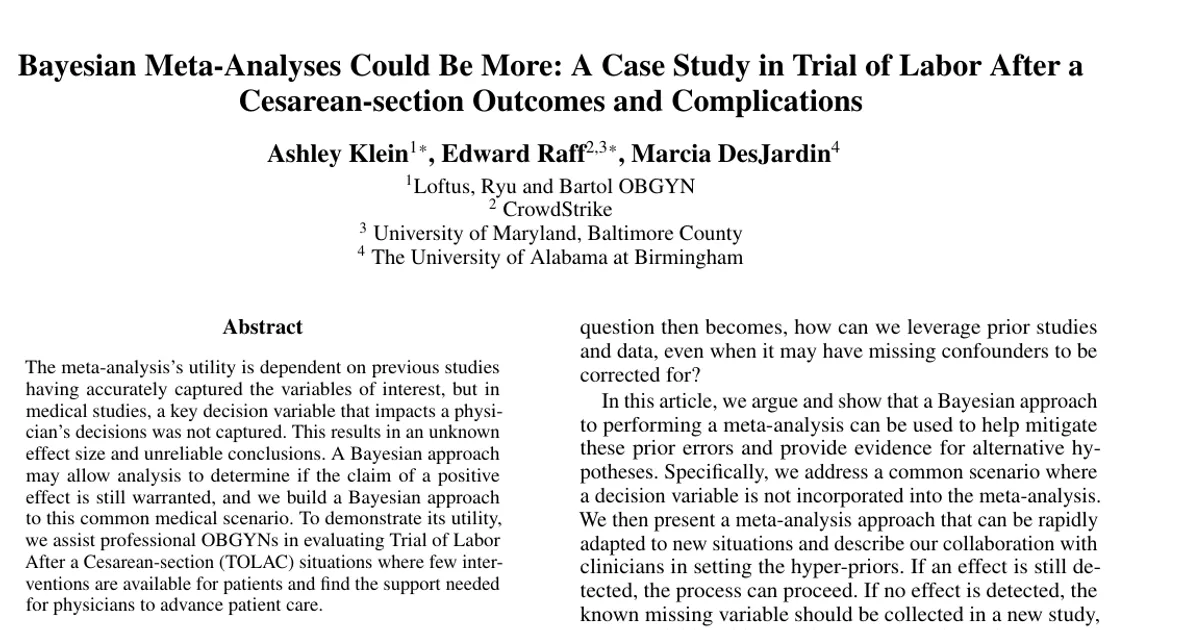
Authors’ abstract
The meta-analysis's utility is dependent on previous studies having accurately captured the variables of interest, but in medical studies, a key decision variable that impacts a physician's decisions was not captured. This results in an unknown effect size and unreliable conclusions. A Bayesian approach may allow analysis to determine if the claim of a positive effect is still warranted, and we build a Bayesian approach to this common medical scenario. To demonstrate its utility, we assist professional OBGYNs in evaluating Trial of Labor After a Cesarean-section (TOLAC) situations where few interventions are available for patients and find the support needed for physicians to advance patient care.