Research
Bandits in Flux: Adversarial Constraints in Dynamic Environments
Overview Research area: Online learning and sequential decision-making, specifically adversarial multi-armed bandits with time-varying (non-stationary) soft constraints. Technical level: Advanced. The
- arXiv
- 2601.19867
- Published
- 2026-01-27
- Authors
- Tareq Si Salem
AI summary
Overview
- Research area: Online learning and sequential decision-making, specifically adversarial multi-armed bandits with time-varying (non-stationary) soft constraints.
- Technical level: Advanced. The paper is a theory-heavy contribution built on online mirror descent, Lagrangian primal-dual methods, and dynamic regret analysis.
- Scope in one sentence: The paper introduces BCOMD, a bandit-feedback primal-dual mirror-descent algorithm that achieves order-optimal dynamic regret and sublinear constraint violation when both costs and constraints change adversarially over time.
What This Paper Is About
The paper studies a multi-armed bandit problem in which a decision-maker repeatedly picks one of n actions over T time slots, observes only the cost f_t(a_t) and constraint value g_t(a_t) of the action it actually played, and must keep cumulative constraint violation small over time. Unlike most prior work, the environment is non-stationary along two axes: the costs and constraints change adversarially, and the benchmark is a time-varying sequence of optimal feasible decisions rather than a single fixed best action. The goal is to prove regret and violation bounds that are sublinear in T and that scale with standard measures of environmental change.
Key Contributions
- The authors provide a methodology for using the online mirror descent framework for a new variant of the non-stationary multi-armed bandit problem with soft time-varying constraints.
- They derive what they describe as the tightest known theoretical guarantees for dynamic regret and soft constraint violation in this setting: dynamic regret of Õ(min{√(P_T T), V_T^{1/3} T^{2/3}}) and constraint violation of Õ(√T), compared with prior state-of-the-art results of Õ(V_T^{1/4} T^{3/4}) and Õ(V_T^{1/4} T^{3/4}) in Deng et al. (2022a).
- The paper claims the regret and violation rates are order-optimal, matching the lower bound in Proposition 1.
- They report empirical evaluations demonstrating the superiority of the approach, though the truncated content does not include the experimental setup or numeric results.
Main Findings
- Regret guarantee: Under Assumptions 1, 2 and 3, BCOMD attains dynamic regret Õ(min{√(P_T T), V_T^{1/3} T^{2/3}}), where
P_Tis the comparator path length andV_Tis the cost temporal variation. - Violation guarantee: The same policy attains constraint violation Õ(√T).
- Order-optimality: Proposition 1, attributed to Chen et al. (2025) and Besbes et al. (2015), states that for
T ≥ n ≥ 2andV_T ≤ T/n, any policy has regret Ω(min{V_T^{1/3} T^{2/3}, √(P_T T)}). The paper therefore claims its rate matches this lower bound. - Improvement over prior constrained results: Deng et al. (2022a) achieved regret Õ(V_T^{1/4} T^{3/4}) and violation Õ(V_T^{1/4} T^{3/4}); this work reports Õ(min{√(P_T T), V_T^{1/3} T^{2/3}}) regret and Õ(√T) violation.
- Unconstrained comparison: The paper states that in the unconstrained case its algorithm attains the same regret rate as Chen et al. (2025), namely min{V_T^{1/3} T^{2/3}, √(P_T T)}.
- Agnostic setting: When the regularity assumptions are removed, the paper reports regret min{√(P_T) T^{2/3}, V_T^{1/3} T^{7/9}} and violation √T, which it describes as the best known bounds in the constrained setting under those conditions.
- Comparison table entries (as reported): Cao and Liu (2018) achieved regret √(P_T T) with violation (P_T)^{1/4} T^{3/4} under path-length regularity; Zhao et al. (2021) achieved T^{3/4}(1+P_T)^{1/2} under path length in the unconstrained dynamic setting; Deng et al. (2022b) achieved V_T^{1/4} T^{3/4} under temporal variation; Kim and Yun (2025) used P_T with an agnostic regret of P_T √T; static unconstrained MAB (Auer et al., 2002a) uses no regularity and gives O(√T).
- Incomparability of regularity measures: Path length
P_Tand temporal variationV_Tare complementary. The paper notes there are cases whereV_T = Ω(T)whileP_T = O(1), and cases whereV_T = O(1)whileP_T = Ω(T); concrete examples are said to be in Appendix G. - Parameter choices in the main theorem:
c_T = min{√P_T, V_T^{1/3} T^{1/6}},μ = 1/(M√T),η = max{1, c_T}/(M√T),γ = Θ(T^{-1/2}), andM = 4((3n+2)/ρ + 1)^2. - Technical lemmas: Lemma 1 bounds the expected Bregman divergence between iterates by
1.5 η² n (1 + λ_t² + Ω²). Lemma 3 bounds the dual variables byΩ ≜ log(γ^{-1})/ρ · (μ/η) + 3n/(2ρ)·η + 1/(2ρ)·μ + 3n/ρ + 2/ρ + 1forη ≤ Ω^{-2}andμ > 0. Lemma 4 gives a telescoping bound oflog(1/γ)(1 + 2 Σ ||x*_{t+1} − x*_t||). - Why OGD is not used: The paper explains that standard online gradient descent guarantees rely on a bounded second moment of the gradient estimator, which fails under bandit feedback on the simplex: the supremum of the expected squared norm is infinite whenever
f_t(a) > 0for some action, because the estimatorf(a_t) x_{t,a_t}^{-1} e_{a_t}explodes asx_a → 0. - Small-probability exploration: The algorithm restricts its domain to the restricted simplex
Δ_{n,γ} = Δ_n ∩ [γ,1]^n, guaranteeing that every action has probability at leastγ, which the paper describes as controlling exploration.
Methodology in Plain English
The algorithm, called BCOMD (Bandit-Feedback Mirror Descent with Time-Varying Constraints), combines three ideas.
First, it converts the constrained problem into an unconstrained one using a Lagrangian: it minimizes a weighted combination of the cost and the constraint, Ψ(x, λ) = f_t(x) + λ g_t(x), where the multiplier λ acts as an importance weight on constraint violations. The multiplier is updated with a simple rule, λ_{t+1} = (λ_t + μ g_t(a_t))_+, which increases when violations are observed.
Second, because only the chosen action's cost and constraint are revealed, the algorithm builds unbiased single-point gradient estimates by dividing the observed value by the probability of having picked that action: f̃_t = f(a_t) x_{t,a_t}^{-1} e_{a_t} and similarly for constraints.
Third, because those estimates have unbounded variance and break ordinary gradient descent, the algorithm performs its updates in the mirror descent framework using the negative entropy mirror map Φ(x) = Σ x_i log(x_i). Updates happen in the dual space and are then mapped back and projected onto the restricted simplex via a Bregman projection.
The analysis proceeds through four lemmas covering the divergence of the iterates, the Lagrangian gap, boundedness of the dual variables, and a telescoping argument adapted from Bubeck (2011). The paper also outlines a meta-algorithm in Section 5.3 for tuning without knowing P_T and V_T in advance, replacing Assumption 3.
Why This Matters
- Impact on research: Prior work on dynamic constrained bandits relied mostly on Gaussian-process models with forgetting mechanisms such as sliding windows and restarts, which require committing to a forgetting schedule tuned to an assumed rate of change. This paper offers a framing that adapts to non-stationarity without such prior tuning and provides guarantees under both path-length and temporal-variation measures, matching a known lower bound.
- Recommendation systems: The paper cites recommendation systems as a classical bandit application area (Li et al., 2010; Li et al., 2011), where the constrained variant applies to engagement under fairness constraints.
- Hyperparameter optimization: Minimizing validation error while ensuring a sufficiently short prediction time for the learned model (Joy et al., 2016; Zhou and Ji, 2022).
- Wireless communications: Maximizing throughput under a cumulative soft energy consumption limit (Orhan et al., 2012).
- Federated learning: Energy-aware client selection in federated learning systems (Zhu et al., 2024), plus budget-constrained ad allocation (Li and Stoltz, 2022) and fair resource distribution across competing tasks (Wang et al., 2024).
- Industry relevance: The author is affiliated with the Paris Research Center, Huawei Technologies France, and the motivating applications—wireless resource management, ad allocation, and network scheduling (György et al., 2007; Li et al., 2020; Xu et al., 2024; Huang et al., 2023)—are directly relevant to deployed networked systems where rare constraint violations carry significant cost.
Future Directions
- Removing the regularity assumption rigorously in practice: The paper states that Section 5.3 introduces a meta-algorithm that learns
P_TandV_Tinstead of assuming knowledge of them (Assumption 3); the truncated content does not detail this procedure, so its practical tuning cost is an open question. - Empirical scope: The abstract states that empirical evaluations demonstrate superiority, but the available content does not report datasets, baselines, or numeric results, so reproducing and extending the experimental comparison is a natural next step.
- Generalizing the mirror map: The main results are derived specifically for the negative entropy instantiation. Whether the same regret and violation rates hold for other mirror maps satisfying Assumption 4 is not established in the available content.
- Lower bounds for constraint violation: The paper cites a regret lower bound (Proposition 1) but the available content does not report a matching lower bound for violation, leaving open whether Õ(√T) violation is also optimal.
- Extension to hard constraints or multiple constraints: The formulation treats constraints as soft with long-run feasibility, and uses a scalar multiplier
λ; scaling to multiple simultaneous constraints is not addressed in the available content.
Target Audience
Researchers and graduate students in online learning, bandit theory, and constrained optimization who are familiar with online mirror descent, Bregman divergences, and dynamic regret. It is also relevant to practitioners in wireless networking, ad allocation, federated learning, and recommendation systems who need algorithms that control long-run constraint violation while tracking a changing environment, though such readers would need the theoretical background to follow the proofs.
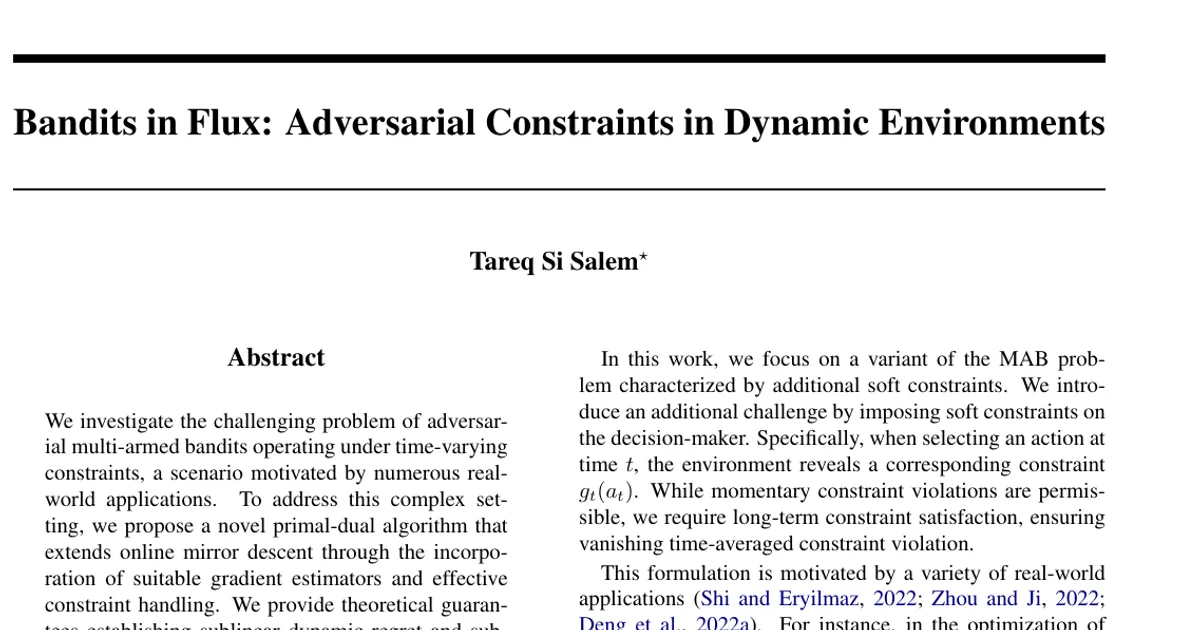
Authors’ abstract
We investigate the challenging problem of adversarial multi-armed bandits operating under time-varying constraints, a scenario motivated by numerous real-world applications. To address this complex setting, we propose a novel primal-dual algorithm that extends online mirror descent through the incorporation of suitable gradient estimators and effective constraint handling. We provide theoretical guarantees establishing sublinear dynamic regret and sublinear constraint violation for our proposed policy. Our algorithm achieves state-of-the-art performance in terms of both regret and constraint violation. Empirical evaluations demonstrate the superiority of our approach.