Research
Attention Isn't All You Need for Emotion Recognition:Domain Features Outperform Transformers on the EAV Dataset
Overview Research area: Affective computing / multimodal emotion recognition (EEG, audio, video), with a focus on model design under severe data scarcity. Technical level: Intermediate. The paper assu
- arXiv
- 2601.22161
- Published
- 2026-01-07
- Authors
- Anmol Guragain
AI summary
Overview
Research area: Affective computing / multimodal emotion recognition (EEG, audio, video), with a focus on model design under severe data scarcity.
Technical level: Intermediate. The paper assumes familiarity with transformers, attention, CNNs, and basic signal-processing concepts (MFCCs, power spectral density, frequency bands), but explains its reasoning in mostly plain terms.
Scope (one sentence): A systematic comparison of three model families — pretrained transformer baselines (M1), novel factorized attention architectures (M2), and minimally improved CNNs with domain features (M3) — on the 42-subject EAV multimodal emotion dataset, testing whether architectural complexity actually helps when there are only about 280 training samples per subject.
What This Paper Is About
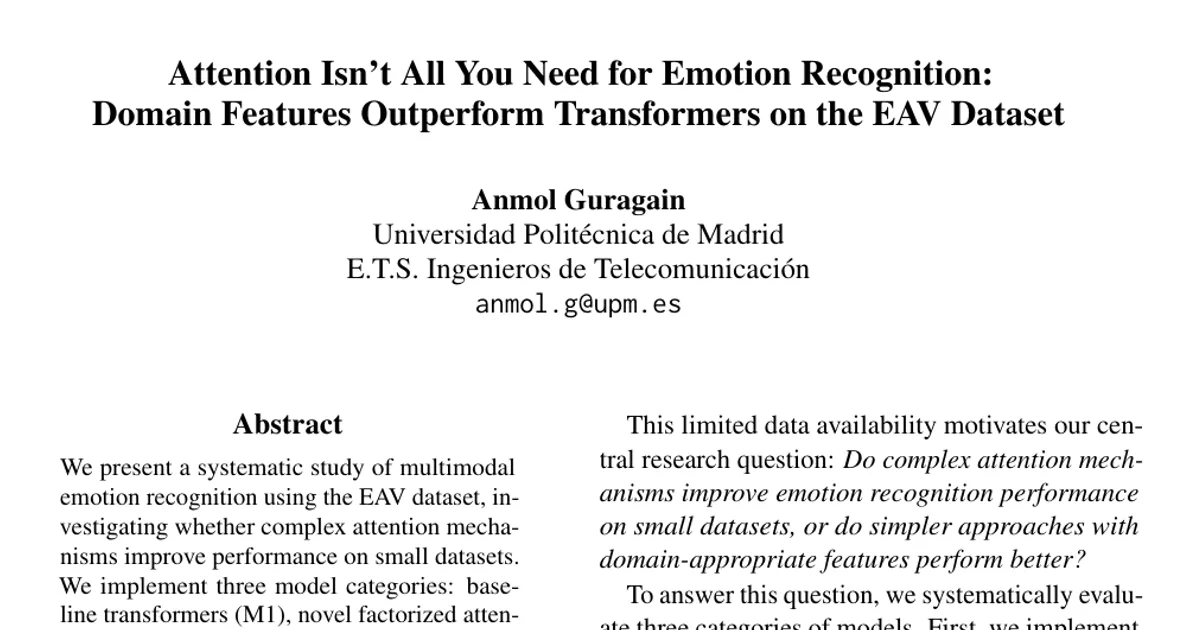
The EAV dataset provides synchronized EEG, audio, and video from 42 participants in conversation, but after a 70/30 per-subject split each modality has only roughly 280 training and 120 test samples per subject. The paper asks a direct question: do increasingly sophisticated attention mechanisms — factorized spatial/temporal/frequency/asymmetry attention — actually improve emotion recognition on data this small, or do simpler models with hand-engineered, domain-appropriate features do better? The author implements both and reports that the complex attention designs consistently lose.
Key Contributions
- A negative result for factorized attention: All three novel M2 architectures (EEG tri-stream, audio temporal-frequency dual attention, vision ViViT-style space-time attention) underperformed their baselines, by 5 to 13 percentage points, due to overfitting and disruption of pretrained features.
- A positive result for domain features: Adding delta MFCCs to the audio CNN raised accuracy from 61.9% to 65.56% (+3.66pp), and frequency-domain EEG features (band power, differential entropy, alpha asymmetry) raised EEG accuracy to 67.62% (+7.62pp over the paper baseline). The paper describes these as state-of-the-art results on this dataset.
- Evidence that pretraining domain matters more than architecture for vision: A ViT pretrained on facial emotion data reached 75.30%, exceeding the paper's ViViT result of 74.5% and beating all improved CNN variants.
- A diagnostic account of failure modes and a reproducibility appendix: Model-capacity comparisons, augmentation lists, feature definitions, and implementation-fidelity fixes (removing a redundant softmax before CrossEntropyLoss; restoring a true squeeze-and-excitation bottleneck).
Main Findings
- M2 factorized attention underperformed everywhere: EEG tri-stream reached 48.00% (±12.1) versus a 60.00% paper CNN baseline; EEGNet-Improved reached 58.47% (±11.2) versus the 53.50% paper transformer baseline but still below the 60.00% CNN baseline; audio dual-attention reached 49.46% (±15.8); vision ViViT-style reached 69.54% (±12.3) against the paper's 74.5%. Overall the M2 models fell 5 to 13 percentage points below baselines.
- EEG band-power features gave the largest gain: 67.62% (±8.2), which is +7.62pp over the 60.00% paper EEG baseline. The feature vector combines band power (150 dims), differential entropy (150 dims), and alpha asymmetry (6 dims) for 306 dimensions, feeding an MLP of shape 306→128→64→5.
- A bug fix alone was not enough for EEG: Removing a redundant
nn.Softmax(dim=1)beforeCrossEntropyLossgave 57.66% (±13.7), still below the 60.00% paper baseline; feature engineering was what produced the gain. - Audio improved with 40 extra delta MFCC features: Expanding the feature vector from 180 to 220 dimensions raised audio accuracy from the 61.90% paper baseline to 65.56% (±9.3), a +3.66pp gain, described as the paper's best audio result.
- Vision: domain pretraining beat architecture changes: The M1 ViT pretrained on facial emotion recognition reached 75.30% (±10.5), exceeding the paper's ViViT result of 74.5% (+0.80pp). The improved vision CNNs reached 69.42% (±11.9) after the SE-block fix and 72.68% (±10.8) with delta features (+1.28pp over the 71.40% paper CNN baseline).
- Fixed squeeze-excitation bottleneck mattered: The original video CNN used reduction ratio 1 (2048→2048→2048, essentially no bottleneck); setting it to 16 produced the M3-Vision v1 result of 69.42%.
- Large subject-level variability: Subject 17 was the most expressive across all modalities (82.50% EEG, 85.00% audio, 93.33% vision). Difficult subjects such as S35 (46.67% EEG, 55.00% audio, 56.67% vision) and S12 (54.17% audio, 43.33% vision) stayed far lower.
- Capacity appears mismatched to data: In the appendix's capacity table, M2 dual-attention had roughly 12M trainable parameters and scored 49.46%, while M3-Audio had roughly 5K trainable parameters and scored 65.56%; both sit on the same 87M-parameter AST backbone. The M2 EEG tri-stream small variant has 138K parameters against roughly 48% accuracy.
- The learned skip weights favored pretrained paths: The EEG tri-stream skip initialization puts about 73% of the signal through the convolutional path, and the audio dual-attention skip weight of −2.0 (α ≈ 0.12) preserves roughly 88% of pretrained features — yet the residual attention contribution still hurt accuracy.
Methodology in Plain English
The author built three families of models on the same data and compared them against numbers reported in the original EAV paper.
M1 (baselines): Off-the-shelf pretrained transformers fine-tuned per modality. For EEG, a custom convolutional front end feeding six transformer encoder layers (4 heads, hidden dimension 60). For audio, the pretrained AST model with a 5-class head, using a two-stage schedule (10 epochs frozen at learning rate 5e-4, then 15 epochs unfrozen at 5e-6). For vision, a ViT pretrained on facial emotion images, treating each of 25 frames independently and averaging predictions (10 epochs frozen, then 5 unfrozen).
M2 (new attention designs): Each modality got an attention scheme matching its structure. The EEG model split into three parallel streams — across channels, across time, and across six hemispheric pairs (Fp1-Fp2, F3-F4, F7-F8, C3-C4, P3-P4, O1-O2), with the F3-F4 pair weighted 1.2× based on Davidson's frontal asymmetry model. The audio model reshaped AST's 1212 patches into a 101×12 time-frequency grid and applied temporal attention then frequency attention. The vision model did spatial attention within frames, then temporal attention across frames, following ViViT's factorized encoder. All three added skip connections meant to preserve pretrained features.
M3 (small fixes plus features): Rather than new architectures, the author fixed implementation problems and injected domain knowledge. Audio got 40 delta MFCC features capturing short-term spectral change. EEG got 306 frequency-domain features computed with Welch's method over five bands (delta 0.5–4 Hz, theta 4–8 Hz, alpha 8–13 Hz, beta 13–30 Hz, gamma 30–45 Hz), plus differential entropy and alpha asymmetry. Vision got a corrected SE bottleneck (reduction ratio 16) and later frame-to-frame delta features.
Everything was trained on NVIDIA RTX 6000 Ada GPUs (48GB VRAM), evaluated subject-dependently with 70/30 splits, and reported as mean accuracy plus standard deviation across all 42 subjects.
Why This Matters
The paper pushes back on the default assumption that more attention machinery equals better performance. It shows concretely that on a real dataset with roughly 280 training samples per subject, established signal-processing priors beat carefully motivated architectural innovations — and that two of the "improvements" were actually straightforward implementation bugs (a double softmax, a degenerate SE bottleneck). That reframes some apparent model failures as engineering failures.
Real-world applications:
- Mental health monitoring: Continuous affect tracking from EEG and voice is a stated motivation; the finding that compact frequency-domain features work suggests cheaper, more deployable sensing pipelines.
- Human-computer interaction: Emotion-aware interfaces could run on lighter models informed by band power and delta coefficients rather than large attention stacks.
- Assistive technologies: Systems for people with limited communication ability benefit from reliable, low-latency affect estimation, which the paper's simpler models favor.
- Speech and behavioral analysis tools: The audio result specifically supports delta-coefficient features, a long-standing staple in affective speech tooling such as openSMILE, over transformer-only approaches on small in-domain data.
Industry relevance: The paper's practical lesson is cost-oriented. If a 220-dimensional feature set plus a small head beats a 12M-trainable-parameter attention module on the same 87M backbone, teams collecting small proprietary emotion datasets can cut compute and latency without losing accuracy — and should audit baseline implementations before investing in new architectures.
Future Directions
- Multimodal fusion: The paper explicitly did not explore combining EEG, audio, and vision, and notes fusion may improve results by exploiting complementary information.
- Cross-subject generalization: All experiments are subject-dependent; the paper states cross-subject evaluation remains unexplored, and the large subject-level spread (S17 at 93.33% vision versus S12 at 43.33%) suggests this is a significant open problem.
- Retesting factorized attention on larger datasets: The author suggests the M2 designs may benefit from more careful hyperparameter tuning and from larger emotion datasets where their inductive biases could pay off.
- Spontaneous versus acted emotion: The EAV conversational paradigm may not transfer to spontaneous emotional expression, which the paper lists as a limitation.
Target Audience
Researchers and practitioners in affective computing and applied machine learning who work with small multimodal datasets, especially those deciding whether to adopt transformer variants for EEG, speech, or video emotion tasks. It is also useful for engineers doing implementation audits of baseline models, and for students looking for a clear case study in matching model capacity to data size. The reproducibility appendix (splits, input shapes, feature definitions, augmentations, capacity table) makes it directly actionable for anyone trying to replicate or extend EAV results.
Authors’ abstract
We present a systematic study of multimodal emotion recognition using the EAV dataset, investigating whether complex attention mechanisms improve performance on small datasets. We implement three model categories: baseline transformers (M1), novel factorized attention mechanisms (M2), and improved CNN baselines (M3). Our experiments show that sophisticated attention mechanisms consistently underperform on small datasets. M2 models achieved 5 to 13 percentage points below baselines due to overfitting and destruction of pretrained features. In contrast, simple domain-appropriate modifications proved effective: adding delta MFCCs to the audio CNN improved accuracy from 61.9% to 65.56% (+3.66pp), while frequency-domain features for EEG achieved 67.62% (+7.62pp over the paper baseline). Our vision transformer baseline (M1) reached 75.30%, exceeding the paper's ViViT result (74.5%) through domain-specific pretraining, and vision delta features achieved 72.68% (+1.28pp over the paper CNN). These findings demonstrate that for small-scale emotion recognition, domain knowledge and proper implementation outperform architectural complexity.