Research
Attention as Binding: A Vector-Symbolic Perspective on Transformer Reasoning
Attention as Binding: A Vector-Symbolic Perspective on Transformer Reasoning Overview Research area: Interpretability and reasoning in transformer-based language models, viewed through the lens of Vec
- arXiv
- 2512.14709
- Published
- 2025-12-08
- Authors
- Sahil Rajesh Dhayalkar
AI summary
Attention as Binding: A Vector-Symbolic Perspective on Transformer ReasoningOverview
Research area: Interpretability and reasoning in transformer-based language models, viewed through the lens of Vector Symbolic Architectures (VSAs) and hyperdimensional computing, with connections to neurosymbolic AI.
Technical level: Advanced. The paper is written in algebraic notation (binding, superposition, permutation, role–filler decomposition) and assumes familiarity with transformer internals, attention mechanisms, and the VSA/HRR literature.
Scope: A conceptual synthesis—not an empirical study—that argues transformer self-attention and residual streams can be read as an approximate, soft implementation of VSA binding, unbinding, and superposition, and derives evaluation metrics, architectural proposals, and open problems from that reading.
Publication details: arXiv:2512.14709v1 [cs.AI], 08 Dec 2025, by Sahil Rajesh Dhayalkar (Arizona State University), licensed CC BY 4.0.
What This Paper Is About
Transformer language models show reasoning-like behavior but remain brittle at tasks requiring stable symbolic manipulation, failing on simple problem variations and producing logically inconsistent answers across related prompts. The paper's goal is to explain both the strengths and the failures by interpreting attention and residual connections as an approximate Vector Symbolic Architecture: queries and keys define role spaces, values encode fillers, attention weights perform soft unbinding, and residual connections superpose many bound structures. The stated aim is to turn this algebraic lens into a research agenda—metrics, probes, and architecture designs—for building more interpretable and logically reliable reasoning systems.
Key Contributions
-
A unified interpretation of attention and residual streams as approximate VSA-style binding, unbinding, and superposition. The paper recasts scaled dot-product attention as a differentiable analogue of VSA unbinding, and residual connections as the superposition operator that accumulates bound structures across depth.
-
A taxonomy distinguishing "VSA-like" from "non–VSA-like" transformer mechanisms. Standard transformers and variants (sparse and structured attention, positional schemes such as RoPE and ALiBi, recurrent and memory-augmented models), explicit binding architectures (Memory Networks, Neural Turing Machines, the Differentiable Neural Computer, Slot Attention, fast-weights models, multiplicative RNNs), neurosymbolic and logic-oriented transformers, and hyperdimensional deep architectures are each assessed for how closely they instantiate VSA primitives. Table 1 compares VSAs/HRRs, transformers under this interpretation, and Tensor Product Representations and graph neural networks along dimensions including base representational object, binding mechanism, superposition, positional encoding, decoding/unbinding, advantages, and limitations.
-
A conceptual framework linking VSA structure to chain-of-thought behavior, program-based reasoning, tool use, and logical consistency. Chain-of-thought is described as an externalized trajectory through a VSA-structured internal state space, and program execution is described as a sequence of binding and rebinding operations over a variable/value environment.
-
A research agenda of evaluation protocols and architectural proposals. This includes explicit binding/unbinding heads, hyperdimensional memory layers, training objectives and regularizers that promote role–filler separation and robust superposition, and metrics for measuring "VSA-likeness" and logical compositionality.
Main Findings
-
The central thesis is interpretive, not experimental. The paper argues that attention can be understood as a soft binding/unbinding operator and that logical brittleness arises when these approximations fail. No empirical experiments, dataset sizes, or quantitative benchmark results are reported.
-
Attention resembles VSA unbinding under three conditions. The paper states that attention best approximates VSA binding when (i) role vectors (keys) are near-orthogonal to reduce interference, (ii) attention is relatively sparse, yielding crisp role–filler matches, and (iii) normalization (such as layer norm) ensures consistent geometric structure.
-
Residual connections act as superposition. Because each layer adds its attention and MLP outputs to the running stream, the residual stream accumulates contributions from many heads and transformations, approximating a pipeline of soft binding, superposition, and rewriting in a fixed-dimensional space.
-
An "approximation gap" explains failure modes. Learned embeddings and key projections are not perfectly orthogonal, heads often encode multiple functions simultaneously, attention patterns may be dense, and cross-layer context mixing entangles roles and fillers. These are framed as sources of interference and imperfect unbinding, and the paper defines a layer's or head's "VSA-likeness" as how closely its operations approximate disciplined binding over decorrelated role–filler subspaces with controlled superposition.
-
Specific reasoning failures are mapped to specific algebraic breakdowns. Variable confusion (duplicated or swapped roles) is attributed to weak role–filler separation or overwritten bindings; role swaps between premises and conclusions are attributed to deficiencies in positional/permutation encoding; broader inconsistency across related queries is attributed to interference between superposed bindings representing different contexts.
-
Chain-of-thought is reinterpreted as state updates. Each reasoning step is modeled as adding or modifying bound role–filler pairs in the residual stream, with reasoning sequences mapping to nested bindings and permutations. The paper notes that mismatches between generated chain-of-thought and actual computation can produce fluent but unfaithful reasoning, and argues the VSA framework can describe both faithful and spurious traces in one algebraic language.
-
Program execution is reinterpreted as VSA algebra. A program environment is written as a superposition of variable/value bindings, with additional bindings and permutations encoding control flow, call stacks, or proof-tree positions; attention performs unbinding (reading a variable or subgoal) while MLP and later layers rewrite and rebind fillers.
-
Chain-of-thought is not assumed to be necessary for this structure. The paper states that program synthesis and execution correspond to VSA operations guided by transformer parameters "regardless of whether explicit code is shown to the model."
-
Proposed "VSA-likeness" metrics. Three are defined: role–filler recoverability (can a probe recover a filler when cued with its role?), interference under superposition (how well unbinding works as the number and similarity of combined bindings varies, yielding capacity and interference curves), and alignment with VSA operators (how closely a head's learned transformation matches known binding or permutation operations such as convolution or fixed permutations).
-
Proposed behavioral benchmarks are described but not run. The paper points to variable binding and systematic generalization tasks such as SCAN, compositional benchmarks, algebraic simplification, equation solving and rewriting tasks, and paraphrased inference problems, and recommends holding out combinations of roles and fillers during training, permuting symbol identities, and enforcing generalization to unseen rule instantiations.
-
Proposed probing methods for pretrained LLMs are described but not run. These include representational similarity analysis (RSA) to compare hidden-state geometry with synthetic VSA encodings, linear and nonlinear probes to decode roles, fillers, and bindings, and interventional studies that edit embeddings or residual streams to inject synthetic bindings (for example, swapping variable roles) to check whether predictions reflect consistent unbinding and rebinding.
Methodology in Plain English
This is a position and synthesis paper rather than an experimental one. The author takes three bodies of literature—transformer/attention mechanisms and reasoning techniques (chain-of-thought, tool-augmented models), Vector Symbolic Architectures as an algebra for compositional vectors, and neurosymbolic frameworks that combine statistical and symbolic computation—and lines them up so that the components of one map onto the components of another.
The mapping is the paper's core move. In a VSA, symbols are random high-dimensional vectors; binding (via elementwise multiplication, circular convolution, or XOR) forms role–filler pairs; superposition (addition) stores sets of such pairs; permutation encodes order or hierarchy; and unbinding recovers a filler from a bound vector via similarity search. The paper argues that queries and keys in attention act as role vectors, values act as fillers, the softmax attention weights act as a smooth unbinding operator, and residual connections act as superposition. Multi-head attention then provides multiple parallel binding channels, and positional schemes such as RoPE can be read as differentiable permutation operations.
From that mapping, the author derives consequences rather than testing them: failure modes are explained as breakdowns of the algebra, evaluation metrics are proposed that measure how VSA-like a head or layer is, and architectural changes are proposed that would push transformers closer to the algebra by design.
Why This Matters
Impact on research. The paper offers an alternative to describing attention purely as content-addressable lookup or dynamic feature selection, arguing those views do not specify how roles, fillers, and structured relations are encoded internally. An algebraic framing makes falsifiable claims possible—for example, that measures of role–filler separability and interference sensitivity should correlate with reasoning consistency and proof quality. It also connects interpretability work on attention heads to the older cognitive-science and neurosymbolic literature on binding and variable binding.
Real-world applications (drawn from the domains the paper discusses):
-
Tool-augmented assistants. The paper proposes that hyperdimensional memory layers could hold tool states and partial results, with encoders and decoders mapping symbolic formulas into and out of a shared memory so that solvers and LLMs operate over compatible representations.
-
Formal verification and theorem proving. The paper discusses interfaces between hyperdimensional internal states and logic and theorem provers, SMT solvers, and probabilistic programs, plus decoders that turn such states back into human-readable proofs or explanations.
-
Reliable structured reasoning for code. Program-of-Thoughts and program-based chain-of-thought with code-plus-tests are treated as verifiable reasoning traces, and the paper argues these traces correspond to explicit program states that a VSA can encode.
-
Knowledge graph and ontology integration. The paper suggests VSA encodings may bridge graph-based reasoning and text-based LLM reasoning.
Industry relevance. The paper's practical claim is that VSA-inspired architectural biases—explicit binding/unbinding heads, hyperdimensional memory layers, orthogonality regularizers, and auxiliary unbinding tasks—could make models more robust to paraphrase, variable renaming, and problem variation. It frames this as a route toward reasoning systems that are both interpretable and logically reliable, while acknowledging the trade-off between VSA-like rigidity and the neural flexibility that captures statistical patterns in natural data.
Future Directions
-
Conditions for equivalence. Under what assumptions on initialization, training dynamics, and embedding geometry do attention layers implement an algebra closely matching a VSA binding/unbinding system? For instance, can approximate orthogonality of key/query spaces plus sparsity of attention weights guarantee a well-formed binding operator with a similarity-based inverse?
-
Expressivity in terms of VSA algebraic capacity. What classes of logical transformations or proof procedures can be simulated with finite role vectors, binding operators, and superposition capacity, and how do these capabilities scale with model depth, width, and number of heads? The paper notes that existing work connecting transformers to formal language classes rarely appeals to explicit role–filler algebras.
-
Granularity and rigidity trade-offs. Should VSA structure be imposed at the token level via specialized embeddings or heads, at the layer level via dedicated binding layers, or through a separate hyperdimensional memory module accessed by cross-attention? Hybrid designs with some VSA-like heads and other free-form heads could reveal how training distributes symbolic versus statistical responsibilities.
-
Integration with external symbolic systems. How should hyperdimensional representations of formulas, partial proofs, or knowledge-graph fragments interface with logic and theorem provers, SMT solvers, or probabilistic programs? The paper proposes encoders that map symbolic structures into VSA representations compatible with the model's internal algebra and decoders that transform hyperdimensional states back into human-readable proofs, with similar considerations for ontologies and knowledge graphs and for multi-agent or tool-augmented systems.
Target Audience
Researchers working on transformer interpretability, mechanistic analysis of attention heads, and neurosymbolic AI will get the most from this paper, since the contribution is a conceptual and algebraic reframing rather than a set of results. It is also relevant to engineers and scientists building reasoning systems who want a principled vocabulary for why models fail on variable substitution and paraphrase, and to anyone designing architectures with explicit memory, binding, or slot mechanisms. Readers without background in vector symbolic architectures or attention algebra will need to work through the notation; the paper provides its own background sections on transformers and on VSAs, plus a comparison table against Tensor Product Representations and graph neural networks. Note that the available paper content is truncated near the end of the open-problems section, and no concluding experimental validation is reported.
Authors’ abstract
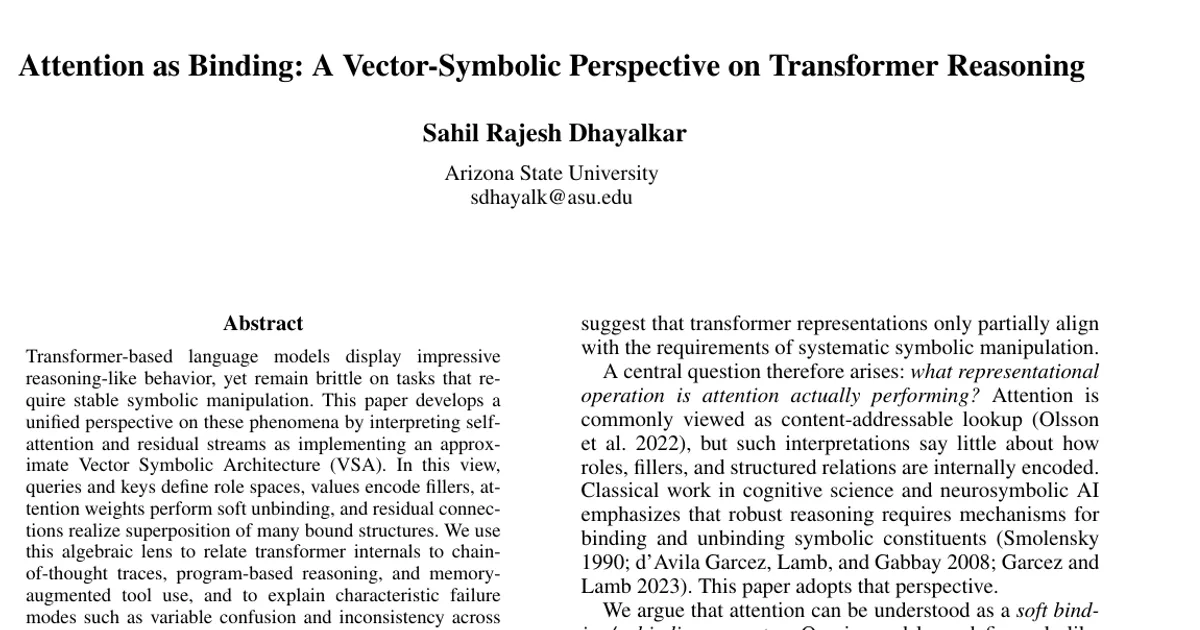
Transformer-based language models display impressive reasoning-like behavior, yet remain brittle on tasks that require stable symbolic manipulation. This paper develops a unified perspective on these phenomena by interpreting self-attention and residual streams as implementing an approximate Vector Symbolic Architecture (VSA). In this view, queries and keys define role spaces, values encode fillers, attention weights perform soft unbinding, and residual connections realize superposition of many bound structures. We use this algebraic lens to relate transformer internals to chain-of-thought traces, program-based reasoning, and memory-augmented tool use, and to explain characteristic failure modes such as variable confusion and inconsistency across logically related prompts. Building on this perspective, we propose VSA-inspired architectural biases, including explicit binding/unbinding heads and hyperdimensional memory layers, and training objectives that promote role-filler separation and robust superposition. Finally, we outline metrics for measuring "VSA-likeness" and logical compositionality, and pose theoretical and architectural open problems. Overall, the paper argues that viewing attention as soft vector-symbolic computation offers a principled route toward more interpretable and logically reliable reasoning systems.