Research
Athena: An Autonomous Open-Hardware Tracked Rescue Robot Platform
Overview Research area: Field robotics — ground-based search and rescue (UGVs with manipulators), mechanical/electrical platform design, and open hardware. Technical level: Advanced. The paper is a ha
- arXiv
- 2602.19898
- Published
- 2026-02-23
- Authors
- Stefan Fabian, Aljoscha Schmidt, Jonas Süß, Dishant, Aum Oza, Oskar von Stryk
AI summary
Overview
Research area: Field robotics — ground-based search and rescue (UGVs with manipulators), mechanical/electrical platform design, and open hardware.
Technical level: Advanced. The paper is a hardware design and integration paper, with detailed mechanical, electrical, and embedded-systems specifications alongside a small empirical evaluation.
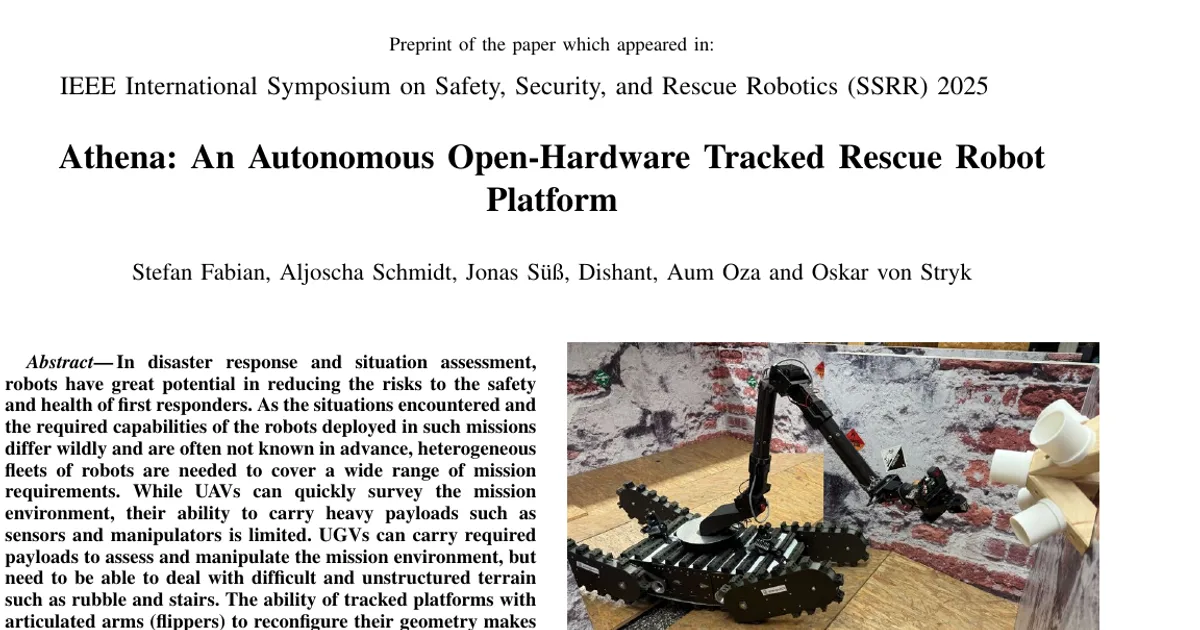
Scope: This paper documents the complete design, integration, and preliminary evaluation of Athena, a tracked rescue robot with four independently reconfigurable flippers and a seven-joint manipulator, released as open hardware and open-source low-level software.
What This Paper Is About
Disaster response missions are unpredictable, and rescue robots must be able to carry payloads, manipulate objects like doors and valves, and traverse rubble and stairs — capabilities that few commercially available platforms offer in an affordable, modifiable package. Most tracked robots with articulated flippers are high-cost, closed designs with limited interfaces for research, and almost none of the top-performing RoboCup Rescue teams publish their hardware. The goal of this work is to provide a lightweight, compact, and comparatively affordable tracked rescue robot whose full CAD and PCB files and low-level software are publicly released, so other researchers can build on and modify it.
Key Contributions
-
A complete open-hardware tracked rescue robot design. Athena is a tracked platform weighing 50 kg, measuring 0.7 m x 0.5 m, and costing less than 60,000€ in materials, with CAD files, PCB files, and low-level software released as open source.
-
A novel belt and track-profile mounting system. The locomotion system uses a processed industrial PU T10 belt with steel cord, where every sixth tooth has two teeth removed and holes drilled so that steel tooth inserts with threads can hold screw-mounted profiles. This allows profiles to be replaced when worn or swapped to experiment with different designs and materials.
-
A low-cost, reliable remote emergency stop (E-Stop). Built from ESP32 S3 boards with LoRa radios on sender and receiver, it costs approximately 83€ in materials (described as less than 90€ in the electronics section) and provides a fail-safe that activates if no messages arrive within 300 ms.
-
A redundant, sensor-rich manipulator and perception suite. A seven-joint manipulator (eight including the gripper) provides a maximum reach of 1.54 m, integrates a force-torque sensor and gripper-mounted RGBD, thermal, and RGB cameras, and is paired with a symmetric dual-environment-perception module built around two Livox MID-360 LiDARs.
Main Findings
-
Terrainability. Athena achieved a maximum climbable step height of 41 cm using stacked pallets and was able to climb stairs of up to 45 degrees. Stairs with steeper inclination were not tested. When fully extended, the robot's total length increases from 72 cm to 128 cm.
-
Speed and flipper design. Four individually reconfigurable flippers are driven by Dynamixel H54-200-S500-R servo motors with a 2:1 translation. Two Unitree A1 main drive motors per side provide up to 30 N·m each, for a combined 60 N·m per side, resulting in a maximum speed of up to 1.5 m/s.
-
Manipulator payload. Lifting tests at three distances gave payloads of 7.2 kg at 0.5 m, 4.8 kg at 1 m, and 2.9 kg at the full 1.54 m extension.
-
Field failure and redesign. During stress tests at the RoboCup Rescue League in Brazil, 2025, the 3D-printed pulleys for the main belt withstood the motor moments, but the smaller flipper drive pulleys failed in the stairs scenario when the track was locked. They were reinforced with a sandwich structure of a 3D-printed pulley and a laser-cut steel plate transferring moments via multiple screw bolts.
-
Profile material comparison. In the first iteration of track profiles, parts made from Poly 75-70 proved significantly more wear-and-tear-resistant than PT Flex 70, where the majority of profiles were partially ripped or completely torn off. A few Poly 75-70 profiles were torn off through the screw mounting hole, which the authors plan to address with an embedded steel plate.
-
Remote E-Stop latency. In the evaluated scenarios, typical trigger timings were 8 ± 3 ms at 12 m line of sight, 8 ± 5 ms obstructed at 3 m, 33 ± 29 ms through a stone wall at 12 m, and 8 ± 4 ms through a closed glass door at 12 m. With only LoRa enabled, timing was 249 ± 4 ms. Maximum observed timings were 29 ms, 113 ms, 128 ms, 62 ms, and 268 ms respectively. The worst-case delay roughly doubles human reaction time, while under normal conditions it is within the error margin of human reaction time.
-
Open-hardware comparison. In the paper's comparison table, Athena is listed with a maximum speed of 1.5 m/s, a 41 cm maximum step height, a 7-DoF manipulator with 1.54 m reach and 2.9 kg payload at maximum reach, a weight of 50 kg, and dimensions of 0.7 m x 0.5 m — compared against Quince (1.1 m/s, 34 cm, no manipulator, 27 kg), Karo (0.8 m/s, step height not applicable, 6-DoF arm, 1.3 m reach, 85 kg), and Asterix (1.1 m/s, 30 cm, 6-DoF arm, 0.85 m reach, 2.5 kg payload, 57.3 kg).
-
No navigation-autonomy results are reported. The evaluation covers terrainability, step height, manipulator payload, and E-Stop trigger speed; the paper describes the platform as enabling autonomy research rather than evaluating autonomous behaviors.
Methodology in Plain English
The authors began from the shortcomings of their previous platform, Asterix, and from designs by the RoboCup teams Shinobi and Quix. On Asterix, the tracks were built from profiles mounted on bike chains, which covered only a small part of the robot's footprint and tended to derail on unstructured terrain; the guiding rails added to fix this increased friction and caused motors to overheat. Athena replaces this with an industrial PU belt guided by a low-friction chassis, whose track profiles are screwed into steel tooth inserts embedded in the belt.
The chassis is built from glued 3 mm carbon-fiber reinforced plastic plates with 0°/90° fiber orientation plus a 3 mm aluminum base plate, which helps cool the electronics and lowers the center of mass. The chassis size was chosen so the robot fits inside a large suitcase for international transport.
For the arm, the team used cylindrical CFRP tubes to maximize stiffness-to-weight, with through-bore slip rings inside the tubes so all roll joints can rotate continuously, and 3D-printed titanium brackets to maximize pitch joint range. Control electronics route motor power through a custom E-Stop board with high-side power switches, and the enable pin is routed through physical buttons on the manipulator by wire so motors can be shut off without depending on the microcontroller.
Evaluation combined field testing at the RoboCup Rescue League in Brazil, 2025 (continuous stress tests on crossing ramps, pallets, and stairs with obstacles) with laboratory tests. Step height was measured with stacked pallets, payload was measured by lifting progressively heavier weights at 0.5 m, 1 m, and 1.54 m until the arm could not hold the object for at least 20 seconds, and the E-Stop was tested by connecting the sender to the E-Stop board's power output through a voltage divider and toggling the state one thousand times per scenario across five conditions.
Why This Matters
Impact on research. Most top-performing RoboCup Rescue teams in 2022 to 2024 built their own robots, but to the authors' knowledge none published their designs, and open-hardware designs for articulated tracked robots are scarce. Athena provides a released CAD/PCB and low-level software baseline that other groups can build, modify, and reproduce, lowering the entry cost for rescue robotics research.
Real-world applications.
- Explosive ordnance disposal and other dangerous, non-time-critical response tasks where robots protect first responders.
- Inspection of buildings at risk of collapse, where manipulation of doors and valves and traversal of rubble and stairs are required.
- Nuclear or radiation-exposed site reconnaissance and cleanup, following the precedent of robot use at Chernobyl in 1986 and Fukushima in 2011.
- Situation assessment using the thermal camera for temperature-based inspection and the LiDAR/camera setup for mapping and semantic environment modeling.
Industry relevance. The belt design uses a processing method common in industrial conveyor belts that can be ordered from belt manufacturers at competitive rates, and the replaceable-profile concept parallels approaches used on platforms such as the Telerob Telemax and large machinery. The paper positions Athena against commercial articulated tracked platforms (Telerob Telemax, Jaguar V6, Tready by HEBI Robotics), which it describes as typically high-cost and closed, with limited interfaces that hinder the modifications research often requires.
Future Directions
- Reinforcing the Poly 75-70 profile connections by embedding a steel plate in the profile to strengthen the screw mounting points, after some profiles tore off through the mounting hole.
- Testing steeper stair inclinations, since the evaluation only covered stairs up to 45 degrees and steeper stairs were not tested.
- Experimenting with different track profile designs and materials, which the exchangeable belt mounting system was specifically created to enable.
- Developing autonomy, assistance functions, environment perception, and semantic environment modeling on top of the platform's symmetric high-coverage sensors and on-board compute, which the conclusion identifies as the intended follow-up research.
Target Audience
Rescue robotics researchers and RoboCup Rescue League teams who need a documented, modifiable platform; hardware, mechanical, and embedded-systems engineers interested in tracked locomotion, flipper mechanisms, belt-driven tracks, or power and E-Stop design; and students or laboratories who want a lower-cost alternative to commercial articulated tracked robots with published CAD, PCB, and low-level software.
Authors’ abstract
In disaster response and situation assessment, robots have great potential in reducing the risks to the safety and health of first responders. As the situations encountered and the required capabilities of the robots deployed in such missions differ wildly and are often not known in advance, heterogeneous fleets of robots are needed to cover a wide range of mission requirements. While UAVs can quickly survey the mission environment, their ability to carry heavy payloads such as sensors and manipulators is limited. UGVs can carry required payloads to assess and manipulate the mission environment, but need to be able to deal with difficult and unstructured terrain such as rubble and stairs. The ability of tracked platforms with articulated arms (flippers) to reconfigure their geometry makes them particularly effective for navigating challenging terrain. In this paper, we present Athena, an open-hardware rescue ground robot research platform with four individually reconfigurable flippers and a reliable low-cost remote emergency stop (E-Stop) solution. A novel mounting solution using an industrial PU belt and tooth inserts allows the replacement and testing of different track profiles. The manipulator with a maximum reach of 1.54m can be used to operate doors, valves, and other objects of interest. Full CAD & PCB files, as well as all low-level software, are released as open-source contributions.