Research
Ask or Answer: A Decision Framework for Multi-Turn Health Misinformation Intervention
Ask or Answer: A Decision Framework for Multi-Turn Health Misinformation Intervention Overview Research area: Dialogue-based AI for health misinformation correction; decision-theoretic multi-turn inte
- arXiv
- 2608.21721
- Published
- 2026-08-22
- Authors
- Xiaoying Song, Anirban Saha Anik, Jinyu Liu, Qitao Tan, Geng Yuan, Lingzi Hong
AI summary
Ask or Answer: A Decision Framework for Multi-Turn Health Misinformation InterventionOverview
- Research area: Dialogue-based AI for health misinformation correction; decision-theoretic multi-turn intervention; user heterogeneity modeling.
- Technical level: Advanced (assumes familiarity with reinforcement learning — GRPO, LoRA fine-tuning, reward shaping — and dialogue policy design).
- Scope: The paper proposes RO-PnR, a policy that learns at each dialogue turn whether to ask the user a clarifying question or commit to a final correction, evaluated across three health-misinformation datasets and three 8B base models with simulated users varying in health literacy and belief commitment.
What This Paper Is About
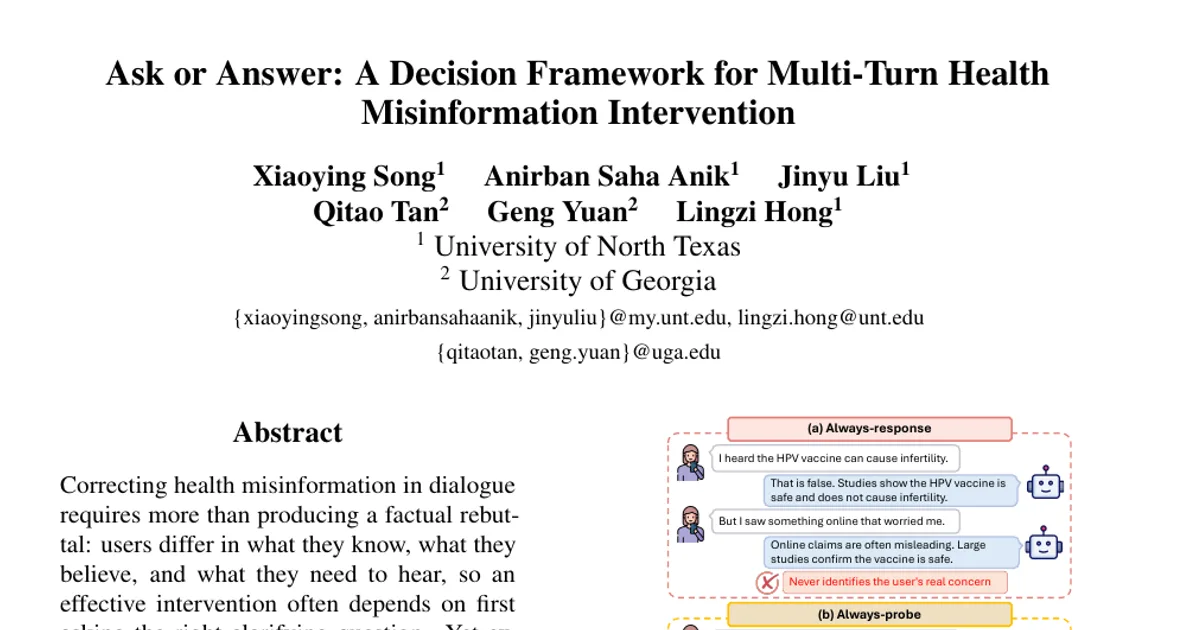
Correcting health misinformation in conversation is not just a matter of producing accurate facts — the right correction depends on what a specific user already knows, what they believe, and how firmly they hold that belief. The core problem is that existing systems either respond immediately with a generic rebuttal or probe the user with clarifying questions indiscriminately, treating clarification as either unnecessary or always beneficial. The goal of this paper is to build an agent that learns when asking is worth its cost, so that it gathers the missing context only when the expected gain justifies the extra interaction turn.
Key Contributions
- A reframing of health misinformation intervention as a probe-or-respond decision problem. The authors move beyond the single-turn, one-size-fits-all paradigm of prior counterspeech work by grounding the decision in domain-specific user dynamics.
- RO-PnR (Reward-Optimized Probe-and-Respond), a decision-theoretic policy that learns when asking is worth its cost, choosing between probing for more information and committing to a final correction at each turn.
- A turn-level reward design combining forward-looking value with an explicit interaction cost. The value of a probe is estimated as the expected quality at conversation end after probing, from which a per-question cost scaling with the number of clarifications already asked is subtracted.
- A latent user model with two coupled dimensions — health literacy (functional, interactive, critical) and belief commitment (strong, hesitant, open) — which defines a 3×3 latent user profile grid used to simulate heterogeneous users during multi-turn interaction.
Main Findings
-
Highest cost-adjusted utility across nearly every setting. RO-PnR obtains the highest utility on nearly every (dataset, model) combination, reaching 0.71–0.73 in utility versus 0.68–0.72 for the strongest baseline (SFT), with consistent gains across all three adaptation dimensions (Audience Alignment, Personalized Grounding, Tailored Actionability).
-
Roughly 30% fewer turns than always-probe baselines. RO-PnR occupies the productive middle, using roughly 3.5 turns, about 30% fewer than the always-probe baselines, while delivering the highest utility.
-
Baselines expose a sharp trade-off. Single-Turn skips probing entirely and scores lowest (0.53–0.64). Fixed-Q and Reactive almost probe every turn (≥4.9 on average) and reach competitive adaptation but at high interaction cost. Confidence rarely probes (1.1–2.0 turns) and suffers the largest quality drop, especially on MisinfoCorrect, where utility falls to 0.58–0.62.
-
Factual reliability is preserved. Factual error rates remain low across methods, with 0.06–0.14 for RO-PnR, indicating that adaptation gains do not compromise factual reliability.
-
Largest gains on the hardest user slices. On Functional-literacy users, RO-PnR reaches 0.65–0.69 versus 0.62–0.67 for SFT. On Strong-believer users the gap widens further: 0.65–0.69 for RO-PnR versus 0.6–0.66 for SFT and only 0.57–0.61 for Confidence. On Open users, RO-PnR reaches 0.76–0.77 while baselines cluster in the 0.73–0.76 range.
-
Long-horizon reward matters. The reward-horizon ablation, which replaces the forward-looking reward with an immediate next-turn gain, degrades utility from 0.71 to 0.60, showing that a probe's value often materializes several turns later and cannot be captured by a one-step reward.
-
Probe cost prevents over-probing. The probe-cost sweep shows that c = 0 leads to over-probing (5.83 turns) and a quality collapse to 0.51, while moderate costs (c = 0.03 to 0.05) recover near-best performance at approximately 3 turns, confirming the policy is stable across a reasonable range of c.
-
Human validation supports the simulator and the judge. Mean pairwise agreement is 0.83 for persona accuracy and 0.85 for consistency, with multi-rater Scott's π of 0.70 and 0.68. Persona accuracy averages 3.87 with 76% of samples scoring 4 or 5; persona consistency averages 4.64 with 97% of samples at 4 or above. The LLM judge aligns well with humans on Quality: Scott's π = 0.55, 73% exact agreement, MAE = 0.23, 87% of samples within ±0.5 points, Pearson = 0.57 and Spearman = 0.72.
-
Strong human pairwise preference, with one revealing exception. RO-PnR is preferred overall at 79.70% versus 20.30% for Fixed-Q, primarily because its responses are perceived as more explanatory, credible, and actionable. The exception is User 2 (functional literacy, strong belief commitment), who favors Fixed-Q for being easier to process, less confrontational, and less reliant on institutional authority — highlighting a trade-off where users with strong prior commitments may benefit from softer, less institution-centered framing.
Methodology in Plain English
The researchers treat the intervention as a sequence of decisions rather than a single generated response. At every turn, the agent sees the dialogue history — the original misinformation post plus everything the user has said — and picks between two actions: Probe (ask one clarifying question) or Respond (produce the final, personalized correction).
To decide, the agent compares two reward values. For Respond, the reward is the quality of the correction it can produce right now. For Probe, the reward is the expected quality at the end of the conversation if it asks one more question first, minus a per-question cost that grows with the number of clarifications already asked. The agent probes only when the expected long-horizon improvement from one more clarification outweighs the cumulative interaction cost, so early probes face a low bar while later probes must justify a higher cost.
Because the value of asking depends on hidden user traits, the researchers model each simulated user with a latent state on two dimensions: health literacy (functional, interactive, critical) and belief commitment (strong, hesitant, open). Together these form a 3×3 grid of user types, and each dialogue keeps a fixed profile throughout the interaction. User replies are generated by a profile-conditioned LLM simulator (GPT-4o-mini).
Training happens in two stages. The policy is first warm-started with supervised fine-tuning on the best resolved trajectory in each group using LoRA adapters. It is then optimized with Group Relative Policy Optimization (GRPO), which suits the binary turn-level setting because it derives advantages by comparing candidate actions within the same decision group, eliminating the need for a separate value network. Supervision operates directly on paired Respond and Probe records built from multi-turn rollouts, so the policy learns the local trade-off directly.
Evaluation uses three adaptation sub-metrics scored by an LLM judge — Audience Alignment, Personalized Grounding, Tailored Actionability — averaged into an overall Quality score, plus a factual error rate, turn count, and Utility defined as Quality minus cost. The primary dataset is CounterHealth, used for fine-tuning, with MisinfoCorrect and PUBHEALTH used for evaluation. Base models are Llama-3.1-8B-Instruct, Qwen3-8B, and Gemma-4-E4B-it. Baselines are Single-Turn, Fixed-Q, Reactive, Confidence-Gated, and SFT.
Why This Matters
This work shifts the question in misinformation research from "what should the correction say?" to "should the agent ask first, and when is asking no longer worth it?" That reframing matters because indiscriminate probing and eager responding are both failure modes with real costs — one wastes user attention, the other delivers a correction that misses the user's actual concern.
Real-world applications:
- Public health messaging platforms that respond to vaccine or treatment misinformation in chat or comment threads, where a tailored reply is more likely to land than a generic fact sheet.
- Clinical and patient-education chatbots that need to gauge whether a patient has understood prior guidance before deciding to explain further or move on.
- Community moderation and fact-checking assistants handling high volumes of health claims, where each unnecessary clarification turn consumes scarce reviewer or user attention.
- Health literacy-aware communication tools for audiences with limited literacy, who are precisely the slice where the paper reports the largest gains and where framing choices matter most.
Industry relevance: The framework offers a general recipe — forward-looking reward plus explicit interaction cost, trained with GRPO — that any conversational AI product optimizing for cost-adjusted quality rather than raw response quality could adopt. The cost knob (c) gives deployers a direct way to trade off thoroughness against user burden.
Future Directions
- Real-user interaction studies. The authors rely on simulated users as a proxy because collecting large-scale real-user interactions is costly, and explicitly call for incorporating real-user data and refining both the simulator and the policy under more realistic interaction settings.
- Joint optimization of when and how to probe. The current framework decides only when to probe; the question of what clarification question is most appropriate at a particular stage remains open, and the authors suggest jointly optimizing probe timing and probe content.
- Richer models of user burden. Cost is currently modeled as a fixed per-turn quantity rather than the more nuanced cognitive load users experience. More refined ways of measuring user burden and integrating it into the policy could yield more cognitively aware interaction.
- Handling strongly committed users. The pairwise preference study shows that a functional-literacy, strong-belief-commitment user preferred the baseline for being less confrontational and less reliant on institutional authority, raising the open question of how to adapt framing — not just timing — for resistant users.
Target Audience
This paper is most useful to researchers and practitioners working on conversational AI for misinformation correction, health communication technologies, and dialogue policy learning. It will particularly interest those studying reinforcement learning from human or AI feedback (especially GRPO-based training), audience-aware or personalized generation, and decision-theoretic dialogue systems that trade off information gathering against interaction cost. Health communication researchers interested in how health literacy and belief commitment shape intervention effectiveness will also find the latent user model and per-profile results relevant, though the LLM-based simulation and evaluation pipeline assumes a technical audience comfortable with model training and LLM-as-judge methodology.
Authors’ abstract
Correcting health misinformation in dialogue requires more than producing a factual rebuttal: users differ in what they know, what they believe, and what they need to hear, so an effective intervention often depends on first asking the right clarifying question. Yet existing methods either respond immediately or probe indiscriminately, treating clarification as either unnecessary or always beneficial. We propose Reward-Optimized Probe-and-Respond (RO-PnR), a framework that learns when asking is worth its cost. At each turn, RO-PnR chooses between probing for more information and committing to a final correction, guided by a turn-level reward that weighs the expected gain from probing against its interaction cost. To capture how user heterogeneity affects probing value, we model each simulated user with a latent state along health literacy and belief commitment. Experiments show that RO-PnR achieves the highest cost-adjusted utility across three health-misinformation datasets and three base models, using 30% fewer turns than always-probe baselines.