Research
Ariadne's Thread of LipSync: Unraveling Forgeries via Inconsistency between Lip Motions and Head Poses
Overview Research area: Computer vision and multimedia forensics, specifically the detection and source attribution of lip-synchronization (LipSync) deepfake videos using audio-visual and physiologica
- arXiv
- 2610.08417
- Published
- 2026-10-06
- Authors
- Tianyi She, Jiawei Liu, Weifeng Liu, Hanqing Zhao, Weiming Zhang, Kejiang Chen
AI summary
Overview
Research area: Computer vision and multimedia forensics, specifically the detection and source attribution of lip-synchronization (LipSync) deepfake videos using audio-visual and physiological motion cues.
Technical level: Advanced. The paper assumes familiarity with deepfake detection, contrastive representation learning, temporal sequence models (Bi-LSTM, temporal CNNs), cross-attention over audio-visual streams, and face landmark/6-DoF pose representations.
Scope: The paper proposes LipDA, a two-stage framework that detects LipSync forgeries by measuring the broken coordination between lip motion and head pose, and attributes them to a specific source generator, supported by a new large-scale dataset (LipSync-A).
What This Paper Is About
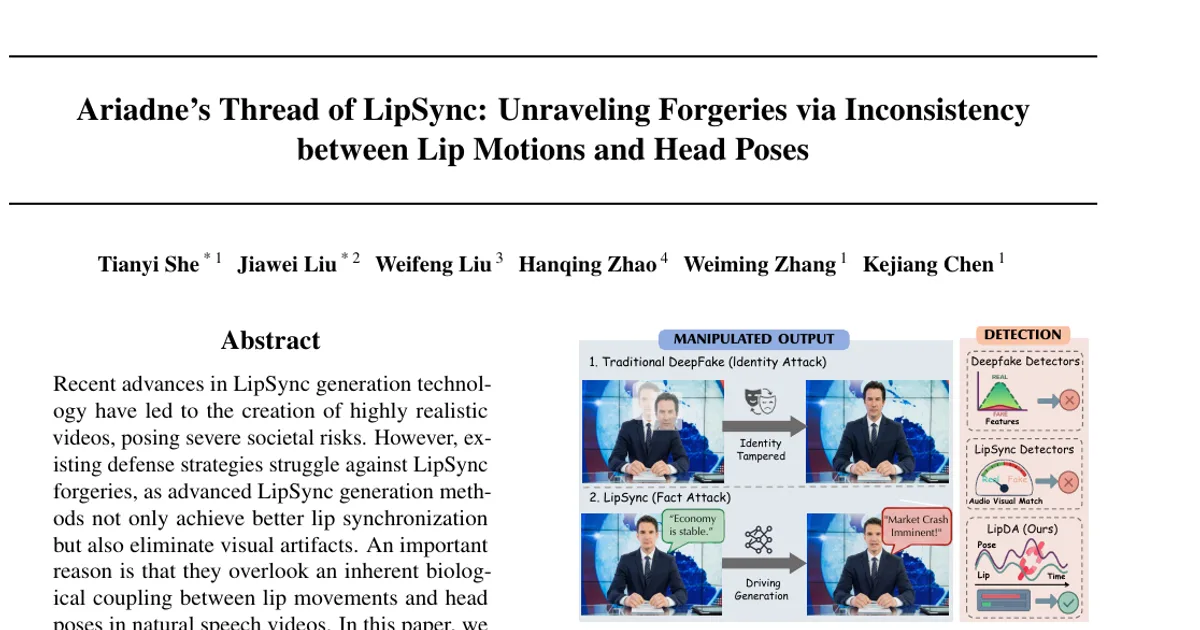
LipSync generation tools can take a real person's face and make them appear to say words they never spoke, while preserving their identity and visual surroundings — making these forgeries harder to spot than face swaps. Existing detectors look for visual artifacts or audio-visual sync errors, but modern diffusion- and GAN-based generators have largely eliminated those cues. This paper argues that natural speech physically couples lip articulation with head movement, and that generators break this coupling because they synthesize lips and head pose as separate problems — so measuring the lip-pose mismatch becomes a reliable forensic signal, and the specific way each model family breaks that coupling becomes a fingerprint for attribution.
Key Contributions
-
Physiological signal discovery. The authors identify that the natural coupling between lip motion and global head pose is disrupted by LipSync generation, and show that the resulting temporal dynamics form a separable feature space usable both for detection and for identifying the source model family.
-
Unified detection-and-attribution framework. They propose LipDA, described as the first unified framework to jointly address LipSync detection and source attribution, built from a two-stage design that combines contrastive learning (Stage I) with cross-modal temporal modeling (Stage II).
-
A new forensic dataset. They construct LipSync-A, described as the first large-scale dataset explicitly designed for LipSync forensics, containing 16,000 synthetic videos from 15 state-of-the-art generators spanning 7 architectures, with every video labeled by its source generator to enable attribution evaluation.
-
Demonstrated generalization and robustness. Experiments show strong cross-domain transfer to unseen generators and to a traditional DeepFake dataset, plus stability under visual and audio perturbations.
Main Findings
-
Detection performance: In the audio-visual setting, LipDA achieves 95.96% ACC / 99.42% AUC on LipSync-A, 98.34% ACC / 99.82% AUC on AVLips, and 94.48% ACC / 97.50% AUC on TalkHeadBench, averaging 96.26% ACC and 98.91% AUC. It outperforms the previous state-of-the-art, SpeechForensics, by +7.46% in ACC and +7.97% in AUC.
-
Visual-only variant also works: Even without audio, LipDA (V) reaches 93.47% / 97.83 (LipSync-A), 97.02% / 99.59 (AVLips), and 93.05% / 98.65 (TalkHeadBench), averaging 94.51% ACC and 98.69% AUC — above every baseline, including multimodal ones.
-
A small audio caveat: Adding audio slightly decreased AUC on TalkHeadBench (from 98.65 to 97.50), which the authors attribute to high variability in that dataset's real-scene audio.
-
Attribution performance: Across five generator families (Transformer-, GAN-, Diffusion-, VAE-based, and statistical models), LipDA averages 97.5% ACC and 93.9% F1, an average F1 improvement of over 12 percentage points over the second-best method, TALL (92.3% ACC / 81.5% F1). For example, on Diffusion-based generators it reaches 99.9% ACC and 99.9% F1, and on Transformer-based ones 93.8% ACC / 87.6% F1.
-
Unseen-generator generalization: On three generators excluded from training, LipDA scores 87.8% ACC / 84.3% F1 (Sonic), 84.6% / 84.3% (KDTalker), and 95.5% / 95.4% (OmniSync). Several baselines collapse to near chance — AVAD sits at roughly 49.5–49.7% ACC on all three, and LipFD at 45.6–51.2%.
-
Transfer to traditional DeepFake detection: Although trained only on LipSync forgeries, LipDA generalizes to identity-swap manipulations on Celeb-DF with 92.76% ACC, 91.86% AUC, 98.38% AP, 4.33% FPR, and 1.54% FNR — far ahead of LipForensics (71.91% ACC) and near-chance baselines such as NPR (50.10% ACC, 100.0% FNR).
-
Action unit (AU) evidence: Video-driven forgeries show significantly reduced AU intensity, indicating suppressed facial activity from the transplanted driving signal; audio-driven forgeries mimic lip dynamics well but show erratic peaks in AU17 (chin raise), revealing a failure of lip-pose coordination.
-
t-SNE separability: Stage I embeddings for lip and pose from unseen real samples are tightly intermingled (physiological coupling), while fake samples form distinct, separable clusters. Separately, pose features from different generator families form well-separated clusters.
-
Ablations (on AVLips, full model 97.90% ACC): Removing the alignment loss drops accuracy by 17.3 points (80.56%); removing the pose branch drops 23.1 points (74.78%); removing the lip branch causes a collapse of 44.4 points (53.50%). Replacing ResNet-18 with CLIP-ViT costs 12.0 points (85.73%), while MobileNet costs 1.7 (96.23); pooling for pose costs 0.7 (97.20) and flattening costs 2.6 (95.27).
-
Temporal parameters: Detection accuracy improves with video length and saturates at approximately 8 seconds under the non-random sampling protocol. Sliding-window length is a trade-off: long enough to capture temporal information, but not so long that redundant motion dilutes the inconsistency cue.
Methodology in Plain English
The researchers start from a biological observation: in real speech, the mouth and the head move together as parts of one control system. Generators break this. Video-driven methods copy motion and head pose from a separate driving video onto a source identity; audio-driven methods typically solve "audio to lips" and "head pose" as two separate problems, so the lip is hard-constrained by audio while the head is sampled from a learned distribution or taken from an unrelated source.
Stage I (detection). The video is cut into sliding windows of T = 5 frames. Lip regions are cropped (96×96) and encoded with a ResNet-based encoder, while head motion is represented as facial landmark trajectories (468 landmarks) and embedded by a separate pose projection head. Both streams are projected into a shared latent space. A margin-based contrastive loss pulls the lip and pose embeddings together for real videos and pushes them apart for forgeries, while an MLP classifier on the concatenated features is trained with binary cross-entropy.
Stage II (attribution). Trained separately with Stage I encoders frozen, this stage uses two modules. The Temporal Dynamic Module (TDM) encodes keypoint sequences with a Temporal-CNN followed by a Bi-LSTM to capture generator-specific motion patterns. The Modality Synchronization Module (MSM) encodes lip ROIs with a 3D-CNN and audio MFCCs with a 1D-CNN, then uses multi-head cross-attention so the visual features attend to the audio, followed by temporal averaging. The two resulting features are concatenated into a "fingerprint" and passed to a classifier trained only on forged samples with their true generator labels, using cross-entropy.
Data. The authors build LipSync-A from LaPa and HDTF identities with VFHQ and VCTK driving signals, generating roughly 16,000 videos from 15 generators (including about 270 via commercial APIs), split into 3,926 training, 841 validation, and 842 testing samples with disjoint identities and driving signals. Training uses Adam at 1×10⁻⁵, batch size 32, for 20 epochs, with MediaPipe landmarks and MFCC audio. Evaluation covers in-domain LipSync-A plus zero-shot tests on AVLips and TalkHeadBench, unseen generators, and Celeb-DF, compared against 15 SOTA detectors (8 unimodal, 7 multimodal).
Why This Matters
Impact on research. The paper reframes LipSync forensics away from chasing local artifacts and audio-visual sync errors — cues that diffusion-based generators have largely erased — toward a global physiological constraint that is much harder for a generator to optimize. It also argues that binary real/fake output is insufficient for forensics and demonstrates a working pipeline for source attribution, a task the authors say prior literature largely overlooks.
Real-world applications:
- Verifying user-submitted video in newsrooms and on social platforms, where a fabricated statement by a real public figure is more damaging than a face swap.
- Fraud prevention in finance and business communications, motivated by the cited incident in which criminals impersonated a corporate executive to defraud a company of $25 million.
- Judicial and law-enforcement forensics, where attributing a forged clip to a specific generator family supports accountability rather than just flagging it as fake.
- Trust and safety for commercial avatar and virtual-anchor pipelines, since the dataset includes roughly 270 samples generated via commercial APIs.
Industry relevance. The work offers content-moderation and identity-verification vendors a detector that transfers to unseen generators (87.8–95.5% ACC on Sonic, KDTalker, and OmniSync), survives compression, blur, and contrast changes, and reaches 92.76% ACC on the non-LipSync Celeb-DF benchmark without being trained on that manipulation type. The released dataset and code give the field a reproducible, attribution-labeled benchmark where none previously existed.
Future Directions
- Extending beyond LipSync: The authors state that applying the framework to broader AI-generated image forgery domains remains unexplored.
- Audio robustness for attribution: The Stage-II attribution module degrades under certain audio perturbations, suggesting practical deployments need audio-quality awareness.
- Operational limits under weak motion: Detection relies on visible lip dynamics and head motion, and degrades for stationary speakers, persistent downward gaze, or prolonged facial occlusion — motivating complementary cues from upper-face or full-body dynamics.
- Broader generator coverage and adversarial pressure: Generalization was tested on three unseen LipSync generators (Sonic, KDTalker, OmniSync); whether the lip-pose fingerprint holds as generators begin to explicitly model head-lip coordination remains an open question for the described cat-and-mouse setting.
Target Audience
This paper is most valuable to deepfake-detection and multimedia-forensics researchers, especially those working on lip-sync and talking-head forensics; computer-vision engineers building content-moderation or identity-verification systems; and forensic practitioners who need not just a fake/real verdict but evidence of which generator produced a clip. Readers with background in contrastive learning and audio-visual representation learning will get the most from the methodology section, while the dataset and benchmark tables make it directly useful to anyone seeking an attribution-labeled LipSync evaluation resource.
Authors’ abstract
Recent advances in LipSync generation technology have led to the creation of highly realistic videos, posing severe societal risks. However, existing defense strategies struggle against LipSync forgeries, as advanced LipSync generation methods not only achieve better lip synchronization but also eliminate visual artifacts. An important reason is that they overlook an inherent biological coupling between lip movements and head poses in natural speech videos. In this paper, we propose LipDA, a novel framework for joint LipSync Detection and Attribution, which takes advantage of the inconsistency between head and lip. For detection, the framework learns to quantify this discrepancy by contrasting lip and pose features from authentic versus forged videos. For attribution, our method is designed to capture the unique temporal dynamics and audio-visual synchronization patterns that act as the fingerprint of models, enabling source tracing. We conduct extensive experiments on two challenging LipSync datasets as well as our own proposed large-scale and multi-generator dataset. LipDA achieves over 97\% AUC in detection and 97.5\% accuracy in model attribution, significantly outperforming existing methods. Code and the proposed LipSync-A dataset are available at https://github.com/AnsonShe/LipDA.