Research
AReA: Adaptive Receptive-Field Attention for Efficient High-Resolution Diffusion Transformers
Overview Research area: Computer vision, specifically text-to-image (T2I) generation with Diffusion Transformers (DiTs) and inference-time methods for generating images above a model's training resolu
- arXiv
- 2610.17227
- Published
- 2026-10-12
- Authors
- Javad Rajabi, Koorosh Roohi, David B. Lindell, Babak Taati
AI summary
Overview
Research area: Computer vision, specifically text-to-image (T2I) generation with Diffusion Transformers (DiTs) and inference-time methods for generating images above a model's training resolution.
Technical level: Advanced. The paper assumes familiarity with transformer self-attention, diffusion denoising schedules, Rotary Position Embeddings (RoPE), and image-latent patch grids.
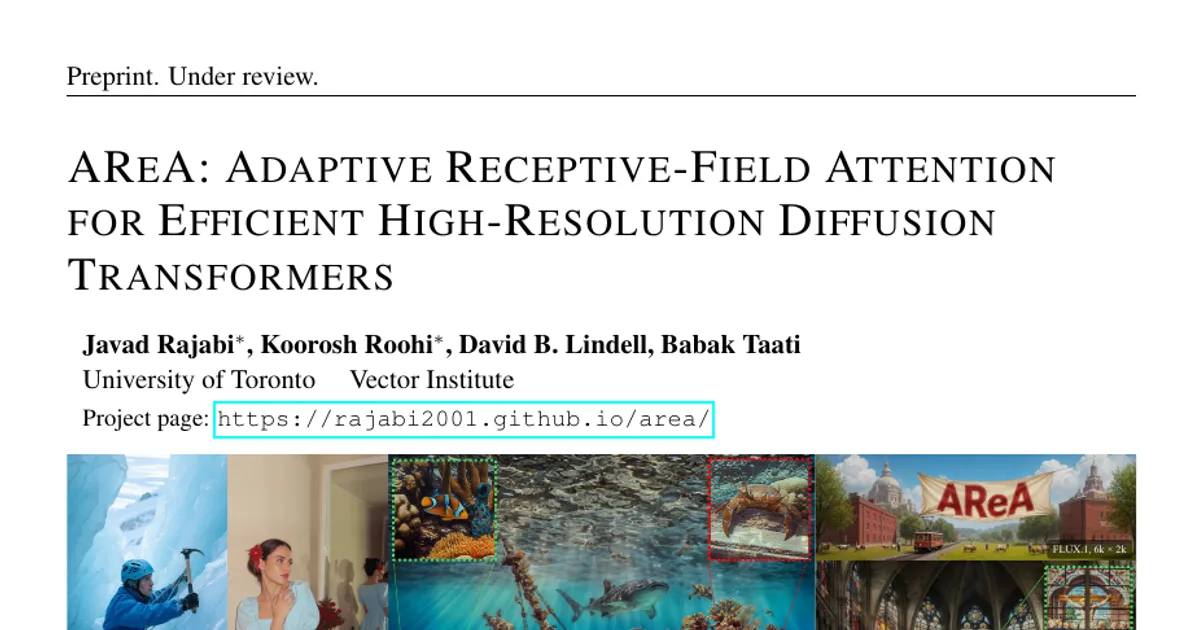
Scope: The paper proposes AReA, a training-free attention mechanism that replaces uniform full attention with a coarse-to-fine, step-adaptive receptive field so that pretrained DiTs can generate coherent high-resolution images faster and without RoPE extrapolation.
What This Paper Is About
Diffusion Transformers are typically trained at a fixed resolution (for FLUX.1, a 64 × 64 patch grid), and generating far beyond it fails in two ways at once: attention cost grows quadratically with the token count, and the model is exposed to token counts and relative distances it never saw during training, pushing it out of distribution. The paper argues both problems share a single root cause — uniform full attention applied at every denoising step — and shows that attention's effective receptive field naturally narrows as denoising proceeds, so a fixed global receptive field is both wasteful and harmful. AReA's goal is to align the attention receptive field with that coarse-to-fine progression, without retraining, extra parameters, or RoPE length extrapolation.
Key Contributions
-
Diagnosis of a shared failure mode. The authors identify uniform full attention as the common source of the quadratic cost and the structural distortions and degraded detail seen at high resolution, since it forces long-range interactions beyond the training range at every step.
-
An empirical characterization of attention locality. Using vanilla FLUX.1 at 1024 × 1024, averaged across heads, blocks, and 24 prompts, they measure the attention-weighted query–key distance and find it shrinks only 1.4× over all keys but 5.5× over dominant keys (those receiving at least 1/4 of the maximum attention), showing that the most important keys move close to the query late in denoising.
-
AReA, a two-phase training-free attention mechanism. Phase I applies cross-scale coarse attention over pooled keys and values on a grid matched to the training resolution; Phase II applies adaptive windowed fine attention with shrinking windows, Discrete Wavelet Transform (DWT)-guided window splitting, a Halo of neighboring tokens, and a global-KV bridge. It adds no parameters, requires no retraining, and integrates into existing DiT models without RoPE extrapolation.
-
A new benchmark and extensive evaluation. The authors introduce HRGen-1K, a benchmark of 1,000 challenging, diverse LLM-generated prompts, and evaluate AReA against DyPE, UltraImage, SigMa, and SEGA on Aesthetic-4K (195 prompts) across multiple models and resolutions, reporting lower latency than all baselines at every resolution tested.
Main Findings
-
Latency and speedups. AReA reduces generation time at every tested resolution, with the advantage growing as resolution increases. The authors report speedups over uniform full-resolution global attention of 3.2× on FLUX.1 and 2.9× on Qwen-Image at 6144². At 4096 × 4096 on Aesthetic-4K, AReA runs in 151 s on FLUX.1 versus 314 s for the base model and 319 s for SEGA, and in 487 s on Qwen-Image versus 902 s for the base model and 906 s for SEGA.
-
Quality gains across resolutions. On Aesthetic-4K, AReA ranks first or second on most metrics for both FLUX.1 and Qwen-Image across 6144 × 2048, 2048 × 4096, 4096 × 4096, and 5120 × 5120. For example, at 4096 × 4096 on FLUX.1 it reaches ImageReward 1.3250, Aesthetic 6.37, CLIP 29.71, PickScore 23.31, FID 148.5, and FID_p 58.2, versus ImageReward 1.2702, Aesthetic 6.31, CLIP 29.16, PickScore 23.16, FID 150.6, and FID_p 71.8 for SEGA.
-
HRGen-1K results. At 4096 × 4096 on FLUX.1, AReA scores ImageReward 0.6001, Aesthetic 5.87, CLIP 29.89, PickScore 21.44, HPS 0.275, and IS 13.90, compared with ImageReward 0.4422, Aesthetic 5.82, CLIP 29.63, PickScore 21.18, HPS 0.270, and IS 11.99 for SEGA, and ImageReward −1.4649, Aesthetic 5.12, CLIP 23.36, PickScore 19.04, HPS 0.232, and IS 7.20 for the base model.
-
Both phases are necessary. In ablations at 4096 × 4096 on FLUX.1 with Aesthetic-4K, removing Phase I (full attention instead) drops ImageReward to −0.41 and raises FID to 171.42; removing Phase II drops ImageReward to 1.10 with FID 155.44. Without Phase I, local windows evolve independently and produce inconsistent content; without Phase II, the output lacks fine texture and remains blurry.
-
The pooling ramp matters. Holding the Phase I pooling factor fixed degrades results: a flat f = 2 gives ImageReward 1.23 and FID 152.08, and a flat f = 4 with no ramp gives ImageReward 1.27 and FID 154.21, versus ImageReward 1.32 and FID 148.50 for the full AReA. A fixed f = 4 forms the layout on a 64 × 64 pooled grid that is too coarse to separate objects (the paper's example shows sheep merging into a single blurred mass), while a fixed f = 2 forms it on a 128 × 128 grid at twice the training resolution, producing scattered and repeated subjects.
-
Block-center pooling is the best representative choice. Center pooling yields ImageReward 1.32, Aesthetic 6.37, MUSIQ 45.22, PickScore 23.31, HPS 0.297, CLIP 29.71, and FID 148.50, beating mean (FID 152.78), random (FID 152.53), and medoid (FID 151.82) pooling on nearly all metrics.
-
Auxiliary components reduce specific artifacts. Removing the global-KV bridge produces duplicated and repeated subjects and raises FID from 148.50 to 161.25, while leaving most metrics nearly unchanged. Removing the Halo introduces seams along window boundaries (FID 148.76). Removing DWT splits increases latency from 151 s to 187 s.
-
Fixed windows are a trap for evaluation. Using a fixed window size of 64 matching FLUX.1's native resolution fragments the image into inconsistent regions; the paper notes such outputs are unusable yet still score well on metrics insensitive to layout errors such as Aesthetic, with the failure instead showing up in lower ImageReward and PickScore and a higher FID of 152.15.
Methodology in Plain English
The authors begin from the observation that denoising has a natural rhythm: early steps lay out the overall composition, and later steps polish local detail. Instead of asking every token to look at every other token at every step, they let the "view" of attention contract in step with that rhythm.
Phase I (early steps). Queries stay at full target resolution, but keys and values are spatially pooled into f × f blocks, with one representative token per block (the block center is the default). The pooled keys are placed on a coarse (W/f) × (H/f) grid, and the full-resolution query coordinates are scaled by 1/f so queries and keys share one coordinate system. Each full-resolution query then attends to the pooled keys, so every token still sees the whole image — just through a downsampled view — at 1/f² of the cost of full attention. The pooling factor is not constant: it starts at a value that matches the model's native training grid (f = 4 at 4096², where the 256 × 256 patch grid maps to the native 64 × 64) and ramps down linearly to a floor of f_min = 2, with each value snapped to a valid grid divisor. Text tokens are never pooled, so each of the N queries attends to T + N/f² keys.
Phase II (later steps). Attention is confined to local windows that shrink geometrically from w_start — the largest window for which windowed attention is still cheaper than a full-attention pass, roughly 70% of the longer side of the patch grid — down to w_min, the model's native range. The grid is covered by a base tiling spaced evenly so overlap is distributed equally. A DWT map computed from the current hidden states then measures fine detail: windows over smooth regions are split into four quadrants to save computation, while windows over detailed regions keep their scheduled size. Three safeguards keep windows from showing their seams: overlapping outputs are blended with center-weighted averaging, window boundaries are randomly shifted across steps so seams never form at fixed locations, and each window's keys and values are extended with a narrow ring of neighboring tokens (the Halo, with δ_max set to 8). A global-KV bridge additionally extends each window with R = (ρw_t)² tokens drawn from the rest of the grid, selected by their deviation from the global mean key and spread spatially, with ρ set to 0.5.
Scheduling the switch. Because denoising progress differs across models and samplers, the transition from Phase I to Phase II is defined by a noise level σ* rather than a step count, chosen empirically at the point where composition is established. In practice, the first 8 steps of FLUX.1 and the first 20 steps of Qwen-Image use Phase I. All experiments ran on NVIDIA H100 GPUs.
Why This Matters
The paper shows that the high-resolution capability is already latent in pretrained DiTs and that unlocking it does not require new weights, retraining, or architecture changes — only a rethinking of what each query is allowed to attend to. Because AReA is training-free and avoids RoPE extrapolation, it sidesteps the generalizability limits and artifacts that the authors attribute to RoPE-based direct-inference methods, whose outputs often stretch subjects and bodies or fail on text at high resolution. The measured speedups and the 67-million-pixel outputs suggest that resolution scaling can become a practical rather than prohibitive operation.
Real-world applications that depend
Authors’ abstract
Generating images beyond the training resolution of Diffusion Transformers (DiTs) remains challenging, as the number of tokens grows rapidly with resolution, full attention becomes expensive, and outputs often suffer from structural distortions and degraded detail. We identify uniform full attention as the common source of both problems. Attending to all tokens at every step causes quadratic cost and exposes the model to more tokens and relative distances beyond the training range, pushing the model out of distribution. We observe that attention's effective receptive field narrows during denoising, from global in early steps that form structure to local in later steps that refine details. We propose AReA, a training-free attention mechanism whose receptive field evolves from coarse to fine, following the denoising progression. In early steps, AReA applies cross-scale coarse attention over downsampled keys and values, capturing global context, while in later steps it applies local attention within progressively shrinking windows. Without additional parameters or training, experiments show that AReA consistently outperforms state-of-the-art training-free baselines across target resolutions and different models, while also being faster and more efficient.