Research
APEX: Asynchronous Prefix Denoising for Extreme Compression
Overview Research area: Generative computer vision — specifically latent diffusion models and autoencoder/latent-space design for image synthesis. Technical level: Advanced. The paper assumes familiar
- arXiv
- 2610.12843
- Published
- 2026-10-09
- Authors
- David Dinkevich, Nisan Chiprut, Yoav HaCohen, Dani Lischinski
AI summary
Overview
Research area: Generative computer vision — specifically latent diffusion models and autoencoder/latent-space design for image synthesis.
Technical level: Advanced. The paper assumes familiarity with latent diffusion, flow matching, Transformer denoisers (DiT/SiT), classifier-free guidance, and FID-style evaluation.
Scope: The paper introduces APEX, an autoencoder-plus-denoiser design that pairs a structure-to-detail channel hierarchy with staggered ("asynchronous") denoising to make extreme spatial compression (64× and 128×) practical for ImageNet-512 latent diffusion.
What This Paper Is About
Latent diffusion models cut cost by shrinking an image onto a small spatial grid, but aggressive compression forces you to add latent channels to keep reconstructions faithful — and wider latents are harder for the diffusion model to generate. This reconstruction–generation dilemma means practitioners must either lose reconstruction quality (fewer channels) or lose generation quality (more channels). APEX's goal is to make extreme spatial compression competitive by reshaping that trade-off rather than accepting it, so that very short token sequences become a genuine quality-and-compute advantage instead of only a per-step speedup.
Key Contributions
- Making hierarchy and asynchronous denoising work together. The authors show that nested channel levels plus staggered local timesteps do not combine automatically, and couple three elements in one fixed-token latent: resolution-supervised cumulative channel levels, per-level local times on a shared global clock, and a training-probability allocation along that clock.
- Turning high compression into a compute advantage. With training compute matched, APEX at 64 tokens outperforms a less-compressed 256-token baseline (f32c32) at every evaluated guided inference budget, with the margin growing as sampling compute shrinks.
- Generating without an additional information bottleneck. Instead of restricting what the latent can store or importing pretrained semantic structure, APEX improves generative tractability while maintaining comparable reconstruction quality.
Main Findings
- Slower degradation as latents widen (64× compression). At f64, APEX's gFID moves from 2.85 (c128) to 3.15 (c256) to 4.90 (c512), while flat DC-AE degrades from 3.22 to 9.19 to 26.10 under matched denoiser-training FLOPs and total NFE.
- Slower degradation as latents widen (128× compression). At f128, going from c512 to c1024 changes APEX from 8.98 to 18.77, versus DC-AE at 14.44 → 89.47 and DC-AE 1.5 at 11.86 → 51.47. At f128c1024, Spectrum Matching reaches 73.71 and FreqWarm 79.51.
- Best result at 16 tokens. At f128c512, APEX reaches 8.98 guided gFID with SiT-XL from a 4×4 grid of 16 tokens, while every compared method remains in double digits.
- Matching a 1024-token baseline with far less training compute. The 64-token f64c8-32-128 model reaches gFID 2.62, matching the 1024-token f8c4 SD-VAE SiT-XL/2 result, using 1.78×10²⁰ versus 1.21×10²¹ denoiser-training FLOPs — about 15%.
- Beating a less-compressed model under matched compute. Against f32c32 at matched training and guided sampling compute, APEX reaches gFID 2.74 with 250 NFEs at the 1× budget, versus 2.95 for f32c32 with 64 NFEs; at 1000 NFEs (4×) APEX reaches 2.67. APEX and f32c32 select CFG 1.4, flat f64c128 selects 1.5.
- Compression alone is not enough. The flat f64 baseline is preferable only at the smallest sampling budgets; by 1/2× relative compute, f32c32 is already better despite receiving one quarter as many evaluations. APEX removes that crossover.
- The components only work together (Table 2, f64c128, SiT-B/1). DC-AE scores 13.27 gFID; adding APEX levels to ordinary diffusion worsens it to 20.37; adding cumulative-prefix diffusion training recovers part of it to 17.83; adding APEX diffusion reaches 8.12.
- Subtractive controls confirm the coupling. Removing matched-resolution targets gives 8.77 (+0.65), while naively applying the staggered schedule to the DC-AE 1.5 construction (many small uniform-width levels) fails at 52.89 (+44.77).
- The gap and the clock allocation are the sensitive knobs. The stagger gap g is optimized near 0.25 (g=0 reduces to synchronous diffusion), and structure-heavy training allocation helps; the main models use p_L0 = 0.9 rather than 1, since deeper hierarchies would otherwise leave later levels with little or no direct supervision (uniform sampling corresponds to p_L0 = 2/3).
- Every level earns its place. With p_L0 = 1, stopping inference after the first, second, or third level completes (redistributing the same 250 NFEs) gives gFID 19.83, 9.04, and 8.12 — even L2, largely unsupervised late in its trajectory, matters.
- Hierarchy alone barely changes reconstruction. Following DC-AE 1.5, imposing a channel hierarchy has little effect on full-latent reconstruction, so all methods are matched at each latent geometry to the same rFID (e.g., 0.22 / PSNR 26.15 for f64c128, 0.23 / 25.73 for f128c512).
Methodology in Plain English
The authors start from a DC-AE autoencoder, which trades spatial resolution for channels. They split each latent token's channels into ordered groups, so that cumulative "prefixes" (level 0 = first 8 channels, level 1 = first 32, level 2 = all 128, for example) act as progressively richer descriptions of the same scene.
Two ideas drive the design. First, the autoencoder is trained so that each prefix is judged at its own resolution: a level is sampled, all later channels are zeroed, the shared decoder emits a full-resolution image, and both that image and the target are downscaled to the level's assigned size before the reconstruction loss is applied. Early levels therefore learn layout and shape rather than wasting capacity on isolated sharp edges; later levels restore missing detail.
Second, generation runs on one global clock. Each level has a local time that falls from 1 to 0 within its own window, with the windows ordered so earlier levels are never noisier than the refinement levels that condition on them. At any moment a level is unstarted (zeroed), denoising (noised at its local time), or done (clean context). One shared Transformer predicts velocities for all blocks in a single forward pass, but only denoising levels are supervised and updated. Under the equal-gap schedule the update reduces to a single shared Euler step, so per-step cost matches that of a flat model even though extra channel groups are being generated.
Training adds two practical ingredients: a loss that weights each level's error equally across denoising levels (so wide refinement levels don't dominate), and a clock-sampling density that concentrates training on the interval where the structure level is denoising. The input projection rows for later channel groups are initialized to zero, so the model starts as a structure-only generator and gradually learns to use refinement information without touching the Transformer trunk.
Evaluation uses ImageNet-512 at 64× and 128× compression, SiT-XL/1 for main results and SiT-B/1 for ablations, rFID/PSNR on the validation split for reconstruction, and gFID from 50K class-conditional samples under the ADM protocol, with cumulative denoiser-training FLOPs matched across compared methods.
Why This Matters
For research, the paper reframes the reconstruction–generation dilemma as a co-design problem: it shows empirically that a structured latent without a matching asynchronous denoiser is worse than a flat latent (20.37 versus 13.27 gFID), and that a staggered schedule without the matching hierarchy collapses (52.89). That is a concrete negative result about modular reuse of two individually sensible ideas, and it shifts the frontier at 64× and 128× compression rather than just reporting a single operating point.
Potential real-world applications:
- Compute-constrained image generation: short 16- or 64-token sequences with strong FID are attractive where Transformer attention cost or sampling budgets dominate, since attention grows quadratically with token count.
- High-resolution synthesis pipelines: the paper targets 512² images under extreme compression, a setting relevant to production image-generation and editing systems that must hit latency targets.
- Content creation and design tools: progressive structure-then-detail decoding exposes usable intermediate images, which suits interactive preview workflows.
- Efficient training and research iteration: matching a 1024-token baseline's gFID at roughly 15% of its denoiser-training FLOPs lowers the cost of reaching competitive quality.
Industry relevance is direct: the work comes from Lightricks with academic collaborators at Hebrew University of Jerusalem, is released under CC BY 4.0 with code, and is aimed squarely at the cost/quality trade-offs that govern deployed diffusion systems.
Future Directions
- Learning the design choices instead of hand-picking them. The authors explicitly flag that APEX still requires choosing channel boundaries, per-level target resolutions, the stagger gap, and the global-clock distribution, and that jointly learning these with the autoencoder and denoiser is a promising direction.
- Better clock schedules. The formulation is described as schedule-agnostic — any monotone local clocks satisfying the ordering constraint are valid — yet only the equal-gap form is used throughout; non-uniform or adaptive gaps remain unexplored.
- Behavior beyond ImageNet-512 and the evaluated widths. All reported results are at 64× and 128× compression on ImageNet-512 with SiT-XL/1 and SiT-B/1; whether the gains hold at other resolutions, datasets, or text-conditional settings is not reported.
- Combining with orthogonal approaches. The baselines it beats (DC-AE 1.5 prefix training, FreqWarm's frequency curriculum, Spectrum Matching's spectral regularization) modify different parts of the pipeline, leaving open whether those ideas stack with APEX's channel hierarchy and staggered clock.
Target Audience
Researchers and engineers working on diffusion-model efficiency, latent-space and tokenizer design, or hierarchical/coarse-to-fine generative models. It is most useful to readers already comfortable with latent diffusion training recipes and FID-based benchmarking; practitioners deciding whether to trade spatial tokens for channels in a production image generator will find the compute-matched comparisons and the design-choice guidance in Section 4.4 directly actionable.
Authors’ abstract
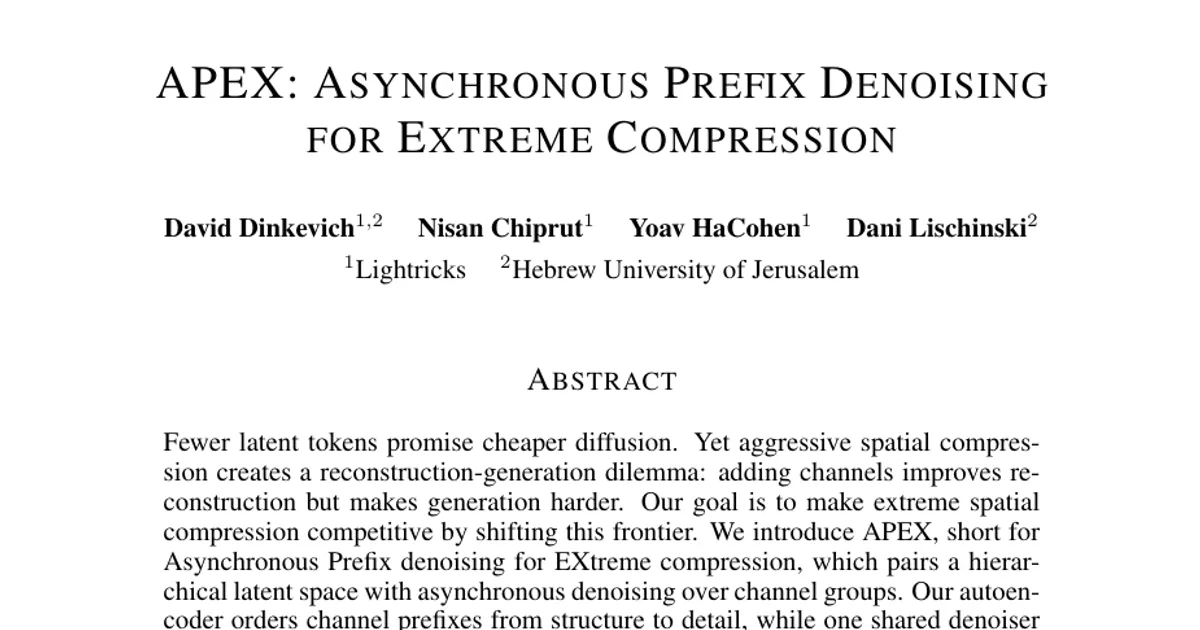
Fewer latent tokens promise cheaper diffusion. Yet aggressive latent compression creates a reconstruction-generation dilemma: adding channels improves reconstruction but makes generation harder. We introduce APEX, short for Asynchronous Prefix denoising for EXtreme compression, which pairs a hierarchical latent space with asynchronous denoising over channel groups. Our autoencoder orders channel prefixes from structure to detail, while one shared denoiser generates them at staggered local times without adding tokens. On ImageNet-512, APEX outperforms existing methods at every evaluated channel count under 64x and 128x compression. At matched training and guided sampling compute, it also outperforms a 256-token model at every evaluated budget, with larger gains at lower compute. Code is available at https://daviddinkevich.github.io/APEX.