Research
Amortized Simulation-Based Inference in Generalized Bayes via Neural Posterior Estimation
Overview Research area: Simulation-based inference (SBI), generalized Bayesian inference (GBI), neural posterior estimation (NPE), and amortized variational inference. Technical level: Advanced. The p
- arXiv
- 2601.22367
- Published
- 2026-01-29
- Authors
- Shiyi Sun, Geoff K. Nicholls, Jeong Eun Lee
AI summary
Overview
Research area: Simulation-based inference (SBI), generalized Bayesian inference (GBI), neural posterior estimation (NPE), and amortized variational inference.
Technical level: Advanced. The paper assumes familiarity with Bayesian inference, importance sampling, score matching, and Langevin dynamics, though the core idea is stateable simply.
Scope: The paper introduces a single neural estimator conditioned on both the observation and the generalized-Bayes temperature, giving one-pass posterior sampling across a family of tempered ("power") posteriors without test-time MCMC or simulator calls.
What This Paper Is About
Generalized Bayesian inference down-weights or up-weights the likelihood with a temperature β, which improves robustness when the simulator is misspecified. The problem is that existing GBI methods need expensive MCMC or SDE-based samplers, and they must be re-run from scratch for every new observation and every new value of β. This paper asks whether one neural network can learn the entire family p_β(θ|x) ∝ π(θ)p(x|θ)^β at once, so that sampling becomes a single forward pass.
Key Contributions
-
The first fully amortized variational approximation for the power-posterior family. The authors train a single (x, β)-conditioned neural posterior estimator q_φ(θ|x, β) that covers both observations x and the temperature β, replacing inference-time MCMC or SDE sampling with one forward pass. They state this is the first such fully amortized approximation for this specific tempered posterior family.
-
Two complementary training routes. Route A synthesizes off-manifold training pairs (θ, x) from the tempered joint π(θ)p(x|θ)^β using a learned joint score and short-run annealed Langevin dynamics. Route B reuses a single fixed base dataset π(θ)p(x|θ) and reweights it per temperature with self-normalized importance sampling (SNIS), instantiated either with a neural likelihood estimator (m(x) = 1) or a neural ratio estimator (m(x) = p(x)^(1−β)).
-
Theory for the reweighted objective. Proposition 4.1 shows that minimizing the SNIS objective is equivalent to minimizing the expected forward KL from the tempered posterior to q_φ — a consistent forward-KL fit. Proposition 4.2 shows that for the NRE-based weights the weight variance is finite, with Var[w_β] < 1 for β ∈ [1/2, 1].
-
An empirical comparison against non-amortized power-posterior samplers. Across four standard SBI benchmarks and a Hodgkin–Huxley neuroscience simulator, the β-amortized estimator is compared with MCMC-based power-posterior references using two-sample metrics over a range of temperatures.
Main Findings
-
Competitive accuracy without inference-time MCMC: Across four standard SBI benchmarks — Gaussian Mixture, Two Moons, SLCP, and the chaotic Lorenz–96 system — the β-amortized estimator achieves posterior approximations that are competitive, in standard two-sample metrics, with non-amortized MCMC-based power-posterior samplers over a wide range of temperatures.
-
Metrics used: Discrepancies are measured with MMD (Gretton et al., 2012) and C2ST (Friedman, 2004; Lopez-Paz and Oquab, 2016) as functions of β. MMD captures distributional discrepancies in kernel mean embeddings; C2ST is often more sensitive to small but classifiable differences between sample sets.
-
Simulation budget studied: The experiments compare 10k versus 100k simulator-generated training pairs to quantify temperature-robustness and data efficiency. The symbol n in the figures denotes the number of simulator-generated training pairs, not the number of datapoints inside an observation.
-
Route B is efficient near β = 1: SNIS-weighted NPE is a good choice when β is not far from 1, especially for β ≤ 1, where reweighting is comparatively stable. Effective-sample-size diagnostics show ESS is highest near β = 1 and drops as β moves away from the base proposal, especially for SLCP and Lorenz–96. At β < 1, Route B approximates a diffuse target using samples from a more concentrated base joint, so its curves can rise in both C2ST and MMD as β decreases.
-
Route A helps at small β: Route A appears relatively robust at small β in the Gaussian mixture and SLCP tests, where the weight variance for Route B SNIS methods increases. It can be advantageous when SNIS reweighting becomes unreliable (ratio/likelihood miscalibration or ESS collapse at small β) or when the base joint undercovers tempered regions.
-
Route A has its own failure mode: Route A generates samples via short-run annealed Langevin dynamics, which helps with support exploration but is sensitive to score error and multimodal geometry, as seen in the Two Moons benchmark.
-
Off-manifold samples: Because Route A performs Langevin updates directly in the ambient joint space targeting the tempered joint p_β(θ, x), the generated pairs are not constrained to remain exact forward-simulation pairs — what the authors call "off-manifold." This is only useful to the extent the learned score extrapolates locally beyond the nominal simulator-supported region.
-
Hodgkin–Huxley results: Using RouteB_NLE trained with 10,000 prior-sampled simulations on the single-compartment Hodgkin–Huxley model (eight parameters, seven summary statistics from the voltage trace), the one-dimensional marginal posteriors at β ∈ {0.1, 1.0, 2.0} are broadly consistent across β, with only modest shifts in a subset of parameters — visible changes in the tails/peaks for g_Na and g_K, while E_leak remains nearly unchanged. Posterior predictive simulations at β = 0.1 qualitatively reproduce observed spiking patterns across three selected experimental sweeps from the Allen Cell Types Database.
-
The authors do not claim uniform superiority: The paper states explicitly that it does not claim the amortized methods are uniformly best, and that performance tends to be better where the tempered target remains well covered by the training distribution, degrading in harder benchmarks or at extreme β.
Methodology in Plain English
The target quantity is the power posterior p_β(θ|x) ∝ π(θ)p(x|θ)^β. At β = 0 this is the prior, at β = 1 it is the ordinary Bayesian posterior, and in between the data are down-weighted. Existing methods draw samples from this at test time with MCMC, which is slow and must be redone for each new dataset and each β. The authors instead train one network that takes both x and β as inputs and outputs a distribution over θ, so that drawing samples later is just a forward pass.
They build such a network in two different ways.
Route A builds a training set that actually looks like the tempered joint distribution. First the authors train a neural score network to approximate ∇ log p(θ, x) on samples from π(θ)p(x|θ), using denoising score matching (NCSN). Then they run short Langevin dynamics in the joint (θ, x) space using the identity ∇log p̃_β(θ,x) = β∇log p(θ,x) − (β−1)(∇_θ log π(θ), 0), annealing across a schedule of noise scales. The resulting (θ, x, β) triples are used as training data for a conditional maximum-likelihood fit of q_φ(θ|x, β).
Route B avoids scores and MCMC entirely. It draws one base dataset from π(θ)p(x|θ) and reuses it for every β. Because the tempered joint is just the base joint multiplied by a weight w_β(θ, x) = p(x|θ)^(β−1)m(x), the authors compute self-normalized importance weights and minimize a weighted negative log-likelihood. Two instantiations exist: an NLE version with m(x) = 1 using a learned likelihood p̂_η(x|θ), and an NRE version with m(x) = p(x)^(1−β) using a classifier-based ratio estimate. The weighted objective is shown to be a forward-KL fit to the tempered posterior.
Evaluation proceeds by conditioning on a single held-out observation x_obs per task and averaging the MMD and C2ST curves over held-out tasks rather than reporting one favorable observation. β is restricted to a bounded domain [β_min, β_max] with 0 < β_min ≤ 1 ≤ β_max < ∞ for numerical stability.
Why This Matters
The paper's impact is that it moves robustness tuning in simulation-based inference from a repeated-cost activity to a post-hoc one. After a single training run, users can sweep β to inspect posterior stability, posterior-predictive behavior, and ESS diagnostics, or plug the amortized sampler into existing β-calibration procedures without rerunning inference for each temperature. It also reframes GBI as an amortization problem over the hyperparameter itself, in contrast to prior work that amortizes cost evaluation (ACE) or GBI hyperparameters by conditional normalizing flows with reverse-KL, but still requires parameter sampling at test time.
Real-world applications (the first is demonstrated in the paper; the rest follow from the framing of SBI in scientific and engineering domains where mechanistic simulators exist but the likelihood is intractable or poorly specified):
- Neuroscience: Fitting Hodgkin–Huxley conductance parameters from real electrophysiological recordings in the Allen Cell Types Database, a setting the paper calls difficult due to model mismatch and experimental variability.
- Scientific simulators with an intractable likelihood: Climate, epidemiology, and cosmology-style models where parameter inference must be redone for many observations.
- Robustness under model misspecification: Settings where measurement noise or an imperfect simulator would otherwise cause a standard Bayesian posterior to concentrate on pseudo-true regions that are not meaningful or stable.
- High-throughput inference pipelines: Workflows where many observations x_obs must be processed and inference-time sampling over θ would limit throughput.
Industry relevance: The paper's central selling point is cost structure — large offline simulation and training cost traded for fast reuse at test time, with no simulator calls and no MCMC per query. That trade-off matters for any organization that runs a fixed simulator many times over many datasets. The authors note the approach is best viewed as complementary to per-instance adaptive inference, which may be more cost-effective and robust when simulations are prohibitively expensive or the data-generating process shifts after training.
Future Directions
- Improving Route B under difficult geometry: Route B's accuracy hinges on the quality and variance of the importance weights. Weight dispersion, ratio/likelihood miscalibration, and ESS collapse at small β remain open problems, particularly for SLCP and Lorenz–96.
- Making Route A robust at large β: Score estimation errors propagate along the annealing path and are amplified at large inverse temperatures, and the Langevin steps are sensitive to discretization steps, noise schedules, and iteration counts. The paper notes an ablation on step size for the Gaussian mixture in Appendix A.1, but the underlying instability for sharp, multimodal, or weakly connected posterior geometries remains unresolved.
- Characterizing the limits of off-manifold sampling: Route A's benefit in misspecified settings depends on how far the learned score can extrapolate beyond the nominal simulator-supported region. The authors state this is not an unrestricted guarantee far off-manifold, leaving the extent of that validity to be established.
- Extending to adaptive or non-stationary settings: The paper positions amortized inference as complementary to per-instance adaptive methods such as those following Gutmann and Corander, 2016 — suggesting an open question of when to amortize versus when to adapt, especially if the data-generating process shifts after training.
Target Audience
Researchers and practitioners in simulation-based inference, generalized Bayesian inference, and likelihood-free inference who already work with neural posterior, likelihood, or ratio estimation. It is also relevant to applied scientists in domains such as neuroscience, physics, and engineering who run mechanistic simulators and need robust parameter inference across many datasets. Readers looking for a self-contained introduction to generalized Bayes or normalizing flows will find the paper assumes substantial background; the theoretical results (Propositions 4.1 and 4.2) are aimed at readers comfortable with importance sampling and forward-KL variational arguments.
Authors’ abstract
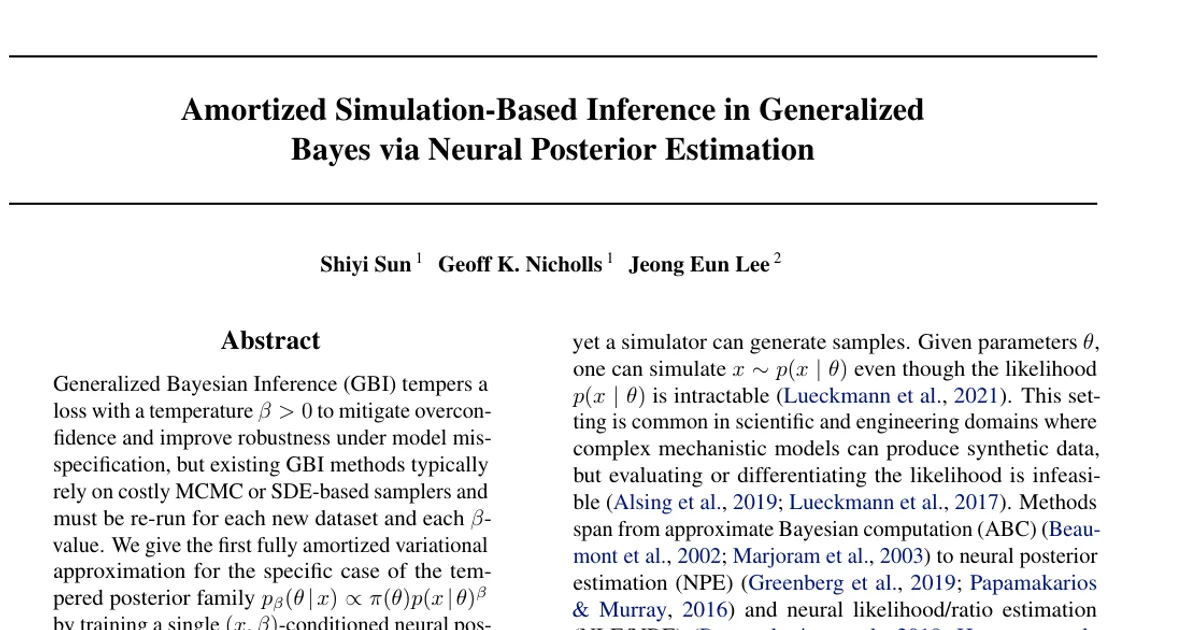
Generalized Bayesian Inference (GBI) tempers a loss with a temperature $β> 0$ to mitigate overconfidence and improve robustness under model misspecification, but existing GBI methods typically rely on costly MCMC or SDE-based samplers and must be re-run for each new dataset and each $β$ value. We give the first fully amortized variational approximation for the tempered posterior family by training a single data- and $β$-conditioned neural posterior estimator that enables sampling in a single forward pass, without simulator calls or inference-time MCMC. We introduce two complementary training routes: one synthesizes off-manifold samples from the tempered joint distribution, and the other reweights a fixed base dataset using self-normalized importance sampling (SNIS). We show that the SNIS-weighted objective provides a consistent forward-KL fit to the tempered posterior with finite weight variance. Across four standard simulation-based inference benchmarks, including the chaotic Lorenz-96 system, our $β$-amortized estimator achieves competitive posterior approximations, in standard two-sample metrics, matching non-amortized MCMC-based power-posterior samplers over a wide range of temperatures.