Research
ALPINE: Adaptive Localization for Parameter- and Sample-Efficient Few-Shot Learning
Overview Research area: Few-shot image classification within computer vision, specifically meta-learning architectures evaluated under tight parameter and training-sample budgets. Technical level: Int
- arXiv
- 2609.22323
- Published
- 2026-09-16
- Authors
- Neeraj Yadav
AI summary
Overview
Research area: Few-shot image classification within computer vision, specifically meta-learning architectures evaluated under tight parameter and training-sample budgets.
Technical level: Intermediate. The abstract assumes familiarity with few-shot benchmarks (CIFAR-FS, MiniImageNet, CUB-200-2011) and standard baselines (Prototypical Networks, Relation Networks, MAML), but the core idea — a small network with an attention-like patch selection mechanism — is explained without heavy formalism.
Scope: A single-author paper proposing an ultra-lightweight spatial-relational architecture and evaluating it against three established few-shot baselines under a matched training-episode budget, with an unusual emphasis on falsifying the authors' own architectural claims.
What This Paper Is About
Most few-shot learning papers report accuracy and little else, leaving unstated how much compute and how many training samples were needed to get there. That matters to practitioners who do not have large-scale compute. This paper builds a deliberately tiny architecture (roughly 22,000–35,000 parameters) for few-shot image classification and asks whether it can match or beat standard baselines while using far fewer parameters and training episodes. It then goes further and tests whether the architecture's headline component — pairwise relational computation — is actually responsible for its performance.
Key Contributions
- An ultra-lightweight spatial-relational architecture of 22,249–34,917 parameters that combines fixed Gabor edge-energy guidance with a windowed, content-adaptive patch locator for few-shot image classification.
- A strictly matched, iso-episode-budget evaluation protocol — 250 meta-training episodes, 5 canonical seeds, and 600 evaluation episodes per seed — used to compare against Prototypical Networks, Relation Networks, and MAML.
- Falsification ablations and a capacity sweep, including zeroing relational tokens at inference and retraining without them entirely, plus a sweep showing an accuracy plateau near 22–35k parameters.
- A reproducibility release, providing full seed-level results and checkpoint hashes.
Main Findings
-
Accuracy gains with fewer parameters: The architecture achieves 5-shot accuracy gains over Prototypical Networks, Relation Networks, and MAML on both CIFAR-FS and MiniImageNet, while using 27–53% fewer parameters than any baseline. The abstract does not report the absolute accuracy figures or the size of the gains beyond the fact that they are gains.
-
Consistency across seeds: The 5-shot gains are described as consistent across all five seeds, though the abstract gives no per-seed numbers, variance, or confidence intervals.
-
Faster convergence: The model converges in fewer training episodes than the baselines, per the abstract; the specific episode counts at which convergence occurs are not stated.
-
Cross-domain generalization: It generalizes better to an unseen fine-grained domain, CUB-200-2011 birds, with zero retraining. No transfer accuracy numbers are given in the abstract.
-
Robustness: It is more robust to 50% occlusion and 25% spatial translation than all three baselines. The abstract does not quantify the robustness gap.
-
The relational computation is not the main driver: Falsification ablations — zeroing relational tokens at inference and retraining without them entirely — show that the architecture's pairwise relational computation, while present, is not the primary source of its performance. The content-adaptive patch locator is. The authors state they report this honestly.
-
A genuine capacity plateau: A capacity sweep shows an accuracy plateau near 22–35k parameters, suggesting the operating range is not arbitrarily small but sits on a plateau.
-
Reproducibility artifacts: Full seed-level results and checkpoint hashes are released, which is unusual for a paper whose central architectural claim is partly retracted by its own experiments.
Methodology in Plain English
The architecture appears to have two stages. First, a fixed Gabor edge-energy filter provides guidance — it is not learned, so it costs no parameters and encodes a generic notion of where edges and structure are in an image. Second, a windowed, content-adaptive patch locator decides which patches to look at, adapting to the content of each input rather than using a fixed grid. The extracted patches are turned into tokens that participate in pairwise relational computation, in the style of relational networks.
Training is meta-learning style, driven by episodes rather than a conventional single-pass training set, and the comparison is designed to be fair: every method sees the same number of meta-training episodes, and evaluation uses a large fixed number of test episodes per seed across five seeds. To test the architecture's own claim, the authors run falsification experiments — they disable the relational tokens at inference, and separately retrain the model without relational tokens at all, to see whether performance collapses. They also sweep model capacity to check whether accuracy degrades smoothly or plateaus. The abstract does not describe the training objective, optimizer, episode sampling details, or the exact form of the patch locator.
Why This Matters
Impact on research: The paper pushes against accuracy-only reporting in few-shot learning by tying results to parameter and training-sample budgets. Its more distinctive move is methodological: running falsification ablations against its own proposed mechanism and reporting that the headline component is not the main driver. Combined with the release of seed-level results and checkpoint hashes, this models a more honest and reproducible style of empirical reporting.
Real-world applications:
- Medical imaging, where labeled examples are scarce and models often must run on modest hospital or clinic hardware.
- Fine-grained biological monitoring, such as bird, plant, or wildlife identification, which the CUB-200-2011 transfer test approximates.
- Industrial visual inspection, where defects are rare, classes change often, and only a handful of examples of each defect type may be available.
- On-device and edge vision, where parameter count and training cost directly determine whether a model can be deployed or updated at all.
Industry relevance: The parameter range cited, 22–35k, is small enough to matter for embedded and mobile deployment, and the iso-episode-budget framing speaks to teams whose bottleneck is labeling and training compute rather than inference hardware. The capacity plateau is directly useful for engineering trade-offs: it suggests accuracy does not improve much by scaling this particular design further.
Future Directions
- Explain and improve the patch locator. Since the ablations point to the content-adaptive patch locator as the real driver, understanding why it works and whether a better locator exists is the most obvious next step.
- Test whether relational computation ever helps. The falsification result raises the question of whether pairwise relational tokens contribute in other regimes — different shot counts, larger datasets, or different domains.
- Broaden the evaluation beyond the stated settings. The work covers 5-shot results on CIFAR-FS and MiniImageNet plus zero-shot transfer to CUB-200-2011; other shot counts, additional domains, and other modalities are untested in what the abstract reports.
- Probe the plateau. A capacity sweep showing a plateau near 22–35k parameters invites the question of how far below that range accuracy can be pushed before it breaks down, and what the lower bound on capacity for few-shot learning looks like.
Target Audience
Researchers working on few-shot learning and efficient meta-learning will get the most from this paper, particularly those interested in evaluation protocols and in negative or self-falsifying results. Practitioners who need small models trained on limited data — in medical imaging, ecological monitoring, or embedded vision — will find the parameter budget and convergence claims relevant. Students entering the area will find the baseline comparison (Prototypical Networks, Relation Networks, MAML) a useful orientation, though the abstract alone does not supply the implementation detail needed to reproduce the method.
Authors’ abstract
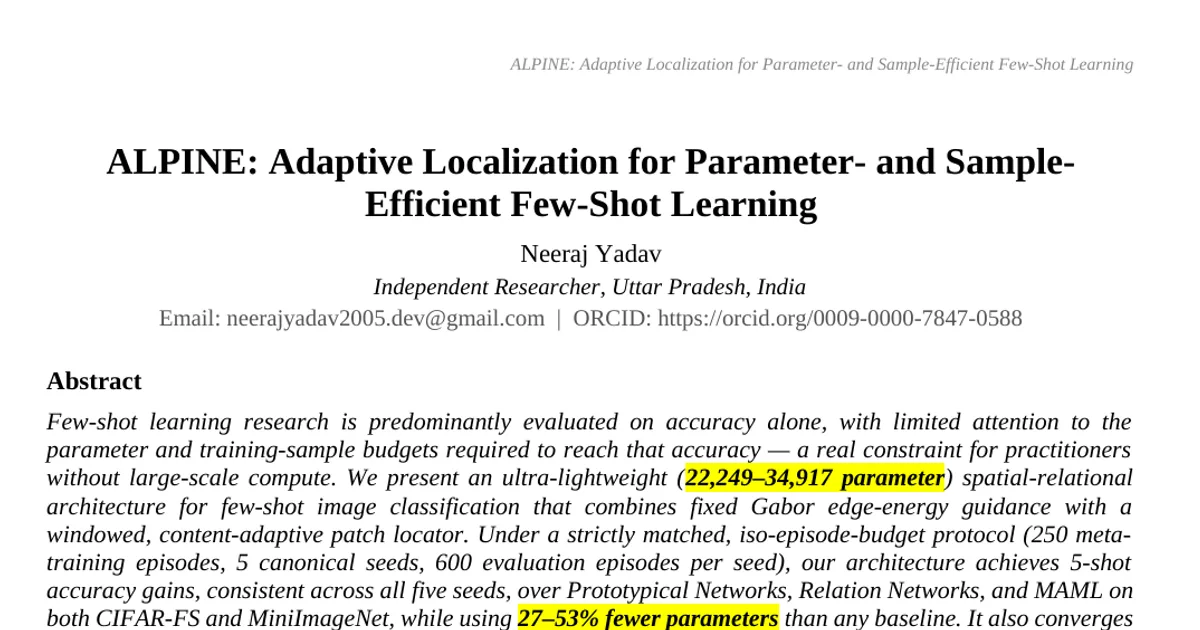
Few-shot learning research is predominantly evaluated on accuracy alone, with limited attention to the parameter and training-sample budgets required to reach that accuracy - a real constraint for practitioners without large-scale compute. We present an ultra-lightweight (22,249-34,917 parameter) spatial-relational architecture for few-shot image classification that combines fixed Gabor edge-energy guidance with a windowed, content-adaptive patch locator. Under a strictly matched, iso-episode-budget protocol (250 meta-training episodes, 5 canonical seeds, 600 evaluation episodes per seed), our architecture achieves 5-shot accuracy gains, consistent across all five seeds, over Prototypical Networks, Relation Networks, and MAML on both CIFAR-FS and MiniImageNet, while using 27-53% fewer parameters than any baseline. It also converges in fewer training episodes, generalizes better to an unseen fine-grained domain (CUB-200-2011 birds, zero retraining), and is more robust to 50% occlusion and 25% spatial translation than all three baselines. A series of falsification ablations - zeroing relational tokens at inference and retraining without them entirely - shows that the architecture's pairwise relational computation, while present, is not the primary driver of its performance; the content-adaptive patch locator is. We report this honestly, together with a capacity sweep showing a genuine accuracy plateau near 22-35k parameters, and release full seed-level results and checkpoint hashes for reproducibility.