Research
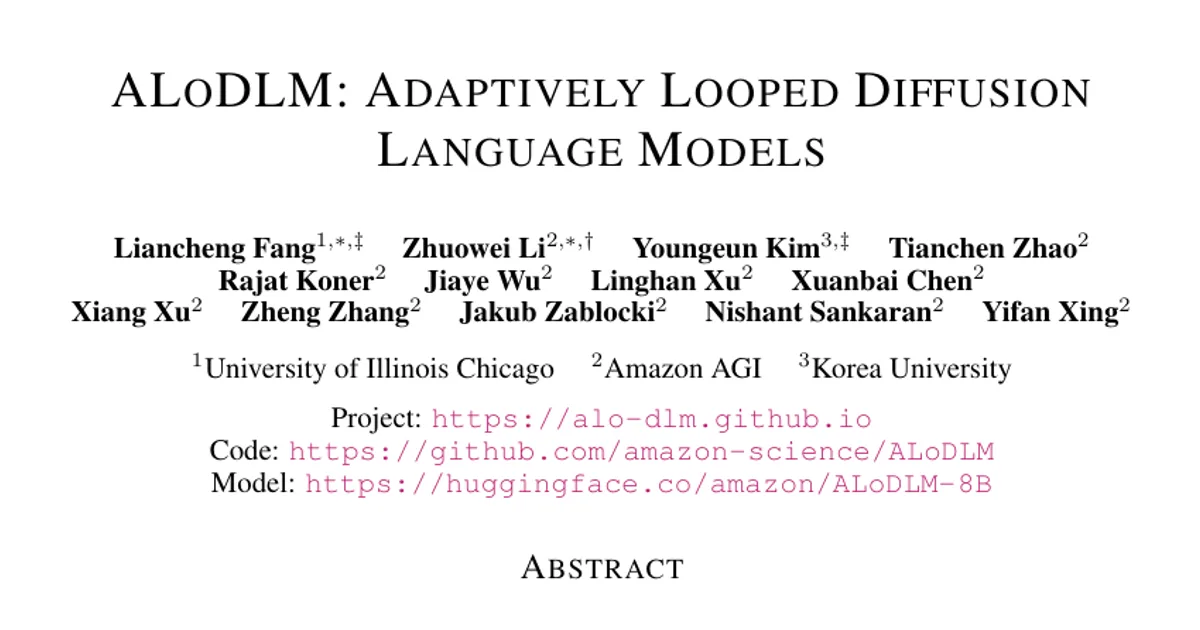
ALoDLM: Adaptively Looped Diffusion Language Models
Overview Research area: Efficient text generation with diffusion language models (DLMs); specifically, adaptive computation and inference-time scaling for masked diffusion LLMs. Technical level: Advan
- arXiv
- 2610.04198
- Published
- 2026-10-03
- Authors
- Liancheng Fang, Zhuowei Li, Youngeun Kim, Tianchen Zhao, Rajat Koner, Jiaye Wu, Linghan Xu, Xuanbai Chen, Xiang Xu, Zheng Zhang, Jakub Zablocki, Nishant Sankaran, Yifan Xing
AI summary
Overview
Research area: Efficient text generation with diffusion language models (DLMs); specifically, adaptive computation and inference-time scaling for masked diffusion LLMs.
Technical level: Advanced. The paper assumes familiarity with diffusion language models, variational inference (ELBO/NELBO), score-function gradient estimators, and KV caching in inference engines.
Scope: The paper proposes ALoDLM, a diffusion language model that replaces the uniform per-step denoiser computation used by existing DLMs with token-adaptive latent recurrence, and validates it at 1.7B and 8B parameter scales across eleven benchmarks.
What This Paper Is About
Diffusion language models can generate text quickly because they predict many masked tokens in parallel, but they consistently produce lower-quality text than autoregressive (AR) models of comparable size. The authors argue the root cause is a "computation–difficulty mismatch": within a single denoising step, some masked positions are easy to predict while others need far more computation, yet standard DLMs spend exactly the same fixed depth on every masked position. The goal is a model that keeps and keeps refining internal representations for the hard tokens while letting the easy ones commit early and become usable context, closing the quality gap without giving up parallel decoding speed.
Key Contributions
-
Token-adaptive looped architecture. ALoDLM adds an inner recurrence loop inside each denoising step. Confident tokens commit early and are fed back as discrete context; unresolved tokens retain and refine their accumulated latent states through additional recurrent passes, up to a maximum depth K.
-
Principled training objective. The paper treats token-wise exit schedules as latent variables and derives a conditional negative evidence lower bound (NELBO) that jointly optimizes token prediction and computation allocation. Because the sum over exit schedules is exponentially large and each single token's exit choice changes the context for all remaining tokens, the authors instead use a variational distribution parameterized by an exit gate.
-
Unbiased gradient estimator with variance reduction. A single-trajectory score-function estimator is derived and proven unbiased for both the denoiser parameters and the halting policy; practical regularization (relaxing the joint KL penalty), intermediate denoiser supervision over pre-commitment readouts, and a detached first-pass control variate are added to stabilize training.
-
Scale and benchmark performance. ALoDLM is trained at 1.7B and 8B parameters via direct supervised fine-tuning of Qwen3 backbones on a 5B-token corpus. The authors state the 8B model is, to their knowledge, the largest looped DLM to date, and it achieves state-of-the-art average benchmark scores among evaluated DLMs while outperforming its Qwen3-based AR counterparts.
Main Findings
- Average benchmark scores: Across eleven benchmarks spanning general reasoning, math and science, and code generation, ALoDLM achieves average scores of 65.5 at 1.7B and 80.3 at 8B, surpassing all evaluated DLMs and the corresponding AR baselines.
- Gain over the strongest DLM baseline: ALoDLM-8B outperforms WeDLM-8B (75.1 average) by 5.2 points on average, leading on ten of the eleven tasks.
- Gain over AR baselines: ALoDLM improves on Qwen3 at both scales — 63.8 vs. 65.5 at 1.7B and 78.5 vs. 80.3 at 8B.
- Code generation gains: ALoDLM sweeps all four coding benchmarks over all baselines, with the stated exception of being slightly behind the AR models on MBPP+ (ALoDLM-8B scores 72.5 on MBPP+ versus 74.5 for Qwen3-8B).
- Throughput on GSM8K: ALoDLM-8B delivers approximately 2.7× the throughput of vLLM-served Qwen3-8B at comparable or higher accuracy.
- Matched-accuracy frontier: At a matched accuracy of 93.25%, optimized ALoDLM-8B reaches 612.4 tokens/s versus 564.2 for WeDLM, an 8.5% throughput gain; the two frontiers cross near 650 tokens/s, above which WeDLM leads.
- Compute per token: At the same 93.25% accuracy threshold, ALoDLM requires 133.5 GFLOPs per generated token versus 154.6 for WeDLM, a 13.6% reduction; ALoDLM maintains higher accuracy across the entire evaluated compute range.
- Decoding control knobs: On GSM8K at fixed q = 0.5, raising the entropy threshold τ from 0.1 to 0.6 lifts throughput from 278.7 to 508.3 tokens/s while accuracy falls from 93.8% to 92.3%; at τ = 0.9 accuracy falls to 89.9%. At fixed τ = 0.2, raising q from 0.1 to 0.9 raises accuracy from 93.3% to 93.8% while throughput drops from 455.3 to 309.0 tokens/s.
- Test-time scaling: Increasing q raises average loops per token from 1.6 to 2.34 and the average eleven-benchmark score from 77.9% to 79.1%.
- Learned token preferences: Mean first-pass halt probabilities differ by token type, averaged equally over GSM8K, MATH-500, MBPP-sanitized, and HumanEval. Numerical tokens have the lowest mean at 0.369, about 11.5% below the cross-dataset reference mean of 0.417; word tokens have the highest at 0.428. These preferences emerge without explicit difficulty labels or predefined halting targets.
- Maximum recurrent depth: Under matched settings at 8B, K = 2 and K = 4 improve faster early than K = 8, but K = 2 plateaus at a lower score; K = 4 achieves performance comparable to K = 8 later in training, motivating the choice of K = 4.
- Loop placement: Middle-layer recurrence over layers [10, 26) outperforms last-layer recurrence over [20, 36) of Qwen3-8B later in training, despite both cores containing 16 layers. The full-stack trajectory [0, 36) is included only as a historical reference evaluated on a different benchmark subset.
- Variance reduction: For the measured subset of 4,096 denoiser normalization parameters, removing intermediate supervision increases conditional gradient variance to 1.76×, 1.49×, and 1.42× the full-method value at training steps 1,000, 6,500, and 17,000, respectively.
- Progressive refinement in training: After the initial training phase, deeper recurrent readouts exhibit lower training loss on their active tokens.
Methodology in Plain English
The model architecture is split into three parts: a Prelude (token embeddings plus optional prefix Transformer blocks), a Recurrent Core (the intermediate Transformer blocks that get applied repeatedly), and a Coda (any remaining suffix blocks). At each outer denoising step, instead of running one fixed-depth denoiser over all masked positions, the model runs an inner loop of up to K recurrent passes.
Two heads read out from the core at every pass. The language-model head produces a token distribution, and its predictive entropy decides whether a token is confident enough to commit (entropy at or below threshold τ). A separate ExitGate head produces a halting probability that accumulates across passes; once the mean cumulative halt probability over the still-unresolved positions reaches threshold q, or all positions have committed, the inner loop stops. When a token commits, its sampled token embedding replaces its latent state and becomes discrete context for subsequent passes, while unresolved tokens keep building on their accumulated latent states. If an entire inner loop commits nothing, the model commits the lowest-entropy unresolved position so that progress is guaranteed.
Training the halting policy is the hard part, because which token exits at which depth is a discrete random choice, and one token's exit changes the context for every later prediction — making exact summation over joint exit schedules intractable. The authors therefore introduce a variational distribution over exit schedules (parameterized by the exit gate) and derive a bound on the conditional log-likelihood, with a geometric prior that encourages shallow exits. The denoiser is trained by ordinary backpropagation; the exit gate is trained with a score-function (REINFORCE-style) estimator, with the sampled exit decisions held fixed during backpropagation. They prove this surrogate produces unbiased gradients. To make training stable in practice, they reuse the predictions already produced at earlier passes as extra supervision (adding no new forward passes), add a detached first-pass loss as a control variate, and relax the KL penalty so that the batch-average depth distribution is regularized strongly while per-token depth variation is penalized only weakly.
Concretely, Qwen3-1.7B and Qwen3-8B are converted using WeDLM's streaming block-diffusion framework. Both use K = 4. The recurrent core is all 28 Transformer layers at 1.7B and the middle 16 layers at 8B. Unlike prior pipelines that combine continued pretraining with SFT, the authors skip continued pretraining and go straight to SFT on a 5B-token corpus with AdamW, learning rate 10⁻⁵, and weight decay 0.01. Evaluation follows the OpenCompass protocol with each model's native chat template, greedy decoding, and a 4,096-token generation limit, and all methods in the main table are constrained to generate exactly one token per step under their own default decoding rules. Each baseline uses its own optimized inference engine (LLaDA with dInfer, SDAR with JetEngine, WeDLM and Qwen with vLLM), and ALoDLM is served via vLLM with depth-aware KV caching.
Why This Matters
Impact on research. The paper reframes the DLM quality gap as an allocation problem rather than an architecture problem. Rather than reintroducing autoregressive structure through semi-AR block designs or demoting DLMs to drafters for AR verification, it keeps parallel decoding and instead makes computation per token adaptive within each denoising step. The variational exit-schedule formulation and the proof that the single-trajectory surrogate is unbiased give a reusable template for training other discrete allocation policies inside diffusion models. The result that middle-layer recurrence beats last-layer recurrence, and that K = 4 is sufficient, are concrete design lessons for anyone building looped or recurrent-depth models.
Real-world applications (implied by the paper's framing):
- Latency-sensitive text generation where parallel decoding matters, subject to the caveat that ALoDLM can have a longer Time to First Token than a comparable AR model because the KV cache is built for the full recurrent depth during prefill.
- Code generation, where ALoDLM shows its largest benchmark advantage and where the learned preference for refining numerical tokens is directly useful.
- Mathematical reasoning and scientific question answering, where precise numerical prediction matters and where the model's lowest halting probability is on numerical tokens.
- Serving-time cost reduction, since the same accuracy is reached at a lower estimated GFLOPs per generated token.
Industry relevance. The work comes from Amazon AGI (with University of Illinois Chicago and Korea University), and the code and 8B model are released publicly, so the pattern of converting an existing open-weight dense model (Qwen3) into an adaptive diffusion model via SFT alone — skipping costly continued pretraining — is directly relevant to teams that want faster serving without retraining from scratch or changing their inference stack, since ALoDLM runs on vLLM.
Future Directions
- Reducing Time to First Token. The paper explicitly identifies that building the KV cache for the full recurrent depth during prefill makes prefill slower than a comparable AR model, which can erase the parallel-decoding benefit for short responses; addressing this is an open problem.
- Making throughput more predictable. The authors note generation speed is inherently input-dependent because recurrent computation and the number of simultaneously committed tokens depend on token confidence and halting decisions. On domains underrepresented in training data the model may need more refinement and commit fewer tokens in parallel, potentially reversing the speed advantage — characterizing and mitigating this domain sensitivity is a natural next step.
- Extending the recurrence and depth controls. The paper treats recurrent depth as a test-time scaling axis controlled by q, and shows K = 4 matches K = 8 later in training. Whether larger K, different core placements, or finer-grained schedules push the frontier further is left open. (The truncated content does not report a dedicated future-work section.)
- Broadening evaluation beyond the eleven benchmarks. The reported results cover general reasoning, math/science, and code; long-form generation, multilingual behavior, and latency-sensitive interactive settings are not evaluated in the provided content.
Target Audience
Researchers and engineers working on efficient LLM inference, diffusion language models, adaptive computation, and looped or recurrent-depth Transformer architectures. It is also relevant to practitioners who serve open-weight models at scale and care about the accuracy-versus-throughput frontier, and to readers interested in applying variational objectives and score-function estimators to discrete architectural decisions. Because the paper relies on ELBO derivations and gradient-estimator proofs, readers without a background in variational inference or reinforcement-style gradient estimation will find the methods section demanding, though the high-level idea — spend more computation on the hard tokens — is stated plainly.
Authors’ abstract
Diffusion language models (DLMs) enable fast generation by predicting multiple tokens in parallel, but their practical adoption remains limited by a persistent quality gap relative to comparably sized autoregressive (AR) models. We attribute this gap to a computation-difficulty mismatch: within a partially observed sequence, some unknown tokens are easy to predict, while others require substantially more computation. Existing DLMs nevertheless apply uniform computational depth to all unknown positions at each denoising step. We introduce ALoDLM, which replaces uniform computation with token-adaptive latent recurrence. At each denoising step, ALoDLM iteratively refines latent representations and allocates computation according to token difficulty. Tokens ready to commit are fed back as discrete context, while unresolved tokens retain and further refine their latent states through additional recurrent passes. To learn token prediction and computation allocation jointly, we formulate token-wise computation schedules as latent variables and derive a conditional negative evidence lower bound (NELBO). We train ALoDLM at 1.7B and 8B parameter scales. Across eleven benchmarks, ALoDLM outperforms all evaluated DLMs and the corresponding AR baselines in average benchmark score at both scales. ALoDLM also retains fast parallel decoding, yielding a strong quality-efficiency trade-off among evaluated autoregressive and diffusion models under optimized inference engines.