Research
AlignTune: Modular Toolkit for Post-Training Alignment of Large Language Models
Overview Research area: Post-training alignment of large language models (supervised fine-tuning, preference optimization, and RLHF-style policy optimization), with a focus on the software infrastruct
- arXiv
- 2602.09621
- Published
- 2026-02-10
- Authors
- R E Zera Marveen Lyngkhoi, Chirag Chawla, Pratinav Seth, Utsav Avaiya, Soham Bhattacharjee, Mykola Khandoga, Rui Yuan, Vinay Kumar Sankarapu
AI summary
Overview
Research area: Post-training alignment of large language models (supervised fine-tuning, preference optimization, and RLHF-style policy optimization), with a focus on the software infrastructure that supports these workflows.
Technical level: Intermediate. Readers need some familiarity with SFT, DPO, PPO-style RLHF, LoRA/QLoRA, and modern training libraries (TRL, Unsloth, Hugging Face Transformers) to follow the architectural discussion. The case studies are readable without that background.
Scope (one sentence): The paper introduces AlignTune, a modular Python toolkit that puts supervised fine-tuning and RLHF-style training behind one interface across interchangeable TRL and Unsloth backends, with shared reward and evaluation layers, and demonstrates it on backend comparison benchmarks and two financial-domain alignment case studies.
What This Paper Is About
Practitioners aligning LLMs today work with a fragmented ecosystem: most codebases target a single algorithm or backend, require ad-hoc glue code for reward functions and evaluation, and are hard to reproduce. The paper argues that backend interference, reward fragmentation, and irreproducible pipelines are first-order obstacles that make it hard to distinguish genuine methodological advances from implementation artifacts. AlignTune's goal is to unify SFT and RLHF-style training behind a single interface — with a backend factory, backend isolation, a reward registry, and integrated evaluation — so that alignment experiments can be compared and reproduced without rewriting code per backend.
Key Contributions
- A modular toolkit unifying SFT and RLHF-style training behind a single interface across TRL and Unsloth backends, with a factory API, a common trainer class hierarchy, and a strongly-typed dataclass configuration system (RLConfig, SFTConfig) plus a CLI.
- A backend isolation mechanism that prevents Unsloth from globally patching
transformersduring pure TRL runs, using environment-variable control (PURE_TRL_MODE,TRL_ONLY_MODE,DISABLE_UNSLOTH_FOR_TRL), lazy imports, string-based backend selection, and automatic fallback to TRL — validated experimentally in Section 5.3. - Backend benchmarks comparing TRL and Unsloth on throughput, memory, and evaluation metrics, showing backend-agnostic training. The paper reports that Unsloth achieves a 1.28× speedup over TRL on the GRPO comparison, with comparable accuracy.
- An extensible reward framework with 43 built-in reward functions, domain-specific signals (medical, legal, financial), composable weighted rewards via
CompositeReward, aRewardRegistryfor custom rewards, and a four-class reward-model training pipeline feeding into PPO. - A data management layer supporting Hugging Face Hub, JSON, CSV, Parquet, and directory-based sources through a common
Datasetobject, plus aDatasetCache.
Main Findings
- Backend choice does not compromise final quality. Running identical configurations on TRL and Unsloth, the authors report that final evaluation metrics (reward margins, preference accuracy) are comparable, so backend selection can be based on computational efficiency without introducing confounding variance.
- Unsloth is faster on compatible hardware. The GRPO backend comparison reports Unsloth achieving comparable accuracy with a 1.28× speedup over TRL. The three stated findings are faster throughput and lower memory for Unsloth, similar final metrics across backends, and comparisons achievable without code changes.
- Isolation works as intended. In TRL-only runs, isolation mode prevents Unsloth from being imported, and throughput, memory, and metrics match a baseline TRL environment without Unsloth installed; in Unsloth-enabled runs, isolation flags are cleared and the expected speed and memory gains appear with comparable final metrics.
- Algorithm coverage differs by backend. Table 1 lists SFT, DPO, PPO, GRPO, GSPO, DAPO, Dr. GRPO, Counterfactual GRPO, and PACE as supported on both backends, while GBMPO is TRL-only (marked × for Unsloth). The body text separately states that GSPO, GBMPO, and Meta-ES are currently TRL-only, which conflicts with the table's GSPO row.
- Wealth management case study. On the Bitext Wealth Management LLM Chatbot Training Dataset with Qwen3-4B-Instruct-2507: the Base Model (0-shot) scored BLEU 0.0286 and BERTScore 0.8343; the SFT Model scored BLEU 0.2690 and BERTScore 0.9134; the DPO Model reached the highest BERTScore (0.9142) with BLEU 0.2692. GPT-4o (2-shot) scored BLEU 0.0705 and GPT-5 (2-shot) scored BLEU 0.1218. The paper states the DPO model beats the strongest closed-source baseline (GPT-5 2-shot) across all metrics (0.2692 vs. 0.1218 in BLEU). Note: the text also cites "GPT-4o (0-shot) achieves a BLEU of 0.0850," a figure that does not appear in Table 3, which lists GPT-4o only in the 2-shot setting at BLEU 0.0705.
- Retail banking case study. On the Bitext Retail Banking LLM Chatbot Splits: the SFT Model (0-shot) achieved BLEU 0.2685 and BERTScore 0.9146, while GPT-5 (2-shot) dropped to BLEU 0.0137 and ROUGE-L 0.1869. The authors attribute this to generalist models struggling to suppress conversational "chattiness" in favor of rigid transactional formatting.
- Zero-shot beats few-shot for fine-tuned specialists. For both domains, the fine-tuned models performed better at 0-shot than 2-shot (retail banking SFT: BLEU 0.2685 at 0-shot vs. 0.2549 at 2-shot), which the authors interpret as few-shot prompting acting as distribution noise rather than useful context.
- Positioning relative to prior toolkits. Table 5 compares AlignTune against TRL Scripts, trlx, and OpenRLHF, marking AlignTune as the only one with multi-backend support, backend isolation, and full reward composition.
Methodology in Plain English
The authors build a library rather than propose a new algorithm, and explicitly frame the work as standardizing existing methods. The design has four moving parts:
- A backend factory. Users call one function (
create_sft_trainerorcreate_rl_trainer) with a model name, dataset, backend name, and hyperparameters. The factory dispatches to the correct backend-specific trainer using enums (TrainingType,BackendType,RLAlgorithm) and aBackendConfigdataclass. All returned trainers expose the same.train(),.evaluate(), and.save_model()methods. - Isolation between backends. Unsloth patches the
transformersstack globally when imported. The toolkit sets environment variables to block those patches when TRL is selected, defers the Unsloth import until it is actually needed, avoids enum imports that could trigger Unsloth initialization, and falls back to TRL with an informative error if Unsloth is unavailable or fails compatibility checks. - A shared reward layer. Reward functions implement a common
compute(text, **kwargs) -> floatinterface.CompositeRewardcombines several of them with configurable weights, andRewardRegistrymaps string keys to reward types. Text data scored by these rule-based rewards can be used to train a neural reward model (RewardModelTrainer,RewardModelDataset,RewardModelValidator,RewardModelLoader), which is then plugged into a PPO trainer. - Shared evaluation and configuration. An evaluation subsystem (
EvalRunner,EvalRegistry,EvalConfig,SafeCodeExecutor) wraps lm-eval-harness for standard benchmarks and supports custom tasks, with metrics for text (ROUGE, BLEU), generic quality (perplexity, accuracy), RL-specific quantities (KL divergence, reward accuracy, policy entropy), DPO-specific quantities (win rate, reward margin, preference accuracy, log ratio, implicit reward, calibration), and specialised tasks (pass@k, math accuracy). ASampleLoggergenerates qualitative outputs during training.
For the experiments, the authors run identical configurations on both backends to isolate backend effects: a DPO comparison using a phi-2 model on preference pairs, and a GRPO comparison using Llama-3.2-3B on GSM8K. For the financial case studies, they train Qwen3-4B-Instruct-2507 in three stages (Base, SFT, DPO), construct a class-balanced SFT split, and isolate a subset of 2,000 samples from the training data for DPO preference pairs generated from the SFT policy with GPT-5 used as the judge.
Why This Matters
Impact on research. By isolating backend-specific logic behind one factory boundary and standardizing configuration, the toolkit aims to make controlled comparisons possible so that measured performance differences can be attributed to algorithms rather than to import order, environment variables, or setup skew. Treating rewards as first-class objects also enables reward ablations (sparse vs. dense, rule-based vs. learned) that are difficult when reward logic is coupled to individual trainers.
Real-world applications:
- Wealth management assistants — advisory-centric interactions requiring professional nuance and compliance-aware tone, where the DPO-aligned model achieved the highest BERTScore (0.9142) in the study.
- Retail banking support agents — high-volume, transactional workflows requiring strict procedural adherence (account verification, transfer limits), where SFT achieved BLEU 0.2685.
- Code generation and math reasoning evaluation — via sandboxed code execution, pass@k, math accuracy metrics, and benchmark rewards such as MBPP.
- Regulated-domain alignment more broadly — the reward catalog includes medical accuracy, legal compliance, and financial accuracy signals, plus hallucination, toxicity, and safety rewards.
Industry relevance. The paper's central practical claim is that practitioners currently must choose between reliability and speed; the toolkit aims to make that choice non-binding by letting teams switch backends without rewriting pipelines, while keeping environments reproducible through YAML and typed configuration. The comparison table positions this against TRL Scripts, trlx, and OpenRLHF, all of which lack multi-backend support in that comparison.
Future Directions
- Closing the backend parity gap. GBMPO (and, per the body text, GSPO and Meta-ES) are currently TRL-only; extending Unsloth coverage for these algorithms is a natural next step, and the paper explicitly declines to claim perfect feature parity.
- Resolving reported inconsistencies. The GPT-4o 0-shot BLEU figure cited in the text (0.0850) does not appear in Table 3, and the GSPO/GBMPO/Meta-ES claim conflicts with Table 1 — both would benefit from correction or clarification.
- Quantifying backend efficiency more precisely. The available content reports the 1.28× GRPO speedup but not the specific throughput or peak-memory numbers behind the claim that Unsloth delivers faster throughput and lower memory; those measurements live in Appendix A, which is not included here.
- Broadening beyond Transformer LLMs. The non-goals state that support is limited to transformer-based LLMs compatible with Hugging Face Transformers, and that universal speedups are not claimed, since acceleration depends on GPU and kernel compatibility.
Target Audience
This paper is most useful to ML engineers and applied researchers who train or align LLMs and currently maintain backend-specific training scripts; to research teams that need reproducible comparisons between alignment algorithms; and to practitioners in regulated verticals (finance, legal, medical) who need domain-specific reward signals and verifiable alignment pipelines. Readers looking for new alignment algorithms will not find them here — the paper is explicitly an infrastructure contribution that standardizes existing methods.
Authors’ abstract
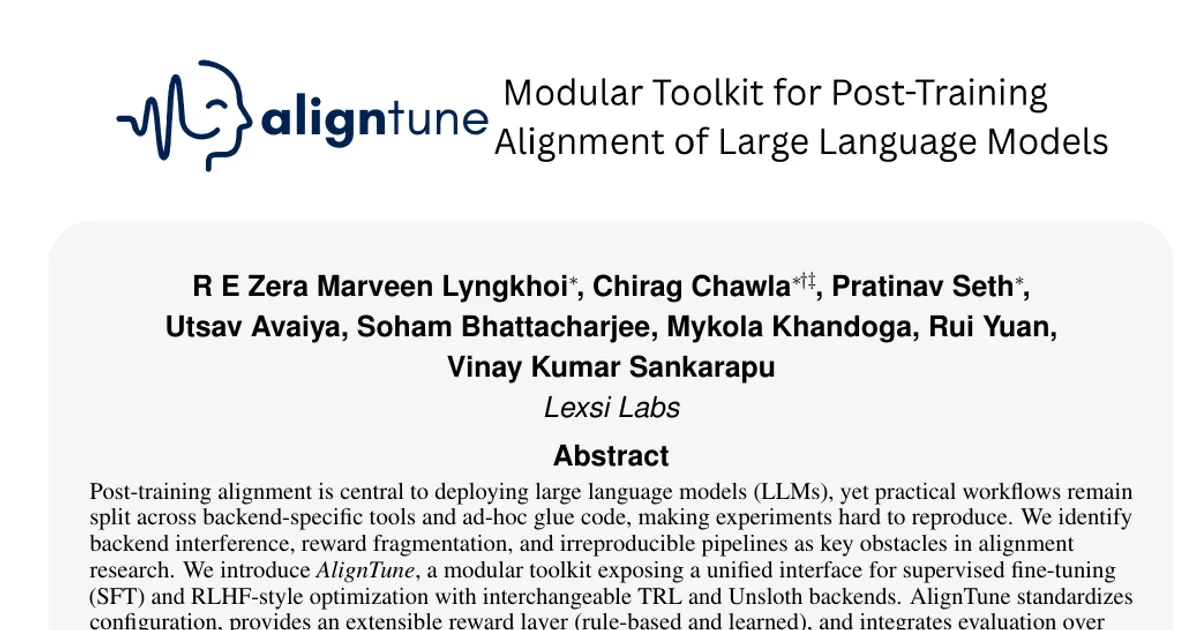
Post-training alignment is central to deploying large language models (LLMs), yet practical workflows remain split across backend-specific tools and ad-hoc glue code, making experiments hard to reproduce. We identify backend interference, reward fragmentation, and irreproducible pipelines as key obstacles in alignment research. We introduce AlignTune, a modular toolkit exposing a unified interface for supervised fine-tuning (SFT) and RLHF-style optimization with interchangeable TRL and Unsloth backends. AlignTune standardizes configuration, provides an extensible reward layer (rule-based and learned), and integrates evaluation over standard benchmarks and custom tasks. By isolating backend-specific logic behind a single factory boundary, AlignTune enables controlled comparisons and reproducible alignment experiments.